


BVLOS Drone Market Overview
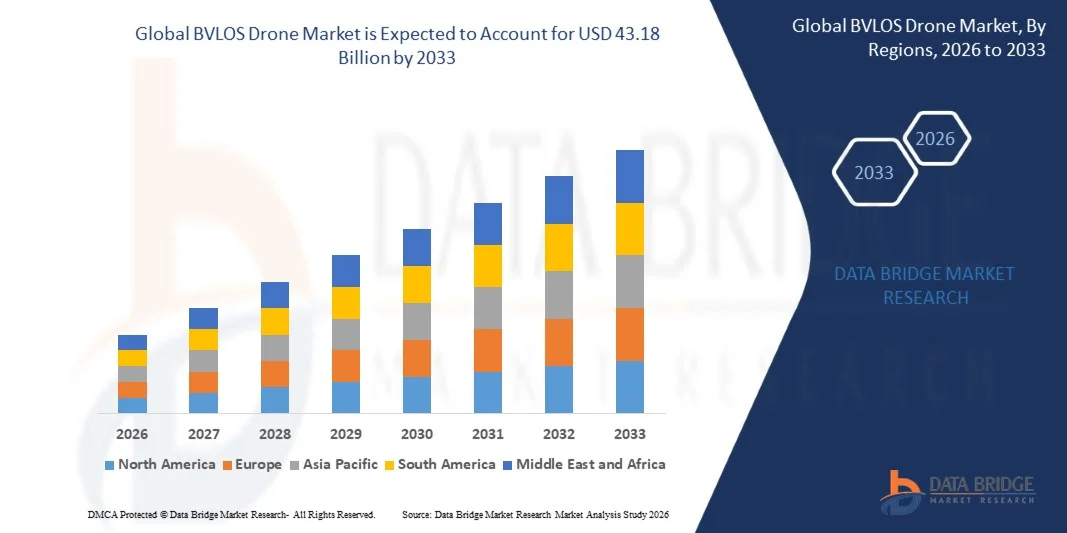
As per Data Bridge Market Research Analysis, the BVLOS Drone Market was valued at USD 13.68 billion in 2025 and is projected to reach USD 43.18 billion by 2033, growing at a CAGR of 15.45% from 2026 to 2033. BVLOS drones are unmanned aerial systems capable of operating beyond the visual line of sight of the pilot, enabling long-range missions that were previously impossible with traditional line-of-sight operations. The market is gaining significant momentum as defense agencies and commercial industries increasingly adopt long-range unmanned platforms for wide-area surveillance, infrastructure inspection, logistics, and mission-critical operations.
The growth is driven by several interrelated factors: increasing dependency on persistent intelligence, surveillance, and reconnaissance (ISR) for border security and environmental assessment; growing demand for autonomous flight capabilities and detect-and-avoid systems; and ongoing investment in communication systems, AI-based navigation, automated flight management, and UTM (Unmanned Traffic Management) technologies. The market is moving from experimental deployment to operational scaling, improving confidence among manufacturers, operators, and end users. While VLOS (Visual Line of Sight) operations still dominate globally, industry surveys indicate that the Middle East and Africa has recorded one of the highest shares of BVLOS operations globally.
Market Size & Forecast
- Global Market Value (2025): USD 13.68 Billion
- Expected Market Value (2033): USD 43.18 Billion
- Forecast CAGR (2026–2033): 15.45%
- Leading Region in 2025: North America
- Fastest Growing Region: Asia-Pacific
Key Market Trends & Insights
- North America held the largest market share in 2025, driven by strong defense spending and progressive regulatory frameworks.
- Asia-Pacific is expected to witness the highest growth over the forecast period, fueled by increasing adoption of drones in agriculture, infrastructure inspection, and commercial delivery services.
- The Fixed-Wing segment is projected to dominate the market, offering superior endurance and range for long-distance BVLOS missions.
- The Fully Autonomous segment is projected to grow at the fastest rate, as autonomous navigation, onboard computing, and multi-sensor tools make long-range missions safer and more manageable.
- Regulatory normalization is a key market trend, with the FAA proposing BVLOS rulemaking (Part 108) in August 2025, providing a framework for safely normalizing BVLOS drone operations.
- Commercial applications, including cargo and medical delivery, precision agriculture, and infrastructure inspection, are expected to drive significant market growth.
- Integration of AI and machine learning is enhancing autonomous capabilities, including real-time obstacle avoidance and data analysis.
- 5G connectivity is providing the high-speed, low-latency communication required for reliable BVLOS operations, enabling real-time command and control of large drone fleets.
Report Scope and BVLOS Drone Market Segmentation
|
Attributes |
BVLOS Drone Key Market Insights |
|
Segments Covered |
|
|
Countries Covered |
North America · U.S. · Canada · Mexico Europe · Germany · France · U.K. · Netherlands · Switzerland · Belgium · Russia · Italy · Spain · Turkey · Rest of Europe Asia-Pacific · China · Japan · India · South Korea · Singapore · Malaysia · Australia · Thailand · Indonesia · Philippines · Rest of Asia-Pacific Middle East and Africa · Saudi Arabia · U.A.E. · South Africa · Egypt · Israel · Rest of Middle East and Africa South America · Brazil · Argentina · Rest of South America |
|
Key Market Players |
· Lockheed Martin Corporation (U.S.) · Northrop Grumman Corporation (U.S.) · Boeing (U.S.) · General Atomics Aeronautical Systems, Inc. (U.S.) · L3Harris Technologies, Inc. (U.S.) · AeroVironment, Inc. (U.S.) · Elbit Systems Ltd. (Israel) · Baykar (Turkey) · Airbus (France) · Leonardo (Italy) · Israel Aerospace Industries (IAI) (Israel) · Zipline International Inc. (U.S.) · Wing (U.S.) · DJI (China) · Skydio (U.S.) · Quantum Systems (Germany) |
|
Market Opportunities |
· Expansion of drone delivery and logistics operations across urban and rural areas · Growing demand for infrastructure inspection and utility monitoring applications · Increasing adoption of precision agriculture and environmental monitoring solutions · Rising defense and security spending on long-range ISR and tactical missions · Development of detect-and-avoid systems and UTM infrastructure for safe BVLOS integration |
|
Value Added Data Infosets |
In addition to the market insights such as market value, growth rate, market segments, geographical coverage, market players, and market scenario, the market report curated by the Data Bridge Market Research team includes in-depth expert analysis, import/export analysis, pricing analysis, production consumption analysis, and pestle analysis. |
BVLOS Drone Market Trends
Trend: Integration of AI and 5G Connectivity
The integration of artificial intelligence and machine learning is a major trend in the BVLOS drone market. AI-powered BVLOS drones can perform complex tasks autonomously, including real-time obstacle avoidance and data analysis, enhancing safety and efficiency while reducing the need for constant human supervision. Simultaneously, the adoption of 5G is a critical enabler, providing the high-speed, low-latency communication required for reliable BVLOS operations. 5G networks enable real-time command and control, streaming high-definition data, and managing large drone fleets from a central location. These technologies are essential for the scalability of drone delivery and long-range surveillance missions.
BVLOS Drone Market Dynamics
Key Market Driver: Growing Demand for Long-Range Unmanned Operations
A primary driver of the BVLOS Drone Market is the rising need for long-range unmanned operations across defense and commercial sectors. Dependency on persistent ISR, infrastructure monitoring, border security, and environmental assessment is leading to the adoption of BVLOS drones. Defense agencies are increasingly adopting BVLOS-capable platforms for wide-area surveillance, strategic reconnaissance, and mission-critical operations. Commercial industries are leveraging BVLOS drones for infrastructure inspection, logistics, precision agriculture, and environmental monitoring. The growing interest in autonomous flight capabilities, detect-and-avoid systems, and airspace integration frameworks is resulting in improved UAV performance and operational efficiency. Ongoing investment in communication systems, AI-based navigation, automated flight management, and UTM technologies is helping expand BVLOS deployment and strengthen long-term market growth.
Key Restraint/Challenge: Regulatory Hurdles and Airspace Integration
A significant challenge facing the BVLOS drone market is the regulatory complexity and airspace integration requirements. While progress is being made, BVLOS operations still require waivers and special approvals in most jurisdictions. The FAA handles BVLOS through two paths: Part 107 waivers (the current system) and the proposed Part 108 framework. In Europe, EASA regulates drones through Open, Specific, and Certified categories. The lack of harmonized global standards creates uncertainty for manufacturers and operators planning cross-border operations. Additionally, the development of detect-and-avoid systems, UTM infrastructure, and secure communication networks is technically complex and requires significant investment. Safety concerns, public acceptance, and privacy issues also pose challenges to widespread BVLOS adoption.
Key Market Opportunity: Emerging Applications and Regional Expansion
he expansion into emerging applications and regions presents significant growth opportunities for the BVLOS drone market. Asia-Pacific is expected to witness the highest growth, driven by increasing adoption of drones in agriculture, infrastructure inspection, and delivery services. The Middle East and Africa region showcases pioneering operational models, with industry surveys indicating a high share of BVLOS flights, suggesting evolving regulatory frameworks and growing technical capabilities in emerging markets. New applications such as drone first responder programs, autonomous aviation systems, and future passenger-carrying eVTOL aircraft are creating additional opportunities. The development of detect-and-avoid systems and UTM infrastructure will enable safe BVLOS integration into non-segregated airspace, opening new commercial possibilities. Companies that invest in developing innovative BVLOS solutions for logistics, emergency response, and urban mobility are well-positioned to capitalize on this growing demand.
BVLOS Drone Market Scope
The BVLOS drone market is segmented on the basis of platform type, component, application, autonomy level, and end user.
-
By Platform Type
On the basis of platform type, the BVLOS Drone Market is segmented into fixed-wing, rotary-wing and hybrid VTOL. The Fixed-Wing segment is projected to dominate the market during the forecast period, offering superior endurance and range for long-distance BVLOS missions. Fixed-wing drones are preferred for applications requiring extended flight times and large-area coverage, such as infrastructure inspection, agriculture, and defense surveillance. Rotary-wing drones offer vertical takeoff and landing capabilities, making them suitable for urban operations and confined spaces. Hybrid VTOL drones combine the vertical takeoff capability of rotary-wing with the long-range endurance of fixed-wing designs, catering to specific applications such as long-distance pipeline inspections and large-scale mapping. The hybrid segment is gaining traction as it offers operational flexibility for missions requiring both vertical takeoff and extended flight range.
-
By Component
On the basis of component, the BVLOS Drone Market is segmented into airframe & structures, propulsion & power system, avionics & flight control system, surveillance & detect-and-avoid system, payloads & mission systems and others. The airframe and structures segment includes the physical framework of the drone, with manufacturers increasingly using lightweight composite materials to improve endurance and payload capacity. Propulsion and power systems are critical for extending flight range, with advances in battery technology and hybrid power systems enabling longer missions. Avionics and flight control systems are essential for autonomous navigation and mission execution. Surveillance and detect-and-avoid systems are critical for safe BVLOS operations, using sensors such as radar, LiDAR, and computer vision to automatically detect other aircraft and obstacles. Payloads and mission systems include cameras, sensors, and delivery mechanisms that enable specific applications.
-
By Application
On the basis of application, the BVLOS Drone Market is segmented into infrastructure inspection & utilities, precision agriculture, cargo, parcel & medical delivery, defense, ISR & tactical missions and others. Infrastructure inspection and utilities monitoring represent a significant growth area, with BVLOS drones enabling cost-effective and safe inspection of pipelines, power lines, and critical infrastructure. Precision agriculture applications, including crop monitoring and spraying, are driving demand for BVLOS drones capable of covering large agricultural areas efficiently. Cargo, parcel, and medical delivery services are increasingly viable as regulatory frameworks evolve, with companies such as Wing, Zipline, and Skydio expanding BVLOS operations. Defense, ISR, and tactical missions remain a dominant application segment, with defense agencies adopting BVLOS drones for wide-area surveillance and strategic reconnaissance. Emergency response and disaster management are emerging as important applications for BVLOS drones.
- By Autonomy Level
On the basis of autonomy level, the BVLOS Drone Market is segmented into remotely piloted, semi-autonomous and fully autonomous. The Fully Autonomous segment is projected to grow at the fastest rate, as autonomous navigation, onboard computing, and multi-sensor tools make long-range missions safer and more manageable. Remotely piloted drones are currently the most common, requiring continuous human control via a ground station. Semi-autonomous drones can execute pre-programmed flight paths while allowing human intervention when needed. Fully autonomous drones leverage AI, machine learning, and advanced sensor fusion to make real-time decisions without human input, enabling scalable BVLOS operations for logistics, inspection, and surveillance applications. The evolution of autonomy levels is closely tied to regulatory acceptance and technological advancement.
- By End User
On the basis of end user, the BVLOS Drone Market is segmented into commercial enterprises, civil government & public safety agencies and defense & military users. Defense and military users represent the largest end-user segment, driven by long-standing adoption of unmanned systems for ISR and tactical missions. Commercial enterprises are the fastest-growing segment, as drone delivery, agriculture, and inspection applications scale up with advancing technology and regulatory frameworks. Civil government and public safety agencies are increasingly adopting BVLOS drones for border security, disaster response, environmental monitoring, and search and rescue operations. Public safety applications include firefighting support, law enforcement surveillance, and emergency medical delivery. The commercial segment is expected to witness the highest growth due to expanding delivery and logistics operations.
BVLOS Drone Market Regional Analysis
North America BVLOS Drone Market Insight
North America held the largest market share in 2025, driven by strong defense spending, a mature commercial drone ecosystem, and progressive regulatory frameworks. The United States is at the forefront of BVLOS drone development and deployment, supported by substantial investments from both defense and commercial sectors. The FAA's proposed BVLOS rulemaking (Part 108) is expected to provide a clear pathway for routine BVLOS operations, accelerating commercial adoption. Key players such as Lockheed Martin, Northrop Grumman, Boeing, General Atomics, and AeroVironment are headquartered in the U.S., strengthening the region's market position. The region's strong venture capital funding for drone startups and favorable regulatory environment for technology innovation are further accelerating market growth.
Asia-Pacific BVLOS Drone Market Insight
Asia-Pacific is expected to witness the highest growth in the BVLOS drone market over the forecast period. The region is driven by rapid urbanization, increasing adoption of drones in agriculture and infrastructure inspection, and growing demand for commercial delivery services. China is a major player, with companies such as DJI leading in drone manufacturing and innovation. Countries including India, Japan, South Korea, and Australia are witnessing significant investments in drone technology and regulatory frameworks. The proliferation of e-commerce platforms and aggressive marketing campaigns by both global and local drone companies have further fueled adoption in the region.
Europe BVLOS Drone Market Insight
Europe represents a mature and technologically advanced market for BVLOS drones, supported by strong regulatory frameworks, significant investments in U-space implementation, and a growing commercial drone ecosystem. The European Union is advancing drone integration through initiatives such as SESAR Joint Undertaking and U-space implementation, which encourages the development of alternative technologies and airspace management systems. Regional developers such as Airbus and Leonardo are strengthening the local technology ecosystem. Strong climate targets, rapid adoption of drone services, and investments in drone infrastructure are collectively driving market growth in Europe.
BVLOS Drone Market Share
The BVLOS Drone industry is primarily led by well-established companies, including:
- Lockheed Martin Corporation (U.S.)
- Northrop Grumman Corporation (U.S.)
- Boeing (U.S.)
- General Atomics Aeronautical Systems, Inc. (U.S.)
- L3Harris Technologies, Inc. (U.S.)
- AeroVironment, Inc. (U.S.)
- Elbit Systems Ltd. (Israel)
- Baykar (Turkey)
- Airbus (France)
- Leonardo (Italy)
- Israel Aerospace Industries (IAI) (Israel)
- Zipline International Inc. (U.S.)
- Wing (U.S.)
- DJI (China)
- Skydio (U.S.)
- Quantum Systems (Germany)
Latest Developments in BVLOS Drone Market
- In January 2026, the FAA and TSA continued advancing the BVLOS rulemaking process under the mandated timeline. Amazon welcomed the proposed framework, stating it would support broader deployment of Prime Air delivery operations. The regulatory progress is expected to unlock significant commercial opportunities for drone delivery and logistics services across the United States.
- In December 2025, the FAA continued moving forward with the BVLOS rulemaking process, with industry stakeholders expressing strong support for the proposed framework. The regulatory momentum is expected to accelerate commercial deployment of BVLOS drone operations across multiple sectors, including delivery, inspection, and public safety applications.
- In November 2025, the Global UTM Association (GUTMA) published a position paper analyzing the FAA's proposed BVLOS rulemaking with a focus on regulatory and technical interoperability, emphasizing the importance of leveraging existing standards and avoiding US-only requirements to ensure global harmonization.
- In October 2025, Australia's Civil Aviation Safety Authority (CASA) launched a 12-month trial to make BVLOS drone approvals more accessible, introducing four new broad area approval pathways under Temporary Management Instruction (TMI 2025-03). The pathways apply to the small drone category (25kg or under) and are available to remotely piloted aircraft operator's certificate (ReOC) holders, with approvals issued for 12 months. The trial supports applications in emergency services, agriculture, infrastructure inspection, and environmental monitoring.
- In October 2025, Indian heavy-lift drone manufacturer BonV Aero successfully completed a 60-kilometer BVLOS delivery mission carrying a 20-kilogram payload, marking India's first long-range heavy-lift BVLOS drone delivery. The 75-minute mission, flown at an average speed of 48 km/h, demonstrates significant advancement in India's drone logistics capabilities for defense, disaster response, and remote-area connectivity applications.
- In October 2025, RocketDNA became the first company to be approved under CASA's new Broad Area BVLOS Self-Assessment Trial, providing a pathway for faster deployment of its autonomous xBot systems across Australia. The approval enables RocketDNA to self-assess operational and safety risks, significantly streamlining operations and reducing approval timelines.

- Interactive Data Analysis Dashboard
- Company Analysis Dashboard for high growth potential opportunities
- Research Analyst Access for customization & queries
- Competitor Analysis with Interactive dashboard
- Latest News, Updates & Trend analysis
- Harness the Power of Benchmark Analysis for Comprehensive Competitor Tracking
Data collection and base year analysis are done using data collection modules with large sample sizes. The stage includes obtaining market information or related data through various sources and strategies. It includes examining and planning all the data acquired from the past in advance. It likewise envelops the examination of information inconsistencies seen across different information sources. The market data is analysed and estimated using market statistical and coherent models. Also, market share analysis and key trend analysis are the major success factors in the market report. To know more, please request an analyst call or drop down your inquiry.
The key research methodology used by DBMR research team is data triangulation which involves data mining, analysis of the impact of data variables on the market and primary (industry expert) validation. Data models include Vendor Positioning Grid, Market Time Line Analysis, Market Overview and Guide, Company Positioning Grid, Patent Analysis, Pricing Analysis, Company Market Share Analysis, Standards of Measurement, Global versus Regional and Vendor Share Analysis. To know more about the research methodology, drop in an inquiry to speak to our industry experts.
Data Bridge Market Research is a leader in advanced formative research. We take pride in servicing our existing and new customers with data and analysis that match and suits their goal. The report can be customized to include price trend analysis of target brands understanding the market for additional countries (ask for the list of countries), clinical trial results data, literature review, refurbished market and product base analysis. Market analysis of target competitors can be analyzed from technology-based analysis to market portfolio strategies. We can add as many competitors that you require data about in the format and data style you are looking for. Our team of analysts can also provide you data in crude raw excel files pivot tables (Fact book) or can assist you in creating presentations from the data sets available in the report.













