


What is the Cable Duct Market Size and Growth Rate?
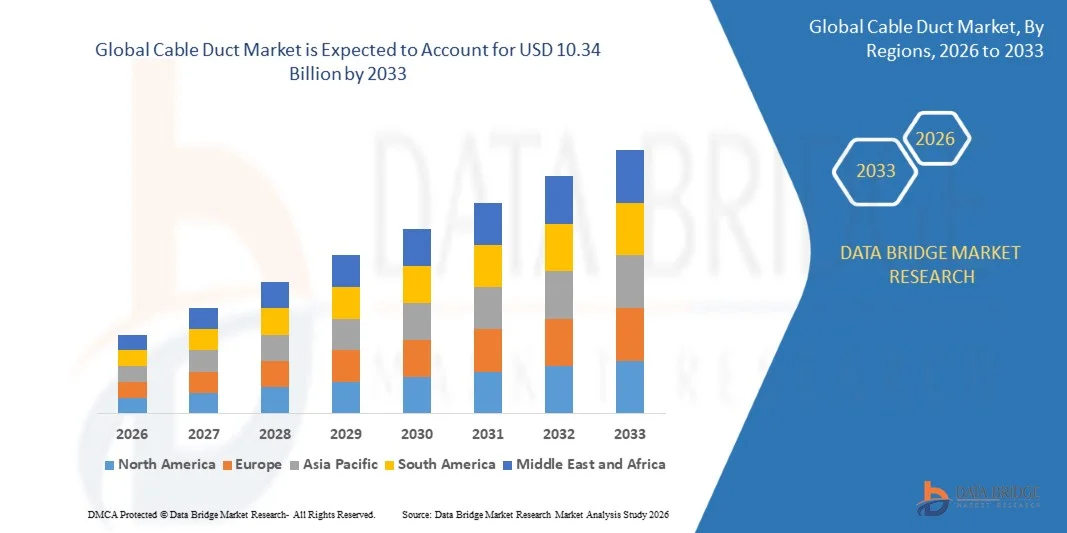
- As per Data Bridge Market Research analysis, the cable duct market was valued at USD 7.0 billion in 2025 and is projected to reach USD 10.34 billion by 2033, growing at a CAGR of 5.0% from 2026 to 2033.
- The market is experiencing steady growth driven by the rapid expansion of fiber-to-the-home (FTTH) broadband networks, accelerating 5G infrastructure rollout, and rising investment in data center construction requiring extensive underground cable protection and routing infrastructure.
- The growing emphasis on network reliability, cable protection from environmental and mechanical damage, and streamlined installation of telecommunication and power cabling is compelling telecom operators, utility companies, and government infrastructure agencies to adopt advanced cable duct systems. HDPE and multi-cell duct technologies are increasingly replacing traditional single-wall systems, offering improved durability, scalability, and future-proof capacity for additional cable installations.
- The accelerating global shift toward underground utility infrastructure, driven by urban aesthetic considerations and improved resilience against extreme weather events, is further expanding the addressable market for cable duct manufacturers across both developed and emerging economies.
Market Size & Forecast
- Global Market Value (2025): USD 7.0 Billion
- Expected Market Value (2033): USD 10.34 Billion
- Forecast CAGR (2026–2033): 5.0%
- Leading Region in 2025: Asia-Pacific
- Fastest Growing Region: Asia-Pacific
What are the Major Takeaways of the Cable Duct Market?
- Asia-Pacific dominated the global cable duct market with the largest revenue share of 37.86% in 2025, supported by large-scale broadband expansion programs, extensive 5G network deployment, and significant government investment in digital and power infrastructure across China, India, and Southeast Asia.
- Asia-Pacific is also expected to be the fastest-growing region at a CAGR of 6.8% from 2026 to 2033, fueled by continued fiber-optic network expansion, rapid urbanization, and increasing data center construction across the region.
- The HDPE material segment led the market with a 44.29% share in 2025, driven by its superior flexibility, corrosion resistance, and widespread use in trenchless and long-distance underground cable installations.
- The multi-duct/multi-cell systems segment is the fastest-growing duct type, projected to register a CAGR of 7.1%, reflecting rising demand for future-proof infrastructure capable of accommodating multiple cable networks within a single installation trench.
- The telecommunication & fiber optic networks application segment dominated the application category with a 48.52% revenue share in 2025, led by accelerating global fiber broadband and 5G backhaul infrastructure deployment.
- Underground/buried installation accounted for 61.37% of the market share in 2025, preferred due to superior cable protection, reduced visual and environmental impact, and long-term durability compared to aerial installation methods.
- The data center application segment is the fastest-growing end-use category, with a CAGR of 7.6%, driven by rapid global expansion of hyperscale and colocation data center facilities requiring extensive underground cable infrastructure.
- The medium diameter segment accounted for 46.73% of the market share in 2025, reflecting its widespread use in standard telecom and power distribution cable installations balancing cost-effectiveness with future capacity requirements.
- The double-wall corrugated ducts segment held a 35.64% share of the duct type category in 2025, supported by its combination of external corrugated strength and smooth internal bore for easy cable pulling across telecom and power infrastructure projects.
- The trenchless/horizontal directional drilling installation method is the fastest-growing installation category, with a projected CAGR of 7.3%, reflecting rising adoption of minimally invasive techniques in dense urban and environmentally sensitive areas.
Report Scope and Cable Duct Market Segmentation
|
Attributes |
Cable Duct Key Market Insights |
|
Segments Covered |
|
|
Countries Covered |
North America
Europe
Asia-Pacific
Middle East and Africa
South America
|
|
Key Market Players |
|
|
Market Opportunities |
|
|
Value Added Data Infosets |
In addition to the market insights such as market value, growth rate, market segments, geographical coverage, market players, and market scenario, the market report curated by the Data Bridge Market Research team includes in-depth expert analysis, import/export analysis, pricing analysis, production consumption analysis, and pestle analysis. |
What is the Key Trend in the Cable Duct Market?
- Telecom operators and infrastructure developers are increasingly adopting microduct and multi-cell duct systems that allow multiple fiber cables to be installed and upgraded within a single trench, significantly reducing civil works costs and installation time for large-scale broadband rollouts.
- For instance, in March 2025, a leading European telecom infrastructure provider expanded its use of multi-cell microduct systems across its national FTTH rollout program, enabling faster fiber deployment while reducing trenching and restoration costs across urban and rural areas.
- Growing adoption of trenchless installation technologies, including horizontal directional drilling and micro-trenching, is enabling faster, less disruptive cable duct installation in densely populated urban environments with limited excavation access.
- Manufacturers are increasingly developing detectable and smart cable duct systems embedded with locating wires and RFID markers, enabling utilities and telecom operators to accurately map underground infrastructure and reduce accidental damage during future excavation work.
- For instance, in February 2025, Dura-Line Corporation expanded its portfolio of detectable HDPE conduit systems featuring integrated tracer wire technology, supporting improved underground asset mapping for telecom and utility infrastructure operators.
- Growing collaboration between duct manufacturers and telecom infrastructure developers is leading to the design of pre-connectorized, plug-and-play duct and cable assemblies that significantly reduce on-site installation time and labor requirements for large-scale network deployment projects.
- For instance, in January 2025, a leading North American conduit manufacturer such as Dura-Line introduced specialized pre-assembled microduct bundle systems to accelerate rollout timelines for major rural broadband initiatives.
- As telecom operators, utility companies, and data center developers continue to prioritize network reliability, installation efficiency, and future-proof capacity, the adoption of advanced cable duct systems is expected to accelerate, reinforcing their role as essential infrastructure for global digital and power connectivity expansion.
What are the Key Drivers of the Cable Duct Market?
- The rapid global expansion of fiber-to-the-home broadband networks and 5G mobile infrastructure has significantly increased demand for reliable, durable cable duct systems capable of protecting fiber optic and network cabling across diverse installation environments.
- For instance, in April 2025, Prysmian Group expanded its cable duct and conduit manufacturing capacity in North America to meet rising demand from telecom operators accelerating fiber broadband deployment under national connectivity expansion programs.
- The rising construction of hyperscale and colocation data centers worldwide is driving substantial demand for underground cable duct infrastructure capable of supporting extensive power and network cabling requirements within and between facilities.
- For instance, in December 2024, Georg Fischer (GF Piping Systems) expanded its data center cable duct product line to address growing demand from hyperscale data center developers requiring high-capacity, scalable underground cable routing solutions.
- Government-backed rural and national broadband connectivity programs across multiple countries are providing substantial funding for last-mile fiber infrastructure, directly increasing demand for cost-effective, durable cable duct systems capable of supporting long-distance underground installations.
- For instance, in October 2024, Ireland's state-backed National Broadband Plan (NBP) accelerated large-scale underground and rural fiber duct deployments to expand high-speed connectivity to underserved households, directly supporting regional infrastructure providers.
- With continued global investment in broadband connectivity, 5G infrastructure, renewable energy grid expansion, and data center construction, cable duct systems will remain essential to protecting and future-proofing critical telecommunication and power infrastructure worldwide.
- The increasing frequency of extreme weather events, including hurricanes, wildfires, and severe storms, is prompting utility companies to accelerate the transition of overhead power and communication lines to underground duct systems, further expanding long-term demand for resilient cable protection infrastructure.
Which Factors are Challenging the Growth of the Cable Duct Market?
- Cable duct installation, particularly underground and trenchless methods, requires substantial upfront capital investment in excavation, specialized equipment, and skilled labor, creating cost barriers for smaller telecom operators and infrastructure developers.
- These high installation costs limit the pace of network expansion in rural and low-density areas, where the cost per connected household or business remains significantly higher than in urban environments.
- For instance, in January 2025, data published by the Fiber Broadband Association (FBA) and Cartesian highlighted that median underground fiber installation expenses reached $18.00 per foot (driven heavily by labor shortages and complex terrain), rendering rural underground builds significantly more capital-intensive than urban equivalents.
- Fluctuating raw material prices for HDPE resin and other polymer inputs, driven by volatility in crude oil and petrochemical markets, create cost unpredictability for cable duct manufacturers and can compress margins during periods of rising input costs.
- Complex and often inconsistent permitting and right-of-way approval processes across different municipalities and jurisdictions can significantly delay large-scale infrastructure projects, adding administrative overhead and extending project timelines for telecom operators and utility companies.
- The high capital investment and lengthy permitting processes associated with underground cable duct installation continue to restrict adoption, particularly among smaller telecom operators and municipal infrastructure projects with constrained budgets. This cost and regulatory barrier slows market penetration in price-sensitive and underserved regions, limiting the pace of broadband and infrastructure expansion despite growing digital connectivity demand.
How is the Cable Duct Market Segmented?
The cable duct market is segmented on the basis of material type, duct type, application, installation method, end user, and diameter.
- By Material Type
On the basis of material type, the global cable duct market is segmented into PVC, HDPE, concrete, steel/metal, and fiberglass. The HDPE segment dominated the market with a 44.29% share in 2025, owing to its superior flexibility, corrosion resistance, and widespread use in trenchless and long-distance underground cable installations. These products remain the preferred choice for telecom operators and utility companies seeking durable, lightweight, and cost-effective cable protection solutions.
The PVC segment continues to hold significant market share, supported by its cost-effectiveness and widespread use in shorter-distance urban installations, while the fiberglass segment is projected to register the fastest growth at a CAGR of 6.9% from 2026 to 2033, driven by increasing demand for lightweight, high-strength duct systems in specialized industrial and high-voltage power transmission applications.
- By Duct Type
On the basis of duct type, the global cable duct market is segmented into single-wall corrugated ducts, double-wall corrugated ducts, solid wall ducts, and multi-duct/multi-cell systems. The double-wall corrugated ducts segment led the market with a 35.64% share in 2025, supported by its combination of external corrugated strength and smooth internal bore for easy cable pulling, widely used across telecom and power infrastructure projects.
The multi-duct/multi-cell systems segment is expected to experience the fastest growth at a CAGR of 7.1% from 2026 to 2033, driven by rising demand for future-proof infrastructure capable of accommodating multiple fiber and cable networks within a single trench, reducing the need for repeated excavation during future network expansion.
- By Application
On the basis of application, the global cable duct market is segmented into telecommunication & fiber optic networks, power transmission & distribution, data centers, renewable energy cabling, and others. The telecommunication & fiber optic networks segment dominated the market with a share of 48.52% in 2025 due to accelerating global fiber broadband and 5G backhaul infrastructure deployment across both developed and emerging markets. the continued expansion of national broadband connectivity programs is reinforcing the dominance of this segment.
The data centers segment is expected to witness the fastest CAGR of 7.6% from 2026 to 2033, driven by this growth is fueled by rapid global expansion of hyperscale and colocation data center facilities requiring extensive underground cable infrastructure for power distribution and network connectivity between server halls and external network access points.
- By Installation Method
On the basis of installation method, the global cable duct market is segmented into underground/buried, aerial/overhead, and trenchless/horizontal directional drilling. The underground/buried segment dominated the market with a share of 61.37% in 2025 due to its superior cable protection, reduced visual and environmental impact, and long-term durability compared to aerial installation methods. increasing municipal preference for underground infrastructure in urban development and redevelopment projects is reinforcing this segment’s leading position.
The trenchless/horizontal directional drilling segment is expected to witness the fastest CAGR of 7.3% from 2026 to 2033, driven by the rising adoption of minimally invasive installation techniques that reduce surface disruption, restoration costs, and installation time in densely populated urban environments. additionally, growing regulatory preference for trenchless methods in historic and environmentally sensitive areas is further accelerating adoption of this installation approach.
- By End User
On the basis of end user, the global cable duct market is segmented into telecom operators, utility companies, data center operators, government & municipal infrastructure, and industrial. The telecom operators segment dominated the market with a share of 42.18% in 2025 due to sustained global investment in fiber broadband and 5G network infrastructure expansion. the widespread adoption of multi-cell duct systems by telecom infrastructure developers seeking scalable, future-proof network capacity is reinforcing this segment’s leading position.
The data center operators segment is expected to witness the fastest CAGR of 7.8% from 2026 to 2033, driven by rising investment in hyperscale and edge data center construction worldwide requiring extensive underground power and network cable infrastructure. additionally, growing demand for reliable, high-capacity connectivity between data center campuses is further accelerating adoption of cable duct systems across this segment.
- By Diameter
On the basis of diameter, the global cable duct market is segmented into small diameter, medium diameter, and large diameter. The medium diameter segment dominated the market with a share of 46.73% in 2025 due to its widespread use in standard telecom and power distribution cable installations balancing cost-effectiveness and future capacity requirements. established manufacturing standards and broad compatibility with common installation equipment continue to support strong demand for medium diameter cable ducts.
The large diameter segment is expected to witness the fastest CAGR of 6.5% from 2026 to 2033, driven by rising demand for multi-cell and high-capacity duct systems capable of housing multiple cables for major backbone network and data center infrastructure projects.
Which Region Holds the Largest Share of the Cable Duct Market?
- Asia-Pacific dominated the cable duct market and accounted for the largest revenue share of 37.86% in 2025, supported by large-scale broadband expansion programs, extensive 5G network deployment, and significant government investment in digital and power infrastructure across the region.
- The region also benefits from rapid urbanization, growing data center construction activity, and strong domestic manufacturing capacity for HDPE and PVC duct products. Continued government focus on national digital connectivity and smart city development continues to strengthen Asia-Pacific’s leadership position in the global market.
China Cable Duct Market Insight
China cable duct market is growing rapidly, driven by extensive government investment in 5G network infrastructure, nationwide fiber broadband expansion, and large-scale data center construction across major metropolitan areas. Growing adoption of HDPE and multi-cell duct systems across telecom and power infrastructure projects is significantly boosting market demand. In addition, rising domestic manufacturing capabilities and increasing investment in smart city and digital infrastructure development are positioning China as the largest and fastest-growing market for cable ducts globally.
Japan Cable Duct Market Insight
Japan cable duct market is witnessing steady growth, supported by the country’s advanced fiber broadband infrastructure, ongoing 5G network densification, and ongoing efforts to relocate overhead utility cabling underground to improve disaster resilience against earthquakes and typhoons. Utility companies and telecom operators continue to invest in high-durability duct systems designed to withstand seismic activity and extreme weather conditions. Continued government support for underground infrastructure modernization is further contributing to market growth in Japan.
Europe Cable Duct Market Insight
Europe’s cable duct market is driven by rapid renewable energy expansion, electricity grid modernization, broadband and 5G network deployment, data-center development, industrial automation, and increasing electrification across sectors. Growing smart-city projects and electric vehicle charging infrastructure are further supporting demand for efficient cable management systems. Replacement of aging electrical infrastructure, stringent European sustainability and energy-efficiency regulations, and rising preference for fire-resistant, lightweight, durable, and recyclable materials are also influencing market growth. Additionally, increasing underground cable installations and investments in resilient communication and power networks are creating significant opportunities across Europe.
Germany Cable Duct Market Insight
The Germany cable duct market is expanding steadily, supported by the country’s national fiber broadband expansion targets, strong industrial manufacturing base, and increasing investment in renewable energy grid infrastructure. Telecom operators and utility companies are increasingly adopting multi-cell duct systems to support efficient, future-proof network expansion across both urban and rural regions. Continued government support for digital infrastructure investment and grid modernization is further driving market growth in Germany.
U.K. Cable Duct Market Insight
The U.K. cable duct market is expanding steadily due to accelerating full-fiber broadband rollout targets, growing 5G network densification, and rising investment in offshore wind and renewable energy grid connections requiring extensive underground and subsea cable protection infrastructure. Increasing adoption of trenchless installation methods to minimize disruption in historic and densely populated urban areas is supporting market growth. Furthermore, integration of detectable duct technologies is improving underground asset management, positioning the U.K. as a key market for advanced cable duct solutions.
Which are the Top Companies in Cable Duct Market?
The cable duct industry is primarily led by well-established companies, including:
- Dura-Line Corporation (Orbia) (U.S.)
- Prysmian Group (Italy)
- Georg Fischer AG (GF Piping Systems) (Switzerland)
- Pipelife International GmbH (Wienerberger) (Austria)
- JM Eagle, Inc. (U.S.)
- IPEX Inc. (Canada)
- Condux International, Inc. (U.S.)
- Champion Fiberglass, Inc. (U.S.)
- Advanced Drainage Systems, Inc. (U.S.)
- Sekisui Chemical Co., Ltd. (Japan)
- Rehau Group (Germany)
- Fränkische Rohrwerke Gebr. Kirchner GmbH & Co. KG (Germany)
- Diamond Plastics Corporation (U.S.)
- Vinidex Pty Ltd (Australia)
- Blue Diamond Industries, LLC (U.S.)
- National Pipe & Plastics, Inc. (U.S.)
- Polypipe Group (Aliaxis) (U.K.)
- Pipeline Plastics, LLC (U.S.)
- Radius Systems Limited (U.K.)
- Shawcor Ltd. (Canada)
What are Latest Developments in Cable Duct Market?
- In September 2025, Dura-Line Corporation launched a new generation of detectable multi-cell microduct systems featuring enhanced tracer wire integration and improved impact resistance, aimed at supporting large-scale FTTH deployment programs while enabling more accurate underground infrastructure mapping for telecom operators.
- In January 2025, Prysmian Group expanded its cable duct manufacturing facility in Asia-Pacific to increase production capacity for HDPE conduit systems, strengthening its ability to meet rising demand from regional broadband and 5G infrastructure deployment programs.
- In November 2025, Georg Fischer (GF Piping Systems) introduced a new large-diameter multi-cell duct system specifically engineered for hyperscale data center campuses, offering increased cable capacity and simplified installation for power and network infrastructure between facility buildings.
- In November 2024, Pipelife International launched an upgraded double-wall corrugated duct product line featuring improved crush resistance for use in high-traffic urban roadway installations, expanding its portfolio for municipal and telecom infrastructure applications.
- In June 2023, Sekisui Chemical partnered with several regional telecom infrastructure developers to conduct field trials of its lightweight fiberglass-reinforced duct systems, demonstrating improved installation efficiency and durability for long-distance underground cable routing projects.
- In August 2024, IPEX Inc. expanded its manufacturing capacity for large-diameter HDPE duct systems in North America to meet rising demand from data center developers and utility companies undertaking major grid modernization projects.

- Interactive Data Analysis Dashboard
- Company Analysis Dashboard for high growth potential opportunities
- Research Analyst Access for customization & queries
- Competitor Analysis with Interactive dashboard
- Latest News, Updates & Trend analysis
- Harness the Power of Benchmark Analysis for Comprehensive Competitor Tracking
Data collection and base year analysis are done using data collection modules with large sample sizes. The stage includes obtaining market information or related data through various sources and strategies. It includes examining and planning all the data acquired from the past in advance. It likewise envelops the examination of information inconsistencies seen across different information sources. The market data is analysed and estimated using market statistical and coherent models. Also, market share analysis and key trend analysis are the major success factors in the market report. To know more, please request an analyst call or drop down your inquiry.
The key research methodology used by DBMR research team is data triangulation which involves data mining, analysis of the impact of data variables on the market and primary (industry expert) validation. Data models include Vendor Positioning Grid, Market Time Line Analysis, Market Overview and Guide, Company Positioning Grid, Patent Analysis, Pricing Analysis, Company Market Share Analysis, Standards of Measurement, Global versus Regional and Vendor Share Analysis. To know more about the research methodology, drop in an inquiry to speak to our industry experts.
Data Bridge Market Research is a leader in advanced formative research. We take pride in servicing our existing and new customers with data and analysis that match and suits their goal. The report can be customized to include price trend analysis of target brands understanding the market for additional countries (ask for the list of countries), clinical trial results data, literature review, refurbished market and product base analysis. Market analysis of target competitors can be analyzed from technology-based analysis to market portfolio strategies. We can add as many competitors that you require data about in the format and data style you are looking for. Our team of analysts can also provide you data in crude raw excel files pivot tables (Fact book) or can assist you in creating presentations from the data sets available in the report.













