


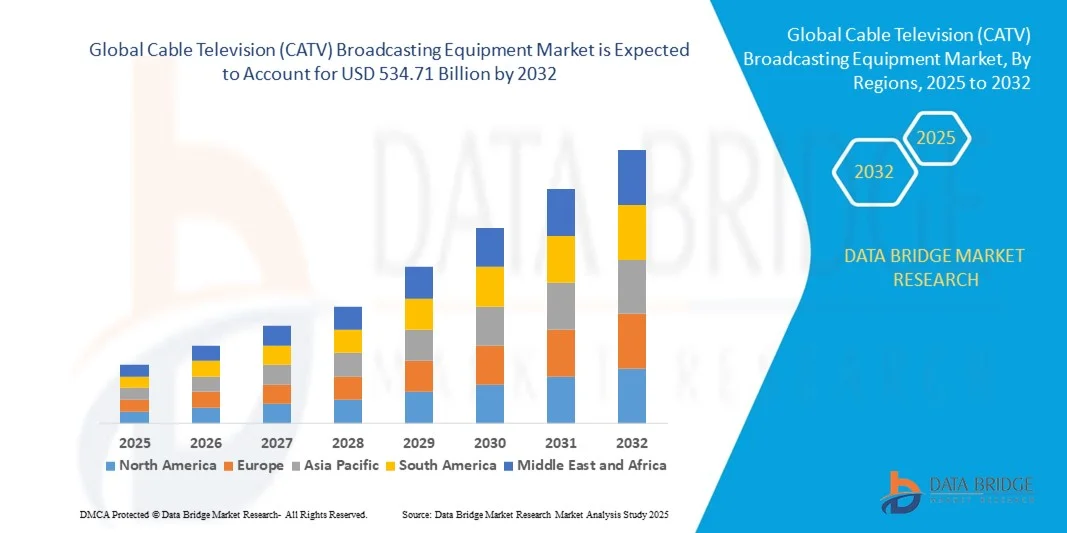
Global Cable Television (CATV) Broadcasting Equipment Market Size
- The global Cable Television (CATV) Broadcasting Equipment Market was valued at USD 356.45 billion in 2024 and is projected to reach USD 534.71 billion by 2032, growing at a CAGR of 5.20% during the forecast period.
- Market growth is primarily driven by increasing digital content consumption, the expansion of high-speed broadband infrastructure, and the demand for enhanced transmission quality across residential and commercial sectors.
- Additionally, the shift toward IP-based broadcasting and cloud-based solutions is revolutionizing content delivery and management, further accelerating the deployment of advanced CATV broadcasting equipment and fueling overall industry growth.
Global Cable Television (CATV) Broadcasting Equipment Market Analysis
- Cable Television (CATV) broadcasting equipment, comprising modulators, amplifiers, antennas, and transmitters, plays a critical role in delivering high-quality audio-visual content across residential, commercial, and industrial applications, supported by advancements in digital transmission and hybrid fiber-coaxial (HFC) networks.
- The rising demand for CATV broadcasting equipment is largely driven by increasing digital content consumption, growing penetration of smart TVs, and the transition from analog to digital broadcasting across emerging and developed economies.
- North America dominated the Global Cable Television (CATV) Broadcasting Equipment Market with the largest revenue share of 37.4% in 2024, owing to advanced telecommunications infrastructure, early digital transition, and strong investments from major cable service providers, particularly in the U.S., which leads in 4K and high-definition content broadcasting.
- Asia-Pacific is expected to be the fastest-growing region in the Global Cable Television (CATV) Broadcasting Equipment Market during the forecast period due to expanding broadband access, increasing urbanization, and government initiatives to digitize broadcast services across countries like China and India.
- The modulators segment dominated the market with the largest revenue share of 28.6% in 2024, driven by their critical role in converting signals into a format suitable for cable transmission.
Report Scope and Global Cable Television (CATV) Broadcasting Equipment Market Segmentation
|
Attributes |
Cable Television (CATV) Broadcasting Equipment Key Market Insights |
|
Segments Covered |
|
|
Countries Covered |
North America
Europe
Asia-Pacific
Middle East and Africa
South America
|
|
Key Market Players |
|
|
Market Opportunities |
|
|
Value Added Data Infosets |
In addition to the insights on market scenarios such as market value, growth rate, segmentation, geographical coverage, and major players, the market reports curated by the Data Bridge Market Research also include in-depth expert analysis, geographically represented company-wise production and capacity, network layouts of distributors and partners, detailed and updated price trend analysis and deficit analysis of supply chain and demand. |
Global Cable Television (CATV) Broadcasting Equipment Market Trends
Enhanced Broadcasting Efficiency Through AI and Cloud Integration
- A significant and accelerating trend in the global Cable Television (CATV) Broadcasting Equipment Market is the integration of artificial intelligence (AI), machine learning (ML), and cloud-based technologies into broadcasting infrastructure. This convergence is revolutionizing how content is transmitted, monitored, and managed, offering unprecedented levels of efficiency, automation, and scalability.
- For Instance, AI-powered video compression and encoding solutions from companies like Harmonic and Evertz are enabling broadcasters to deliver high-quality content with reduced bandwidth requirements. Similarly, cloud-native platforms are being used to virtualize playout and content delivery, minimizing hardware dependency and operational costs.
- AI integration allows for advanced content tagging, real-time analytics, and automated quality control, which enhances viewer experience and operational efficiency. For instance, EVS’s AI-enabled replay and highlights systems can automatically detect key moments in live broadcasts, allowing for instant content generation and faster decision-making during live events.
- Cloud integration facilitates remote production, centralized content management, and seamless collaboration across distributed teams. With virtualized broadcast chains, operators can monitor and manage multiple channels from a single interface, ensuring consistent content delivery across platforms.
- This shift towards intelligent, software-defined, and cloud-enabled broadcasting systems is reshaping the operational models of cable broadcasters. Leading players like Cisco and Grass Valley are offering end-to-end cloud broadcasting ecosystems, integrating AI for adaptive bitrate streaming, audience behavior analytics, and automated content curation.
- The demand for AI- and cloud-integrated CATV broadcasting equipment is growing rapidly across both developed and emerging markets, as broadcasters aim to reduce latency, lower costs, and meet evolving viewer expectations in a multi-screen, on-demand content landscape.
Global Cable Television (CATV) Broadcasting Equipment Market Dynamics
Driver
Growing Need Due to Digital Content Expansion and Infrastructure Modernization
-
The rapid expansion of digital content consumption and the modernization of broadcast infrastructure are major driving forces behind the increasing demand for Cable Television (CATV) broadcasting equipment. Broadcasters are under pressure to deliver high-quality, low-latency content across multiple platforms, prompting a shift toward more advanced, efficient, and scalable broadcasting solutions.
- For instance, in March 2024, Harmonic Inc. announced the launch of its next-generation cloud-native streaming platform designed to support ultra-high-definition (UHD) and low-latency content delivery, reflecting the industry’s push toward more immersive viewing experiences. Such innovations are expected to significantly contribute to market growth in the coming years.
- As consumers demand seamless streaming and high-definition content, broadcasters are investing in equipment capable of supporting IP-based transmission, 4K/8K resolution, and hybrid fiber-coaxial (HFC) systems. These advanced systems enable flexible and scalable broadcasting infrastructure across residential and commercial applications.
- Furthermore, governments and telecom companies across emerging markets are making significant investments in digital infrastructure and broadband expansion, boosting the deployment of CATV broadcasting equipment. This trend is particularly prominent in Asia-Pacific and Latin America, where rapid urbanization and increased media consumption are fueling infrastructure upgrades.
- The demand for next-gen broadcasting equipment is also being driven by the need for remote production, automated workflows, and virtualized operations—especially in the post-pandemic landscape. As a result, solutions that offer interoperability, cloud integration, and cost-efficiency are gaining traction across the global market.
Restraint/Challenge
High Capital Investment and Integration Complexities
- Despite the growing demand, high initial capital investment and technical integration complexities act as significant restraints for the widespread adoption of advanced CATV broadcasting equipment. The transition from legacy systems to IP-based or cloud-enabled solutions often requires a complete overhaul of existing infrastructure, which can be financially and logistically challenging for smaller operators.
- For Instance, mid-sized broadcasters may struggle to justify the cost of upgrading to 4K-ready or cloud-native equipment, especially in regions where the return on investment is uncertain due to limited consumer demand or bandwidth constraints.
- Integration of new technologies such as AI, cloud, and IP broadcasting often demands specialized skill sets, posing an operational challenge. Companies may face hurdles in training their workforce, ensuring compatibility across platforms, and maintaining uptime during system transitions.
- Additionally, regulatory uncertainties in certain regions related to spectrum allocation and broadcasting standards can further complicate equipment deployment and delay infrastructure upgrades.
- To overcome these barriers, market players are increasingly focusing on modular, scalable, and software-defined broadcasting solutions that can be integrated with legacy systems. Flexible financing models, vendor partnerships, and government support will also be key in enabling broader adoption of modern CATV broadcasting technologies.
Global Cable Television (CATV) Broadcasting Equipment Market Scope
Cable television (CATV) broadcasting equipment market is segmented on the basis of product, technology, and amplifier.
- By Product
On the basis of product, the Global Cable Television (CATV) Broadcasting Equipment Market is segmented into Dish Antennas, Amplifiers, Switches, Video Servers, Encoders, Transmitters and Repeaters, Modulators, and Others. The modulators segment dominated the market with the largest revenue share of 28.6% in 2024, driven by their critical role in converting signals into a format suitable for cable transmission. With the growing demand for high-definition and ultra-HD content, modulators are essential for maintaining signal integrity and enabling compatibility across multiple platforms.
The video servers segment is expected to witness the fastest CAGR of 22.3% from 2025 to 2032, fueled by the rising adoption of IP-based broadcasting and the need for efficient content storage and distribution. As broadcasters shift toward cloud-based workflows and on-demand services, video servers provide scalable, centralized management of media assets, making them increasingly vital in both live and pre-recorded content delivery.
- By Technology
Based on technology, the Global Cable Television (CATV) Broadcasting Equipment Market is segmented into Analog Broadcasting and Digital Broadcasting. The digital broadcasting segment dominated the market with the largest revenue share of 66.7% in 2024, attributed to the global transition from analog systems to digital broadcasting technologies, which offer enhanced picture quality, efficient bandwidth usage, and multi-channel capabilities. Governments across regions are mandating digital switchover, further boosting this segment.
The digital broadcasting segment is also projected to be the fastest growing, with a CAGR of 21.8% from 2025 to 2032, driven by advancements in compression standards, growing internet penetration, and the rising demand for interactive and high-definition television services. Digital broadcasting supports seamless integration with IP networks, enabling broadcasters to reach wider audiences through both traditional cable and internet-based platforms, thus fueling rapid adoption.
- By Amplifier
On the basis of amplifier type, the Global Cable Television (CATV) Broadcasting Equipment Market is segmented into MMIC Amplifiers, Hybrid Amplifiers, and Others. The hybrid amplifier segment held the largest market revenue share of 54.1% in 2024, owing to their widespread use in CATV networks for signal boosting across long distances without distortion. These amplifiers are highly efficient and offer better noise performance, making them ideal for large-scale network deployments.
The MMIC (Monolithic Microwave Integrated Circuit) amplifier segment is anticipated to witness the fastest CAGR of 23.4% during the forecast period. This growth is driven by increasing demand for compact, high-frequency amplifiers that offer superior performance in terms of gain and linearity. MMIC amplifiers are gaining traction due to their suitability in advanced broadcasting systems, particularly in high-capacity data transmission and modern digital CATV infrastructure, supporting growing bandwidth requirements.
Global Cable Television (CATV) Broadcasting Equipment Market Regional Analysis
- North America dominated the Global Cable Television (CATV) Broadcasting Equipment Market with the largest revenue share of 37.4% in 2024, driven by advanced telecommunications infrastructure, early transition to digital broadcasting, and strong presence of major industry players such as Cisco, Harmonic, and Arris International.
- Broadcasters and service providers in the region are investing heavily in upgrading legacy systems to IP-based and cloud-enabled platforms to meet the rising demand for high-definition and on-demand content.
- The market growth is further supported by high consumer expectations for content quality, widespread broadband access, and the increasing adoption of smart TVs and streaming devices. The U.S. leads regional growth, with operators focusing on next-gen technologies such as AI-powered compression, virtualized headends, and remote production capabilities, reinforcing North America's position as a mature and innovation-driven market for CATV broadcasting equipment.
U.S. CATV Broadcasting Equipment Market Insight
The U.S. CATV broadcasting equipment market captured the largest revenue share of 78% in 2024 within North America, driven by the country’s advanced digital infrastructure and increasing demand for high-definition and on-demand content. Rapid investments in IP-based broadcasting, the adoption of cloud-enabled systems, and the shift toward OTT content delivery are fueling market growth. Leading U.S.-based companies such as Cisco and Harmonic are spearheading innovation through AI-powered encoding, virtualized playout systems, and scalable cloud solutions. Additionally, the demand for seamless content delivery across multiple platforms and devices supports the continuous upgrade of broadcasting infrastructure across residential and commercial settings.
Europe CATV Broadcasting Equipment Market Insight
The Europe CATV broadcasting equipment market is projected to grow at a substantial CAGR throughout the forecast period, supported by the accelerated transition from analog to digital broadcasting across the region. Stricter regulatory mandates on digitalization, such as the EU’s digital switchover initiatives, are key drivers. Increasing viewership of cable and IPTV services, combined with the expansion of fiber-optic networks, is promoting adoption of modern broadcasting equipment. Moreover, rising demand for multilingual and localized content, especially in multilingual nations, is pushing broadcasters to adopt flexible, scalable, and modular solutions across residential and enterprise segments.
U.K. CATV Broadcasting Equipment Market Insight
The U.K. CATV broadcasting equipment market is expected to grow at a noteworthy CAGR during the forecast period, supported by the country’s focus on digital broadcasting innovation and rising demand for high-definition content delivery. Major broadcasters and telecom operators in the U.K. are investing in IP-based broadcasting systems and virtualized production workflows to enhance operational efficiency. With increasing consumption of OTT and hybrid broadcast services, the U.K. market is seeing growth in demand for encoders, video servers, and modulators that support adaptive streaming and cloud integration.
Germany CATV Broadcasting Equipment Market Insight
The Germany CATV broadcasting equipment market is anticipated to expand at a considerable CAGR, driven by the nation's strong emphasis on technological innovation and infrastructure modernization. Germany’s well-established broadcasting sector is undergoing transformation through digitization, particularly in public and private cable networks. Demand for high-performance amplifiers, modulators, and encoders is growing as broadcasters aim to deliver ultra-HD and low-latency content. Government-backed initiatives supporting broadband expansion and 5G deployment are also contributing to the enhanced distribution of CATV services, especially in underserved and rural regions.
Asia-Pacific CATV Broadcasting Equipment Market Insight
The Asia-Pacific CATV broadcasting equipment market is set to grow at the fastest CAGR of 24% from 2025 to 2032, fueled by increasing urbanization, rapid digital transformation, and growing media consumption in countries such as China, India, and Japan. Government efforts to promote digital broadcasting and broadband infrastructure are driving the adoption of modern equipment. The region benefits from a large population base and rising middle class, increasing the demand for high-quality cable TV services. Local manufacturing capabilities and competitive pricing from regional players are also making CATV equipment more accessible to a wider range of broadcasters and operators.
Japan CATV Broadcasting Equipment Market Insight
The Japan CATV broadcasting equipment market is gaining momentum due to the country’s highly digitalized environment and strong focus on technological innovation. The demand for 4K and 8K broadcasting, especially around major national events, is pushing broadcasters to upgrade their systems. Japan’s established telecom infrastructure and rising integration of AI and cloud technologies in media workflows are key growth factors. The market is also seeing increased investment in IP-based video transport and real-time encoding solutions that align with Japan’s preference for cutting-edge, compact, and energy-efficient broadcasting systems.
China CATV Broadcasting Equipment Market Insight
The China CATV broadcasting equipment market accounted for the largest market revenue share in Asia-Pacific in 2024, driven by the country’s rapid digitalization, robust cable TV subscriber base, and aggressive infrastructure development. Government initiatives supporting the rollout of digital cable networks and smart city developments are significantly influencing market growth. Chinese broadcasters are adopting hybrid broadcast systems, combining traditional cable infrastructure with IP-based solutions to serve urban and rural markets efficiently. Additionally, the presence of strong domestic manufacturers and favorable regulatory support is positioning China as a key growth engine in the global CATV equipment market.
Global Cable Television (CATV) Broadcasting Equipment Market Share
The Cable Television (CATV) Broadcasting Equipment industry is primarily led by well-established companies, including:
- Cisco (U.S.)
- Telefonaktiebolaget LM Ericsson (Sweden)
- Evertz (Canada)
- EVS Broadcast Equipment (Belgium)
- Grass Valley Canada (Canada)
- Harmonic (U.S.)
- Clyde Broadcast (U.K.)
- Sencore (USA)
- Eletec Radio Broadcasting Equipment & Transmitters (France)
- ACORDE Technologies S.A. (Spain)
- AVL India Private Limited (India)
- ETL Systems Ltd (U.K.)
- Global Invacom (Singapore)
- Arris International (U.S.)
- RFE Broadcast (Italy)
- Beamr Imaging Ltd. (Israel)
- Newtec (Belgium)
- DATUM SYSTEMS (U.S.)
- Comtech Telecommunications Corp. (U.S.)
- Wellav Technologies Ltd. (China)
- AnaCom, Inc. (U.S.)
What are the Recent Developments in Global Cable Television (CATV) Broadcasting Equipment Market?
- In April 2023, Harmonic Inc., a global leader in video delivery infrastructure, announced the launch of its next-generation VOS®360 Media SaaS platform upgrade, aimed at enhancing cloud-based content delivery for broadcasters and operators worldwide. This initiative reinforces Harmonic’s commitment to providing scalable and flexible solutions for live streaming and linear TV. With increased support for UHD and low-latency delivery, the platform is enabling broadcasters to adapt to the dynamic demands of modern viewers while reducing infrastructure costs—strengthening Harmonic's position in the global CATV broadcasting equipment market.
- In March 2023, Evertz Microsystems Ltd., a key player in broadcast technology, unveiled its new SCORPION Smart Media Processing Platform at the NAB Show. Designed to support 12G-SDI, IP, and HDMI signal formats, the SCORPION platform addresses evolving hybrid broadcasting workflows. Its modular design offers flexibility for both traditional CATV systems and IP-based infrastructure, aligning with industry trends toward virtualization and cloud-based operations. This launch marks Evertz’s strategic expansion into next-gen media transport solutions.
- In March 2023, Cisco Systems Inc. partnered with several leading North American cable operators to roll out its Cloud Native Broadband Network Gateway (cnBNG), enhancing the scalability and speed of broadband and cable TV service delivery. This initiative supports operators transitioning toward DOCSIS 4.0 and converged IP-based broadcast networks. Cisco’s solution is aimed at future-proofing cable infrastructure while reducing operational complexity, reinforcing its leadership in the CATV broadcasting space.
- In February 2023, Sencore Inc. announced the release of its AG 6000 Modular Video Gateway, offering broadcasters advanced signal monitoring, decoding, and re-multiplexing capabilities in a compact, customizable platform. Targeted at cable operators looking to optimize network performance and improve transmission efficiency, the AG 6000 supports multiple input/output formats and cloud integration. This development illustrates Sencore’s ongoing investment in high-performance solutions that enable seamless digital signal delivery.
- In January 2023, EVS Broadcast Equipment expanded its footprint in Asia with the deployment of its LiveCeption Signature solution for a major sports broadcasting network in Japan. The technology enables real-time replay and highlight generation for live events, utilizing AI-assisted automation to streamline production workflows. This deployment reflects EVS’s focus on enhancing viewer engagement through advanced broadcasting solutions and solidifies its presence in the rapidly growing Asia-Pacific CATV broadcasting equipment market.

- Interactive Data Analysis Dashboard
- Company Analysis Dashboard for high growth potential opportunities
- Research Analyst Access for customization & queries
- Competitor Analysis with Interactive dashboard
- Latest News, Updates & Trend analysis
- Harness the Power of Benchmark Analysis for Comprehensive Competitor Tracking
Global Cable Television Catv Broadcasting Equipment Market, Supply Chain Analysis and Ecosystem Framework
To support market growth and help clients navigate the impact of geopolitical shifts, DBMR has integrated in-depth supply chain analysis into its Global Cable Television Catv Broadcasting Equipment Market research reports. This addition empowers clients to respond effectively to global changes affecting their industries. The supply chain analysis section includes detailed insights such as Global Cable Television Catv Broadcasting Equipment Market consumption and production by country, price trend analysis, the impact of tariffs and geopolitical developments, and import and export trends by country and HSN code. It also highlights major suppliers with data on production capacity and company profiles, as well as key importers and exporters. In addition to research, DBMR offers specialized supply chain consulting services backed by over a decade of experience, providing solutions like supplier discovery, supplier risk assessment, price trend analysis, impact evaluation of inflation and trade route changes, and comprehensive market trend analysis.
Data collection and base year analysis are done using data collection modules with large sample sizes. The stage includes obtaining market information or related data through various sources and strategies. It includes examining and planning all the data acquired from the past in advance. It likewise envelops the examination of information inconsistencies seen across different information sources. The market data is analysed and estimated using market statistical and coherent models. Also, market share analysis and key trend analysis are the major success factors in the market report. To know more, please request an analyst call or drop down your inquiry.
The key research methodology used by DBMR research team is data triangulation which involves data mining, analysis of the impact of data variables on the market and primary (industry expert) validation. Data models include Vendor Positioning Grid, Market Time Line Analysis, Market Overview and Guide, Company Positioning Grid, Patent Analysis, Pricing Analysis, Company Market Share Analysis, Standards of Measurement, Global versus Regional and Vendor Share Analysis. To know more about the research methodology, drop in an inquiry to speak to our industry experts.
Data Bridge Market Research is a leader in advanced formative research. We take pride in servicing our existing and new customers with data and analysis that match and suits their goal. The report can be customized to include price trend analysis of target brands understanding the market for additional countries (ask for the list of countries), clinical trial results data, literature review, refurbished market and product base analysis. Market analysis of target competitors can be analyzed from technology-based analysis to market portfolio strategies. We can add as many competitors that you require data about in the format and data style you are looking for. Our team of analysts can also provide you data in crude raw excel files pivot tables (Fact book) or can assist you in creating presentations from the data sets available in the report.













