


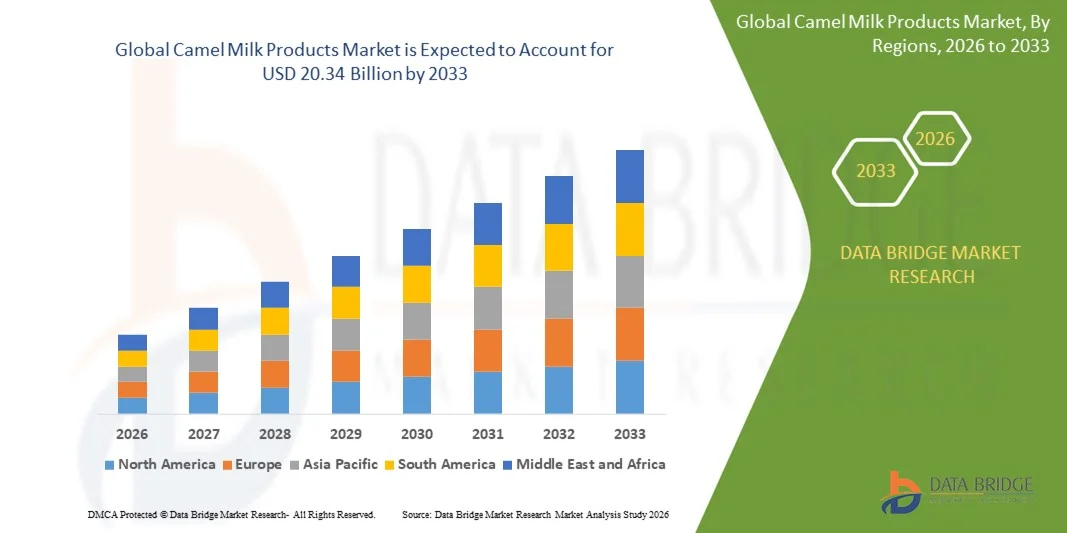
What is the Global Camel Milk Products Market Size and Growth Rate?
- The global camel milk products market size was valued at USD 12.47 billion in 2025 and is expected to reach USD 20.34 billion by 2033, at a CAGR of 6.30% during the forecast period
- Increasing popularity of camel milk due to its easy-to-digest property among lactose-intolerant consumers is a vital factor escalating the market growth, also rising number of urban consumers, increase in the health concern among people, rise in the urban population and diversification in camel dairy products, rising continuous change in the lifestyle, rising suffering from arthritis and aging problems all over the globe, which in turn increases the product demand and growing recognition for the camel’s milk and other dairy products as it possess many health benefits are the major factors among others driving the camel milk products market briskly
What are the Major Takeaways of Camel Milk Products Market?
- Rising research and development activities and increasing modernization in the new products offered in the market will further create new opportunities for the camel milk products market
- However, high price of camel milk products as compared to other counterparts is the major factor among others acting as restraints, and will further challenge the camel milk products market in the forecast period
- Middle East and Africa dominated the camel milk products market with a 58.69% revenue share in 2025, supported by the cultural preference for camel milk, well-established local production, and strong demand across households and commercial applications in countries such as Saudi Arabia, U.A.E., and Kenya
- North America is projected to register the fastest CAGR of 8.2% from 2026 to 2033, fueled by growing consumer awareness of camel milk’s health benefits in the U.S. and Canada
- The Plain Milk segment dominated the market with a revenue share of 42.3% in 2025, driven by strong consumer preference for natural, unflavored camel milk due to its high protein content, low fat, and lactose-friendly properties
Report Scope and Camel Milk Products Market Segmentation
|
Attributes |
Camel Milk Products Key Market Insights |
|
Segments Covered |
|
|
Countries Covered |
North America
Europe
Asia-Pacific
Middle East and Africa
South America
|
|
Key Market Players |
|
|
Market Opportunities |
|
|
Value Added Data Infosets |
In addition to the insights on market scenarios such as market value, growth rate, segmentation, geographical coverage, and major players, the market reports curated by the Data Bridge Market Research also include in-depth expert analysis, pricing analysis, brand share analysis, consumer survey, demography analysis, supply chain analysis, value chain analysis, raw material/consumables overview, vendor selection criteria, PESTLE Analysis, Porter Analysis, and regulatory framework. |
What is the Key Trend in the Camel Milk Products Market?
“Rising Demand for Nutrient-Rich and Functional Camel Milk Products”
- The camel milk products market is witnessing a strong trend toward nutrient-enriched, functional, and specialty formulations, including flavored milk, probiotic variants, and fortified products. This trend is driven by growing consumer preference for healthy, natural, and high-protein dairy alternatives
- For instance, companies such as Desert Farms, The Camel Milk Co. Australia, and Vital Camel Milk have expanded their product lines to include fortified, flavored, and functional camel milk beverages and powders for immunity, digestive health, and wellness support
- Increasing consumer awareness about lactose intolerance, diabetes-friendly diets, and high-protein nutrition is accelerating demand for camel milk products
- Manufacturers are integrating advanced pasteurization, homogenization, and fortification techniques to enhance shelf life, taste, and nutrient retention
- Rising R&D in clean-label, organic, and eco-friendly packaging is driving product innovation in the camel milk sector
- As consumers continue shifting toward natural, functional, and sustainable dairy alternatives, camel milk products are expected to remain central to the global functional dairy market
What are the Key Drivers of Camel Milk Products Market?
- Rising demand for nutrient-rich, low-fat, and lactose-friendly dairy alternatives is driving global adoption of camel milk products
- For instance, in 2025, Desert Farms and The Camel Milk Co. Australia increased production of fortified camel milk beverages and powders targeting health-conscious consumers
- Growing awareness of health benefits, including immunity support, digestive wellness, and diabetes management, is fueling market expansion across North America, Europe, and Asia-Pacific
- Technological advancements in pasteurization, fortification, flavor enhancement, and packaging are improving product quality, safety, and convenience
- Increased focus on sustainable dairy farming, organic sourcing, and eco-friendly packaging strengthens market growth
- With ongoing investment in R&D, product innovation, and international distribution, the Camel Milk Products market is expected to maintain strong growth in the coming years
Which Factor is Challenging the Growth of the Camel Milk Products Market?
- High production and sourcing costs associated with camel milk, specialized processing, and fortified formulations limit affordability in price-sensitive regions
- For instance, during 2024–2025, fluctuations in camel milk supply impacted production for leading companies
- Regulatory compliance for milk safety, dairy fortification standards, and import/export restrictions increases operational complexity
- Limited consumer awareness in emerging markets about camel milk benefits restricts large-scale adoption
- Competition from cow milk, plant-based milk alternatives, and other functional dairy products creates price and market pressures
- To overcome these challenges, companies are focusing on efficient farm-to-product supply chains, organic certification, scalable processing, and consumer education to offer high-quality, functional, and sustainable camel milk solutions
How is the Camel Milk Products Market Segmented?
The market is segmented on the basis of type, application, and distribution channel.
• By Type
On the basis of type, the camel milk products market is segmented into Plain Milk, Flavored Milk, Powder, Ice Cream, Fermented, and Others. The Plain Milk segment dominated the market with a revenue share of 42.3% in 2025, driven by strong consumer preference for natural, unflavored camel milk due to its high protein content, low fat, and lactose-friendly properties. Plain camel milk is widely consumed in households and health-conscious communities for immunity support, digestive wellness, and general nutrition. Continuous innovation in organic sourcing, cold-chain distribution, and fortified variants is boosting global adoption.
The Flavored Milk segment is projected to grow at the fastest CAGR from 2026 to 2033, supported by rising demand for palatable, nutrient-enriched options, particularly among children and young adults. Manufacturers are introducing chocolate, vanilla, and fruit-flavored camel milk to enhance appeal and drive consumption.
• By Application
On the basis of application, the camel milk products market is segmented into Household and Commercial uses. The Household segment dominated the market with a revenue share of 59.1% in 2025, fueled by increasing adoption of camel milk as a daily dietary supplement for immunity, wellness, and lactose-friendly nutrition. Households are increasingly purchasing plain, flavored, and powdered camel milk products for direct consumption and home-based recipes. Continuous product innovation, convenient packaging, and easy-to-consume formulations are driving adoption globally.
The Commercial segment is projected to grow at the fastest CAGR between 2026 and 2033, driven by rising use in cafes, restaurants, hotels, and food processing industries. Camel milk-based beverages, desserts, and fortified products are gaining traction in commercial menus, supporting the growth of foodservice and hospitality channels worldwide.
• By Distribution Channel
On the basis of distribution channel, the camel milk products market is segmented into Supermarket & Hypermarkets, Online Stores, Retail Stores, and Others. The Supermarket & Hypermarkets segment dominated the market with a revenue share of 48.7% in 2025, supported by wide availability, bulk purchasing, and visibility in organized retail formats across North America, Europe, and Asia-Pacific. Retailers offer plain, flavored, and powdered camel milk under refrigerated and shelf-stable formats, making it convenient for households and commercial buyers.
The Online Stores segment is projected to grow at the fastest CAGR from 2026 to 2033, driven by rising e-commerce adoption, subscription-based deliveries, and direct-to-consumer models. Online channels enable access to specialty, organic, and fortified camel milk products, particularly in regions where physical retail penetration is limited, further accelerating global market growth.
Which Region Holds the Largest Share of the Camel Milk Products Market?
- Middle East and Africa dominated the camel milk products market with a 58.69% revenue share in 2025, supported by the cultural preference for camel milk, well-established local production, and strong demand across households and commercial applications in countries such as Saudi Arabia, U.A.E., and Kenya. High awareness of camel milk’s nutritional and medicinal benefits, combined with growing organized retail and dairy cooperatives, contributes to regional leadership
- Leading players are leveraging innovative packaging, fortified products, and flavored variants to expand their presence. Government support for local camel dairy farming and exports further strengthens market dominance
- Rising urbanization, disposable incomes, and consumer inclination toward health and wellness products are driving the adoption of camel milk across Middle Eastern and African markets
Saudi Arabia Camel Milk Products Market Insight
Saudi Arabia is the largest contributor in Middle East and Africa, driven by high demand for plain and flavored camel milk, powders, and ice creams. Manufacturers are investing in advanced processing, cold-chain logistics, and fortified formulations to enhance product quality, shelf-life, and convenience. Cultural acceptance, consumer awareness, and government support for camel milk production underpin sustained growth.
U.A.E. Camel Milk Products Market Insight
The U.A.E. contributes significantly, supported by organized camel milk dairies, premium product offerings, and rising commercial applications. Collaborations between local producers and international brands are expanding product portfolios to include fortified, flavored, and value-added camel milk products. The focus on clean-label, high-quality dairy products continues to drive market growth.
North America Camel Milk Products Market Insight
North America is projected to register the fastest CAGR of 8.2% from 2026 to 2033, fueled by growing consumer awareness of camel milk’s health benefits in the U.S. and Canada. Expanding online retail, subscription models, and direct-to-consumer distribution are accelerating adoption. Nutrient-enriched, flavored, and organic camel milk products are gaining traction among health-conscious urban populations.
U.S. Camel Milk Products Market Insight
The U.S. leads North America, driven by demand for plain, flavored, and powdered camel milk for household consumption and specialty food applications. Manufacturers are investing in fortified formulations, convenient packaging, and digital marketing strategies to educate consumers on the nutritional benefits of camel milk.
Canada Camel Milk Products Market Insight
Canada contributes steadily, supported by niche dairy processors and rising adoption in commercial and health-focused applications. Premium and organic camel milk products are increasingly offered through retail chains, e-commerce platforms, and specialty stores. Consumer preference for plant-free, lactose-friendly milk alternatives continues to support market expansion.
Europe Camel Milk Products Market Insight
Europe holds a significant share, led by Germany, the U.K., France, and the Netherlands. Demand is driven by awareness of functional dairy alternatives, growing specialty food markets, and the popularity of camel milk in health and wellness products. Sustainable sourcing and premium offerings strengthen adoption across households and commercial channels.
Germany Camel Milk Products Market Insight
Germany leads Europe, fueled by rising consumption of flavored, powdered, and fermented camel milk. Manufacturers are introducing fortified and organic variants for wellness-conscious consumers, supported by strong retail networks and online distribution.
U.K. Camel Milk Products Market Insight
The U.K. market is expanding steadily, supported by premium camel milk products and collaborations between local and international brands. Awareness campaigns highlighting nutritional benefits, eco-friendly packaging, and subscription delivery models are driving growth.
Which are the Top Companies in Camel Milk Products Market?
The camel milk products industry is primarily led by well-established companies, including:
- Camelicious (U.A.E.)
- Desert Farms, Inc. (U.S.)
- The Camel Milk Co. Australia Pty Ltd (Australia)
- Camilk (Unknown)
- Camel Dairy Smits (Kamelenmelkerij Smits) (Netherlands)
- Al Ain Farms (U.A.E.)
- Tiviski Pvt Ltd (Mauritania)
- UK Camel Milk Ltd (U.K.)
- Aadvik Foods (India)
- QCamel (Unknown)
- GCMMF (Gujarat Cooperative Milk Marketing Federation) (India)
What are the Recent Developments in Global Camel Milk Products Market?
- In August 2025, Beder Camel Farm introduced its first camel milk yogurt in Somalia, produced from camels raised on its expansive farm, where animal welfare and sustainable practices are prioritized, marking a significant milestone in functional dairy product offerings
- In January 2025, Camelicious announced expansion plans targeting 30 global markets by 2030, identifying China as the largest market surpassing U.A.E. domestic consumption, while aiming for 15-20% organic growth annually and exploring franchise partnerships in Japan and South Korea, strengthening its international presence
- In August 2024, AROYA Cruises, Cruise Saudi’s separate business unit, and Sawani, one of the dairy businesses, signed a memorandum of understanding to offer Nougelato camel milk products on AROYA’s ships, enhancing growth opportunities and market visibility for camel milk products in the cruise sector
- In March 2023, Camel Milk Co Australia launched camel milk freeze-dried powder in a resealable stand-up pouch, using a unique freeze-drying process that preserves taste, texture, and nutrients while extending shelf life, representing innovation in camel milk preservation technology
- In December 2022, Amul expanded its camel dairy product range with camel milk ice cream and camel powder launches, offering ice cream made entirely from camel milk without flavorings or colorings, highlighting the growing adoption of camel milk in premium and specialty dairy products

- Interactive Data Analysis Dashboard
- Company Analysis Dashboard for high growth potential opportunities
- Research Analyst Access for customization & queries
- Competitor Analysis with Interactive dashboard
- Latest News, Updates & Trend analysis
- Harness the Power of Benchmark Analysis for Comprehensive Competitor Tracking
Global Camel Milk Products Market, Supply Chain Analysis and Ecosystem Framework
To support market growth and help clients navigate the impact of geopolitical shifts, DBMR has integrated in-depth supply chain analysis into its Global Camel Milk Products Market research reports. This addition empowers clients to respond effectively to global changes affecting their industries. The supply chain analysis section includes detailed insights such as Global Camel Milk Products Market consumption and production by country, price trend analysis, the impact of tariffs and geopolitical developments, and import and export trends by country and HSN code. It also highlights major suppliers with data on production capacity and company profiles, as well as key importers and exporters. In addition to research, DBMR offers specialized supply chain consulting services backed by over a decade of experience, providing solutions like supplier discovery, supplier risk assessment, price trend analysis, impact evaluation of inflation and trade route changes, and comprehensive market trend analysis.
Data collection and base year analysis are done using data collection modules with large sample sizes. The stage includes obtaining market information or related data through various sources and strategies. It includes examining and planning all the data acquired from the past in advance. It likewise envelops the examination of information inconsistencies seen across different information sources. The market data is analysed and estimated using market statistical and coherent models. Also, market share analysis and key trend analysis are the major success factors in the market report. To know more, please request an analyst call or drop down your inquiry.
The key research methodology used by DBMR research team is data triangulation which involves data mining, analysis of the impact of data variables on the market and primary (industry expert) validation. Data models include Vendor Positioning Grid, Market Time Line Analysis, Market Overview and Guide, Company Positioning Grid, Patent Analysis, Pricing Analysis, Company Market Share Analysis, Standards of Measurement, Global versus Regional and Vendor Share Analysis. To know more about the research methodology, drop in an inquiry to speak to our industry experts.
Data Bridge Market Research is a leader in advanced formative research. We take pride in servicing our existing and new customers with data and analysis that match and suits their goal. The report can be customized to include price trend analysis of target brands understanding the market for additional countries (ask for the list of countries), clinical trial results data, literature review, refurbished market and product base analysis. Market analysis of target competitors can be analyzed from technology-based analysis to market portfolio strategies. We can add as many competitors that you require data about in the format and data style you are looking for. Our team of analysts can also provide you data in crude raw excel files pivot tables (Fact book) or can assist you in creating presentations from the data sets available in the report.













