


What is the Camera Based Digital Pen Market Size and Growth Rate?
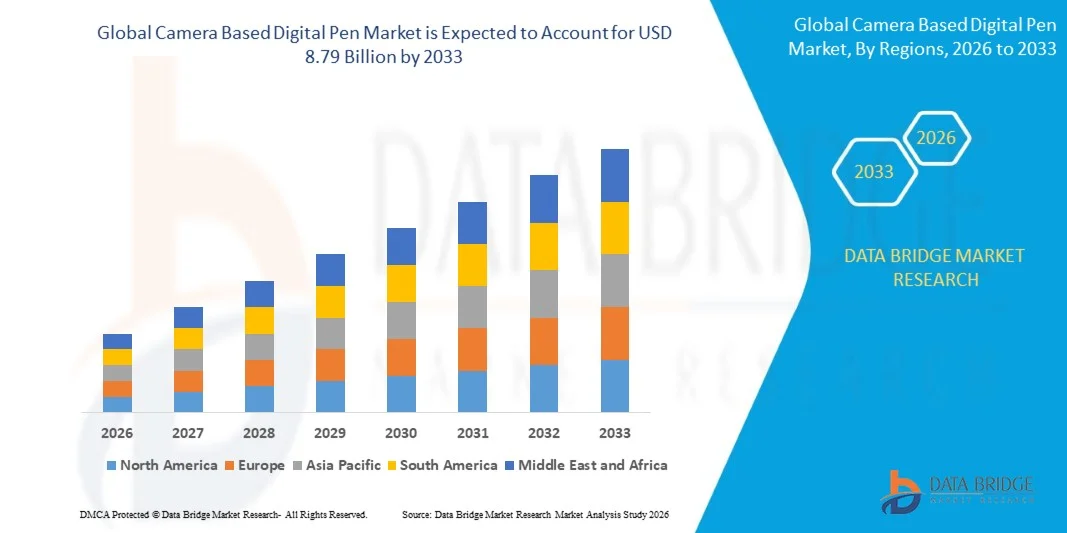
- As per market analysis, the Global Camera Based Digital Pen Market was valued at USD 3.10 billion in 2025 and is projected to reach USD 8.79 billion by 2033, growing at a CAGR of 10.96% from 2026 to 2033.
- The market is witnessing growth driven by increasing adoption of digital writing and note-taking solutions, rising demand for paper-to-digital conversion, growing use of smart learning technologies, and increasing integration of cameras and optical recognition technologies into digital pens. Camera based digital pens are used across education, corporate documentation, healthcare, field services, creative applications, and personal note-taking, supporting their adoption across consumer and commercial applications.
- Increasing adoption of digital classrooms, remote learning, electronic documentation, handwriting recognition, artificial intelligence, and cloud-based note management is creating further growth opportunities. The expansion of smart education infrastructure, rising demand for real-time handwriting digitization, increasing integration of optical character recognition technologies, and advancements in camera miniaturization, image processing, connectivity, and AI-based handwriting recognition are supporting market development across education, enterprise, healthcare, and other professional applications.
Market Size & Forecast
- Market Value (2025): USD 3.10 billion
- Expected Market Value (2033): USD 8.79 Million
- Forecast CAGR (2026–2033): 10.96%
- Leading Region in 2025: North America
- Fastest Growing Region: Asia-Pacific
What are the Major Takeaways of the Camera Based Digital Pen Market?
- North America dominated the Global Camera Based Digital Pen Market share with 43.23% in 2025, supported by increasing adoption of digital documentation solutions, growing use of connected writing technologies, and rising demand for paperless workflows across education, healthcare, BFSI, government, and enterprise applications. The strong presence of technology providers and high adoption of smartphones, tablets, and cloud-based applications are further supporting regional market development.
- Asia-Pacific is expected to witness strong growth in the Global Camera Based Digital Pen Market during the forecast period CAGR of 6.32% in 2026 to 2033, supported by increasing digitalization, expanding digital education, rising smartphone and tablet penetration, and growing adoption of electronic documentation solutions. Increasing investments in digital infrastructure and connected technologies across China, Japan, South Korea, and India are further supporting regional adoption.
- Handwriting represented a key product segment of the Global Camera Based Digital Pen Market share with 32.12% in 2025, supported by increasing demand for converting handwritten notes, signatures, forms, and drawings into digital formats. The growing adoption of digital note-taking and handwriting-recognition technologies across education, business, healthcare, and personal applications is supporting demand for handwriting-focused camera-based digital pens.
- Multiple Operating System represented a key compatibility segment of the Global Camera Based Digital Pen Market 54.12% in 2025, supported by increasing demand for flexible digital writing solutions that can connect with different smartphones, tablets, computers, and other connected devices. Compatibility across multiple operating systems enables users to transfer and synchronize captured handwritten information across different digital environments.
- Android represented a key platform segment of the Global Camera Based Digital Pen Market with share of 21.13% in 2025, supported by the widespread adoption of Android smartphones and tablets and the availability of mobile applications for digital note-taking, handwriting recognition, scanning, and data synchronization. The large Android device ecosystem is supporting the integration of camera-based digital pens with mobile productivity applications.
Report Scope Camera Based Digital Pen Market Segmentation
|
Attributes |
Camera Based Digital Pen Market Key Market Insights |
|
Segments Covered |
|
|
Countries Covered |
North America
Europe
Asia-Pacific
Middle East and Africa
South America
|
|
Key Market Players |
|
|
Market Opportunities |
|
|
Value Added Data Infosets |
In addition to the insights on market scenarios such as market value, growth rate, segmentation, geographical coverage, and major players, the market reports curated by the Data Bridge Market Research also include in-depth expert analysis, geographically represented company-wise production and capacity, network layouts of distributors and partners, detailed and updated price trend analysis and deficit analysis of supply chain and demand. |
What is the Key Trend in the Camera Based Digital Pen Market?
- Increasing integration of smart connectivity, real-time digitization, and AI-enabled handwriting management is emerging as a key trend in the Camera Based Digital Pen Market. Manufacturers are increasingly combining camera-based handwriting capture with Bluetooth connectivity, dedicated mobile applications, handwriting recognition, cloud synchronization, and digital note management. These developments enable users to convert handwritten notes and drawings into digital content while maintaining the conventional writing experience.
- The trend is particularly relevant to education, professional documentation, healthcare, and business applications where handwritten information needs to be captured, edited, stored, and shared digitally. The broader digital pen market is also witnessing increasing integration of AI-enabled features designed to improve productivity and workflow automation.
- For instance, on May 2025, NeoLAB officially launched the Neo smartpen R1, a lightweight multifunctional smart pen designed to combine analog writing with digital functionality. The company also introduced a renewed Neo Studio application to provide an improved user experience across smartphones and computers. The launch demonstrates the industry's movement toward smart pens that combine physical handwriting with connected digital workflows.
- The integration of camera-based handwriting capture with specialized paper and digital applications is also supporting this trend. Moleskine's Smart Writing Set, for example, combines a Smart Pen with Ncoded Smart Notebook technology and the Moleskine Notes application to transform handwritten words and drawings into digital documents. The system supports Bluetooth connectivity and digital synchronization, illustrating the shift toward integrated hardware-software ecosystems rather than standalone digital pens.
What are the Key Drivers of the Camera Based Digital Pen Market?
- Growing digitization of handwritten information across education, healthcare, and business workflows is emerging as a key driver in the market. Camera-based digital pens enable handwritten notes, forms, drawings, and other paper-based information to be captured and converted into digital data, supporting faster documentation, storage, sharing, and workflow automation. The growing adoption of digital pens across education, healthcare, retail, and professional applications is strengthening demand for technologies that bridge traditional paper-based writing with digital platforms.
- For instance, in February 2025, Nuwa launched a Crowdbuilding initiative for its AI-powered Nuwa Pen, inviting 6,000 early adopters to provide feedback for refining the product. The pen is designed to capture handwriting on ordinary paper and digitize it in real time, demonstrating the industry's movement toward intelligent digital writing solutions that combine traditional handwriting with digital data capture.
- Increasing integration of artificial intelligence and handwriting recognition technologies is supporting market growth by enabling digital pens to convert handwritten content into editable and searchable digital text. Modern digital writing systems increasingly provide features such as handwriting-to-text conversion, automatic synchronization, search, organization, and integration with digital applications. Moleskine's Smart Writing System, for instance, enables handwritten notes to be digitized, converted into editable text, synchronized, and searched across devices.
- Rising demand for paper-to-digital workflows in healthcare and other documentation-intensive sectors is further driving adoption. Digital pens can capture handwritten clinical information and other forms while reducing manual data-entry requirements. In 2026, industry analysis identified healthcare digitization and the need for efficient documentation and accurate data capture as important factors supporting digital pen adoption.
Which Factors are Challenging the Growth of the Camera Based Digital Pen Market?
- Increasing integration of AI-powered handwriting recognition and digital note-processing technologies is emerging as a key trend in the market. Camera-based digital pen manufacturers are increasingly incorporating handwriting recognition, real-time text conversion, searchable notes, cloud synchronization, and AI-assisted processing to improve the usability of handwritten information.
- However, these capabilities increase the technological complexity of products and require continuous software, application, and platform development. Compatibility with different operating systems and connected devices can also create adoption challenges, particularly for users seeking seamless integration across smartphones, tablets, computers, and cloud platforms.
- For instance, on February 16, 2026, NeoLAB officially launched the Neo smartpen M1+, a renewed full-specification model designed to connect analog writing with digital applications. The product supports offline storage, USB Type-C charging, Neo Studio 2, and Chrome browser-based use on computers, while retaining compatibility with D1-type pen refills. The continued development of such connected features demonstrates the need for manufacturers to continuously improve hardware and software integration to remain competitive.
- The challenge is expected to remain important as camera-based digital pens depend on specialized paper, optical recognition, connectivity, and companion applications. For example, Neo Smartpen requires Ncode-printed paper because its infrared camera reads microscopic codes to determine pen position, while recognition can be affected by poor print quality and strong direct sunlight or infrared light. These technical requirements can restrict usage flexibility compared with conventional pens and increase the overall dependence on compatible accessories and environmental conditions.
How is the Camera Based Digital Pen Market Segmented?
The market is segmented on the basis of Product, Compatibility, Platform, Application, and End User.
- By Product
On the basis of product, the global camera-based digital pen market is segmented into Handwriting and Scanning. The Handwriting segment is expected to dominate the market with a share of 32.12% in 2025, supported by increasing demand for capturing handwritten notes, signatures, forms, drawings, and other written information in digital formats. Camera-based handwriting pens combine conventional writing functionality with optical recognition technology, enabling handwritten content to be stored, transferred, and processed digitally across professional and consumer applications.
The Scanning segment is expected to witness significant demand during the forecast period with CAGR of 7.12% 2026 to 2033, supported by increasing adoption of paper-to-digital workflows, document digitization, and real-time information capture. Scanning functionality is particularly relevant across banking, healthcare, retail, and field-based applications where handwritten information needs to be captured and transferred into digital systems.
- By Compatibility
On the basis of compatibility, the global camera-based digital pen market is segmented into Multiple Operating System and Single Operating System. The Multiple Operating System segment is expected to dominate the market with a share of 54.12% in 2025, supported by growing demand for digital pens that can operate across different computing environments. Compatibility with multiple operating systems provides greater flexibility for organizations using smartphones, tablets, laptops, and desktop systems across different technology ecosystems.
The Single Operating System segment is expected to maintain demand during the forecast period with CAGR 6.12% of 2026 to 2033, particularly among users and organizations operating within standardized technology environments. These solutions can provide optimized integration with specific operating systems and associated applications.
- By Platform
On the basis of platform, the Global Camera Based Digital Pen Market is segmented into Android, iOS, and Windows. The Android segment is expected to account for significant market demand share of 21.13% in 2025, supported by the broad installed base of Android smartphones and tablets and their increasing use across education, business, healthcare, and field applications. The availability of devices across different price categories also supports the adoption of camera-based digital pen solutions.
The iOS segment is expected to witness of forecast period with CAGR of 6.12% in 2026 to 2033 substantial demand due to the strong integration of digital writing technologies with smartphones and tablets and the availability of productivity, education, and creative applications. The Windows segment is supported by adoption across enterprise and professional environments, particularly for documentation, communication, data capture, and office workflows.
- By Application
On the basis of application, the Global Camera Based Digital Pen Market is segmented into Billing & Back Office, Clinical Documentation, Communication, Education, Media & Entertainment, Retail, and Other Applications. The Clinical Documentation and Education applications are expected to account for significant demand with share of 32.13% in 2025, supported by the need to digitize handwritten information while retaining familiar pen-and-paper workflows. In healthcare, digital pens can support patient forms, clinical records, prescriptions, and other documentation processes, while educational institutions can use them for handwritten assignments, examinations, notes, and learning activities.
The Billing & Back Office segment is expected to witness forecast period with CAGR of 4.12% of 2026 to 2033, increasing adoption as businesses seek to digitize paper-based forms, signatures, invoices, and administrative records. The segment is supported by applications involving customer forms, inventory-related documentation, signatures, and transaction records. Meanwhile, Communication and Media & Entertainment applications benefit from digital handwriting, sketching, annotation, and content creation capabilities.
- By End User
On the basis of end user, the Global Camera Based Digital Pen Market is segmented into Banking, Financial Services, and Insurance (BFSI), Government, Healthcare, IT & Telecom, Manufacturing, and Other End Users. The Healthcare segment is expected to represent significant demand with market share of 23.14% in 2025, driven by the need to capture patient information, consent forms, prescriptions, and clinical documentation while reducing dependence on manual data-entry processes. Digital pen technologies have already been used in healthcare environments for collecting patient information and transferring handwritten records into electronic systems.
The BFSI segment is expected to witness strong adoption as financial institutions forecast period with CAGR of 5.12% in 2026 to 2033 increasingly digitize forms, signatures, customer onboarding documents, and other paper-intensive workflows. The Government segment is supported by digital transformation initiatives and the need to convert paper-based administrative processes into digital records.
Which Region Holds the Largest Share of the Camera Based Digital Pen Market?
- Asia Pacific accounted for a 43.23% of the global digital pen market in 2025, supported by increasing digitalization across China, Japan, South Korea, and India, growing adoption of smartphones and tablets, and expanding applications of digital pens across education, healthcare, and commercial sectors. The region also has a strong presence of digital-pen technology companies, including Wacom and NeoLAB Convergence, supporting product development and ecosystem expansion.
- Asia Pacific is expected to witness the fastest growth in the global digital pen market during the forecast period, at a CAGR of 6.32 from 2026 to 2033. Growth is supported by the expansion of e-learning, increasing smartphone and tablet penetration, rapid digitization of business processes, and rising adoption of digital handwriting and scanning technologies.
U.S. Camera Based Digital Pen Market Insight
The U.S. Camera Based Digital Pen Market is experiencing increasing adoption, driven by the growing digitization of handwritten information across education, healthcare, financial services, retail, and business environments. Demand is supported by the widespread use of smartphones, tablets, and cloud-based applications that enable users to capture, transfer, and manage handwritten content digitally. Camera-based digital pens are increasingly used for documentation, signatures, note-taking, forms, and workflow automation. Technological advancements in optical recognition, wireless connectivity, handwriting conversion, and software integration are further supporting product development and adoption across professional and consumer applications.
Europe Camera Based Digital Pen Market Insight
The Europe Camera Based Digital Pen Market is experiencing steady growth, driven by increasing digitization across education, healthcare, banking, retail, and corporate environments. Organizations are adopting camera-based digital pens to convert handwritten information into digital records while maintaining familiar paper-based workflows. Growing demand for paperless documentation, electronic record management, and connected workplace solutions is further supporting market expansion. Countries such as Germany, the U.K., France, Italy, and Spain represent important markets due to their established technology infrastructure and growing adoption of digital productivity tools. Integration with cloud platforms and handwriting-recognition software is also creating additional opportunities across the region.
U.K. Camera Based Digital Pen Market Insight
The U.K. Camera Based Digital Pen Market is experiencing steady adoption, supported by increasing digitization of education, healthcare, financial services, and business documentation. Organizations are increasingly using digital pen solutions to capture handwritten information and convert paper-based records into digital workflows while maintaining familiar writing practices. Demand is further supported by the growing use of smartphones, tablets, and cloud-based applications that enable synchronization and remote access to captured content. In healthcare and BFSI, camera-based digital pens can support documentation, form processing, signatures, and data collection, creating opportunities for market expansion.
Germany Camera Based Digital Pen Market Insight
Germany’s Camera Based Digital Pen Market is supported by the country’s strong digital transformation across healthcare, education, financial services, government, and industrial sectors. Increasing adoption of paper-to-digital workflows is encouraging organizations to use digital pens for capturing handwritten forms, signatures, notes, and operational records. Demand is further supported by Germany’s established enterprise IT infrastructure and emphasis on efficient documentation processes. Healthcare institutions are exploring digital documentation solutions, while educational and corporate users are adopting connected writing technologies for note-taking and collaboration. Growing integration with cloud platforms, mobile devices, and handwriting recognition technologies is expected to create additional opportunities for market participants.
Asia-Pacific Camera Based Digital Pen Market Insight
The Asia-Pacific Camera Based Digital Pen Market is witnessing steady growth, supported by increasing digital transformation across education, healthcare, banking, retail, and corporate sectors. Rising smartphone and tablet adoption in countries such as China, Japan, South Korea, and India is supporting demand for connected writing and scanning solutions. The region's expanding e-learning ecosystem and growing need to digitize handwritten information are further supporting market development. Technological advancements in optical recognition, handwriting conversion, wireless connectivity, and cloud synchronization are encouraging manufacturers to introduce multifunctional digital pens for consumer and enterprise applications.
Japan Camera Based Digital Pen Market Insight
Japan is a significant market for camera based digital pen, supported by its advanced semiconductor manufacturing ecosystem and the strong presence of Kioxia and Sandisk. The country is strengthening its NAND production capabilities through investments in advanced manufacturing infrastructure. In July 2026, Kioxia and Sandisk began production of 10th-generation 3D flash memory at the Kitakami Plant in Iwate Prefecture, targeting growing demand for high-capacity storage and AI applications. In August 2026, the companies also announced planned investments exceeding USD 31 billion in Japan through 2032 to expand flash-memory manufacturing infrastructure.
China Camera Based Digital Pen Market Insight
China’s camera-based digital pen market is supported by the country’s rapid digital transformation, expanding smart education ecosystem, and growing adoption of electronic documentation across enterprises and public institutions. Increasing use of smartphones, tablets, and connected computing devices is creating a favorable environment for digital writing and paper-to-digital solutions. Demand is also being supported by applications in education, healthcare, banking, retail, and government documentation, where handwritten information can be captured and transferred into digital systems. In addition, the presence of domestic technology manufacturers and a strong electronics manufacturing ecosystem is supporting product innovation, connectivity, and cost-effective digital pen solutions.
Which are the Top Companies in Camera Based Digital Pen Market?
The Camera Based Digital Pen Market industry is primarily led by well-established companies, including:
- Apple Inc. (U.S.)
- Canon Inc. (Japan)
- Hanvon Technology Co., Ltd. (China)
- Hewlett Packard Enterprise Development LP (U.S.)
- Moleskine S.p.A. (Italy)
- NeoLAB Convergence Inc. (South Korea)
- Toshiba Corporation (Japan)
- Wacom Co., Ltd. (Japan)
- Anoto Group AB (Sweden)
- STAEDTLER Mars GmbH & Co. KG (Germany)
- NEO SMARTPEN (South Korea)
- Luidia, Inc. (U.S.)
- Dynabook Inc. (Japan)
- IRIS S.A. (Belgium)
- XCALLIBRE (South Africa)
What are Latest Developments in Camera Based Digital Pen Market?
- In April 2025, Anoto Group AB introduced the inq smartpen portfolio, combining smartpens, notebooks, accessories, and software. The new inq platform uses AI-powered handwriting recognition to convert handwritten notes into searchable and shareable digital text and supports synchronization with smartphones, tablets, and laptops.
- In May 2025, NeoLAB launched the Neo smartpen R1, positioned as its lightest and multifunctional smartpen model. Alongside the product launch, NeoLAB introduced an updated Neo Studio 2 application and a PC browser version, enabling users to access, edit, and synchronize handwritten information across mobile and computer platforms.
- In September 2025, Wacom announced that its digital pen and ink technologies were adopted by Montblanc for its digital paper solution. The development demonstrates the expanding use of digital pen technologies in premium writing products and connected paper-based workflows.
- In November 2025, Wacom announced a collaboration with Thundercomm to develop a VR/MR content-creation platform using digital pen technology. The initiative focuses on combining pen input with immersive technologies to support digital content creation across emerging spatial-computing applications.
- In May 2026, Anoto launched the inq exam platform, targeting digital assessment and classroom learning. The platform enables handwritten examinations to be captured digitally, provides real-time visibility of pen strokes, supports secure cloud-based archiving, and offers optional AI-assisted grading.
- In June 2026, INQ Group, formerly Anoto Group, announced a strategic collaboration with C. Josef Lamy GmbH (LAMY) to jointly develop, market, and distribute co-branded digital ink smartpens and notebooks. The collaboration combines INQ's digital writing technology and software platform with LAMY's design and brand capabilities.

- Interactive Data Analysis Dashboard
- Company Analysis Dashboard for high growth potential opportunities
- Research Analyst Access for customization & queries
- Competitor Analysis with Interactive dashboard
- Latest News, Updates & Trend analysis
- Harness the Power of Benchmark Analysis for Comprehensive Competitor Tracking
Global Camera Based Digital Pen Market, Supply Chain Analysis and Ecosystem Framework
To support market growth and help clients navigate the impact of geopolitical shifts, DBMR has integrated in-depth supply chain analysis into its Global Camera Based Digital Pen Market research reports. This addition empowers clients to respond effectively to global changes affecting their industries. The supply chain analysis section includes detailed insights such as Global Camera Based Digital Pen Market consumption and production by country, price trend analysis, the impact of tariffs and geopolitical developments, and import and export trends by country and HSN code. It also highlights major suppliers with data on production capacity and company profiles, as well as key importers and exporters. In addition to research, DBMR offers specialized supply chain consulting services backed by over a decade of experience, providing solutions like supplier discovery, supplier risk assessment, price trend analysis, impact evaluation of inflation and trade route changes, and comprehensive market trend analysis.
Data collection and base year analysis are done using data collection modules with large sample sizes. The stage includes obtaining market information or related data through various sources and strategies. It includes examining and planning all the data acquired from the past in advance. It likewise envelops the examination of information inconsistencies seen across different information sources. The market data is analysed and estimated using market statistical and coherent models. Also, market share analysis and key trend analysis are the major success factors in the market report. To know more, please request an analyst call or drop down your inquiry.
The key research methodology used by DBMR research team is data triangulation which involves data mining, analysis of the impact of data variables on the market and primary (industry expert) validation. Data models include Vendor Positioning Grid, Market Time Line Analysis, Market Overview and Guide, Company Positioning Grid, Patent Analysis, Pricing Analysis, Company Market Share Analysis, Standards of Measurement, Global versus Regional and Vendor Share Analysis. To know more about the research methodology, drop in an inquiry to speak to our industry experts.
Data Bridge Market Research is a leader in advanced formative research. We take pride in servicing our existing and new customers with data and analysis that match and suits their goal. The report can be customized to include price trend analysis of target brands understanding the market for additional countries (ask for the list of countries), clinical trial results data, literature review, refurbished market and product base analysis. Market analysis of target competitors can be analyzed from technology-based analysis to market portfolio strategies. We can add as many competitors that you require data about in the format and data style you are looking for. Our team of analysts can also provide you data in crude raw excel files pivot tables (Fact book) or can assist you in creating presentations from the data sets available in the report.













