Candelilla Wax Market Overview
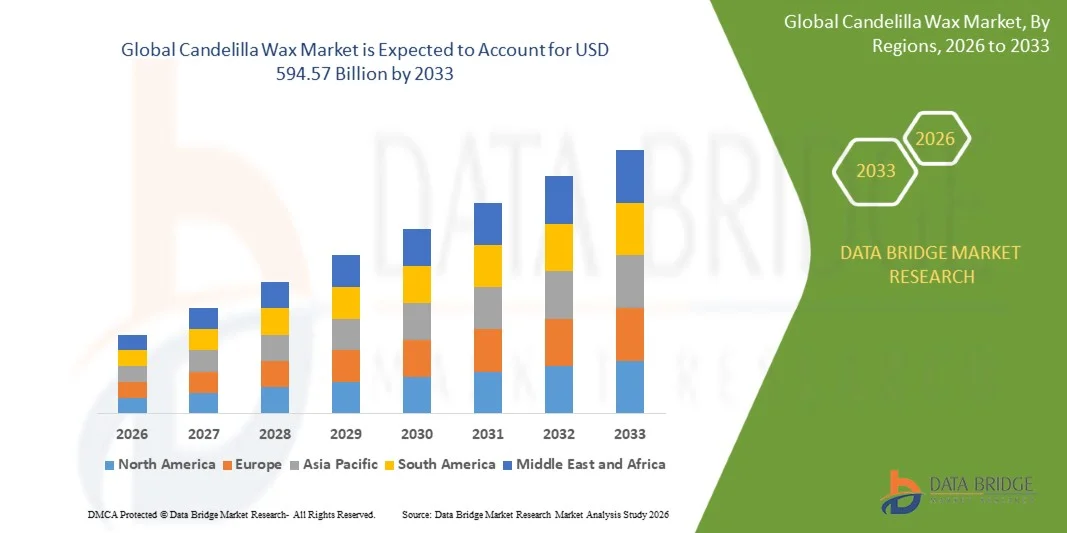
The Candelilla Wax Market was valued at USD 192.35 billion in 2025 and is projected to reach USD 594.57 billion by 2033, growing at a CAGR of 15.15% from 2026 to 2033. The market is witnessing strong growth driven by increasing demand for natural and plant-based ingredients across cosmetics, food, pharmaceutical, and personal care industries, along with rising consumer preference for sustainable and vegan product formulations worldwide.
The growing shift toward clean-label and eco-friendly products, combined with increasing restrictions on synthetic additives and animal-derived ingredients, is encouraging manufacturers to adopt candelilla wax as a natural thickening, glazing, binding, and stabilizing agent. Candelilla wax is increasingly being utilized in lip balms, lotions, confectionery coatings, chewing gum, and pharmaceutical tablet coatings because of its excellent emulsifying properties, glossy finish, and moisture resistance. In addition, expanding vegan cosmetics production, rising organic food consumption, and increasing awareness regarding biodegradable raw materials are further supporting market expansion across developed and emerging economies.
Key Market Trends & Insights
- North America dominated the candelilla wax market with the largest revenue share of 38.7% in 2025, supported by increasing demand for natural and plant-based ingredients across cosmetics, pharmaceuticals, and food industries.
- Asia-Pacific is expected to be the fastest-growing region, recording a CAGR of from 2026 to 2033. Growth is driven by expanding cosmetics manufacturing activities, rising disposable incomes, increasing consumer preference for natural ingredients, and growing adoption of plant-based products across China, Japan, India, and Southeast Asian countries.
- The Refined Lump segment held the largest market revenue share of approximately 41.8% in 2025 driven by its high purity, smooth texture, and extensive use across cosmetics, pharmaceuticals, and food processing applications. Refined lump candelilla wax is widely preferred because of its superior stability, enhanced gloss properties, and compatibility with premium personal care and clean-label food formulations.
- The Powder segment is projected to register the fastest growth at a CAGR of 16.4% from 2026 to 2033, driven by increasing demand for easy-to-blend and highly dispersible wax formulations in cosmetics, nutraceutical coatings, and industrial applications. Rising usage in vegan beauty products, powdered food additives, and pharmaceutical formulations is accelerating segment expansion globally.
- The Glazing Agent segment accounted for the largest market revenue share of nearly 38.6% in 2025 driven by increasing utilization of candelilla wax in confectionery products, fruits, chewing gum, and bakery coatings to improve surface shine, moisture resistance, and product shelf life. Growing demand for natural and edible coating ingredients across food processing industries is supporting strong segment growth.
- The Emulsifier segment is anticipated to witness the fastest growth at a CAGR of 17.1% from 2026 to 2033, supported by rising demand for plant-based stabilizing and emulsifying agents in vegan cosmetics, skincare formulations, and pharmaceutical products. Increasing adoption of natural emulsifiers in clean-label and organic formulations is further contributing to segment expansion.
- The Cosmetics and Personal Care segment held the largest market revenue share of approximately 44.3% in 2025 driven by rising consumer demand for vegan, cruelty-free, and plant-based beauty products worldwide. Candelilla wax is extensively utilized in lip balms, lipsticks, lotions, mascaras, and skincare formulations because of its excellent thickening, binding, and texture-enhancing properties.
- The Pharmaceuticals segment is projected to register the fastest growth at a CAGR of 16.8% from 2026 to 2033, driven by increasing use of candelilla wax in tablet coatings, controlled-release drug formulations, and pharmaceutical stabilizers. Rising demand for natural excipients and plant-derived coating agents in modern pharmaceutical manufacturing is accelerating segment growth across developed and emerging healthcare markets.
Market Size & Forecast
- Global Market Value (2025): USD 192.35 Billion
- Expected Market Value (2033): USD 594.57 Billion
- Forecast CAGR (2026–2033): 15.15%
- Leading Region in 2025: North America
- Fastest Growing Region: Asia-Pacific
Report Scope and Candelilla Wax Market Segmentation
|
Attributes |
Candelilla Wax Key Market Insights |
|
Segments Covered |
· By Form: Crude Lump, Powder, Flakes, Refined Lump, and Granules · By Application: Additive, Glazing Agent, Binder, and Emulsifier · By End-Use Industry: Pharmaceuticals, Cosmetics and Personal Care, Food, and Textile |
|
Countries Covered |
North America · U.S. · Canada · Mexico Europe · Germany · France · U.K. · Netherlands · Switzerland · Belgium · Russia · Italy · Spain · Turkey · Rest of Europe Asia-Pacific · China · Japan · India · South Korea · Singapore · Malaysia · Australia · Thailand · Indonesia · Philippines · Rest of Asia-Pacific Middle East and Africa · Saudi Arabia · U.A.E. · South Africa · Egypt · Israel · Rest of Middle East and Africa South America · Brazil · Argentina · Rest of South America |
|
Key Market Players |
• Koster Keunen (U.S.) |
|
Market Opportunities |
• Rising Demand For Vegan And Plant-Based Cosmetic Ingredients |
|
Value Added Data Infosets |
In addition to the insights on market scenarios such as market value, growth rate, segmentation, geographical coverage, and major players, the market reports curated by the Data Bridge Market Research also include in-depth expert analysis, pricing analysis, brand share analysis, consumer survey, demography analysis, supply chain analysis, value chain analysis, raw material/consumables overview, vendor selection criteria, PESTLE Analysis, Porter Analysis, and regulatory framework. |
Candelilla Wax Market Trends
Trend: Rising Adoption Of Natural And Vegan Ingredients In Personal Care And Food Applications
Increasing consumer preference for plant-based, biodegradable, and clean-label ingredients across cosmetics, pharmaceuticals, and food industries is accelerating demand for candelilla wax globally. Conventional synthetic waxes and animal-derived ingredients are facing growing scrutiny because of environmental concerns, regulatory restrictions, and changing consumer purchasing behavior, encouraging manufacturers to adopt natural wax alternatives with sustainable sourcing characteristics.
In the cosmetics industry, manufacturers are increasingly incorporating candelilla wax, For instance in lip balms, mascaras, lotions, and vegan skincare formulations, to improve texture stability, gloss retention, and product consistency while supporting cruelty-free product claims. In food applications, the wax is being utilized as a glazing and coating agent for confectionery products, chewing gum, and fruits because of its moisture resistance and edible plant-based composition.
The rapid expansion of vegan beauty products and organic food categories across North America and Europe is also increasing commercial demand for natural wax ingredients capable of replacing petroleum-based additives. In addition, pharmaceutical manufacturers continue to use candelilla wax in tablet coatings and controlled-release formulations because of its excellent binding and stabilizing properties. Industry data from 2025 indicated that global vegan cosmetic product launches increased by nearly 18–20%, significantly supporting consumption of plant-derived wax ingredients such as candelilla wax in premium formulations.
Candelilla Wax Market Dynamics
Key Market Driver: Growing Demand For Sustainable And Plant-Based Raw Materials
Industries worldwide are witnessing increasing pressure from consumers and regulatory authorities to reduce dependence on synthetic chemicals and animal-derived ingredients in food, cosmetics, and pharmaceutical products. Rising awareness regarding environmental sustainability, biodegradability, and ethical sourcing practices is creating strong demand for naturally derived waxes capable of delivering multifunctional performance across industrial applications.
Manufacturers in cosmetics, personal care, and food processing industries are increasingly adopting candelilla wax to improve product texture, stability, and shelf life while meeting clean-label and vegan certification requirements. Cosmetic companies are actively reformulating products, For instance lipsticks and moisturizers, using plant-based wax ingredients to align with growing consumer demand for sustainable beauty products.
Similarly, food manufacturers are utilizing candelilla wax as a glazing and coating agent to replace synthetic additives and improve product appearance and moisture protection. Real-world commercial product launches across the U.S. and Europe during 2024 integrating plant-based wax formulations demonstrated increasing consumer preference for vegan-certified personal care and confectionery products, contributing to annual demand growth of nearly 12–15% for natural wax ingredients.
Key Restraint/Challenge: Limited Raw Material Availability And Price Volatility
The candelilla wax industry remains highly dependent on the cultivation and harvesting of the candelilla shrub primarily found in northern Mexico and parts of the southwestern U.S., creating supply concentration risks and raw material availability concerns. Climatic variations, drought conditions, and fluctuations in agricultural output can directly impact wax production volumes and global supply stability.
In addition, labor-intensive extraction and refining processes increase overall production costs, limiting affordability for small-scale manufacturers and cost-sensitive applications. Price fluctuations associated with limited raw material supply and export dependency further create procurement challenges for cosmetics and food processing companies operating under strict cost management requirements.
Commercial industry assessments indicate that natural wax prices, including candelilla wax, experienced fluctuations of around 10–14% during supply-constrained periods in 2024, driven by lower shrub harvesting yields and increasing global demand from premium cosmetic and food manufacturers. Limited scalability compared to synthetic wax alternatives continues to restrict widespread adoption across high-volume industrial applications.
Key Market Opportunity: Expanding Applications In Vegan Cosmetics And Clean-Label Food Products
Modern consumers are increasingly prioritizing vegan, organic, and naturally sourced products across beauty, food, and wellness categories, creating significant opportunities for candelilla wax manufacturers worldwide. Conventional synthetic stabilizers and petroleum-derived waxes are gradually being replaced by plant-based alternatives capable of delivering similar performance characteristics while supporting sustainable branding and regulatory compliance.
Cosmetic companies are increasingly integrating candelilla wax, For instance in vegan lipsticks, sunscreens, and skincare formulations, to improve texture, emulsification, and product durability without using animal-derived ingredients such as beeswax. In food applications, rising demand for clean-label confectionery coatings, fruit glazing, and edible protective films is accelerating adoption of candelilla wax as a natural additive with moisture-resistant properties.
In addition, advancements in refining technologies and sustainable sourcing initiatives are improving wax purity and application versatility, opening opportunities across pharmaceutical coatings, nutraceutical products, and biodegradable packaging materials. Product development programs conducted during 2025 across North America and Europe reported that plant-based formulations using natural wax ingredients achieved consumer preference ratings nearly 15–18% higher than comparable synthetic-based products in premium personal care categories.
Candelilla Wax Market Scope
The market is segmented on the basis of form, application, and end-use industry.
- By Form
On the basis of form, the Candelilla Wax Market is segmented into Crude Lump, Powder, Flakes, Refined Lump, and Granules. The Refined Lump segment held the largest market revenue share of approximately 41.8% in 2025 driven by its high purity, smooth texture, and extensive use across cosmetics, pharmaceuticals, and food processing applications. Refined lump candelilla wax is widely preferred because of its superior stability, enhanced gloss properties, and compatibility with premium personal care and clean-label food formulations.
The Powder segment is projected to register the fastest growth at a CAGR of 16.4% from 2026 to 2033, driven by increasing demand for easy-to-blend and highly dispersible wax formulations in cosmetics, nutraceutical coatings, and industrial applications. Rising usage in vegan beauty products, powdered food additives, and pharmaceutical formulations is accelerating segment expansion globally.
- By Application
On the basis of application, the Candelilla Wax Market is segmented into Additive, Glazing Agent, Binder, and Emulsifier. The Glazing Agent segment accounted for the largest market revenue share of nearly 38.6% in 2025 driven by increasing utilization of candelilla wax in confectionery products, fruits, chewing gum, and bakery coatings to improve surface shine, moisture resistance, and product shelf life. Growing demand for natural and edible coating ingredients across food processing industries is supporting strong segment growth.
The Emulsifier segment is anticipated to witness the fastest growth at a CAGR of 17.1% from 2026 to 2033, supported by rising demand for plant-based stabilizing and emulsifying agents in vegan cosmetics, skincare formulations, and pharmaceutical products. Increasing adoption of natural emulsifiers in clean-label and organic formulations is further contributing to segment expansion.
- By End-Use Industry
On the basis of end-use industry, the Candelilla Wax Market is segmented into Pharmaceuticals, Cosmetics and Personal Care, Food, and Textile. The Cosmetics and Personal Care segment held the largest market revenue share of approximately 44.3% in 2025 driven by rising consumer demand for vegan, cruelty-free, and plant-based beauty products worldwide. Candelilla wax is extensively utilized in lip balms, lipsticks, lotions, mascaras, and skincare formulations because of its excellent thickening, binding, and texture-enhancing properties.
The Pharmaceuticals segment is projected to register the fastest growth at a CAGR of 16.8% from 2026 to 2033, driven by increasing use of candelilla wax in tablet coatings, controlled-release drug formulations, and pharmaceutical stabilizers. Rising demand for natural excipients and plant-derived coating agents in modern pharmaceutical manufacturing is accelerating segment growth across developed and emerging healthcare markets.
Candelilla Wax Market Regional Analysis
North America Candelilla Wax Market Insight
North America dominated the candelilla wax market with the largest revenue share of 38.7% in 2025, supported by increasing demand for natural and plant-based ingredients across cosmetics, pharmaceuticals, and food industries. Consumers in the region highly prefer clean-label, vegan, and environmentally sustainable products, encouraging manufacturers to incorporate candelilla wax into personal care formulations, confectionery coatings, and pharmaceutical applications. The growing popularity of organic cosmetics, rising awareness regarding biodegradable ingredients, and strong demand for cruelty-free beauty products are further supporting widespread market adoption across the region.
U.S. Candelilla Wax Market Insight
The U.S. candelilla wax market captured the largest revenue share in 2025 within North America, fueled by the rapid expansion of vegan cosmetics, clean-label food products, and natural pharmaceutical formulations. Manufacturers are increasingly utilizing candelilla wax in lip balms, lotions, chewing gum, and tablet coatings to improve texture, gloss, and product stability while meeting consumer demand for sustainable ingredients. The growing presence of premium beauty brands and increasing investments in plant-based personal care product development are further propelling market growth. Moreover, rising demand for organic food coatings and biodegradable packaging applications is contributing significantly to industry expansion.
Europe Candelilla Wax Market Insight
The Europe candelilla wax market is expected to witness the fastest growth rate from 2026 to 2033, primarily driven by stringent regulations regarding synthetic additives and rising consumer preference for sustainable and vegan product formulations. The increasing demand for clean-label cosmetics, pharmaceutical excipients, and natural food additives is fostering the adoption of candelilla wax across multiple industries. European consumers are increasingly prioritizing eco-friendly and cruelty-free products, encouraging manufacturers to shift toward plant-derived wax ingredients. The region is also witnessing strong growth in premium skincare, nutraceutical, and organic confectionery applications utilizing natural wax formulations.
U.K. Candelilla Wax Market Insight
The U.K. candelilla wax market is expected to witness the fastest growth rate from 2026 to 2033, driven by increasing adoption of vegan cosmetics and rising demand for natural food ingredients. Consumers across the U.K. are increasingly prioritizing sustainable beauty products and clean-label food formulations, encouraging manufacturers to replace synthetic additives with plant-based alternatives such as candelilla wax. In addition, the growing popularity of cruelty-free skincare brands and organic confectionery products is supporting market expansion. The country’s well-established retail and e-commerce infrastructure is also accelerating accessibility of vegan and plant-based consumer products.
Germany Candelilla Wax Market Insight
The Germany candelilla wax market is expected to witness the fastest growth rate from 2026 to 2033, fueled by increasing focus on sustainable manufacturing practices and demand for environmentally friendly raw materials across cosmetics and pharmaceutical industries. Germany’s strong emphasis on clean-label formulations and green chemistry is promoting adoption of plant-derived wax ingredients in premium skincare products, nutraceutical coatings, and pharmaceutical applications. The integration of natural wax ingredients into organic cosmetics and biodegradable product formulations is becoming increasingly prevalent, supported by strong consumer awareness regarding environmental sustainability and product safety.
Asia-Pacific Candelilla Wax Market Insight
The Asia-Pacific candelilla wax market is expected to witness the fastest growth rate from 2026 to 2033, supported by rising disposable incomes, rapid urbanization, and increasing consumer awareness regarding natural and vegan products across China, Japan, India, and Southeast Asian countries. The region’s expanding cosmetics manufacturing sector and growing demand for clean-label food products are driving adoption of candelilla wax in multiple industrial applications. Furthermore, increasing investments in organic personal care products and plant-based food processing ingredients are supporting market accessibility and commercial expansion across emerging economies.
Japan Candelilla Wax Market Insight
The Japan candelilla wax market is expected to witness the fastest growth rate from 2026 to 2033 due to the country’s strong demand for premium cosmetics, technologically advanced skincare products, and high-quality food ingredients. Japanese consumers place significant emphasis on product purity, texture quality, and environmentally sustainable formulations, encouraging manufacturers to adopt natural wax ingredients in cosmetics and nutraceutical applications. The growing use of candelilla wax in lip care products, pharmaceutical coatings, and specialty food applications is fueling market growth. Moreover, Japan’s increasing aging population is driving demand for safe, plant-based ingredients in healthcare and wellness products.
China Candelilla Wax Market Insight
The China candelilla wax market accounted for the largest market revenue share in Asia-Pacific in 2025, attributed to rapid expansion of the cosmetics industry, rising middle-class consumer spending, and growing adoption of natural personal care products. China remains one of the largest global markets for beauty and skincare products, generating strong demand for plant-based wax ingredients across cosmetics, food processing, and pharmaceutical applications. The increasing popularity of vegan beauty products, clean-label confectionery items, and organic wellness products is significantly supporting market growth. In addition, expanding domestic manufacturing capabilities and rising investments in sustainable product development are further propelling the candelilla wax market in China.
Candelilla Wax Market Share
The Candelilla Wax industry is primarily led by well-established companies, including:
• Koster Keunen (U.S.)
• NOREVO (Germany)
• Strahl & Pitsch, Inc. (U.S.)
• Carmel Industries (Canada)
• KahlWax (Germany)
• Multiceras (Mexico)
• Poth Hille (Germany)
• CALWAX (U.S.)
• Arjun Beeswax (India)
• Roger A. Reed, Inc. (U.S.)
• Spectrum Chemical Manufacturing Corp. (U.S.)
• Paramold Manufacturing LLC (U.S.)
• The International Group, Inc. (Canada)
• Hase Petroleum Wax Co. (U.S.)
• Parchem fine & specialty chemicals (U.S.)
• Shri Ram Sons Wax Private Limited (India)
• Merck KGaA (Germany)
• Waxoils (U.K.)
• AADRA INTERNATIONAL (India)
Latest Developments in Candelilla Wax Market
- In October 2023, Multiceras, product launch, introduced its new eLife Candelilla Wax certified as 100% organic by Ecocert Greenlife under the COSMOS standard for natural and organic cosmetics. The development was aimed at strengthening the company’s sustainable product portfolio and supporting increasing demand for certified plant-based ingredients across cosmetics and personal care industries. The product enables manufacturers to develop authentic organic formulations while complying with international sustainability and clean-label standards. This launch is expected to accelerate adoption of eco-friendly wax ingredients and reinforce market growth for natural and vegan cosmetic formulations globally.

- Interactive Data Analysis Dashboard
- Company Analysis Dashboard for high growth potential opportunities
- Research Analyst Access for customization & queries
- Competitor Analysis with Interactive dashboard
- Latest News, Updates & Trend analysis
- Harness the Power of Benchmark Analysis for Comprehensive Competitor Tracking
Global Candelilla Wax Market, Supply Chain Analysis and Ecosystem Framework
To support market growth and help clients navigate the impact of geopolitical shifts, DBMR has integrated in-depth supply chain analysis into its Global Candelilla Wax Market research reports. This addition empowers clients to respond effectively to global changes affecting their industries. The supply chain analysis section includes detailed insights such as Global Candelilla Wax Market consumption and production by country, price trend analysis, the impact of tariffs and geopolitical developments, and import and export trends by country and HSN code. It also highlights major suppliers with data on production capacity and company profiles, as well as key importers and exporters. In addition to research, DBMR offers specialized supply chain consulting services backed by over a decade of experience, providing solutions like supplier discovery, supplier risk assessment, price trend analysis, impact evaluation of inflation and trade route changes, and comprehensive market trend analysis.
Data collection and base year analysis are done using data collection modules with large sample sizes. The stage includes obtaining market information or related data through various sources and strategies. It includes examining and planning all the data acquired from the past in advance. It likewise envelops the examination of information inconsistencies seen across different information sources. The market data is analysed and estimated using market statistical and coherent models. Also, market share analysis and key trend analysis are the major success factors in the market report. To know more, please request an analyst call or drop down your inquiry.
The key research methodology used by DBMR research team is data triangulation which involves data mining, analysis of the impact of data variables on the market and primary (industry expert) validation. Data models include Vendor Positioning Grid, Market Time Line Analysis, Market Overview and Guide, Company Positioning Grid, Patent Analysis, Pricing Analysis, Company Market Share Analysis, Standards of Measurement, Global versus Regional and Vendor Share Analysis. To know more about the research methodology, drop in an inquiry to speak to our industry experts.
Data Bridge Market Research is a leader in advanced formative research. We take pride in servicing our existing and new customers with data and analysis that match and suits their goal. The report can be customized to include price trend analysis of target brands understanding the market for additional countries (ask for the list of countries), clinical trial results data, literature review, refurbished market and product base analysis. Market analysis of target competitors can be analyzed from technology-based analysis to market portfolio strategies. We can add as many competitors that you require data about in the format and data style you are looking for. Our team of analysts can also provide you data in crude raw excel files pivot tables (Fact book) or can assist you in creating presentations from the data sets available in the report.