


What is the Canister Vacuum Cleaner Market Size and Growth Rate?
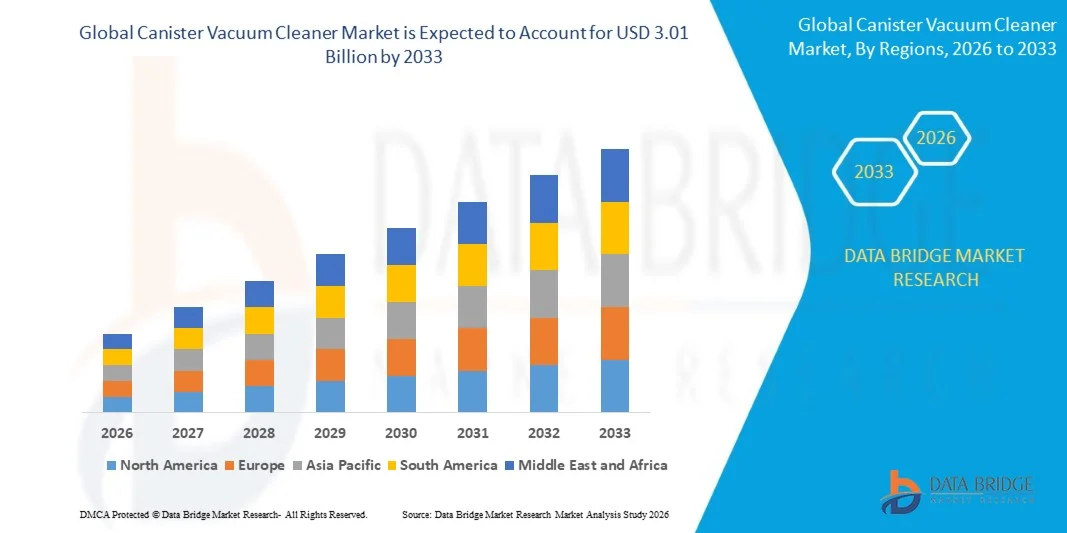
- As per Data Bridge Market Research analysis, the canister vacuum cleaner market was valued at USD 1.50 billion in 2025 and is projected to reach USD 3.01 billion by 2033, growing at a CAGR of 9.10% from 2026 to 2033.
- The market is experiencing consistent growth driven by growing awareness regarding hygiene and cleanliness, rising health consciousness, increasing disposable income, urbanization, and busier lifestyles. Canister vacuum cleaners are gaining demand in residential and commercial applications because of their powerful suction, flexible design, and ability to clean carpets, upholstery, furniture, stairs, and other difficult-to-reach areas.
- The increasing focus on indoor air quality and allergen control, combined with technological advancements in filtration and cleaning performance, is supporting the adoption of canister vacuum cleaners. Innovations such as bagless operation, multi-layer filtration, HEPA filtration, improved suction, and specialized cleaning attachments are further enhancing product functionality and creating opportunities for market expansion.
Market Size & Forecast
- Global Market Value (2025): USD 1.50 Billion
- Expected Market Value (2033): USD 3.01 Billion
- Forecast CAGR (2026–2033): 9.10%
- Leading Region in 2025: North America
- Fastest Growing Region: Asia Pacific
What are the Major Takeaways of the Canister Vacuum Cleaner Market?
- North America dominated the canister vacuum cleaners market with 31.9% of the market share in 2025, supported by strong demand for premium household appliances, established retail infrastructure, high e-commerce penetration, and consumer preference for advanced cleaning technologies
- Asia-Pacific is expected to be the fastest-growing region at a CAGR of 10.8% from 2026 to 2033, fueled by rapid urbanization, rising disposable incomes, increasing awareness of hygiene and cleanliness, and growing adoption of advanced vacuum-cleaning technologies.
- The wet-dry canister vacuum segment led the market with a 55% share in 2025, driven by its ability to collect both dry debris and liquid spills.
- Bagless canister vacuum are the fastest-growing type, projected to register a CAGR of 10%, reflecting the surge in consumer preference for convenient dust disposal and reduced dependence on replacement bags.
- The electric segment dominated the mode of operation category with a 75% revenue share in 2025, led by widespread electricity availability, established technology, and extensive use across residential, commercial, and industrial cleaning applications.
- Portable accounted for 60% of the market share in 2025, preferred by its flexibility, maneuverability, and ability to operate across multiple cleaning locations.
- The cordless canister vacuum segment is the fastest-growing power source category, with a CAGR of 9%, driven by advances in lithium-ion batteries, longer operating times, and growing demand for portability.
Report Scope and Canister Vacuum Cleaner Market Segmentation
|
Attributes |
Canister Vacuum Cleaner Key Market Insights |
|
Segments Covered |
|
|
Countries Covered |
North America
Europe
Asia-Pacific
Middle East and Africa
South America
|
|
Key Market Players |
|
|
Market Opportunities |
|
|
Value Added Data Infosets |
In addition to the insights on market scenarios such as market value, growth rate, segmentation, geographical coverage, and major players, the market reports curated by the Data Bridge Market Research also include in-depth expert analysis, geographically represented company-wise production and capacity, network layouts of distributors and partners, detailed and updated price trend analysis and deficit analysis of supply chain and demand. |
What is the Key Trend in the Canister Vacuum Cleaner Market?
- Canister vacuum cleaners are increasingly incorporating advanced filtration and improved cleaning performance, as consumers place greater emphasis on indoor cleanliness, allergen control, and efficient removal of dust and microscopic particles from carpets, hardwood floors, upholstery, stairs, and hard-to-reach areas.
- For instance, in March 2024, Electrolux Group developed a vacuum cleaner using up to 44% recycled material, with paint-free surfaces and recycled plastic formulations, demonstrating the growing focus on sustainable materials and environmentally conscious product design in the vacuum-cleaner industry.
- HEPA filtration is becoming an important product-development trend, with manufacturers incorporating multi-stage filtration systems to improve dust and allergen capture while addressing growing consumer concerns about indoor air quality.
- The demand for versatile and maneuverable cleaning equipment is supporting canister vacuum adoption, particularly because these products provide powerful suction and can be used across multiple household surfaces and difficult-to-access areas.
- Manufacturers are also focusing on improved filtration efficiency and reduced particulate emissions, creating opportunities for products that combine strong cleaning performance with better air filtration and containment.
- For instance, in April 2026, Electrolux introduced the Ultimate800 Bagged Canister Vacuum, combining a three-step HEPA filtration system, automatic suction adjustment, LED cleaning technology, and multiple cleaning modes, reflecting the trend toward smarter, higher-performance, and more hygienic canister vacuum cleaners.
- As manufacturers continue improving filtration, suction, maneuverability, and multi-surface cleaning capabilities, advanced canister vacuum cleaners are expected to remain relevant for consumers seeking efficient and comprehensive household cleaning solutions.
What are the Key Drivers of the Canister Vacuum Cleaner Market?
- The growing awareness of hygiene and cleanliness is increasing demand for efficient vacuum-cleaning appliances, particularly as consumers seek convenient solutions for removing dust, allergens, pet hair, and debris from different household surfaces.
- For instance, in August 2025, Miele introduced the Guard L1 Electro canister vacuum with smart functionality, including an LCD touchscreen, cleaning-mode controls, maintenance alerts, and Wi-Fi connectivity, demonstrating how consumer demand for convenience and connected household appliances is driving innovation in canister vacuum cleaners.
- Changing lifestyles, urbanization, rising disposable incomes, and increasing health consciousness are supporting household spending on cleaning appliances, while demand for convenient and high-performance cleaning equipment continues to expand across residential applications.
- Canister vacuum cleaners benefit from powerful suction, better flow rate, versatility, and maneuverability, allowing users to clean carpets, hardwood floors, upholstery, stairs, underneath furniture, and other difficult-to-reach areas efficiently.
- Growing concerns regarding indoor air quality and allergens are further encouraging demand for advanced filtration systems, particularly products incorporating HEPA and multi-stage filtration technologies capable of capturing fine particles.
- For instance, in March 2025, Miele launched its new Guard generation of bagged canister vacuum cleaners, featuring improved hygiene, enhanced convenience, advanced technology, and more than 99.99% overall filtration performance, demonstrating continued product innovation in the canister vacuum cleaner market.
- With consumers increasingly prioritizing effective cleaning, indoor hygiene, filtration performance, and convenient operation, manufacturers are expected to continue developing technologically advanced canister vacuum cleaners with improved suction and filtration capabilities.
Which Factors are Challenging the Growth of the Canister Vacuum Cleaner Market?
- The increasing availability of alternative vacuum-cleaning technologies, including robotic and cordless stick vacuum cleaners, creates competitive pressure on traditional canister vacuum cleaners, particularly among consumers prioritizing convenience and automated cleaning.
- For instance, in January 2024, Godfreys entered voluntary administration after lower customer demand amid cost-of-living pressures, higher operating costs, and increased competition reduced profitability, demonstrating the pressure that changing consumer spending and competitive intensity can place on conventional vacuum-cleaner businesses
- Robotic vacuum cleaners are gaining adoption because they offer automated cleaning, scheduled operation, smartphone control, and integration with smart-home technologies, providing convenience that canister models generally do not offer.
- The growing preference for lightweight and cordless cleaning equipment may also constrain demand for conventional canister models, as consumers increasingly seek portable products that require less manual movement during household cleaning activities.
- Filtration and dust-containment performance also remain important product challenges, because vacuuming can contribute to particulate and allergen emissions when filtration or containment systems are inadequate.
- For instance, in March 2024, Godfreys announced the progressive closure of its stores after administrators failed to secure a viable buyer, with the administrators citing lower customer demand, higher operating costs, and increased competition as factors affecting the business.
- As consumers increasingly compare canister cleaners with automated, cordless, and smart alternatives, manufacturers face the continuing challenge of improving portability, filtration, convenience, and cleaning performance while maintaining the strong suction and versatility associated with canister designs.
How is the Canister Vacuum Cleaner Market Segmented?
The canister vacuum cleaner market is segmented on the basis of type, mode of operation, system type, power source, application, and end-use.
- By Type
On the basis of type, the canister vacuum cleaner market is segmented into wet-dry canister vacuum, traditional canister vacuum, bagless canister vacuum, and dry canister vacuum. The wet-dry canister vacuum segment dominated the market with an estimated share of 55% in 2025, owing to its ability to collect both dry debris and liquid spills. These systems provide greater versatility than conventional dry-only vacuum cleaners and can perform multiple cleaning tasks using a single machine. Their all-in-one cleaning capability is particularly valuable across commercial and industrial environments. Wet-dry models are also available with high-powered motors, large collection capacities, and specialized accessories for demanding applications. The ability to handle different forms of waste efficiently continues to support the segment's leading position.
The bagless canister vacuum segment is projected to be the fastest-growing segment, with an estimated CAGR of 10% from 2026 to 2033, supported by consumer preference for convenient dust disposal and reduced dependence on replacement bags. Bagless systems use reusable dust containers that can be emptied after cleaning, reducing recurring expenditure on disposable bags. Advances in cyclonic separation and filtration technologies are improving dust collection and cleaning performance. Consumers are increasingly attracted to products that offer convenient maintenance and visible dirt collection. Manufacturers are also incorporating improved filtration and dust-containment technologies into bagless designs. These developments are expected to support continued expansion of the bagless canister vacuum segment.
- By Mode of Operation
On the basis of mode of operation, the market is segmented into electric and pneumatic. The electric segment dominated the market with an estimated share of 75% in 2025, supported by widespread electricity availability, established technology, and extensive use across residential, commercial, and industrial cleaning applications. Electric systems provide consistent suction and are suitable for routine and prolonged cleaning activities. Their broad availability and familiarity among consumers further strengthen adoption. Electric vacuum cleaners are offered across different motor capacities and configurations, allowing users to select equipment according to cleaning requirements. Their established infrastructure and relatively straightforward operation continue to support market dominance.
The pneumatic segment is projected to be the fastest-growing segment, with an estimated CAGR of 7% during the forecast period, driven by increasing demand for specialized cleaning systems in hazardous industrial environments. Pneumatic vacuum cleaners operate using compressed air and can be advantageous where electrical equipment may create safety concerns. They are particularly suitable for environments containing combustible dust, flammable materials, or potentially explosive atmospheres. Their ability to operate without an electric motor can provide additional safety and continuous-operation advantages. Increasing workplace-safety requirements are encouraging industrial facilities to adopt specialized pneumatic systems. Growing industrial demand for safe cleaning equipment is therefore expected to support segment expansion.
- By System Type
On the basis of system type, the market is segmented into portable and stationary. The portable segment dominated the market with an estimated share of 60% in 2025, primarily because of its flexibility, maneuverability, and ability to operate across multiple cleaning locations. Portable systems can be moved between rooms, commercial areas, workshops, and production facilities without permanent installation. Their mobility makes them particularly suitable for cleaning stairs, corners, machinery, furniture, and other difficult-to-reach locations. Portable vacuum cleaners can also accommodate different hoses, nozzles, brushes, and specialized attachments. Their relatively simple deployment and broad application range continue to support their leading position.
The stationary segment is projected to be the fastest-growing system type at a CAGR of 7% during forecast period, driven by increasing demand for centralized and high-capacity vacuum systems in commercial and industrial environments. Stationary systems are suitable for applications requiring continuous and intensive cleaning operations. They can provide efficient collection of dust, debris, and other materials without requiring frequent movement of the main vacuum unit. Their suitability for manufacturing facilities, workshops, processing plants, and other demanding environments supports increasing adoption. Growing emphasis on workplace cleanliness, dust control, and operational efficiency is further supporting demand. The increasing need for reliable, high-capacity cleaning systems is expected to accelerate growth of the stationary segment.
- By Power Source
On the basis of power source, the market is segmented into corded canister vacuum and cordless canister vacuum. The corded canister vacuum segment dominated the market with an estimated share of 60% in 2025, owing to continuous power availability, consistent suction performance, and suitability for extended cleaning operations. Corded systems do not require battery charging, allowing users to operate them for prolonged periods. They remain widely used in households, commercial establishments, and professional cleaning applications. Their established technology and reliable operating performance support widespread consumer acceptance. The availability of electrical infrastructure in most application environments further strengthens demand for corded systems.
The cordless canister vacuum segment is projected to be the fastest-growing power-source category, with an estimated CAGR of 9% from 2026 to 2033, driven by advances in lithium-ion batteries, longer operating times, and growing demand for portability. Cordless designs eliminate restrictions associated with electrical cables and provide greater freedom of movement. Improvements in battery energy density and motor efficiency are helping manufacturers improve runtime and suction performance. Consumers are increasingly seeking convenient, lightweight, and easy-to-use cleaning equipment. The declining limitations associated with battery-powered systems are encouraging broader adoption. The shift toward flexible cleaning solutions is therefore expected to accelerate cordless canister vacuum growth.
- By Application
On the basis of application, the market is segmented into medium duty, heavy duty, and explosion proof. The medium-duty segment dominated the market with an estimated share of 45% in 2025, owing to its broad suitability for routine cleaning across commercial facilities, workshops, offices, retail establishments, and institutional environments. Medium-duty systems provide a balance between suction power, collection capacity, maneuverability, and operating cost. They can manage regular dust and debris without requiring the specialized construction of heavy-duty or explosion-proof equipment. Their broad application base creates demand across numerous industries and commercial settings. Their combination of adequate performance, versatility, and relatively accessible operating costs supports their leading position.
The explosion-proof segment is projected to witness the fastest growth, with an estimated CAGR of 8% through the forecast period, driven by increasing requirements for specialized cleaning equipment in hazardous environments. Explosion-proof systems are designed for applications involving combustible dust, flammable substances, and potentially explosive atmospheres. They are particularly relevant to chemical processing, pharmaceuticals, food processing, metalworking, and other industrial operations. Increasing workplace-safety requirements and regulatory compliance are encouraging industrial facilities to invest in specialized vacuum systems. Pneumatic and certified explosion-proof equipment can provide safer cleaning in demanding environments. Growing industrial activity and stricter safety practices are therefore expected to support strong segment growth.
- By End-Use
On the basis of end-use, the market is segmented into industrial and commercial. The commercial segment dominated the market with a 44.7% share in 2025, supported by extensive use of canister vacuum cleaners in hotels, restaurants, corporate offices, retail shops, hospitals, and other commercial establishments. Commercial operators require efficient cleaning equipment that can cover large areas quickly. Canister designs provide maneuverability, powerful suction, long hoses, wide nozzles, and access to difficult-to-clean areas. These characteristics make them suitable for maintaining hygiene across large commercial facilities. Continued emphasis on cleanliness, productivity, and operational efficiency is expected to maintain the commercial segment's leading position.
The industrial segment is projected to be the fastest-growing end-use segment, with an estimated CAGR of 7% through the forecast period, driven by increasing demand for specialized cleaning equipment across manufacturing and processing facilities. Industrial operations generate dust, metal particles, liquids, production debris, and other materials that require efficient collection. Canister systems can be configured with specialized filtration, collection, and safety features for different industrial requirements. Demand is particularly relevant to automotive, pharmaceutical, construction, metalworking, food and beverage, and other manufacturing environments. Increasing attention to workplace hygiene, worker safety, and production-area cleanliness is supporting investment in industrial vacuum equipment.
Which Region Holds the Largest Share of the Canister Vacuum Cleaner Market?
- North America dominated the canister vacuum cleaners market with 31.9% of the market share in 2025, supported by strong demand for premium household appliances, established retail infrastructure, high e-commerce penetration, and consumer preference for advanced cleaning technologies
- The region also benefits from high e-commerce penetration, established vacuum-cleaner manufacturers, and growing consumer preference for cordless and technologically advanced cleaning products. The U.S. market is supported by increasing awareness of indoor air quality and cleanliness, while smart-home features such as IoT connectivity, voice control, remote control, and app-based functionality are strengthening demand for advanced vacuum cleaners. North America's established consumer-appliance infrastructure and strong purchasing power are expected to continue supporting its leading position.
U.S. Canister Vacuum Cleaner Market Insight
The U.S. canister vacuum cleaner market is witnessing strong growth due to high consumer spending on household appliances, increasing awareness of indoor air quality, and demand for powerful and durable cleaning products. The country has a mature household-appliance market with established manufacturers, extensive retail networks, and strong consumer access to advanced vacuum-cleaning technologies. Consumers are increasingly seeking products offering powerful suction, improved filtration, convenience, and reliable cleaning performance. Growing adoption of premium and technologically advanced vacuum cleaners is further supporting market development. In addition, expanding e-commerce distribution is making a wider range of canister vacuum cleaners accessible to consumers across the country.
Asia-Pacific Canister Vacuum Cleaner Market Insight
The Asia-Pacific canister vacuum cleaner market is expected to witness rapid growth, driven by rising urbanization, expanding middle-class populations, improving household incomes, and increasing awareness of hygiene and cleanliness. The region benefits from growing demand for modern household appliances as consumers increasingly shift from traditional cleaning methods toward convenient mechanical cleaning solutions. China, Japan, and India represent important markets because of their large consumer populations and expanding appliance industries. Increasing e-commerce penetration is also improving access to domestic and international vacuum-cleaner brands. Growing adoption of technologically advanced and energy-efficient cleaning appliances is creating additional opportunities for manufacturers.
Japan Canister Vacuum Cleaner Market Insight
The Japan canister vacuum cleaner market is witnessing consistent growth due to strong household cleanliness standards, demand for reliable appliances, and increasing adoption of technologically advanced cleaning products. Japanese consumers place considerable emphasis on product quality, durability, compact design, and ease of use, supporting demand for sophisticated vacuum-cleaning equipment. The country's aging population is also encouraging demand for convenient appliances that can simplify routine household cleaning. Manufacturers are increasingly incorporating lightweight designs, improved filtration, enhanced suction, and smart functionality into vacuum-cleaner products. Growing consumer interest in cordless and automated cleaning technologies is also influencing product development. These factors are supporting continued innovation and demand within Japan's canister vacuum cleaner market.
China Canister Vacuum Cleaner Market Insight
The China canister vacuum cleaner market is growing steadily, supported by rapid urbanization, expanding residential and commercial infrastructure, and increasing demand for efficient cleaning solutions. Growth in offices, hospitals, shopping centers, hotels, and other commercial facilities is increasing the need for professional cleaning equipment. Rising consumer awareness of household hygiene is also encouraging greater adoption of modern vacuum-cleaning appliances. China's expanding e-commerce ecosystem provides consumers with convenient access to domestic and international appliance brands. Manufacturers are increasingly incorporating improved suction systems, filtration technologies, and convenient operating features into vacuum cleaners. These developments, combined with China's large consumer base and expanding appliance industry, are supporting continued market growth.
U.K. Canister Vacuum Cleaner Market Insight
The U.K. canister vacuum cleaner market is experiencing steady growth, supported by established household-appliance penetration, strong consumer awareness of cleaning products, and demand for convenient and efficient vacuum-cleaning solutions. Consumers increasingly prefer products that combine strong cleaning performance with improved filtration, maneuverability, and ease of maintenance. The country's well-developed retail and e-commerce infrastructure provides widespread access to both domestic and international vacuum-cleaner brands. Increasing interest in premium appliances and technologically advanced cleaning solutions is supporting product innovation. Cordless, smart, and energy-efficient technologies are also influencing consumer purchasing preferences.
Germany Canister Vacuum Cleaner Market Insight
The Germany canister vacuum cleaner market is expanding steadily due to strong consumer preference for high-quality, durable, efficient, and environmentally conscious household appliances. German consumers place considerable emphasis on product reliability, cleaning performance, energy efficiency, and long-term usability. The country's established appliance-manufacturing ecosystem and strong presence of leading household-appliance brands support continuous product innovation. Increasing consumer interest in cordless, smart, and energy-efficient vacuum cleaners is encouraging manufacturers to develop more advanced cleaning technologies. Sustainability considerations and European energy-efficiency requirements are also influencing product development and purchasing decisions.
Which are the Top Companies in Canister Vacuum Cleaner Market?
The canister vacuum cleaner industry is primarily led by well-established companies, including:
- Miele & Cie. KG (Germany)
- Electrolux (Sweden)
- Dyson (U.K.)
- SEBO Stein & Co. GmbH (Germany)
- BSH Hausgeräte GmbH (U.S.)
- BISSELL Inc. (U.S.)
- SharkNinja Operating LLC (U.S.)
- Panasonic Life Solutions India Pvt. Ltd. (Japan)
- SAMSUNG (South Korea)
- LG Electronics Inc. (South Korea)
- Nilfisk Group (Denmark)
- Tennant Company (U.S.)
- Numatic International (U.K.)
- Pacvac (Australia)
- Alfred Kärcher SE & Co. KG (Germany)
- ELECTROSTAR GmbH (Germany)
- Festool GmbH (Germany)
- Metropolitan Vacuum Company (U.S.)
- Makita Corporation (Japan)
- Columbus (Germany)
What are Latest Developments in Canister Vacuum Cleaner Market?
- In March 2025, Electrolux introduced its latest energy-efficient corded and cordless vacuum-cleaner technologies, incorporating automatic and smart cleaning modes that adjust suction according to cleaning requirements. The company highlighted improvements in energy efficiency, durability, and the use of recycled plastics in its vacuum-cleaner portfolio. The development demonstrates the industry's increasing focus on sustainable materials and intelligent cleaning technologies. It also supports the broader shift toward more energy-efficient vacuum-cleaning products
- In September 2024, Miele announced the launch of its new Guard generation of bagged cylinder/canister vacuum cleaners, including the Guard S1, Guard M1, and Guard L1. The Guard L1 introduced features such as a new ComfortFit bag concept, multi-stage filtration, automatic cleaning mode, an LCD colour display, and app connectivity. This product launch demonstrates continued innovation in the traditional canister vacuum cleaner category, particularly around hygiene, convenience, energy efficiency, and smart functionality.
- In September 2024, Miele presented its new Guard L1 cylinder vacuum cleaner generation at IFA 2024, introducing improvements in ease of use, hygiene, filtration, and design. The flagship Guard L1 incorporated highly efficient motors, redesigned floorheads and air guides, a new bag concept, and a multi-stage filtration system. The Guard L1 Comfort version also introduced an LCD colour display for information such as bag fill level and exhaust-filter condition. This development demonstrates continued innovation in the traditional canister/cylinder vacuum category
- In April 2023, INALSA launched three new wet-and-dry vacuum-cleaner models, expanding its product portfolio with machines featuring stainless-steel tanks and different capacity configurations. The new range was designed to provide both wet and dry cleaning capabilities, increasing versatility for household and professional applications. The launch reflects growing product development around multifunctional vacuum-cleaning systems. It also demonstrates manufacturers' efforts to provide equipment capable of handling different types of cleaning requirements with a single machine.
- In June 2023, SEBO launched the SEBO PROFESSIONAL D9, a new professional vacuum cleaner featuring the company's first electric carpet brush. The product was developed for professional cleaning applications and combines conventional vacuum technology with an electrically powered carpet-cleaning brush to improve cleaning performance on carpets. The launch represents continued product development in professional cylinder/canister vacuum-cleaner systems and demonstrates manufacturers' focus on improving cleaning performance through specialized floor-care technology.

- Interactive Data Analysis Dashboard
- Company Analysis Dashboard for high growth potential opportunities
- Research Analyst Access for customization & queries
- Competitor Analysis with Interactive dashboard
- Latest News, Updates & Trend analysis
- Harness the Power of Benchmark Analysis for Comprehensive Competitor Tracking
Global Canister Vacuum Cleaner Market, Supply Chain Analysis and Ecosystem Framework
To support market growth and help clients navigate the impact of geopolitical shifts, DBMR has integrated in-depth supply chain analysis into its Global Canister Vacuum Cleaner Market research reports. This addition empowers clients to respond effectively to global changes affecting their industries. The supply chain analysis section includes detailed insights such as Global Canister Vacuum Cleaner Market consumption and production by country, price trend analysis, the impact of tariffs and geopolitical developments, and import and export trends by country and HSN code. It also highlights major suppliers with data on production capacity and company profiles, as well as key importers and exporters. In addition to research, DBMR offers specialized supply chain consulting services backed by over a decade of experience, providing solutions like supplier discovery, supplier risk assessment, price trend analysis, impact evaluation of inflation and trade route changes, and comprehensive market trend analysis.
Data collection and base year analysis are done using data collection modules with large sample sizes. The stage includes obtaining market information or related data through various sources and strategies. It includes examining and planning all the data acquired from the past in advance. It likewise envelops the examination of information inconsistencies seen across different information sources. The market data is analysed and estimated using market statistical and coherent models. Also, market share analysis and key trend analysis are the major success factors in the market report. To know more, please request an analyst call or drop down your inquiry.
The key research methodology used by DBMR research team is data triangulation which involves data mining, analysis of the impact of data variables on the market and primary (industry expert) validation. Data models include Vendor Positioning Grid, Market Time Line Analysis, Market Overview and Guide, Company Positioning Grid, Patent Analysis, Pricing Analysis, Company Market Share Analysis, Standards of Measurement, Global versus Regional and Vendor Share Analysis. To know more about the research methodology, drop in an inquiry to speak to our industry experts.
Data Bridge Market Research is a leader in advanced formative research. We take pride in servicing our existing and new customers with data and analysis that match and suits their goal. The report can be customized to include price trend analysis of target brands understanding the market for additional countries (ask for the list of countries), clinical trial results data, literature review, refurbished market and product base analysis. Market analysis of target competitors can be analyzed from technology-based analysis to market portfolio strategies. We can add as many competitors that you require data about in the format and data style you are looking for. Our team of analysts can also provide you data in crude raw excel files pivot tables (Fact book) or can assist you in creating presentations from the data sets available in the report.













