


What is the Cannabidiol (CBD) Tea Market Size and Growth Rate?
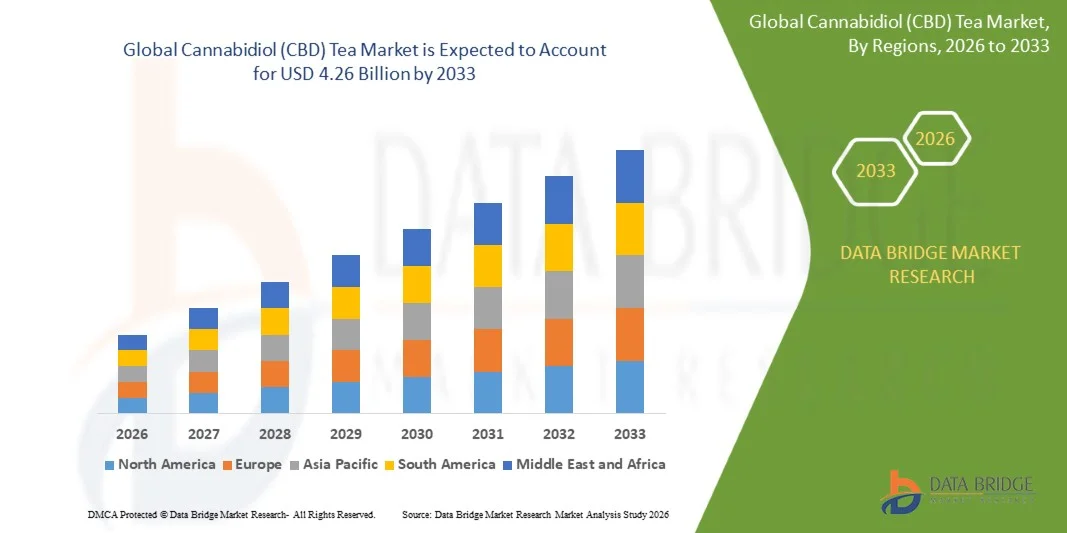
- As per Data Bridge Market Research Analysis the global Cannabidiol (CBD) tea market size was valued at USD 2.55 billion in 2025 and is expected to reach USD 4.26 billion by 2033, at a CAGR of 6.60% during the forecast period
- The market growth is largely fueled by the rising consumer interest in natural wellness beverages and functional drinks, leading to increased adoption of CBD-infused teas for relaxation, stress relief, and overall well-being
- Furthermore, growing awareness of the health benefits of hemp-derived and marijuana-derived products, coupled with the expansion of legal frameworks supporting CBD consumption, is establishing CBD tea as a mainstream functional beverage choice. These converging factors are accelerating the uptake of CBD tea products, thereby significantly boosting the industry’s growth
Market Size & Forecast
- Global Market Value (2025): USD 2.55 Billion
- Expected Market Value (2033): USD 4.26 Billion
- Forecast CAGR (2026–2033): 6.60%
What are the Major Takeaways of Cannabidiol (CBD) Tea Market?
- Cannabidiol (CBD) teas, offering naturally infused beverages with potential health and relaxation benefits, are increasingly sought after in both retail and e-commerce channels due to their convenience, flavor variety, and functional wellness attributes
- The escalating demand for Cannabidiol (CBD) tea is primarily fueled by growing health and wellness consciousness, rising stress levels in urban populations, and increasing availability of premium and ready-to-drink Cannabidiol (CBD) tea products across multiple distribution channels
- North America dominated the Cannabidiol (CBD) tea market with a share of around 60% in 2025, due to increasing consumer awareness of wellness beverages, growing interest in natural and functional drinks, and rising adoption of Cannabidiol (CBD) tea products for relaxation and stress relief
- Asia-Pacific is expected to be the fastest growing region in the Cannabidiol (CBD) tea market during the forecast period due to rising health consciousness, urbanization, and adoption of herbal wellness drinks in countries such as China, Japan, and India
- Hemp derived segment dominated the market with a market share of 52.8% in 2025, due to its wide legal acceptance across regions, minimal psychoactive effects, and strong association with wellness and relaxation. Consumers prefer hemp-derived Cannabidiol (CBD) tea for its perceived safety, natural sourcing, and regulatory compliance, which allows easier distribution in mainstream retail and online channels. Hemp-derived Cannabidiol (CBD) tea also benefits from the growing trend of functional beverages and herbal infusions, providing both relaxation and perceived health benefits
Report Scope and Cannabidiol (CBD) Tea Market Segmentation
|
Attributes |
Cannabidiol (CBD) Tea Key Market Insights |
|
Segments Covered |
|
|
Countries Covered |
North America
Europe
Asia-Pacific
Middle East and Africa
South America
|
|
Key Market Players |
|
|
Market Opportunities |
|
|
Value Added Data Infosets |
In addition to the insights on market scenarios such as market value, growth rate, segmentation, geographical coverage, and major players, the market reports curated by the Data Bridge Market Research also include in-depth expert analysis, pricing analysis, brand share analysis, consumer survey, demography analysis, supply chain analysis, value chain analysis, raw material/consumables overview, vendor selection criteria, PESTLE Analysis, Porter Analysis, and regulatory framework. |
What is the Key Trend in the Cannabidiol (CBD) Tea Market?
“Rising Popularity of Functional and Wellness Beverages”
- A significant trend in the Cannabidiol (CBD) tea market is the increasing preference for functional beverages that combine wellness benefits with natural, plant-based ingredients. Consumers are seeking products that support relaxation, stress relief, and overall well-being, driving the incorporation of CBD into traditional herbal and flavored teas. This trend is elevating the role of Cannabidiol (CBD) tea as both lifestyle and wellness beverages across retail, specialty stores, and online channels
- For instance, Tilray’s Solei brand offers a wide range of CBD-infused teas that focus on wellness and relaxation, while Collective Project by Collective Arts introduced cocktail-inspired CBD beverages that merge functional benefits with lifestyle appeal. Such products strengthen consumer awareness and acceptance of Cannabidiol (CBD) tea as mainstream functional drinks
- The demand for natural and health-oriented ingredients is influencing product formulation trends, with brands incorporating organic herbs, gluten-free bases, and non-GMO components into Cannabidiol (CBD) tea. This is enhancing product differentiation and attracting health-conscious Millennials and Gen-Z consumers seeking holistic wellness solutions
- Urban wellness and at-home self-care routines are contributing to the rising consumption of Cannabidiol (CBD) tea, as consumers increasingly integrate functional beverages into daily relaxation and mindfulness practices. This is fostering higher adoption across e-commerce platforms and premium retail segments
- The growing interest in flavor innovation and experiential beverage consumption is leading brands to experiment with unique tea blends and infusion techniques, enhancing both taste and perceived health benefits. This is positioning Cannabidiol (CBD) tea as a lifestyle-oriented beverage with strong repeat purchase potential
- Premiumization of CBD beverages is another key aspect, with consumers willing to pay higher prices for artisanal and curated tea blends offering specific relaxation, sleep, or immunity benefits. This is accelerating product diversification and strengthening brand loyalty within the functional beverage market
Cannabidiol (CBD) Tea Market Dynamics
Driver
“Growing Consumer Awareness of Health Benefits of CBD”
- The rising awareness among consumers regarding the potential health and wellness benefits of cannabidiol (CBD) is driving adoption of Cannabidiol (CBD) tea across global markets. Cannabidiol (CBD) tea are increasingly perceived as natural solutions for stress relief, relaxation, sleep improvement, and overall mental well-being
- For instance, Creso Pharma launched its cannaQIX brand of CBD-based teas in April 2021, highlighting stress-reduction and relaxation benefits to attract wellness-focused consumers. Such initiatives are raising awareness of CBD as a safe and functional ingredient in daily beverages
- The popularity of CBD as part of a holistic lifestyle is motivating both established beverage companies and new entrants to expand product portfolios, offering teas infused with hemp-derived or marijuana-derived CBD. This expansion supports increased consumer trial and strengthens market penetration
- E-commerce platforms and specialty wellness stores are facilitating greater access and visibility for Cannabidiol (CBD) tea products, allowing consumers to explore and purchase functional beverages with confidence. This is helping brands educate consumers on the potential benefits and safe use of CBD-infused teas
- Increasing research and publications on CBD’s potential health impacts are also enhancing consumer trust and fueling adoption, positioning Cannabidiol (CBD) tea as a preferred alternative to traditional herbal or functional beverages
Restraint/Challenge
“Regulatory Restrictions and Legal Uncertainty”
- The Cannabidiol (CBD) tea market faces significant challenges due to complex regulatory frameworks and inconsistent legalization of hemp- and marijuana-derived CBD products across different countries and regions. These uncertainties limit product availability, complicate marketing, and restrict distribution channels
- For instance, while companies such as Tilray and Solei have successfully launched Cannabidiol (CBD) tea products in North America and Europe, other regions maintain strict regulations on cannabinoid content or ban certain ingredients entirely, creating barriers for market expansion
- Compliance with regional labeling, THC limits, and safety testing requirements increases operational complexity and cost for manufacturers, making it challenging for new entrants to compete effectively
- The varying legal definitions of hemp versus marijuana, along with differences in allowable CBD concentrations, contribute to consumer confusion and cautious adoption. This affects sales growth, particularly in emerging markets where regulatory clarity is limited
- These regulatory and legal challenges collectively restrain the full potential of the Cannabidiol (CBD) tea market, requiring continuous monitoring and adaptation by manufacturers to sustain growth while ensuring consumer safety
How is the Cannabidiol (CBD) Tea Market Segmented?
The market is segmented on the basis of type, distribution channel, and application.
• By Type
On the basis of type, the cannabidiol (CBD) tea market is segmented into marijuana derived, hemp derived, synthetic, and others. The hemp-derived segment dominated the market with the largest revenue share of 52.8% in 2025, driven by its wide legal acceptance across regions, minimal psychoactive effects, and strong association with wellness and relaxation. Consumers prefer hemp-derived Cannabidiol (CBD) tea for its perceived safety, natural sourcing, and regulatory compliance, which allows easier distribution in mainstream retail and online channels. Hemp-derived Cannabidiol (CBD) tea also benefits from the growing trend of functional beverages and herbal infusions, providing both relaxation and perceived health benefits. Leading tea brands have been actively expanding their hemp-based product portfolios to cater to health-conscious consumers seeking natural remedies for stress and sleep improvement. The segment’s dominance is further reinforced by extensive marketing campaigns emphasizing organic cultivation, purity, and sustainable sourcing practices.
The marijuana-derived segment is anticipated to witness the fastest growth rate from 2026 to 2033, fueled by the gradual legalization of cannabis in key markets and increasing consumer curiosity for psychoactive wellness beverages. For instance, brands such as Canopy Growth are introducing premium marijuana-derived Cannabidiol (CBD) tea targeting adult consumers interested in mild euphoria and relaxation. The segment appeals to consumers seeking experiential and novel tea products, combining wellness with recreational enjoyment. Market growth is also driven by expanding cannabis cafes, specialty stores, and lifestyle-oriented marketing, positioning marijuana-derived Cannabidiol (CBD) tea as a trendy and niche product. Increased research on the therapeutic benefits of marijuana-based CBD products supports consumer confidence and adoption, further accelerating growth prospects.
• By Distribution Channel
On the basis of distribution channel, the cannabidiol (CBD) tea market is segmented into supermarkets and hypermarkets, specialty stores, convenience stores, online, and others. The online segment dominated the market with the largest revenue share in 2025, driven by the ease of access, broader product variety, and discreet purchasing options it provides to consumers. Online platforms allow detailed product information, user reviews, and subscription-based delivery services, enhancing customer convenience and fostering brand loyalty. For instance, platforms such as Amazon and specialized CBD e-commerce websites offer extensive hemp-derived and marijuana-derived tea options, making online channels highly attractive for first-time buyers and repeat customers. The segment benefits from increasing internet penetration, digital marketing strategies, and targeted social media campaigns educating consumers about Cannabidiol (CBD) tea benefits. Rising consumer preference for home delivery and wellness-focused subscriptions further reinforces online sales dominance.
Specialty stores are expected to witness the fastest growth rate from 2026 to 2033, driven by increasing consumer interest in premium and curated Cannabidiol (CBD) tea experiences. For instance, brands such as Teavana and local CBD wellness boutiques are offering exclusive blends and in-store tasting experiences to attract health-conscious and curious consumers. Specialty stores provide expert guidance, product sampling, and personalized recommendations, enhancing consumer confidence and willingness to pay a premium. Growing awareness of functional beverages and the trend toward holistic wellness positions specialty retail as a key growth channel. The segment also benefits from collaborations with cafes, spas, and wellness centers, providing a multisensory purchasing experience and elevating brand perception.
• By Application
On the basis of application, the cannabidiol (CBD) tea market is segmented into Millennial, Gen-Z, and Baby Boomers. The Millennial segment dominated the market with the largest revenue share in 2025, driven by high awareness of wellness trends, openness to natural and functional beverages, and active social media influence on lifestyle choices. Millennials prefer Cannabidiol (CBD) tea for stress relief, relaxation, and sleep support, often integrating it into daily self-care routines. For instance, brands such as Sunday Scaries promote Cannabidiol (CBD) tea specifically for stress and productivity management, attracting millennial consumers seeking holistic wellness solutions. The segment also benefits from tech-savvy consumers leveraging online reviews, influencer recommendations, and e-commerce subscriptions to explore new Cannabidiol (CBD) tea varieties. Rising disposable income, urban lifestyles, and demand for plant-based functional beverages further reinforce millennial dominance in the market.
The Gen-Z segment is expected to witness the fastest growth rate from 2026 to 2033, fueled by increasing experimentation with wellness and lifestyle beverages and rising familiarity with cannabis culture. For instance, brands such as Chill Hemp offer flavored Cannabidiol (CBD) tea targeting Gen-Z consumers seeking trendy, functional, and aesthetically appealing products. The segment favors ready-to-drink and innovative formats, providing convenience and visual appeal for social media sharing. Growing awareness of mental health, stress management, and natural relaxation options positions Gen-Z as a significant growth driver for the Cannabidiol (CBD) tea market. Educational campaigns and collaborations with lifestyle brands further accelerate adoption among this younger demographic.
Which Region Holds the Largest Share of the Cannabidiol (CBD) Tea Market?
- North America dominated the Cannabidiol (CBD) tea market with the largest revenue share of around 60% in 2025, driven by increasing consumer awareness of wellness beverages, growing interest in natural and functional drinks, and rising adoption of CBD products for relaxation and stress relief
- Consumers in the region highly value the health benefits, convenience, and premium quality offered by Cannabidiol (CBD) tea, with many preferring hemp-derived options due to regulatory acceptance and perceived safety
- This widespread adoption is further supported by high disposable incomes, a health-conscious population, and the growing trend of at-home wellness rituals, establishing Cannabidiol (CBD) tea as a favored beverage among both Millennials and Gen-Z consumers
U.S. Cannabidiol (CBD) Tea Market Insight
The U.S. Cannabidiol (CBD) tea market captured the largest revenue share in 2025 within North America, fueled by the growing trend of functional beverages and rising demand for stress-relief products. Consumers are increasingly prioritizing plant-based solutions for relaxation, sleep support, and mental well-being, driving adoption of Cannabidiol (CBD) tea. The expanding e-commerce sector, along with specialty Cannabidiol (CBD) tea brands and subscription services, further propels market growth. Moreover, awareness campaigns and wellness influencer endorsements are significantly contributing to consumer confidence and product adoption.
Europe Cannabidiol (CBD) Tea Market Insight
The Europe Cannabidiol (CBD) tea market is projected to expand at a substantial CAGR during the forecast period, primarily driven by increasing awareness of herbal wellness beverages and the expanding legalization of hemp-derived Cannabidiol (CBD) tea products. Urbanization, rising disposable incomes, and the health and lifestyle consciousness of consumers are fostering adoption in countries such as Germany, U.K., and France. European consumers are drawn to premium and artisanal Cannabidiol (CBD) tea for perceived health benefits and unique flavors, supporting growth across specialty stores and e-commerce channels. The market is also witnessing growth in functional beverages, with Cannabidiol (CBD) tea becoming part of wellness routines in residential and retail sectors.
U.K. Cannabidiol (CBD) Tea Market Insight
The U.K. Cannabidiol (CBD) tea market is anticipated to grow at a noteworthy CAGR during the forecast period, driven by rising interest in stress relief, relaxation, and natural wellness products. Concerns about mental health and lifestyle-related stress are encouraging consumers to adopt Cannabidiol (CBD) tea. The U.K.’s robust retail and e-commerce infrastructure, alongside a preference for premium, organic products, continues to stimulate market growth.
Germany Cannabidiol (CBD) Tea Market Insight
The Germany Cannabidiol (CBD) tea market is expected to expand at a considerable CAGR during the forecast period, fueled by increasing awareness of herbal remedies and functional beverages. Germany’s focus on health, wellness, and sustainability promotes adoption of premium Cannabidiol (CBD) tea, particularly hemp-derived variants. Specialty wellness stores and organic retailers are supporting growth, with consumers showing preference for ethically sourced, high-quality products.
Asia-Pacific Cannabidiol (CBD) Tea Market Insight
The Asia-Pacific Cannabidiol (CBD) tea market is poised to grow at the fastest CAGR during the forecast period of 2026 to 2033, driven by rising health consciousness, urbanization, and adoption of herbal wellness drinks in countries such as China, Japan, and India. Government initiatives promoting functional foods, herbal supplements, and wellness products are supporting market expansion. Furthermore, as APAC becomes a production hub for hemp-based teas and Cannabidiol (CBD) tea products, affordability and accessibility are increasing, expanding the consumer base across retail and online channels.
Japan Cannabidiol (CBD) Tea Market Insight
The Japan Cannabidiol (CBD) tea market is gaining momentum due to the country’s high awareness of functional beverages, health-oriented lifestyles, and growing interest in stress-relief products. Japanese consumers place significant emphasis on wellness and relaxation, driving adoption of premium Cannabidiol (CBD) tea. Integration of Cannabidiol (CBD) tea into daily routines and at-home wellness rituals is fueling growth, particularly among Millennials and health-conscious adults.
China Cannabidiol (CBD) Tea Market Insight
The China Cannabidiol (CBD) tea market accounted for the largest revenue share in Asia-Pacific in 2025, attributed to rapid urbanization, rising disposable incomes, and increasing interest in natural wellness products. Cannabidiol (CBD) tea are becoming popular among young adults and professionals seeking relaxation and stress relief. Expansion of e-commerce platforms, domestic manufacturers, and premium hemp-derived Cannabidiol (CBD) tea brands are key factors driving market growth.
Which are the Top Companies in Cannabidiol (CBD) Tea Market?
The Cannabidiol (CBD) tea industry is primarily led by well-established companies, including:
- The Cronos Group (Canada)
- Tilray, Inc. (Canada)
- Aurora Cannabis Inc. (Canada)
- GW Pharmaceuticals plc (U.K.)
- Alkaline88, LLC (U.S.)
- NewAge Inc. (U.S.)
- Cannara (Canada)
- Green Roads (U.S.)
- Koios Beverage Corp. (Canada)
- The Supreme Cannabis Company, Inc. (Canada)
- CANNABIS Aphria (Canada)
- Curaleaf (U.S.)
- Joy Organics (U.S.)
What are Latest Developments in Cannabidiol (CBD) Tea Market?
- In February 2024, Tilray Brands’ wellness division Solei launched new cannabis-infused cold brew teas featuring CBD, including flavors such as Peach Cranberry and Wildberry Hibiscus. This expansion beyond hot teas into ready-to-drink beverages strengthened consumer interest in convenient and flavorful CBD tea options. The launch boosted the market by catering to both relaxation and social consumption needs, driving broader adoption of CBD tea products among young adults and health-conscious consumers seeking functional beverages
- In May 2023, Solei introduced a premium collection of teas infused with CBD, CBN, and low-THC, featuring blends such as Peach Ginger, Lavender Chamomile, and Mint. The introduction of multi-cannabinoid tea products enhanced the perceived wellness benefits of CBD beverages and positioned the segment as a holistic, functional drink category. This development encouraged consumer exploration of complex formulations and drove innovation within the CBD tea market, attracting premium and health-focused audiences
- In October 2021, Alkame Holdings developed a line of CBD teas under the Hooch Brands label using proprietary water-infusion technology, offering flavors such as Lemon Ginger and Turmeric & Tangerine. These teas targeted specific wellness benefits, such as immunity support and relaxation, diversifying the market with functional and flavor-focused products. The launch encouraged broader retailer adoption and consumer experimentation, enhancing the premium and health-oriented segment of the CBD tea market
- In April 2021, Creso Pharma launched three CBD-based tea products under its cannaQIX brand. These products expanded the company’s presence in the functional beverage segment and reinforced consumer confidence in CBD teas as wellness-oriented products. The launch contributed to market growth by providing a trusted, branded option for consumers seeking natural stress relief and relaxation through tea, increasing product availability across retail and online channels
- In November 2020, Collective Arts launched Collective Project, a sister company producing a line of cocktail-inspired beverages infused with CBD. The teas and juices featured fresh fruit and natural, gluten-free, non-GMO ingredients, paired with artist-driven label designs. This development influenced the market by blending wellness with lifestyle appeal, attracting younger, trend-conscious consumers and raising awareness of CBD-infused beverages as both functional and enjoyable drinks

- Interactive Data Analysis Dashboard
- Company Analysis Dashboard for high growth potential opportunities
- Research Analyst Access for customization & queries
- Competitor Analysis with Interactive dashboard
- Latest News, Updates & Trend analysis
- Harness the Power of Benchmark Analysis for Comprehensive Competitor Tracking
Global Cannabidiol Cbd Tea Market, Supply Chain Analysis and Ecosystem Framework
To support market growth and help clients navigate the impact of geopolitical shifts, DBMR has integrated in-depth supply chain analysis into its Global Cannabidiol Cbd Tea Market research reports. This addition empowers clients to respond effectively to global changes affecting their industries. The supply chain analysis section includes detailed insights such as Global Cannabidiol Cbd Tea Market consumption and production by country, price trend analysis, the impact of tariffs and geopolitical developments, and import and export trends by country and HSN code. It also highlights major suppliers with data on production capacity and company profiles, as well as key importers and exporters. In addition to research, DBMR offers specialized supply chain consulting services backed by over a decade of experience, providing solutions like supplier discovery, supplier risk assessment, price trend analysis, impact evaluation of inflation and trade route changes, and comprehensive market trend analysis.
Data collection and base year analysis are done using data collection modules with large sample sizes. The stage includes obtaining market information or related data through various sources and strategies. It includes examining and planning all the data acquired from the past in advance. It likewise envelops the examination of information inconsistencies seen across different information sources. The market data is analysed and estimated using market statistical and coherent models. Also, market share analysis and key trend analysis are the major success factors in the market report. To know more, please request an analyst call or drop down your inquiry.
The key research methodology used by DBMR research team is data triangulation which involves data mining, analysis of the impact of data variables on the market and primary (industry expert) validation. Data models include Vendor Positioning Grid, Market Time Line Analysis, Market Overview and Guide, Company Positioning Grid, Patent Analysis, Pricing Analysis, Company Market Share Analysis, Standards of Measurement, Global versus Regional and Vendor Share Analysis. To know more about the research methodology, drop in an inquiry to speak to our industry experts.
Data Bridge Market Research is a leader in advanced formative research. We take pride in servicing our existing and new customers with data and analysis that match and suits their goal. The report can be customized to include price trend analysis of target brands understanding the market for additional countries (ask for the list of countries), clinical trial results data, literature review, refurbished market and product base analysis. Market analysis of target competitors can be analyzed from technology-based analysis to market portfolio strategies. We can add as many competitors that you require data about in the format and data style you are looking for. Our team of analysts can also provide you data in crude raw excel files pivot tables (Fact book) or can assist you in creating presentations from the data sets available in the report.













