


What is the Canola-based Products Market Size and Growth Rate?
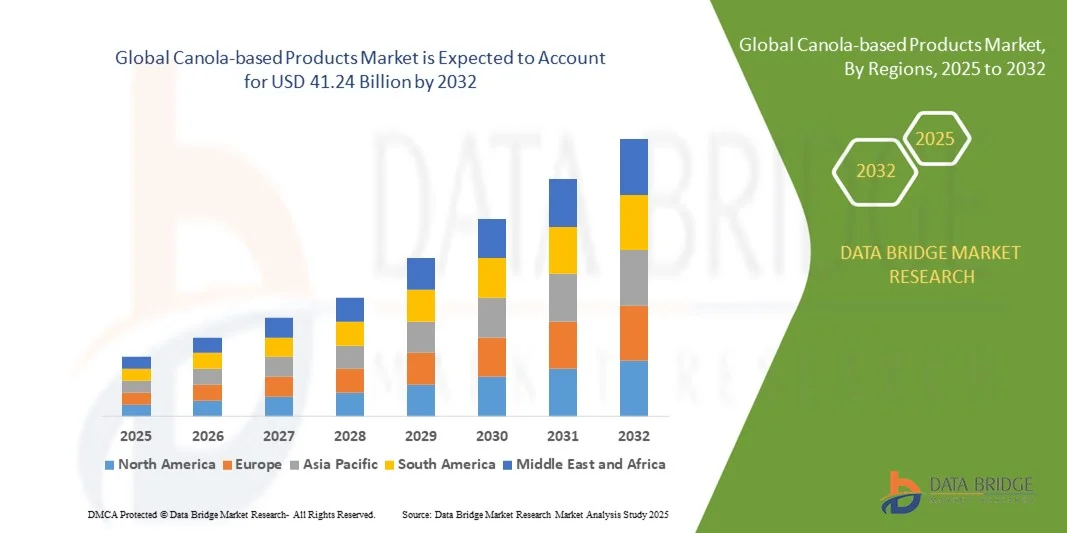
- As per Data Bridge Market Research Analysis the global canola-based products market size was valued at USD 23.3 billion in 2024 and is expected to reach USD 41.24 billion by 2032, at a CAGR of 7.40% during the forecast period
- The market growth is largely fuelled by the increasing consumer preference for plant-based oils, rising awareness of heart-healthy dietary options, and growing applications of canola in food, industrial, and personal care sectors
- Growing adoption of canola-based snacks, spreads, and cooking oils in emerging economies is further boosting demand and contributing to market expansion
What are the Major Takeaways of Canola-based Products Market?
- The rising demand for low-saturated-fat cooking oils and spreads is encouraging the adoption of canola-based products across households and foodservice industries
- Increasing utilization of canola oil in biodiesel production, cosmetics, and industrial lubricants is further driving market expansion
- North America dominated the canola-based products market with the largest revenue share in 2024, driven by rising health awareness, increasing demand for plant-based oils, and the growing adoption of functional food ingredients across food processing and retail sectors
- Asia-Pacific region is expected to witness the highest growth rate in the global canola-based products market, driven by increasing population, urbanization, rising disposable incomes, and growing awareness of nutritional benefits of canola-based products
- The High Protein Meal segment held the largest market revenue share in 2024, driven by its extensive use in animal feed and nutritional supplements. High Protein Meal derived from canola provides essential amino acids, supporting livestock growth and improving feed efficiency
Report Scope and Canola-based Products Market Segmentation
|
Attributes |
Canola-based Products Key Market Insights |
|
Segments Covered |
|
|
Countries Covered |
North America
Europe
Asia-Pacific
Middle East and Africa
South America
|
|
Key Market Players |
|
|
Market Opportunities |
|
|
Value Added Data Infosets |
In addition to the insights on market scenarios such as market value, growth rate, segmentation, geographical coverage, and major players, the market reports curated by the Data Bridge Market Research also include in-depth expert analysis, pricing analysis, brand share analysis, consumer survey, demography analysis, supply chain analysis, value chain analysis, raw material/consumables overview, vendor selection criteria, PESTLE Analysis, Porter Analysis, and regulatory framework. |
What is the Key Trend in the Canola-based Products Market?
Increasing Adoption of Canola-Based Oils and Derivatives
- The growing shift toward canola-based products is transforming the edible oils and food ingredients industry by providing healthier, low-saturated-fat alternatives. Canola oil’s versatility allows its use in cooking, baking, and food processing, supporting improved consumer health and expanded product portfolios. In addition, its neutral flavor and high smoke point make it ideal for industrial frying and commercial food production, enhancing adoption across multiple segments
- The high demand for plant-based and heart-healthy oils is accelerating the adoption of canola oil and related products in both developed and emerging markets. These products are particularly effective in meeting dietary guidelines and consumer preference for functional foods. Furthermore, increased awareness of cardiovascular health and fitness trends is driving manufacturers to incorporate canola-based ingredients into reformulated and fortified food products
- The ease of incorporation and neutral taste of canola-based oils are making them attractive for both commercial food manufacturers and household consumers. Companies benefit from product diversification, enhanced nutritional appeal, and alignment with health-conscious trends. The versatility also extends to bakery, confectionery, and snack industries, where canola derivatives improve texture, shelf life, and product stability
- For instance, in 2023, several packaged food companies in Canada reported increased consumer acceptance and sales growth after reformulating snacks and baked goods using canola oil and canola protein derivatives. These initiatives also enabled better labeling claims, such as “low-saturated-fat” and “heart-healthy,” which resonated with health-focused consumers. The move further encouraged competitors to explore innovative canola-based applications
- While canola-based products are gaining traction across food and industrial applications, their market growth depends on continuous innovation, cost competitiveness, and sustainability initiatives. Manufacturers must focus on optimized extraction methods, value-added derivatives, and consumer education to fully capitalize on this growing demand. Environmental sustainability, including reducing carbon footprint in oil extraction and refining, is becoming a key factor influencing product adoption
Canola-based Products Market Dynamics
Driver
Rising Consumer Awareness About Heart-Healthy Diets and Plant-Based Ingredients
- Increasing consumer preference for low-saturated-fat oils is pushing both food manufacturers and retailers to adopt canola-based products. Canola oil, protein, and derivatives offer functional benefits that support cardiovascular health and overall nutrition. In addition, the rising trend of plant-based diets and flexitarian lifestyles is encouraging wider consumption of canola-based ingredients globally
- Producers are leveraging canola-based ingredients to reformulate processed foods, snacks, and bakery products to meet health standards and label claims. The trend is further supported by evolving food regulations promoting healthier fats and plant-based alternatives. Manufacturers are also exploring blends with other functional oils to enhance taste, texture, and nutritional value, creating more innovative product offerings
- Government initiatives and health organizations promoting the consumption of unsaturated fats and plant-based ingredients are encouraging market adoption. Educational campaigns on canola’s nutritional benefits have strengthened consumer trust and demand. This support extends to export markets, where compliance with international health and nutrition standards opens new growth opportunities for canola-based products
- For instance, in 2022, the U.S. Food and Drug Administration (FDA) updated guidelines encouraging the use of canola and other low-saturated-fat oils in packaged foods, boosting the market for functional edible oils. The move prompted manufacturers to enhance labeling and marketing strategies highlighting health benefits, further driving product adoption among health-conscious consumers
- While consumer awareness and regulatory support are driving market growth, challenges related to supply chain, price volatility, and competition from other vegetable oils need to be addressed to sustain long-term expansion. Companies must also invest in research and development to improve shelf life, stability, and functional properties of canola-based derivatives
Restraint/Challenge
Price Volatility, Supply Chain Constraints, And Competition From Other Edible Oils
- Fluctuating prices of canola seeds and crude oil impact production costs and limit accessibility for small and medium-scale processors. These variations can hinder market expansion and affect profitability for manufacturers. Moreover, extreme weather conditions and crop yield uncertainties contribute to price instability, influencing long-term planning and investment
- In many regions, supply chain limitations, including storage, transportation, and processing capacity, restrict consistent availability of canola-based products. Seasonal yield fluctuations further exacerbate supply challenges. Limited cold storage and inadequate infrastructure in emerging markets increase the risk of spoilage and reduce market reach, especially in remote areas
- Competition from other edible oils, such as soybean, sunflower, and palm oil, continues to limit market share growth, especially in price-sensitive markets. Consumer loyalty and local preferences can influence adoption rates. In addition, aggressive pricing and established distribution networks of competing oils make market penetration challenging for new entrants
- For instance, in 2023, several Asian markets continued to favor palm and soybean oils for cost reasons, despite increasing awareness of canola oil’s health benefits. Companies are therefore required to adopt strategic marketing, educational campaigns, and competitive pricing to improve penetration and consumer acceptance in these regions
- While production technologies and product innovations are evolving, addressing price stability, enhancing processing infrastructure, and promoting consumer education remain critical for unlocking the full growth potential of the global canola-based products market. Sustainability initiatives, including certified sourcing and eco-friendly processing, are increasingly becoming differentiators influencing buyer preference
How is the Canola-based Products Market Segmented?
The market is segmented on the basis of uses, packaging type, distribution channel, and application.
- By Uses
On the basis of uses, the canola-based products market is segmented into High Protein Meal and Biofuel Feedstock. The High Protein Meal segment held the largest market revenue share in 2024, driven by its extensive use in animal feed and nutritional supplements. High Protein Meal derived from canola provides essential amino acids, supporting livestock growth and improving feed efficiency.
The Biofuel Feedstock segment is expected to witness the fastest growth rate from 2025 to 2032, driven by rising demand for renewable energy sources and sustainable fuel alternatives. Canola-derived biofuels are gaining popularity due to their lower carbon emissions, compatibility with existing engines, and government incentives promoting green energy adoption.
- By Packaging Type
On the basis of packaging type, the market is segmented into Bottles, Cans, Drums, Pouches, and Others. The Bottles segment held the largest market revenue share in 2024, fueled by convenient handling, easy storage, and widespread adoption in retail and household use. Bottled packaging ensures product safety, longer shelf life, and suitability for small-scale consumer consumption.
The Drums segment is expected to witness the fastest growth rate from 2025 to 2032, driven by industrial demand for bulk canola oils and derivatives. Drums are widely used in food processing, biofuel production, and lubricant industries due to cost efficiency, ease of transportation, and minimal product degradation.
- By Distribution Channel
On the basis of distribution channel, the market is segmented into Store-Based, Supermarkets and Hypermarkets, Convenience Stores, Others, and Non-Store Based. The Supermarkets and Hypermarkets segment held the largest market revenue share in 2024, driven by the increasing preference for organized retail, product visibility, and one-stop shopping convenience. These channels offer a wide range of canola-based products to meet diverse consumer needs.
The Non-Store Based segment is expected to witness the fastest growth rate from 2025 to 2032, fueled by online sales, direct-to-consumer platforms, and subscription services. The growing penetration of e-commerce and digital marketplaces allows consumers to access premium and specialty canola-based products conveniently.
- By Application
On the basis of application, the market is segmented into Cooking, Processed Food, Lubricants, Personal Care, Biofuels, and Others. The Cooking segment held the largest market revenue share in 2024, driven by the widespread use of canola oil in household kitchens, restaurants, and foodservice sectors. Canola oil’s neutral flavor, high smoke point, and health benefits make it a preferred choice for everyday cooking.
The Biofuels segment is expected to witness the fastest growth rate from 2025 to 2032, driven by rising global initiatives to reduce carbon emissions and promote sustainable energy. Canola-based biofuels are increasingly used in transportation and industrial applications, providing a renewable and environmentally friendly alternative to conventional fossil fuels.
Which Region Holds the Largest Share of the Canola-based Products Market?
- North America dominated the canola-based products market with the largest revenue share in 2024, driven by rising health awareness, increasing demand for plant-based oils, and the growing adoption of functional food ingredients across food processing and retail sectors
- Consumers in the region highly value the nutritional benefits, low saturated fat content, and versatility offered by canola-based oils and derivatives in cooking, processed foods, and biofuel applications
- This widespread adoption is further supported by advanced processing infrastructure, strong distribution networks, and growing preference for sustainable and healthier alternatives, establishing canola-based products as a favored choice for both manufacturers and end-users
U.S. Canola-Based Products Market Insight
The U.S. canola-based products market captured the largest revenue share in North America in 2024, fueled by the growing trend of health-conscious consumption and plant-based diets. Food manufacturers are increasingly incorporating canola oil and protein derivatives into snacks, baked goods, and processed foods to enhance nutritional value. The rise in biofuel production using canola feedstock, alongside government initiatives promoting low-saturated-fat ingredients, is significantly contributing to market expansion.
Europe Canola-Based Products Market Insight
The Europe canola-based products market is expected to witness the fastest growth rate from 2025 to 2032, primarily driven by stringent food safety regulations, rising consumer awareness of healthy eating, and increasing adoption of plant-based products. Urbanization, rising disposable incomes, and growing demand for functional foods are fostering the use of canola oils and derivatives across residential and commercial food applications.
U.K. Canola-Based Products Market Insight
The U.K. canola-based products market is expected to witness robust growth from 2025 to 2032, driven by the increasing demand for heart-healthy oils, plant-based ingredients, and sustainable food solutions. In addition, rising concerns about obesity and cardiovascular health are encouraging both consumers and manufacturers to choose low-saturated-fat alternatives such as canola oil. The U.K.’s strong retail and e-commerce infrastructure further supports market adoption.
Germany Canola-Based Products Market Insight
The Germany canola-based products market is expected to witness substantial growth from 2025 to 2032, fueled by the increasing preference for healthier food options, rising awareness about unsaturated fats, and strong regulatory support for plant-based oils. Germany’s advanced food processing infrastructure and sustainability initiatives promote the adoption of canola-based oils, proteins, and derivatives in both residential and commercial food applications.
Asia-Pacific Canola-Based Products Market Insight
The Asia-Pacific canola-based products market is expected to witness the fastest growth rate from 2025 to 2032, driven by rising population, increasing disposable incomes, and growing health consciousness in countries such as China, Japan, and India. The region's expanding food processing industry, coupled with government programs promoting functional and plant-based foods, is driving market adoption. In addition, improving processing technology and availability of canola products at competitive prices are expanding the consumer base.
Japan Canola-Based Products Market Insight
The Japan canola-based products market is expected to witness strong growth from 2025 to 2032 due to the country’s health-focused culture, aging population, and demand for convenient, nutritious food products. Japanese consumers increasingly prefer low-saturated-fat oils and plant-based protein ingredients. The integration of canola derivatives in processed foods, snacks, and personal care applications, alongside government campaigns promoting healthy diets, is fueling growth.
China Canola-Based Products Market Insight
The China canola-based products market accounted for the largest market revenue share in Asia-Pacific in 2024, attributed to the country’s expanding middle class, rising disposable incomes, and increasing awareness of plant-based nutrition. Canola oil and derivatives are increasingly popular in cooking, processed foods, and biofuel production. The push toward healthier diets, coupled with supportive domestic manufacturing and processing capabilities, are key factors propelling the market in China.
Which are the Top Companies in Canola-based Products Market?
The Canola-based Products industry is primarily led by well-established companies, including:
Here’s the list of companies in bullets with copyright and headquarters countries:
- ADM (Archer Daniels Midland) (U.S.)
- Associated British Foods plc (U.K.)
- Sunora Foods (U.S.)
- Jivo (U.K.)
- Arla Foods amba (Denmark)
- Richardson International Limited (Canada)
- Cargill, Incorporated. (U.S.)
- KTC Edibles (India)
- The J.M. Smucker Company (U.S.)
- Bunge North America, Inc. (U.S.)
- Canaddin Pride Foods Inc. (Canada)
- Manishankar Oils Private Limited. (India)
- Macquarie Oil Co (Australia)
- BORGES INTERNATIONAL GROUP, S.L. (Spain)
- Louis Dreyfus Company (Netherlands)

- Interactive Data Analysis Dashboard
- Company Analysis Dashboard for high growth potential opportunities
- Research Analyst Access for customization & queries
- Competitor Analysis with Interactive dashboard
- Latest News, Updates & Trend analysis
- Harness the Power of Benchmark Analysis for Comprehensive Competitor Tracking
Global Canola Based Products Market, Supply Chain Analysis and Ecosystem Framework
To support market growth and help clients navigate the impact of geopolitical shifts, DBMR has integrated in-depth supply chain analysis into its Global Canola Based Products Market research reports. This addition empowers clients to respond effectively to global changes affecting their industries. The supply chain analysis section includes detailed insights such as Global Canola Based Products Market consumption and production by country, price trend analysis, the impact of tariffs and geopolitical developments, and import and export trends by country and HSN code. It also highlights major suppliers with data on production capacity and company profiles, as well as key importers and exporters. In addition to research, DBMR offers specialized supply chain consulting services backed by over a decade of experience, providing solutions like supplier discovery, supplier risk assessment, price trend analysis, impact evaluation of inflation and trade route changes, and comprehensive market trend analysis.
Data collection and base year analysis are done using data collection modules with large sample sizes. The stage includes obtaining market information or related data through various sources and strategies. It includes examining and planning all the data acquired from the past in advance. It likewise envelops the examination of information inconsistencies seen across different information sources. The market data is analysed and estimated using market statistical and coherent models. Also, market share analysis and key trend analysis are the major success factors in the market report. To know more, please request an analyst call or drop down your inquiry.
The key research methodology used by DBMR research team is data triangulation which involves data mining, analysis of the impact of data variables on the market and primary (industry expert) validation. Data models include Vendor Positioning Grid, Market Time Line Analysis, Market Overview and Guide, Company Positioning Grid, Patent Analysis, Pricing Analysis, Company Market Share Analysis, Standards of Measurement, Global versus Regional and Vendor Share Analysis. To know more about the research methodology, drop in an inquiry to speak to our industry experts.
Data Bridge Market Research is a leader in advanced formative research. We take pride in servicing our existing and new customers with data and analysis that match and suits their goal. The report can be customized to include price trend analysis of target brands understanding the market for additional countries (ask for the list of countries), clinical trial results data, literature review, refurbished market and product base analysis. Market analysis of target competitors can be analyzed from technology-based analysis to market portfolio strategies. We can add as many competitors that you require data about in the format and data style you are looking for. Our team of analysts can also provide you data in crude raw excel files pivot tables (Fact book) or can assist you in creating presentations from the data sets available in the report.













