


What is the Caprylic Acid Market Size and Growth Rate?
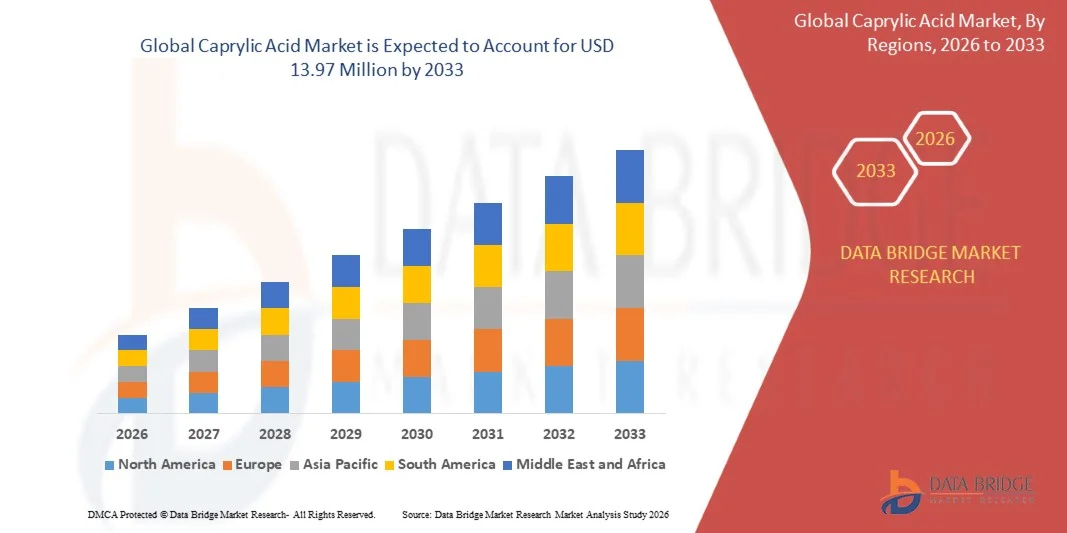
- As per Data Bridge Market Research analysis, the caprylic acid market was valued at USD 9.64 million in 2025 and is projected to reach USD 13.97 million by 2033, growing at a CAGR of 9.70% from 2026 to 2033.
- The market is experiencing positive growth during the forecast period, driven by growing health consciousness among people related to increased nutrition and dietary supplements, increasing federal regulations, and rising environmental concerns regarding non-renewable resources.
- Caprylic acid, also known as octanoic acid, is a saturated medium-chain fatty acid naturally occurring in coconut oil, palm kernel oil, and other plant sources. Its antimicrobial, antifungal, and preservative properties make it an essential ingredient in various formulations across personal care, pharmaceuticals, food and beverages, and industrial applications. The compound serves as a crucial ingredient in skincare formulations, hair care products, and color cosmetics due to its excellent moisturizing and antimicrobial properties. Additionally, caprylic acid is utilized in drug delivery systems, topical medications, and dietary supplements targeting digestive health and weight management.
Market Size & Forecast
- Global Market Value (2025): USD 9.64 Million
- Expected Market Value (2033): USD 13.97 Million
- Forecast CAGR (2026 to 2033): 9.70%
- Leading Region in 2025: North America
- Fastest Growing Region: Asia Pacific
What are the Major Takeaways of the Caprylic Acid Market?
- North America dominated the caprylic acid market with the largest revenue share in of 36.5% in 2023, supported by a highly developed food processing industry with a strong focus on innovation and quality control.
- Asia-Pacific is expected to be the fastest growing region, fueled by strong manufacturing bases and expanding end-use industries. The Asia Pacific caprylic acid market is expected to witness the fastest CAGR over the forecast period, driven by the expansion of e-commerce and increasing demand across food and beverage, pharmaceutical, and personal care applications.
- The personal care segment dominated the market and accounted for a market revenue share of 38.2% in 2023. Caprylic acid has multifunctional properties, making it a versatile ingredient in personal care formulations as an emollient that helps moisturize and soften the skin, along with antimicrobial properties that help preserve formulation stability.
- The food and beverage segment is expected to witness significant growth over the forecast period. The food and beverage industry serves as a primary contributor for caprylic acid consumption, where it serves as a food preservative thanks to its antioxidant and antibacterial activities.
- The pharmaceutical sector presents substantial growth opportunities, with caprylic acid being utilized in drug delivery systems, topical medications, and dietary supplements.
Report Scope and Caprylic Acid Market Segmentation
|
Attributes |
Caprylic Acid Key Market Insights |
|
Segments Covered |
|
|
Countries Covered |
North America
Europe
Asia-Pacific
Middle East and Africa
South America
|
|
Key Market Players |
|
|
Market Opportunities |
|
|
Value Added Data Infosets |
In addition to the insights on market scenarios such as market value, growth rate, segmentation, geographical coverage, and major players, the market reports curated by the Data Bridge Market Research also include import export analysis, production capacity overview, production consumption analysis, price trend analysis, climate change scenario, supply chain analysis, value chain analysis, raw material/consumables overview, vendor selection criteria, PESTLE Analysis, Porter Analysis, and regulatory framework. |
What is the Key Trend in the Caprylic Acid Market?
- The caprylic acid landscape has been undergoing pronounced structural changes through technological innovation, shifting availability of feedstocks, and evolving regulatory expectations.
- Advances in fermentation and enzymatic processing have begun to disrupt traditional chemical synthesis routes by offering pathways that can enhance selectivity and reduce energy intensity.
- Technological shifts are complemented by incremental improvements in fractionation and membrane technologies that allow producers to extract medium-chain fatty acids more efficiently from mixed triglyceride streams, broadening the supply base and enabling new product grades.
- Concurrent with process innovations, feedstock dynamics are exerting powerful effects on supply reliability and cost composition, as vegetable oil sources such as coconut oil and palm kernel oil remain primary agricultural inputs sensitive to climatic variability, planting cycles, and broader commodity market volatility.
- Tariff measures implemented during 2025 have affected caprylic acid value chains, influencing sourcing decisions, cost structures, and supplier relationships.
- The global caprylic acid market was valued at USD 13.62 million in 2025 and is projected to grow to USD 23.13 million by 2032, at a CAGR of 7.85%.
What are the Key Drivers of the Caprylic Acid Market?
- The global caprylic acid market is primarily driven by increasing demand from the personal care and cosmetics industry, where the compound serves as a crucial ingredient in skincare formulations, hair care products, and color cosmetics due to its excellent moisturizing and antimicrobial properties.
- The growing consumer preference for natural and organic personal care products has significantly boosted market growth, as caprylic acid offers a plant-derived alternative to synthetic chemicals.
- The food and beverage segment is expected to witness significant growth over the forecast period, with caprylic acid serving as a food preservative due to its antioxidant and antibacterial activities.
- The expanding role of caprylic acid in the pharmaceutical and nutraceutical sectors, where it is utilized in drug delivery systems, topical medications, and dietary supplements targeting digestive health and weight management, is another key factor driving market growth.
- Nearly 57% of demand is linked to food and personal care applications, with 54% food applications, 46% healthcare usage, and 38% cosmetic demand.
Which Factors are Challenging the Growth of the Caprylic Acid Market?
- Volatility and limited availability of key feedstocks pose significant challenges, as vegetable oil sources such as coconut oil and palm kernel oil remain primary agricultural inputs sensitive to climatic variability, planting cycles, and broader commodity market volatility.
- Raw material volatility affects 36% of market participants, and the high cost and low availability of raw materials used for the production of caprylic acid are anticipated to remain a major challenge.
- As more feedstock is diverted toward domestic energy security, the availability of precursors for caprylic acid production is tightening, with Indonesia's move toward a 50% to 60% biodiesel blend effectively removing millions of tons of palm-based feedstock from the global merchant market.
- Tariff measures implemented during 2025 have affected caprylic acid supply chains, procurement strategies, and competitive positioning.
- Stringent government regulations regarding usage in the food and beverage industry will act as a major market restraint.
- Logistics advantages in Asia-Pacific can be offset by feedstock price volatility and the need to navigate a fragmented regulatory environment across multiple jurisdictions.
How is the Caprylic Acid Market Segmented?
The caprylic acid market is segmented on the basis of raw material and application.
- By Raw Material
On the basis of raw material, the global caprylic acid market is segmented into coconut oil, palm oil, mammal milk, and others. The coconut oil and palm oil segments dominated the market in 2025, owing to their widespread availability and cost-effectiveness as primary sources for caprylic acid production. Vegetable oil sources such as coconut oil and palm kernel oil remain primary agricultural inputs for production models, and their price and availability are sensitive to climatic variability, planting cycles, and broader commodity market volatility. Animal-derived fats, including lard and tallow, provide alternative inputs, and their utilization often reflects regional processing capacities and byproduct management strategies in meat and rendering industries. Synthetic pathways, including chemical synthesis and biosynthetic approaches, offer a route to partially decouple supply from agricultural cycles, yet they come with trade-offs in capital intensity and environmental footprints.
- By Application
On the basis of application, the global caprylic acid market is segmented into personal care, cosmetics, pharmaceutical, food and beverage, fertilizer, chemicals, and others. The personal care segment dominated the market and accounted for a market revenue share of 38.2% in 2023. Caprylic acid has multifunctional properties, making it a versatile ingredient in personal care formulations. It is an emollient that helps moisturize and soften the skin by forming a barrier that prevents water loss. Additionally, it includes antimicrobial properties, which make it effective in preserving the stability of formulations and preventing the growth of bacteria and fungi. The food and beverage segment is expected to witness significant growth over the forecast period. While caprylic acid can be used in food preparation, it in majority serves as a food preservative thanks to its antioxidant and antibacterial activities. Health fueled growth in functional foods and dietary supplements in particular is making it popular among other ingredients.
- By Raw Material
On the basis of raw material, the global caprylic acid market is segmented into coconut oil, palm oil, mammal milk, and others. The coconut oil and palm oil segments dominated the market in 2025, owing to their widespread availability and cost-effectiveness as primary sources for caprylic acid production. Vegetable oil sources such as coconut oil and palm kernel oil remain primary agricultural inputs for production models, and their price and availability are sensitive to climatic variability, planting cycles, and broader commodity market volatility. Animal-derived fats, including lard and tallow, provide alternative inputs, and their utilization often reflects regional processing capacities and byproduct management strategies in meat and rendering industries. Synthetic pathways, including chemical synthesis and biosynthetic approaches, offer a route to partially decouple supply from agricultural cycles, yet they come with trade-offs in capital intensity and environmental footprints.
- By Application
On the basis of application, the global caprylic acid market is segmented into personal care, cosmetics, pharmaceutical, food and beverage, fertilizer, chemicals, and others. The personal care segment dominated the market and accounted for a market revenue share of 38.2% in 2023. Caprylic acid has multifunctional properties, making it a versatile ingredient in personal care formulations. It is an emollient that helps moisturize and soften the skin by forming a barrier that prevents water loss. Additionally, it includes antimicrobial properties, which make it effective in preserving the stability of formulations and preventing the growth of bacteria and fungi.
The food and beverage segment is expected to witness significant growth over the forecast period. While caprylic acid can be used in food preparation, it in majority serves as a food preservative thanks to its antioxidant and antibacterial activities. Health fueled growth in functional foods and dietary supplements in particular is making it popular among other ingredients.
Which Region Holds the Largest Share of the Caprylic Acid Market?
- North America dominated the caprylic acid market and accounted for the largest revenue share in 2025. The North America caprylic acid market accounted for a revenue share of 36.5% in 2023. The food processing industry in North America is highly developed, with a strong focus on innovation and quality control.
- The region benefits from strong consumer electronics adoption, a robust personal care industry, and early adoption of advanced manufacturing technologies. The U.S. and Canada are major consumers of caprylic acid, supported by robust R&D ecosystems and the presence of key market players in chemical innovation and manufacturing. The growing demand for natural and organic personal care products in the region has significantly boosted market growth.
U.S. Caprylic Acid Market Insight
The U.S. caprylic acid market is witnessing steady growth, supported by the country’s highly developed food processing industry, advanced pharmaceutical manufacturing base, and strong demand for specialty ingredients. Increasing use of caprylic acid across food and beverage, pharmaceutical, and personal care applications is supporting market expansion. Moreover, strong emphasis on product quality, formulation innovation, and the development of functional ingredients is further contributing to demand for caprylic acid in the U.S.
Asia-Pacific Caprylic Acid Market Insight
The Asia-Pacific caprylic acid market is expected to witness the fastest CAGR over the forecast period, driven by strong manufacturing bases, expanding end-use industries, and increasing demand across food and beverage, pharmaceutical, and personal care applications. The rapid expansion of e-commerce is improving product accessibility and distribution across emerging markets, while rising industrialization, growing consumer demand for processed foods and personal care products, and expanding pharmaceutical manufacturing are further accelerating regional market growth.
China Caprylic Acid Market Insight
The China caprylic acid market is expected to witness strong growth, driven by expanding manufacturing capabilities, rising food and beverage production, and increasing demand from pharmaceutical and personal care industries. Growing industrialization, expansion of e-commerce, and increasing consumption of processed foods and personal care products are supporting the adoption of caprylic acid across various applications. In addition, China's expanding domestic manufacturing base and growing investments in specialty ingredients are further contributing to market growth.
Which are the Top Companies in Caprylic Acid Market?
The caprylic acid industry is primarily led by well-established companies, including:
- Wilmar International Ltd (Singapore)
- KLK OLEO (Malaysia)
- Procter & Gamble (U.S.)
- IOI Corporation Berhad (Malaysia)
- Pacific Oleochemicals Sdn Bhd (Malaysia)
- McKinley Resources Inc. (U.S.)
- Cremer Oleo GmbH & Co. KG (Germany)
- Merck KGaA (Germany)
- Vigon International LLC (U.S.)
- Spectrum Chemical (U.S.)
- Hydrite Chemical (U.S.)
- Forchem Oyj (Finland)
- Kraton Corporation (U.S.)
- VVF L.L.C. (U.S.)
- Oleon NV (Belgium)
- Emery Oleochemicals (Malaysia)
- Temix Oleo Srl (Italy)
- Musim Mas Group (Singapore)
What are Latest Developments in Caprylic Acid Market?
- In March 2025, the Stepan Company announced that it would expand its production capacity for specialty chemicals including caprylic acid derivatives to meet growing demand from the personal care and pharmaceutical industries. This expansion strengthens Stepan's position in the caprylic acid market by extending its reach across personal care and pharmaceutical sectors, enabling manufacturers to access high-purity caprylic acid for advanced formulations.
- In January 2025, Wilmar International announced a strategic partnership with BASF to co-develop and scale sustainable caprylic triglyceride products across APAC markets, including joint research efforts and coordinated supply agreements. This collaboration demonstrates the growing focus on sustainability in the caprylic acid industry and positions both companies to capture the increasing demand for plant-derived, environmentally friendly ingredients.
- In November 2024, KLK Oleo launched a new caprylic triglyceride-based emollient under its BioOleo line, targeting improved skin feel and formulation stability for personal care brands. This product launch addresses the growing demand for multifunctional ingredients in cosmetics and personal care formulations, reinforcing KLK Oleo's position as a leading supplier of specialty oleochemicals.
- In September 2024, Cargill acquired Greenfield Specialty Alcohols' caprylic triglyceride unit to expand its MCT production capacity and secure a more integrated supply chain for food, nutraceutical, and cosmetic applications. This acquisition enables Cargill to strengthen its position in the growing medium-chain triglyceride market and enhance its capabilities in caprylic acid derivatives.
- In June 2024, BASF SE expanded its portfolio of natural-based ingredients with new caprylic acid derivatives for personal care applications, responding to growing consumer demand for sustainable and plant-derived cosmetic ingredients. This expansion strengthens BASF's position as a leading supplier of specialty chemicals for the personal care industry.

- Interactive Data Analysis Dashboard
- Company Analysis Dashboard for high growth potential opportunities
- Research Analyst Access for customization & queries
- Competitor Analysis with Interactive dashboard
- Latest News, Updates & Trend analysis
- Harness the Power of Benchmark Analysis for Comprehensive Competitor Tracking
Global Caprylic Acid Market, Supply Chain Analysis and Ecosystem Framework
To support market growth and help clients navigate the impact of geopolitical shifts, DBMR has integrated in-depth supply chain analysis into its Global Caprylic Acid Market research reports. This addition empowers clients to respond effectively to global changes affecting their industries. The supply chain analysis section includes detailed insights such as Global Caprylic Acid Market consumption and production by country, price trend analysis, the impact of tariffs and geopolitical developments, and import and export trends by country and HSN code. It also highlights major suppliers with data on production capacity and company profiles, as well as key importers and exporters. In addition to research, DBMR offers specialized supply chain consulting services backed by over a decade of experience, providing solutions like supplier discovery, supplier risk assessment, price trend analysis, impact evaluation of inflation and trade route changes, and comprehensive market trend analysis.
Data collection and base year analysis are done using data collection modules with large sample sizes. The stage includes obtaining market information or related data through various sources and strategies. It includes examining and planning all the data acquired from the past in advance. It likewise envelops the examination of information inconsistencies seen across different information sources. The market data is analysed and estimated using market statistical and coherent models. Also, market share analysis and key trend analysis are the major success factors in the market report. To know more, please request an analyst call or drop down your inquiry.
The key research methodology used by DBMR research team is data triangulation which involves data mining, analysis of the impact of data variables on the market and primary (industry expert) validation. Data models include Vendor Positioning Grid, Market Time Line Analysis, Market Overview and Guide, Company Positioning Grid, Patent Analysis, Pricing Analysis, Company Market Share Analysis, Standards of Measurement, Global versus Regional and Vendor Share Analysis. To know more about the research methodology, drop in an inquiry to speak to our industry experts.
Data Bridge Market Research is a leader in advanced formative research. We take pride in servicing our existing and new customers with data and analysis that match and suits their goal. The report can be customized to include price trend analysis of target brands understanding the market for additional countries (ask for the list of countries), clinical trial results data, literature review, refurbished market and product base analysis. Market analysis of target competitors can be analyzed from technology-based analysis to market portfolio strategies. We can add as many competitors that you require data about in the format and data style you are looking for. Our team of analysts can also provide you data in crude raw excel files pivot tables (Fact book) or can assist you in creating presentations from the data sets available in the report.













