


What is the Carbon Capture for Enhanced Oil Recovery (CCUS-EOR) Size and Overview?
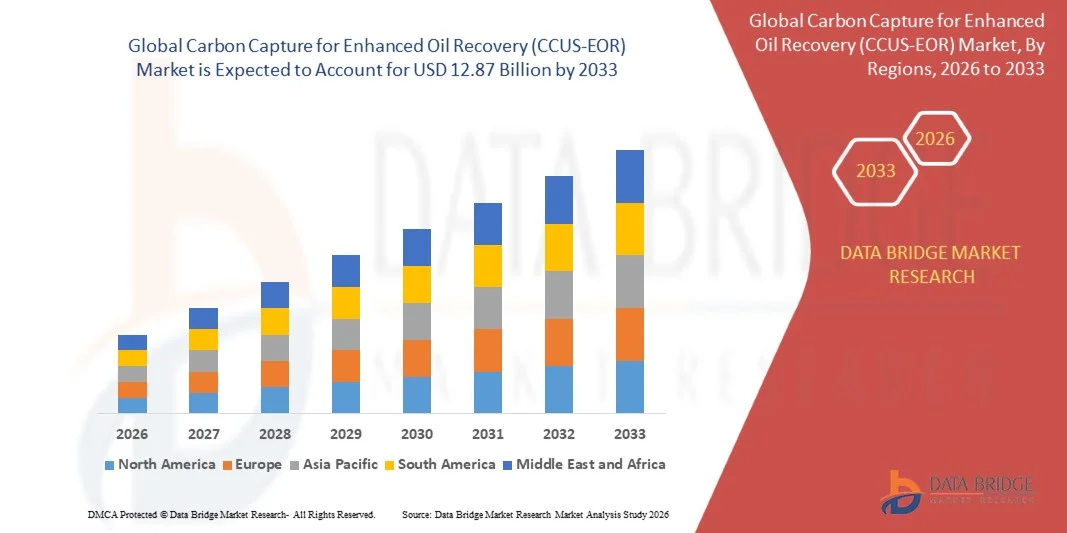
As per Data Bridge Market Research Analysis the Carbon Capture for Enhanced Oil Recovery (CCUS-EOR) Market was valued at USD 5.20 billion in 2025 and is projected to reach USD 12.87 billion by 2033, growing at a CAGR of 12% from 2026 to 2033. The market is experiencing significant growth driven by the increasing adoption of CO₂ EOR techniques to enhance oil recovery from mature fields, supported by favorable policies such as tax credits for carbon sequestration and the growing integration of carbon capture, utilization, and storage (CCUS) technologies.
CCUS-EOR technology is characterized by carbon dioxide being captured and injected into oil fields to enhance oil recovery, while geological sequestration of carbon dioxide is simultaneously achieved. This technology is recognized not only for carbon emissions being reduced but also for economic benefits of oil fields being improved, making it a solution with dual environmental and economic benefits. CO₂-enhanced oil recovery (CO₂-EOR), combined with carbon capture, utilization, and storage (CCUS), offers a strategy to boost hydrocarbon production while reducing atmospheric CO₂. CO₂-EOR has emerged as particularly promising, not only for its effectiveness in mobilizing residual oil but also for its potential to contribute to climate change mitigation through geological carbon storage.
Market Size & Forecast
- Global Market Value (2025): USD 5.20 Billion
- Expected Market Value (2033): USD 12.87 Billion
- Forecast CAGR (2026–2033): 12%
- Leading Region in 2025: North America
- Fastest Growing Region: Asia-Pacific
Key Market Trends & Insights
- North America dominated the global CCUS-EOR market with the largest revenue share in 2025, supported by extensive infrastructure, favorable regulatory frameworks, and significant investments in CO₂ injection methods in mature oil fields, particularly in Texas and along the Gulf Coast. The United States stands as a global leader in the CO₂ EOR market, leveraging its extensive infrastructure and regulatory support. In 2024, the U.S. market size surpassed USD 22 billion, with projections indicating a significant increase to approximately USD 44.25 billion by 2034.
- Asia-Pacific is expected to be the fastest-growing region during the forecast period, driven by increasing energy demand, growing adoption of CCUS technologies, and government initiatives promoting low-carbon oil production. India's NITI Aayog has integrated CCUS into national energy transition plans, including oil recovery enhancement using CO₂ in mature fields. China is actively advancing CCUS-EOR projects, with the Daqing Oilfield demonstrating the dual benefits of reducing emissions and increasing production.
- The Pure CO₂ Injection Systems segment accounted for a significant market share in 2025, driven by the increasing adoption of CO₂ injection methods to enhance oil recovery from mature oil reservoirs. These systems enable producers to extract additional crude oil through enhanced oil flow and reduced oil viscosity.
- CO₂ Capture-Integrated Systems are projected to witness the fastest growth from 2026 to 2033, driven by the growing integration of carbon capture and storage programs that offer promising avenues for improving both oil recovery and carbon reduction objectives.
- The Major Oil & Gas Producers segment dominated the end-user category in 2025, as major companies such as Exxon Mobil Corporation, BP plc, Chevron Corporation, TotalEnergies SE, and Occidental Petroleum Corporation continue to invest in CO₂ EOR technologies to enhance production from aging reservoirs.
Report Scope and Carbon Capture for Enhanced Oil Recovery (CCUS-EOR) Market Segmentation
|
Attributes |
Carbon Capture for Enhanced Oil Recovery (CCUS-EOR) Key Market Insights |
|
Segments Covered |
|
|
Countries Covered |
North America
Europe
Asia-Pacific
Middle East and Africa
South America
|
|
Key Market Players |
|
|
Market Opportunities |
|
|
Value Added Data Infosets |
|
What is the Key Trend in the Carbon Capture for Enhanced Oil Recovery (CCUS-EOR)?
Trend: Integration of Carbon Capture and Storage with Enhanced Oil Recovery
The integration of CO₂ EOR with carbon capture and storage (CCS) programs offers a promising avenue for improving both oil recovery and carbon reduction objectives. This dual strategy enables operators to enhance hydrocarbon production while permanently storing CO₂ in geological formations. CO₂-EOR produces between 0.25 and 0.30 million barrels of additional crude oil daily, primarily in established oil fields which include Texas and the Gulf Coast. The process occurs mainly in established oil fields because CO₂ injection helps recover resources from older oil fields through both stored and naturally occurring CO₂ supply systems.
Carbon Capture for Enhanced Oil Recovery (CCUS-EOR) Market Dynamics
Key Market Driver: Enhanced Oil Recovery Efficiency
Enhanced oil recovery efficiency is the primary driver of the CCUS-EOR market, accounting for approximately 45% of market growth. CO₂ injection into oil reservoirs enhances oil recovery through mechanisms such as miscible displacement, oil viscosity reduction, and swelling effects. Advanced injection techniques including continuous gas injection (CGI), water-alternating-gas (WAG), and gas-assisted gravity drainage (GAGD) address persistent challenges such as gas breakthrough, poor sweep efficiency, and reservoir heterogeneity. CO₂-EOR techniques are expected to improve oil recovery rates by up to 15% in mature fields by 2026.
Key Restraint/Challenge: High Capital and Operational Costs
The high cost of CO₂ capture, transportation, and injection infrastructure remains a significant restraint for the CCUS-EOR market. Advanced capture technologies, pipeline networks, and injection facilities require substantial capital investment. In the CCUS-EOR process, a large amount of energy (such as electricity and fuel) is consumed during capture, transportation, and injection operations, with carbon emissions being generated by the use of these energy sources. Without proper accounting, the carbon reduction effect of the technology could be significantly overestimated.
Key Market Opportunity: Integration of AI and Digital Technologies
The integration of artificial intelligence, digital twins, and advanced monitoring systems presents a significant market opportunity. AI-based reservoir modelling, real-time tracking, and predictive analysis optimize oil recovery rates and lower operational costs. Advanced monitoring techniques, such as 4D seismic imaging and pressure monitoring, detect potential leakage and ensure the integrity of storage sites. These technologies enhance efficiency and sustainability while ensuring competitiveness in a changing energy economy.
How is the Carbon Capture for Enhanced Oil Recovery (CCUS-EOR) Segmented?
The Carbon Capture for Enhanced Oil Recovery (CCUS-EOR) market is segmented on the basis of technology, source, injection method, application, end user, and capacity.
By Technology
On the basis of technology, the global CCUS-EOR market is segmented into pure CO₂ injection systems, CO₂ capture-integrated systems, and hybrid recovery solutions.
The Pure CO₂ Injection Systems segment accounted for a significant market share in 2025, driven by the increasing adoption of CO₂ injection methods to enhance oil recovery from mature oil reservoirs. These systems enable producers to extract additional crude oil through enhanced oil flow and reduced oil viscosity, improving recovery rates by approximately 10 to 20 percent when compared to conventional extraction methods. The United States is the epicenter of CO₂ EOR production, with major markets in Texas' Permian Basin, Mississippi, Louisiana, Montana, and Wyoming.
The CO₂ Capture-Integrated Systems segment is projected to witness the fastest growth from 2026 to 2033, driven by the growing integration of carbon capture and storage programs. Carbon utilization, particularly in enhanced oil recovery (EOR), is emerging as the fastest-growing segment as industries repurpose captured CO₂ for energy production. Collaborating with industrial sources can provide a secure supply of CO₂ while taking advantage of government incentives such as tax credits and carbon trading mechanisms.
By Source
On the basis of source, the global CCUS-EOR market is segmented into industrial processes, natural sources, and geological sources.
The Natural Sources segment is currently the dominant source of CO₂ for EOR operations. Natural carbon dioxide is the source of approximately 78.7% of the CO₂ for CO₂ EOR in the United States. The United States is the only place in the world where commercial-scale CO₂ drilling is occurring, predominantly located in the southwest, with active commercial production sites in Colorado and New Mexico. Industrial processes, including natural gas plants where CO₂ is produced as a by-product, account for the vast majority of the remaining CO₂ used for EOR.
By Injection Method
On the basis of injection method, the global CCUS-EOR market is segmented into continuous CO₂ injection, cyclic CO₂ injection, CO₂ flooding, and water-alternating-gas (WAG) injection.
Continuous CO₂ flooding yields the highest oil recovery compared to other methods. The WAG injection method has become the most effective replacement for constant CO₂ injection, especially in geologically diversified reservoirs. Studies have shown WAG achieving 5.9% higher recovery than continuous CO₂ flooding in certain reservoir conditions. CO₂-WAG injection provides a balanced approach, enhancing recovery while enabling CO₂ sequestration. Advanced injection techniques including continuous gas injection, WAG, and gas-assisted gravity drainage (GAGD) address persistent challenges such as gas breakthrough, poor sweep efficiency, and reservoir heterogeneity.
By Application
On the basis of application, the global CCUS-EOR market is segmented into conventional oilfield operations, tertiary recovery, pilot environmental projects, and carbon utilization initiatives.
The Tertiary Recovery segment dominated the market in 2025, as CO₂-EOR is an advanced production technique that aims to increase oil recovery beyond primary and secondary methods. Enhanced Oil Recovery (EOR) involves tertiary extraction methods specifically engineered to extract residual crude oil remaining after primary and secondary production stages. Declining output from mature oilfields is encouraging operators to adopt tertiary recovery techniques to maximize extraction from existing reservoirs. CO₂ injection is one of the key technologies within the EOR market, alongside thermal and chemical methods.
By End User
On the basis of end user, the global CCUS-EOR market is segmented into major oil & gas producers, independent operators, and government & regulatory initiatives.
The Major Oil & Gas Producers segment dominated the market in 2025, with companies such as Exxon Mobil Corporation, BP plc, Chevron Corporation, TotalEnergies SE, and Occidental Petroleum Corporation leading the market. Oil and gas companies are set to play a major role in terms of scaling both capture and storage capacity. Occidental is the top CO₂ EOR driller in the Permian Basin, which is by far the biggest CO₂ EOR field. Government-backed CO₂ incentives and growing CCUS infrastructure are accelerating adoption, particularly in North America and the Middle East.
Which Region Holds the Largest Share of the Carbon Capture for Enhanced Oil Recovery (CCUS-EOR)?
North America Carbon Capture for Enhanced Oil Recovery (CCUS-EOR) Market Insight
North America dominated the CCUS-EOR market and accounted for the largest revenue share in 2025, supported by extensive infrastructure, favorable regulatory frameworks, and significant investments in CO₂ injection methods in mature oil fields. The United States stands as a global leader in the CO₂ EOR market, leveraging its extensive infrastructure and regulatory support. In 2024, the U.S. market size surpassed USD 22 billion, with projections indicating a significant increase to approximately USD 44.25 billion by 2034. This expansion is attributed to the deployment of CO₂ injection methods in mature oil fields, particularly in Texas and along the Gulf Coast.
U.S. Carbon Capture for Enhanced Oil Recovery (CCUS-EOR) Market Insight
The U.S. CCUS-EOR market is experiencing robust growth, driven by the expansion of CO₂ injection in mature oil fields, rising regulatory support, and growing corporate commitments to carbon management. The U.S. government has enhanced incentives for CO₂ EOR through the 45Q tax credit, which offers up to $85 per metric ton for CO₂ used in oil production. The DOE has selected projects to evaluate CO₂-EOR in unconventional reservoirs, explicitly aiming to pair captured CO₂ with incremental oil recovery. In August 2024, DOE announced up to $54.4 million in additional carbon-management funding.
Canada Carbon Capture for Enhanced Oil Recovery (CCUS-EOR) Market Insight
The Canada CCUS-EOR market is expanding steadily, supported by extensive oil sands operations, growing environmental awareness, and increasing government focus on sustainable carbon management. Canadian operators are investing in advanced CO₂ injection technologies to enhance oil recovery while reducing carbon emissions.
Europe Carbon Capture for Enhanced Oil Recovery (CCUS-EOR) Market Insight
The Europe CCUS-EOR market is witnessing steady growth, driven by stringent environmental regulations, increasing focus on carbon reduction, and growing investments in CCS projects. INEOS and its partners pledged to invest in Greensand Future off the coast of Denmark, aiming to inject as much as 400,000 tonnes of CO₂ per year into an existing depleted oilfield. The project is supported by a USD 197 million grant from the Danish government. Europe focuses on environmental compliance and is projected to reach USD 1.5 billion by 2030.
Asia-Pacific Carbon Capture for Enhanced Oil Recovery (CCUS-EOR) Market Insight
The Asia-Pacific region is expected to witness the fastest growth, driven by increasing energy demand, growing adoption of CCUS technologies, and government initiatives promoting low-carbon oil production. India's NITI Aayog has integrated CCUS into national energy transition plans, including oil recovery enhancement using CO₂ in mature fields. China is actively advancing CCUS-EOR projects, with the Daqing Oilfield demonstrating the dual benefits of reducing emissions and increasing production. Asia-Pacific is projected to reach USD 2.5 billion by 2030.
Middle East and Africa Carbon Capture for Enhanced Oil Recovery (CCUS-EOR) Market Insight
The Middle East and Africa CCUS-EOR market is gradually emerging, driven by increasing oil and gas activities, growing focus on carbon management, and investments in sustainable energy production. National oil companies in the region are increasingly exploring CO₂ injection technologies to enhance recovery from mature fields while reducing carbon footprint.
China Carbon Capture for Enhanced Oil Recovery (CCUS-EOR) Market Insight
The China CCUS-EOR market is growing rapidly, driven by the country's commitment to carbon peak and carbon neutrality goals. China National Petroleum Corporation and Sinopec have taken the lead in proposing strategic plans to achieve carbon neutrality by 2050. In the Tree 16 block of Daqing Oilfield, cumulative net reduction in emissions reached 455,000 tons with an emission reduction rate of 59.21%. This study confirmed that CCUS-EOR technology has the dual benefits of reducing emissions and increasing production.
South America Carbon Capture for Enhanced Oil Recovery (CCUS-EOR) Market Insight
The South America CCUS-EOR market is expanding, driven by increasing oil and gas activities, rising environmental awareness, and growing government focus on sustainable carbon management. Countries such as Brazil are investing in CO₂ injection technologies to enhance oil recovery and reduce carbon emissions.
Which are the Top Companies in Carbon Capture for Enhanced Oil Recovery (CCUS-EOR)?
The Carbon Capture for Enhanced Oil Recovery (CCUS-EOR) industry is primarily led by well-established companies, including:
- Exxon Mobil Corporation (U.S.)
- BP plc (U.K.)
- Chevron Corporation (U.S.)
- TotalEnergies SE (France)
- Occidental Petroleum Corporation (U.S.)
- Shell plc (U.K.)
- Equinor ASA (Norway)
- China National Petroleum Corporation (China)
- China Petroleum & Chemical Corporation (Sinopec) (China)
- Kinder Morgan Inc. (U.S.)
- INEOS Group (U.K.)
- Santos Limited (Australia)
- Beach Energy Limited (Australia)
- Petrofac Limited (U.K.)
- Schlumberger Limited (U.S.)
- Halliburton Company (U.S.)
- Baker Hughes Company (U.S.)
- Weatherford International plc (U.S.)
- TechnipFMC plc (U.K.)
- Aker Solutions ASA (Norway)
What are Latest Developments in Carbon Capture for Enhanced Oil Recovery (CCUS-EOR)?
- In September 2025, NITI Aayog announced that the Indian government will soon launch a national Carbon Capture, Utilisation and Storage (CCUS) mission. The initiative aims to balance rising energy demand with climate goals and could offer financial support ranging from 50% to 100% for select projects. CCUS is expected to play a critical role in India's roadmap to achieve its net-zero emissions target by 2070.
- In May 2025, the U.S. Energy Information Administration (EIA) reported that CO₂ enhanced oil recovery produces between 0.25 and 0.30 million barrels of additional crude oil daily. The process occurs mainly in established oil fields which include Texas and the Gulf Coast. CO₂-EOR currently serves as the final carbon sink for nine of the ten biggest U.S.-based Carbon Capture and Storage (CCS) projects.
- In January 2025, Santos and Beach Energy officially inaugurated Australia's first large-scale onshore carbon capture and storage project at Moomba in the Cooper Basin. The project has already sequestered 340,000 tonnes of CO₂-equivalent since its startup in October 2024. At full capacity, Phase 1 of the project will store up to 1.7 million tonnes of CO₂ per annum using depleted reservoirs.
- In November 2025, INEOS and its partners announced that the Greensand Future project off the coast of Denmark will begin operations next year, initially storing 400,000 tonnes of CO₂ per year. By 2030, the project aims to scale up to as much as 8 million tonnes of CO₂ The CO₂ will be injected into a depleted oil field 1,800 metres below the seabed.
- In May 2024, Kinder Morgan acquired oil and gas producing assets spanning approximately 11,600 acres in West Texas for around $100 million. The pipeline operator plans to leverage U.S. carbon capture incentives to boost production from the properties using CO₂ enhanced oil recovery techniques.
- In April 2024, the U.S. Department of Energy's Office of Fossil Energy and Carbon Management selected $23.2 million in projects to evaluate CO₂-EOR in unconventional reservoirs. The projects aim to assess the feasibility of permanent CO₂ storage in depleted unconventional shale oil and gas reservoirs. The two selected projects will examine the effectiveness of the CO₂-EOR with geologic storage process when applied to low-permeability, light-oil unconventional reservoirs.
- In August 2024, the U.S. Department of Energy announced up to $54.4 million in additional funding to advance diverse carbon management approaches that reduce CO₂ The funding supports the development of technologies that capture CO₂ from industrial and power generation sources or directly from the atmosphere. The captured CO₂ can then be transported either for permanent geologic storage or conversion into valuable products such as fuels and chemicals.

- Interactive Data Analysis Dashboard
- Company Analysis Dashboard for high growth potential opportunities
- Research Analyst Access for customization & queries
- Competitor Analysis with Interactive dashboard
- Latest News, Updates & Trend analysis
- Harness the Power of Benchmark Analysis for Comprehensive Competitor Tracking
Global Carbon Capture For Enhanced Oil Recovery Ccus Eor Market, Supply Chain Analysis and Ecosystem Framework
To support market growth and help clients navigate the impact of geopolitical shifts, DBMR has integrated in-depth supply chain analysis into its Global Carbon Capture For Enhanced Oil Recovery Ccus Eor Market research reports. This addition empowers clients to respond effectively to global changes affecting their industries. The supply chain analysis section includes detailed insights such as Global Carbon Capture For Enhanced Oil Recovery Ccus Eor Market consumption and production by country, price trend analysis, the impact of tariffs and geopolitical developments, and import and export trends by country and HSN code. It also highlights major suppliers with data on production capacity and company profiles, as well as key importers and exporters. In addition to research, DBMR offers specialized supply chain consulting services backed by over a decade of experience, providing solutions like supplier discovery, supplier risk assessment, price trend analysis, impact evaluation of inflation and trade route changes, and comprehensive market trend analysis.
Data collection and base year analysis are done using data collection modules with large sample sizes. The stage includes obtaining market information or related data through various sources and strategies. It includes examining and planning all the data acquired from the past in advance. It likewise envelops the examination of information inconsistencies seen across different information sources. The market data is analysed and estimated using market statistical and coherent models. Also, market share analysis and key trend analysis are the major success factors in the market report. To know more, please request an analyst call or drop down your inquiry.
The key research methodology used by DBMR research team is data triangulation which involves data mining, analysis of the impact of data variables on the market and primary (industry expert) validation. Data models include Vendor Positioning Grid, Market Time Line Analysis, Market Overview and Guide, Company Positioning Grid, Patent Analysis, Pricing Analysis, Company Market Share Analysis, Standards of Measurement, Global versus Regional and Vendor Share Analysis. To know more about the research methodology, drop in an inquiry to speak to our industry experts.
Data Bridge Market Research is a leader in advanced formative research. We take pride in servicing our existing and new customers with data and analysis that match and suits their goal. The report can be customized to include price trend analysis of target brands understanding the market for additional countries (ask for the list of countries), clinical trial results data, literature review, refurbished market and product base analysis. Market analysis of target competitors can be analyzed from technology-based analysis to market portfolio strategies. We can add as many competitors that you require data about in the format and data style you are looking for. Our team of analysts can also provide you data in crude raw excel files pivot tables (Fact book) or can assist you in creating presentations from the data sets available in the report.













