


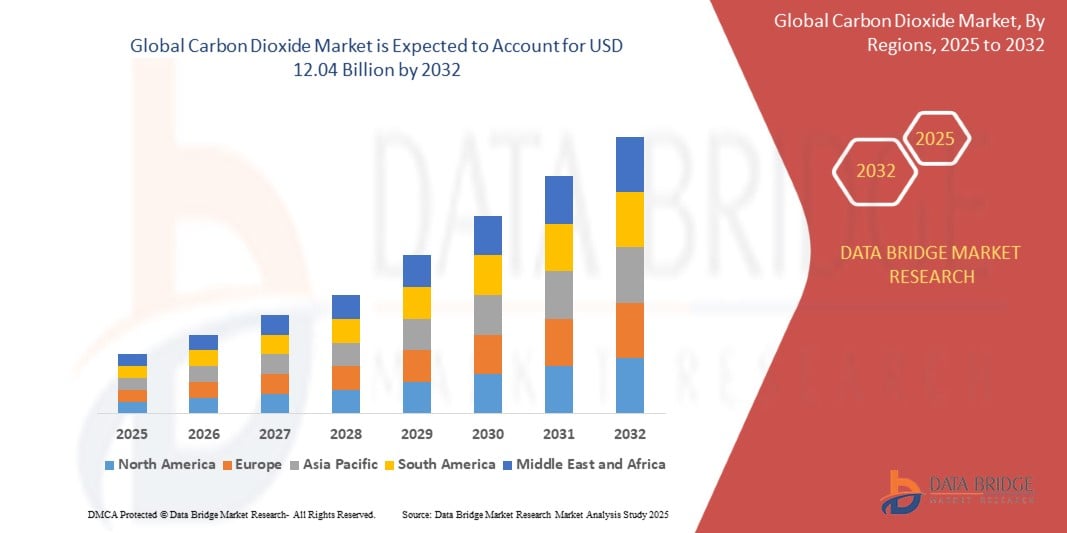
Carbon Dioxide Market Size
- The global carbon dioxide market was valued at USD 9.15 billion in 2024 and is expected to reach USD 12.04 billion by 2032
- During the forecast period of 2025 to 2032 the market is likely to grow at a CAGR of 3.50% primarily driven by the increasing demand for carbon dioxide across various industries such as food and beverages, healthcare, and oil & gas, along with the rising need for enhanced carbon capture and utilization technologies
- This growth is driven by factors such as the expanding application of CO2 in food preservation, beverage carbonation, enhanced oil recovery (EOR), and growing industrial adoption for environmental sustainability practices such as carbon sequestration
Carbon Dioxide Market Analysis
- Carbon dioxide (CO₂) is a colorless, odorless gas that is naturally present in Earth's atmosphere and is used in various industries for different applications. It is produced through natural processes such as respiration and combustion, as well as industrial processes such as the production of hydrogen, ethyl alcohol, and ethylene oxide
- The carbon dioxide market is witnessing growth due to its wide-ranging applications across industries such as food and beverage, healthcare, and oil and gas
- For instance, Coca-Cola and Pepsi use carbon dioxide for carbonation in their soft drinks, while it also helps preserve packaged food items such as meats and vegetables
- In the healthcare sector, carbon dioxide is essential for medical procedures such as laparoscopic surgeries. During these operations, carbon dioxide is used to inflate the abdomen, providing a clearer view for surgeons. It also plays a role in respiratory treatments for patients with conditions such as chronic obstructive pulmonary disease
- The oil and gas industry continues to rely on carbon dioxide for enhanced oil recovery.
- For instance, The Sleipner project in Norway, where carbon dioxide is injected into depleted oil fields to increase production and reduce carbon emissions
- Industrial uses of carbon dioxide are also growing, especially in applications such as welding and chemical production. In the automotive industry, carbon dioxide is used in precision MIG/MAG welding, and in the chemical sector, it serves as a raw material for creating urea in fertilizers
- The market is also benefiting from the rise of carbon capture technologies, where carbon dioxide is captured from industrial emissions
- For instance, projects such as Carbon Clean Solutions in India capture carbon dioxide and convert it into green chemicals for use in various industries
Report Scope and Carbon Dioxide Market Segmentation
|
Attributes |
Bonsai Key Market Insights |
|
Segments Covered |
|
|
Countries Covered |
North America
Europe
Asia-Pacific
Middle East and Africa
South America
|
|
Key Market Players |
|
|
Market Opportunities |
|
|
Value Added Data Infosets |
In addition to the insights on market scenarios such as market value, growth rate, segmentation, geographical coverage, and major players, the market reports curated by the Data Bridge Market Research also include import export analysis, production capacity overview, production consumption analysis, price trend analysis, climate change scenario, supply chain analysis, value chain analysis, raw material/consumables overview, vendor selection criteria, PESTLE Analysis, Porter Analysis, and regulatory framework. |
Carbon Dioxide Market Trends
“Increasing Use of Carbon Dioxide in Sustainability Efforts”
- The use of carbon dioxide in carbon capture and storage technologies is gaining momentum as industries focus on reducing emissions
- For instance, The Sleipner CO2 storage project in Norway captures carbon dioxide from natural gas production and injects it into underground reservoirs, preventing its release into the atmosphere
- Carbon utilization is becoming a significant trend, where captured carbon dioxide is converted into valuable products such as synthetic fuels or chemicals
- For instance, Carbon Clean Solutions, which captures carbon dioxide from industrial processes and uses it to produce green chemicals for various applications
- The development of direct air capture technologies is another growing trend, where carbon dioxide is pulled directly from the atmosphere. Companies such as Clime works are pioneering this technology, offering a way to remove excess carbon dioxide from the air and potentially reverse some effects of climate change
- Carbon dioxide is also being used in enhanced oil recovery, where it is injected into oil fields to improve extraction rates. The In Salah Gas Project in Algeria is one example where carbon dioxide is captured and used for this purpose while also storing it underground, thus reducing net emissions
- The use of carbon dioxide in manufacturing is rising, with its application in producing concrete and other building materials. Companies such as Blue Planet are working on capturing carbon dioxide and turning it into aggregate for concrete production, helping the construction industry lower its carbon footprint
Carbon Dioxide Market Dynamics
Driver
“Expansion of Carbon Capture and Storage (CCS) Technologies”
- Governments worldwide are implementing stringent environmental regulations targeting industries with significant carbon footprints, such as power generation, cement, and steel manufacturing
- For instance, the European Union's Emissions Trading System imposes caps on emissions, compelling these sectors to adopt carbon capture and storage (CCS) technologies to comply with legal requirements and avoid financial penalties
- Technological innovations have enhanced the efficiency and reduced the costs associated with CCS. The development of advanced solvents and membrane technologies has improved the capture process, making it more economically viable for industries to implement. These advancements have led to increased adoption of CCS across various sectors
- Captured carbon dioxide is being repurposed for enhanced oil recovery, where it is injected into mature oil fields to increase extraction efficiency. This not only provides a practical use for the captured CO₂ but also contributes to offsetting the costs associated with CCS implementation
- The food and beverage sector utilizes captured CO₂ for carbonation in soft drinks and preservation of packaged foods. This application demonstrates a sustainable loop where industrial emissions are transformed into valuable inputs for other industries, promoting a circular economy
- Innovative processes are being developed to convert captured carbon dioxide into synthetic fuels. Companies such as, Air Company have pioneered technology to produce ethanol from CO₂ and hydrogen, resulting in carbon-negative products such as vodka and sustainable aviation fuel. This approach not only reduces atmospheric CO₂ levels but also offers a sustainable alternative to fossil fuels
Opportunity
“Emergence of Carbon Dioxide Removal (CDR) Technologies”
- Governments and industries worldwide are prioritizing carbon dioxide removal to meet climate goals, creating significant opportunities for innovative carbon capture technologies
- For instance, The U.S. and the European Union have introduced policies and incentives to accelerate carbon capture adoption, such as the Inflation Reduction Act, which provides tax credits for direct air capture projects
- Technologies that directly capture carbon dioxide from the atmosphere are being increasingly deployed in industrial sectors, with applications in energy, manufacturing, and agriculture. Clime works, a Swiss company, has built one of the largest direct air capture plants in Iceland, which removes carbon dioxide and stores it underground in basalt rock formations, demonstrating the scalability of this approach
- Research institutions, corporations, and policymakers are funding carbon removal initiatives as part of comprehensive climate strategies, encouraging large-scale adoption of these technologies. Microsoft and Shopify have made significant investments in carbon removal startups such as Charm Industrial, which converts captured CO₂ into bio-oil and stores it underground to ensure long-term sequestration
- Industries are exploring ways to repurpose captured carbon dioxide, including its use in enhanced agricultural productivity, synthetic fuel production, and sustainable construction materials. CarbonCure Technologies, a Canadian company, has developed a method to inject captured CO₂ into concrete, reducing emissions while strengthening the material, a solution already adopted by leading construction firms
- Leading companies are incorporating carbon removal technologies into their environmental policies, driving innovation and accelerating market growth in carbon capture and utilization. Google, Stripe, and Meta have pledged millions of dollars toward long-term carbon removal commitments through initiatives such as Frontier, a coalition aimed at advancing carbon capture technologies
Restraint/Challenge
“Market Volatility and Regulatory Uncertainty”
- Industries face challenges in navigating inconsistent carbon policies across different countries, making long-term planning difficult
- For instance, while the European Union has established a well-defined Emissions Trading System (ETS), the U.S. lacks a unified federal carbon pricing mechanism, causing disparities in how carbon capture investments are incentivized
- The success of carbon management projects depends on stable government incentives and regulations. In some cases, sudden policy shifts have disrupted investments
- For instance, Australia’s repeal of its carbon tax in 2014 led to uncertainty in the carbon market, discouraging businesses from investing in emission reduction technologies
- Industries that rely on carbon dioxide, such as the food and beverage sector, face price volatility and supply disruptions.
- For instance, in 2022 when the UK’s CO₂ supply chain was disrupted due to rising energy costs, impacting soft drink manufacturers and meat processing companies that depend on carbon dioxide for packaging and preservation
- Companies are reluctant to implement large-scale carbon capture and storage (CCS) projects due to uncertain long-term returns.
- For instance, ExxonMobil has announced ambitious CCS investments but remains cautious about full-scale implementation due to unclear future regulations and potential changes in government incentives
- Overcoming these challenges requires international collaboration to create stable policies that promote investment in sustainable carbon management. Organizations such as the United Nations and the World Bank are advocating for global carbon pricing frameworks to ensure a predictable market environment, enabling businesses to invest confidently in long-term carbon reduction strategies
Carbon Dioxide Market Scope
The market is segmented on the basis of source, form, delivery mode, production, and application.
|
Segmentation |
Sub-Segmentation |
|
By Source |
|
|
By Form |
|
|
By Delivery Mode |
|
|
By Production |
|
|
By Application |
|
Carbon Dioxide Market Regional Analysis
“North America is the Dominant Region in the Carbon Dioxide Market”
- North America, particularly the U.S. and Canada, dominates the global carbon dioxide market, driven by strong industrial infrastructure and high demand for CO₂ in various sectors
- The U.S. plays a pivotal role in the food and beverage industry, where carbon dioxide is essential for carbonation, preservation, and packaging, with applications in soft drinks, processed foods, and meat packaging
- Significant investments in carbon capture and storage (CCS) technologies in North America aim to reduce emissions, with the region being at the forefront of innovation in this area, ensuring a sustainable future for CO₂ usage
- U.S. government policies, such as tax incentives and regulatory frameworks, encourage industries to adopt carbon dioxide management solutions, driving the market forward and making it more economically viable for businesses
- The oil and gas sector continues to rely heavily on carbon dioxide for enhanced oil recovery, while sectors such as healthcare, where CO₂ is used in medical treatments and as a refrigerant, contribute to the increasing demand for CO₂ in North America
“Asia-Pacific is Projected to Register the Highest Growth Rate”
- The Asia-Pacific region is experiencing the fastest growth in the global carbon dioxide market, driven by the rapid industrialization and economic expansion in emerging countries such as China, India, and Southeast Asian nations
- The food and beverage industry plays a pivotal role in this growth, with carbon dioxide being crucial for carbonation, refrigeration, and preservation, particularly in the production of carbonated beverages, processed foods, and packaged products
- The healthcare sector is another significant driver, with carbon dioxide being used in minimally invasive surgeries and as a refrigerant in medical storage, leading to increased demand as the region's healthcare infrastructure continues to expand
- The adoption of carbon capture and storage (CCS) technologies in the region is growing due to the increasing focus on environmental sustainability, with governments introducing policies and incentives to encourage CO₂ reduction and sustainable technologies
- The rapidly developing manufacturing sectors in Asia-Pacific, including chemical production and oil refining, are contributing to the rising demand for carbon dioxide, further positioning the region as the fastest-growing market for CO₂ in the world
Carbon Dioxide Market Share
The market competitive landscape provides details by competitor. Details included are company overview, company financials, revenue generated, market potential, investment in research and development, new market initiatives, global presence, production sites and facilities, production capacities, company strengths and weaknesses, product launch, product width and breadth, application dominance. The above data points provided are only related to the companies' focus related to market.
The Major Market Leaders Operating in the Market Are:
- Linde PLC (Ireland)
- Air Liquide (France)
- Universal Industrial Gases (U.S.)
- MATHESON TRI-GAS, INC. (U.S.)
- India Glycols (India)
- POET, LLC (U.S.)
- Air Products and Chemicals, Inc. (U.S.)
- Gulfcryo (UAE)
- Delux Industrial Gases (India)
- Ellenbarrie industrial Gases (India)
- TAIYO NIPPON SANSO CORPORATION (Japan)
- Gulfcryo (UAE)
- Acail Gás (Portugal)
Latest Developments in Global Carbon Dioxide Market
- In October 2023, MIT engineers developed an efficient fuel production process from carbon dioxide. This ground breaking technology aims to convert carbon dioxide into usable fuels, addressing both energy needs and climate change by reducing atmospheric CO₂ levels. The development uses an electrochemical process to produce high-density fuels, which could be more energy-efficient and sustainable compared to traditional fuel production methods. The potential benefit includes providing a cleaner alternative to fossil fuels, offering a way to reuse CO₂ and mitigate global warming. This innovation is expected to significantly impact the market by accelerating the transition to green energy technologies and fostering growth in industries focused on carbon capture and sustainable fuel production.

- Interactive Data Analysis Dashboard
- Company Analysis Dashboard for high growth potential opportunities
- Research Analyst Access for customization & queries
- Competitor Analysis with Interactive dashboard
- Latest News, Updates & Trend analysis
- Harness the Power of Benchmark Analysis for Comprehensive Competitor Tracking
Table of Content
1 INTRODUCTION
1.1 OBJECTIVES OF THE STUDY
1.2 MARKET DEFINITION
1.3 OVERVIEW OF GLOBAL CARBON DIOXIDE MARKET
1.4 CURRENCY AND PRICING
1.5 LIMITATION
1.6 MARKETS COVERED
2 MARKET SEGMENTATION
2.1 KEY TAKEAWAYS
2.2 ARRIVING AT THE GLOBAL CARBON DIOXIDE MARKET SIZE
2.3 VENDOR POSITIONING GRID
2.4 MARKETS COVERED
2.5 GEOGRAPHIC SCOPE
2.6 YEARS CONSIDERED FOR THE STUDY
2.7 RESEARCH METHODOLOGY
2.8 TECHNOLOGY LIFE LINE CURVE
2.9 MULTIVARIATE MODELLING
2.1 PRIMARY INTERVIEWS WITH KEY OPINION LEADERS
2.11 DBMR MARKET POSITION GRID
2.12 MARKET APPLICATION COVERAGE GRID
2.13 DBMR MARKET CHALLENGE MATRIX
2.14 IMPORT AND EXPORT DATA
2.15 SECONDARY SOURCES
2.16 GLOBAL CARBON DIOXIDE MARKET: RESEARCH SNAPSHOT
2.17 ASSUMPTIONS
3 MARKET OVERVIEW
3.1 DRIVERS
3.2 RESTRAINTS
3.3 OPPORTUNITIES
3.4 CHALLENGES
4 EXECUTIVE SUMMARY
5 PREMIUM INSIGHTS
5.1 VALUE CHAIN ANALYSIS
5.2 REGULATORY FRAMEWORK
6 INDUSTRY INSIGHTS
7 IMPACT OF COVID-19 PANDEMIC ON GLOBAL CARBON DIOXIDE MARKET
7.1 ANALYSIS ON IMPACT OF COVID-19 ON THE MARKET
7.2 AFTERMATH OF COVID-19 AND GOVERNMENT INITIATIVE TO BOOST THE MARKET
7.3 STRATEGIC DECISIONS FOR MANUFACTUERS AFTER COVID-19 TO GAIN COMPETITIVE MARKET SHARE
7.4 PRICE IMPACT
7.5 IMPACT ON DEMAND
7.6 IMPACT ON SUPPLY CHAIN
7.7 CONCLUSION
8 GLOBAL CARBON DIOXIDE MARKET, BY SOURCE
8.1 OVERVIEW
8.2 HYDROGEN
8.3 ETHYLENE OXIDE
8.4 ETHYL ALCOHOL
8.5 SUBSTITUTE NATURAL GAS
8.6 OTHERS
9 GLOBAL CARBON DIOXIDE MARKET, BY FORM
9.1 OVERVIEW
9.2 SOLID FORM
9.3 LIQUID FORM
9.4 GASEOUS FORM
10 GLOBAL CARBON DIOXIDE MARKET, BY GRADE
10.1 OVERVIEW
10.2 FOOD GRADE
10.3 MEDICAL GRADE
10.4 INDUSTRIAL GRADE
10.5 OTHERS
11 GLOBAL CARBON DIOXIDE MARKET, BY PRODUCTION
11.1 OVERVIEW
11.2 COMBUSTION
11.3 BIOLOGICAL
12 GLOBAL CARBON DIOXIDE MARKET,BY DELIVERY MODE
12.1 OVERVIEW
12.2 CENTRALIZED
12.3 ONSITE
13 GLOBAL CARBON DIOXIDE MARKET, BY APPLICATION
13.1 OVERVIEW
13.2 FOOD
13.3 BEVERAGES
13.4 ALCOHOLIC
13.5 NON-ALCOHOLIC
13.6 OIL & GAS
13.7 PHARMACEUTICALS
13.8 FIRE FIGHTING
13.9 METAL MANUFACTURING & FABRICATION
13.1 ENERGY
13.11 AUTOMOTIVE
13.12 CHEMICALS
13.13 OTHERS
13.14 OTHERS, BY END-USE
13.15 RUBBER
13.16 PULP & PAPER
13.17 AGRICULTURE
13.18 WATER TREATMENT
13.19 OTHERS
14 GLOBAL CARBON DIOXIDE MARKET, BY GEOGRAPHY
14.1 GLOBAL CARBON DIOXIDE MARKET, (ALL SEGMENTATION PROVIDED ABOVE IS REPRESENTED IN THIS CHAPTER BY COUNTRY)
14.2 NORTH AMERICA
14.2.1 U.S.
14.2.2 CANADA
14.2.3 MEXICO
14.3 EUROPE
14.3.1 GERMANY
14.3.2 U.K.
14.3.3 ITALY
14.3.4 FRANCE
14.3.5 SPAIN
14.3.6 RUSSIA
14.3.7 SWITZERLAND
14.3.8 TURKEY
14.3.9 BELGIUM
14.3.10 NETHERLANDS
14.3.11 LUXEMBURG
14.3.12 REST OF EUROPE
14.4 ASIA-PACIFIC
14.4.1 JAPAN
14.4.2 CHINA
14.4.3 SOUTH KOREA
14.4.4 INDIA
14.4.5 SINGAPORE
14.4.6 THAILAND
14.4.7 INDONESIA
14.4.8 MALAYSIA
14.4.9 PHILIPPINES
14.4.10 AUSTRALIA & NEW ZEALAND
14.4.11 REST OF ASIA-PACIFIC
14.5 SOUTH AMERICA
14.5.1 BRAZIL
14.5.2 ARGENTINA
14.5.3 REST OF SOUTH AMERICA
14.6 MIDDLE EAST AND AFRICA
14.6.1 SOUTH AFRICA
14.6.2 EGYPT
14.6.3 SAUDI ARABIA
14.6.4 UNITED ARAB EMIRATES
14.6.5 ISRAEL
14.6.6 REST OF MIDDLE EAST AND AMERICA
15 GLOBAL CARBON DIOXIDE MARKET, COMPANY LANDSCAPE
15.1 COMPANY SHARE ANALYSIS: GLOBAL
15.2 COMPANY SHARE ANALYSIS: NORTH AMERICA
15.3 COMPANY SHARE ANALYSIS: EUROPE
15.4 COMPANY SHARE ANALYSIS: ASIA-PACIFIC
15.5 MERGERS AND ACQUISITIONS
15.6 NEW PRODUCT DEVELOPMENT AND APPROVALS
15.7 EXPANSIONS
15.8 PARTNERSHIP AND OTHER STRATEGIC DEVELOPMENTS
16 SWOT AND DATA BRIDGE MARKET RESEARCH ANALYSIS
17 GLOBAL CARBON DIOXIDE MARKET- COMPANY PROFILE
17.1 LINDE PLC
17.1.1 COMPANY SNAPSHOT
17.1.2 REVENUE ANALYSIS
17.1.3 PRODUCT PORTFOLIO
17.1.4 RECENT UPDATES
17.2 AIR LIQUIDE
17.2.1 COMPANY SNAPSHOT
17.2.2 REVENUE ANALYSIS
17.2.3 PRODUCT PORTFOLIO
17.2.4 RECENT UPDATES
17.3 AIR PRODUCTS INC.
17.3.1 COMPANY SNAPSHOT
17.3.2 REVENUE ANALYSIS
17.3.3 PRODUCT PORTFOLIO
17.3.4 RECENT UPDATESA
17.4 INOX AIR PRODUCTS LTD.
17.4.1 COMPANY SNAPSHOT
17.4.2 REVENUE ANALYSIS
17.4.3 PRODUCT PORTFOLIO
17.4.4 RECENT UPDATES
17.5 CONTINENTAL CARBONIC PRODUCTS, INC.
17.5.1 COMPANY SNAPSHOT
17.5.2 REVENUE ANALYSIS
17.5.3 PRODUCT PORTFOLIO
17.5.4 RECENT UPDATES
17.6 PRAXAIR TECHNOLOGY, INC.
17.6.1 COMPANY SNAPSHOT
17.6.2 REVENUE ANALYSIS
17.6.3 PRODUCT PORTFOLIO
17.6.4 RECENT UPDATES
17.7 MATHESON TRI-GAS, INC.
17.7.1 COMPANY SNAPSHOT
17.7.2 REVENUE ANALYSIS
17.7.3 PRODUCT PORTFOLIO
17.7.4 RECENT UPDATES
17.8 THE MESSER GROUP
17.8.1 COMPANY SNAPSHOT
17.8.2 REVENUE ANALYSIS
17.8.3 PRODUCT PORTFOLIO
17.8.4 RECENT UPDATES
17.9 POET, LLC
17.9.1 COMPANY SNAPSHOT
17.9.2 REVENUE ANALYSIS
17.9.3 PRODUCT PORTFOLIO
17.9.4 RECENT UPDATES
17.1 GULF CRYO
17.10.1 COMPANY SNAPSHOT
17.10.2 REVENUE ANALYSIS
17.10.3 PRODUCT PORTFOLIO
17.10.4 RECENT UPDATES
17.11 BUZWAIR INDUSTRIAL GASES FACTORIES
17.11.1 COMPANY SNAPSHOT
17.11.2 REVENUE ANALYSIS
17.11.3 PRODUCT PORTFOLIO
17.11.4 RECENT UPDATES
17.12 SOL SPA
17.12.1 COMPANY SNAPSHOT
17.12.2 REVENUE ANALYSIS
17.12.3 PRODUCT PORTFOLIO
17.12.4 RECENT UPDATES
17.13 RELIANT GASES
17.13.1 COMPANY SNAPSHOT
17.13.2 REVENUE ANALYSIS
17.13.3 PRODUCT PORTFOLIO
17.13.4 RECENT UPDATES
17.14 IWATANI CORPORATION
17.14.1 COMPANY SNAPSHOT
17.14.2 REVENUE ANALYSIS
17.14.3 PRODUCT PORTFOLIO
17.14.4 RECENT UPDATES
17.15 UNIVERSAL INDUSTRIAL GASES, INC.
17.15.1 COMPANY SNAPSHOT
17.15.2 REVENUE ANALYSIS
17.15.3 PRODUCT PORTFOLIO
17.15.4 RECENT UPDATES
17.16 SOUTHERN INDUSTRIAL GAS SDN BHD
17.16.1 COMPANY SNAPSHOT
17.16.2 REVENUE ANALYSIS
17.16.3 PRODUCT PORTFOLIO
17.16.4 RECENT UPDATES
17.17 AIR WATER INC
17.17.1 COMPANY SNAPSHOT
17.17.2 REVENUE ANALYSIS
17.17.3 PRODUCT PORTFOLIO
17.17.4 RECENT UPDATES
17.18 COSMO ENGINEERING CO.,LTD.
17.18.1 COMPANY SNAPSHOT
17.18.2 REVENUE ANALYSIS
17.18.3 PRODUCT PORTFOLIO
17.18.4 RECENT UPDATES
17.19 SABIC
17.19.1 COMPANY SNAPSHOT
17.19.2 REVENUE ANALYSIS
17.19.3 PRODUCT PORTFOLIO
17.19.4 RECENT UPDATES
17.2 SICGIL INDIA LIMITED
17.20.1 COMPANY SNAPSHOT
17.20.2 REVENUE ANALYSIS
17.20.3 PRODUCT PORTFOLIO
17.20.4 RECENT UPDATES
17.21 MATHESON TRI-GAS, INC.
17.21.1 COMPANY SNAPSHOT
17.21.2 REVENUE ANALYSIS
17.21.3 PRODUCT PORTFOLIO
17.21.4 RECENT UPDATES
*Note: the companies profiled is not exhaustive list and is as per our previous client requirement. we profile more than 100 companies in our study and hence the list of Companies can be modified or replaced on request
18 RELATED REPORTS
19 QUESTIONNAIRE
20 CONCLUSION

Global Carbon Dioxide Market, Supply Chain Analysis and Ecosystem Framework
To support market growth and help clients navigate the impact of geopolitical shifts, DBMR has integrated in-depth supply chain analysis into its Global Carbon Dioxide Market research reports. This addition empowers clients to respond effectively to global changes affecting their industries. The supply chain analysis section includes detailed insights such as Global Carbon Dioxide Market consumption and production by country, price trend analysis, the impact of tariffs and geopolitical developments, and import and export trends by country and HSN code. It also highlights major suppliers with data on production capacity and company profiles, as well as key importers and exporters. In addition to research, DBMR offers specialized supply chain consulting services backed by over a decade of experience, providing solutions like supplier discovery, supplier risk assessment, price trend analysis, impact evaluation of inflation and trade route changes, and comprehensive market trend analysis.
Data collection and base year analysis are done using data collection modules with large sample sizes. The stage includes obtaining market information or related data through various sources and strategies. It includes examining and planning all the data acquired from the past in advance. It likewise envelops the examination of information inconsistencies seen across different information sources. The market data is analysed and estimated using market statistical and coherent models. Also, market share analysis and key trend analysis are the major success factors in the market report. To know more, please request an analyst call or drop down your inquiry.
The key research methodology used by DBMR research team is data triangulation which involves data mining, analysis of the impact of data variables on the market and primary (industry expert) validation. Data models include Vendor Positioning Grid, Market Time Line Analysis, Market Overview and Guide, Company Positioning Grid, Patent Analysis, Pricing Analysis, Company Market Share Analysis, Standards of Measurement, Global versus Regional and Vendor Share Analysis. To know more about the research methodology, drop in an inquiry to speak to our industry experts.
Data Bridge Market Research is a leader in advanced formative research. We take pride in servicing our existing and new customers with data and analysis that match and suits their goal. The report can be customized to include price trend analysis of target brands understanding the market for additional countries (ask for the list of countries), clinical trial results data, literature review, refurbished market and product base analysis. Market analysis of target competitors can be analyzed from technology-based analysis to market portfolio strategies. We can add as many competitors that you require data about in the format and data style you are looking for. Our team of analysts can also provide you data in crude raw excel files pivot tables (Fact book) or can assist you in creating presentations from the data sets available in the report.













