


What is the Carbon Footprint Management Market Size and Growth Rate ?
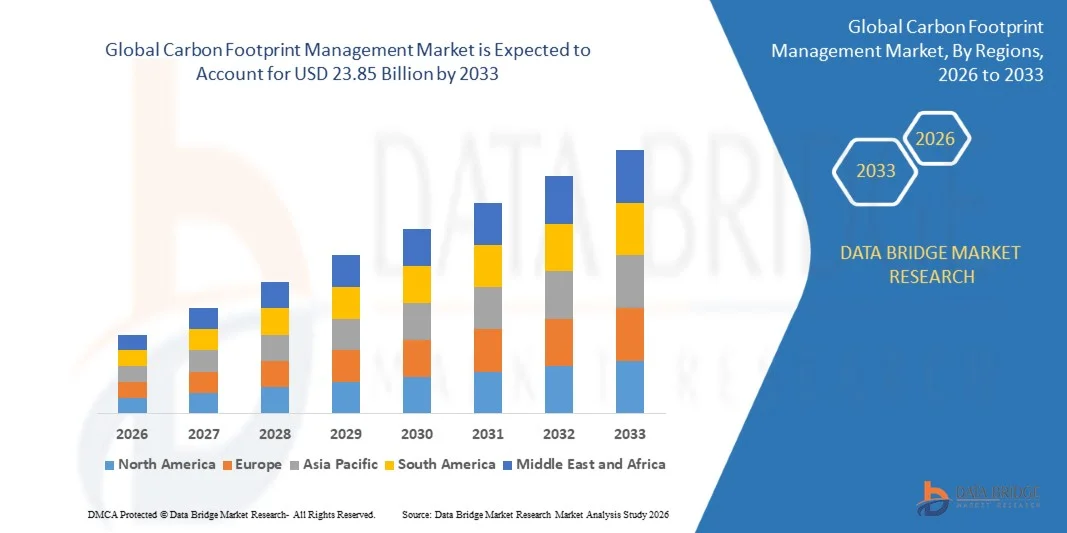
- As per Data Bridge Market Research Analysis the global carbon footprint management market size was valued at USD 14.85 billion in 2025 and is expected to reach USD 23.85 billion by 2033, at a CAGR of 6.10% during the forecast period
- Rising initiatives by corporates for environment sustainability is a crucial factor accelerating the market growth, also rising demand for energy consumption by industries, rising strong initiatives by firms on green building projects, rising implementation of a standardized regulatory framework, rising government initiatives to promote low carbon emission policies and growing concerns about enterprise sustainability and corporate social responsibility (CSR) programs among the corporates are the major factors among others boosting the carbon footprint management market
Market Size and Forecast:
- Market Size (2025): USD 14.85 billion
- Projected Market Size (2033): USD 23.85 billion
- CAGR (2026-2033): 6.10%
What are the Major Takeaways of Carbon Footprint Management Market ?
- Rising adoption of advanced technologies, such as AI, IoT, and big data, across industries, rising modernization of Industry Infrastructure for low carbon emission, increasing modernization and technological advancements in the production techniques and rising research and development activities in the market will further create new opportunities for carbon footprint management market
- However, rising lack of willingness to adopt carbon emission software among developing and undeveloped countries is the vital factor among others restraining the market growth, while lack of tailored solutions to address unique environmental solutions will further challenge the carbon footprint management market
- North America dominated the carbon footprint management market with a 41.62% revenue share in 2025, supported by strong sustainability regulations, rapid enterprise digitalization, and early adoption of AI-enabled carbon accounting tools across the U.S. and Canada
- Asia-Pacific is projected to grow at the fastest CAGR of 11.84% from 2026 to 2033, driven by strong government focus on decarbonization, rapid industrial expansion, and rising adoption of sustainability reporting across China, Japan, India, South Korea, and Southeast Asia
- The Solution segment dominated the market with a 62.4% share in 2025, owing to rapid adoption of software platforms that automate emissions tracking, carbon accounting, reporting, and forecasting
How is the Carbon Footprint Management Market Segmented ?
|
Attributes |
Carbon Footprint Management Key Market Insights |
|
Segments Covered |
|
|
Countries Covered |
North America
Europe
Asia-Pacific
Middle East and Africa
South America
|
|
Key Market Players |
|
|
Market Opportunities |
|
|
Value Added Data Infosets |
In addition to the insights on market scenarios such as market value, growth rate, segmentation, geographical coverage, and major players, the market reports curated by the Data Bridge Market Research also include in-depth expert analysis, pricing analysis, brand share analysis, consumer survey, demography analysis, supply chain analysis, value chain analysis, raw material/consumables overview, vendor selection criteria, PESTLE Analysis, Porter Analysis, and regulatory framework. |
What is the Key Trend in the Carbon Footprint Management Market ?
“Rising Adoption of AI-Driven, Real-Time, and Cloud-Integrated Carbon Tracking Platforms”
- The market is steadily shifting toward AI-enabled, automation-rich, and cloud-based carbon management platforms that offer real-time emissions tracking, predictive analytics, and automated reporting
- Companies are increasingly integrating IoT sensors, digital twins, and API-based data pipelines to collect high-frequency emissions data across factories, supply chains, and distributed assets
- Growing preference for centralized sustainability dashboards, automated GHG accounting, and software platforms that support global disclosure requirements such as CDP, GRI, and the EU CSRD
- For instance, companies such as Schneider Electric, Sphera, Enablon, and IHS Markit have enhanced their platforms with AI-driven forecasting, Scope 1–3 data automation, and advanced analytics tools
- As industries accelerate decarbonization efforts, AI-powered carbon management platforms will remain essential for regulatory compliance, enterprise-wide emissions visibility, and data-driven net-zero strategies
What are the Key Drivers of Carbon Footprint Management Market ?
- Rising need for accurate, automated, and audit-ready emissions reporting as global regulations tighten across the U.S., Europe, and Asia-Pacific
- For instance, in 2025, companies such as Schneider Electric, Greenstone, and Sphera expanded their carbon accounting software capabilities to support enhanced Scope 3 modeling, automated energy data ingestion, and global disclosure alignment
- Increased adoption of IoT, cloud platforms, and ESG digitization across heavy industries, manufacturing, retail, and logistics is boosting demand for enterprise carbon tracking solutions
- Advancements in AI analytics, real-time monitoring, data normalization, and digital twins are strengthening the accuracy, efficiency, and scalability of carbon management tools
- Rapid growth of corporate net-zero commitments and sustainability-linked financing is driving companies to adopt enterprise-grade carbon management platforms
- Supported by rising environmental compliance needs, ESG investments, and the global push for decarbonization, the market is set for strong long-term expansion
Which Factor is Challenging the Growth of the Carbon Footprint Management Market ?
- High implementation and integration costs associated with enterprise carbon management software, IoT infrastructure, and Scope 3 data collection limit adoption among SMEs
- For instance, during 2024–2025, rising costs of IoT hardware, data integration services, and sustainability consulting created budget constraints for several organizations
- Complexity in gathering high-quality emissions data across multi-tier supply chains increases dependence on skilled sustainability professionals
- Limited awareness and technical readiness in emerging economies hinder adoption of advanced carbon management platforms
- Competition from generic ESG tools, energy management software, and in-house carbon tracking spreadsheets reduces differentiation for specialized solution providers
- To overcome these challenges, companies are focusing on cost-effective SaaS platforms, automated data workflows, and AI-driven analytics to expand accessibility and global adoption
How is the Carbon Footprint Management Market Segmented ?
The market is segmented on the basis of component, deployment, and vertical.
• By Component
By component, the carbon footprint management market is segmented into Solution and Services. The Solution segment dominated the market with a 62.4% share in 2025, owing to rapid adoption of software platforms that automate emissions tracking, carbon accounting, reporting, and forecasting. Enterprises are increasingly integrating AI-driven dashboards, IoT-enabled monitoring tools, and automated Scope 1–3 calculation engines to meet compliance mandates such as the EU CSRD, GRI, and CDP. Carbon management solutions also provide centralized data visualization, API-based data ingestion, and cloud-integrated analytics, making them essential for ESG reporting, supply chain assessments, and enterprise-wide decarbonization initiatives.
The Services segment is projected to grow at the fastest CAGR from 2026 to 2033, driven by rising demand for consulting, integration, system customization, and sustainability advisory. Growing complexity in data collection, lifecycle assessments, and regulatory compliance is pushing organizations to rely on external experts to optimize their carbon reduction strategies.
• By Deployment
On the basis of deployment, the carbon footprint management market is segmented into On-Premises and Cloud. The Cloud segment dominated the market with a 58.7% share in 2025, supported by increasing enterprise preference for scalable, subscription-based platforms that enable real-time emissions monitoring, automated data collection, and multi-location reporting. Cloud-based solutions offer lower upfront costs, faster implementation cycles, and seamless integration with IoT sensors, ERP systems, and energy-management platforms. Growing digital transformation initiatives and the need for centralized sustainability reporting across global operations further accelerate cloud adoption.
The On-Premises segment is expected to grow at the fastest CAGR from 2026 to 2033, as sectors with strict data governance—such as utilities, manufacturing, and heavy industries—prefer localized systems for enhanced control, security, and customization. Increasing concerns over data privacy, confidential industrial emissions data, and regulatory audits are driving selective demand for on-premise deployments.
• By Vertical
By vertical, the carbon footprint management market is segmented into Manufacturing, IT & Telecom, Commercial Building, Transportation, Utilities, and Others. The Manufacturing segment dominated the market with a 34.1% share in 2025, driven by high industrial emissions, the need for continuous monitoring, and increasing regulatory pressure to reduce Scope 1 and Scope 2 footprints. Manufacturing facilities actively deploy carbon management platforms to optimize energy consumption, track process emissions, analyze waste generation, and support compliance with national and international climate targets.
The Transportation segment is projected to grow at the fastest CAGR from 2026 to 2033, fueled by rising electrification, fleet decarbonization initiatives, fuel-efficiency regulations, and demand for real-time tracking of logistics emissions. Growing emphasis on sustainable supply chains, EV transition, and low-carbon mobility is encouraging transportation operators to adopt advanced carbon accounting tools to measure and reduce their environmental impact.
Which Region Holds the Largest Share of the Carbon Footprint Management Market ?
- North America dominated the carbon footprint management market with a 41.62% revenue share in 2025, supported by strong sustainability regulations, rapid enterprise digitalization, and early adoption of AI-enabled carbon accounting tools across the U.S. and Canada. Large corporations increasingly deploy advanced carbon management platforms to automate Scope 1–3 reporting, comply with SEC climate disclosures, and integrate ESG data across multi-site operations. Expanding cloud infrastructure, strong adoption of IoT sensors, and ongoing investments in net-zero initiatives reinforce regional leadership
- Companies across North America continue to introduce AI-powered and cloud-integrated platforms with automation, predictive analytics, and real-time emissions monitoring, strengthening technological competitiveness
- High availability of skilled sustainability professionals, mature ESG reporting frameworks, and strong presence of leading carbon management vendors further support the region’s dominance
U.S. Carbon Footprint Management Market Insight
The U.S. is the leading contributor to the North American market, driven by strict emission regulations, rapid adoption of sustainability reporting frameworks, and high investment in digital transformation. Enterprises across manufacturing, IT & telecom, commercial buildings, transportation, and utilities increasingly deploy carbon management platforms for continuous monitoring, automated GHG accounting, and regulatory compliance. Rising development of AI, cloud, and IoT ecosystems further boosts demand for real-time carbon analytics. Strong presence of global carbon management providers, large-scale corporate decarbonization programs, and accelerating net-zero commitments continue to strengthen market growth.
Canada Carbon Footprint Management Market Insight
Canada contributes significantly to regional expansion due to strong environmental policies, growing renewable energy adoption, and increasing emphasis on accurate GHG reporting across industries. Canadian enterprises and government organizations actively implement carbon management software to track emissions, optimize resource efficiency, and meet national climate targets. Universities, research centers, and innovation hubs are adopting digital platforms for life-cycle assessments and sustainability monitoring. Government incentives supporting clean technologies, combined with skilled engineering and ESG talent, continue to drive platform adoption across manufacturing, utilities, transportation, and commercial sectors.
Asia-Pacific Carbon Footprint Management Market
Asia-Pacific is projected to grow at the fastest CAGR of 11.84% from 2026 to 2033, driven by strong government focus on decarbonization, rapid industrial expansion, and rising adoption of sustainability reporting across China, Japan, India, South Korea, and Southeast Asia. The region’s expanding manufacturing base, large-scale renewable energy projects, and growing corporate net-zero commitments are increasing demand for digital carbon tracking platforms. High-volume industrial emissions, large supply-chain footprints, and rapid deployment of IoT and cloud technologies are accelerating adoption of carbon management software across enterprises.
China Carbon Footprint Management Market Insight
China remains the largest contributor to the region, supported by extensive industrial activity, large supply-chain emissions, and strong government policies targeting carbon neutrality by 2060. Enterprises are increasingly adopting carbon management solutions to meet national compliance requirements, conduct energy audits, and optimize operational emissions. Expanding digital ecosystems, strong manufacturing capabilities, and competitive solution providers further accelerate widespread adoption across industries.
Japan Carbon Footprint Management Market Insight
Japan exhibits steady growth driven by strong environmental regulations, large corporate sustainability programs, and advanced industrial infrastructure. Japanese enterprises prioritize high-quality, highly reliable carbon management systems to support precise emissions tracking, energy optimization, and ESG reporting. Growing investments in smart factories, robotics, low-carbon mobility, and renewable energy reinforce long-term adoption of digital carbon management platforms.
India Carbon Footprint Management Market Insight
India is emerging as a high-potential market due to expanding renewable energy capacity, increasing ESG adoption among large enterprises, and government initiatives promoting carbon reporting and sustainability compliance. Industries such as manufacturing, IT services, automotive, and telecom are adopting carbon footprint platforms for energy audits, Scope 1–3 tracking, and sustainability disclosure readiness. Growing startup activity, digital infrastructure expansion, and rising investor focus on ESG accelerate market penetration.
South Korea Carbon Footprint Management Market Insight
South Korea contributes strongly to regional growth, driven by increasing adoption of low-carbon manufacturing practices, smart factories, and green energy solutions. Enterprises across electronics, automotive, semiconductors, and telecom sectors are integrating carbon management systems for real-time monitoring and reporting. Strong government support for carbon neutrality, combined with advanced digital ecosystems and high innovation capacity, reinforces sustained market expansion.
Which are the Top Companies in Carbon Footprint Management Market ?
The carbon footprint management industry is primarily led by well-established companies, including:
- ENGIE Insight Services Inc. (U.S.)
- Enablon (France)
- SKV Solutions Private Limited (India)
- Sustent Consulting Private Limited (India)
- Enviance (Canada)
- FirstCarbon Solutions (U.K.)
- Greenstone+ Ltd (U.K.)
- IHS Markit (U.K.)
- ProcessMAP (U.S.)
- Schneider Electric (France)
- Sphera (U.S.)
What are the Recent Developments in Carbon Footprint Management Market ?
- In October 2025, Ormat began commercial operations of the 35 MW Ijen geothermal power plant in East Java, a facility developed through a joint venture with PT Medco Power Indonesia, where Ormat holds 49% equity and Medco holds 51%, and this project represents the first geothermal installation in East Java with long-term plans to expand capacity to 110 MW under a 30-year PPA, reinforcing the region’s renewable energy growth trajectory
- In July 2023, IBM introduced the IBM Cloud Carbon Calculator, an AI-powered solution designed to help enterprises monitor greenhouse gas emissions generated through cloud services, supporting companies in managing and minimizing their carbon impact as hybrid and multicloud adoption rises, strengthening global efforts toward digital sustainability
- In February 2023, Enablon and Makersite formed a strategic collaboration to support organizations in meeting ESG and Net Zero objectives by enabling decarbonization of supply chains through enhanced data collection, modeling, reporting, planning, forecasting, and operational execution across all three GHG emission Scopes, marking a significant step toward integrated sustainability management
- In September 2022, Enviance acquired Reporting 21, an ESG performance software platform and consultancy, which is expected to be integrated into Cority’s Sustainability Cloud to enhance customer capabilities in sustainability reporting, performance tracking, and ESG decision-making, reinforcing Cority’s position in the environmental compliance and sustainability solutions market

- Interactive Data Analysis Dashboard
- Company Analysis Dashboard for high growth potential opportunities
- Research Analyst Access for customization & queries
- Competitor Analysis with Interactive dashboard
- Latest News, Updates & Trend analysis
- Harness the Power of Benchmark Analysis for Comprehensive Competitor Tracking
Data collection and base year analysis are done using data collection modules with large sample sizes. The stage includes obtaining market information or related data through various sources and strategies. It includes examining and planning all the data acquired from the past in advance. It likewise envelops the examination of information inconsistencies seen across different information sources. The market data is analysed and estimated using market statistical and coherent models. Also, market share analysis and key trend analysis are the major success factors in the market report. To know more, please request an analyst call or drop down your inquiry.
The key research methodology used by DBMR research team is data triangulation which involves data mining, analysis of the impact of data variables on the market and primary (industry expert) validation. Data models include Vendor Positioning Grid, Market Time Line Analysis, Market Overview and Guide, Company Positioning Grid, Patent Analysis, Pricing Analysis, Company Market Share Analysis, Standards of Measurement, Global versus Regional and Vendor Share Analysis. To know more about the research methodology, drop in an inquiry to speak to our industry experts.
Data Bridge Market Research is a leader in advanced formative research. We take pride in servicing our existing and new customers with data and analysis that match and suits their goal. The report can be customized to include price trend analysis of target brands understanding the market for additional countries (ask for the list of countries), clinical trial results data, literature review, refurbished market and product base analysis. Market analysis of target competitors can be analyzed from technology-based analysis to market portfolio strategies. We can add as many competitors that you require data about in the format and data style you are looking for. Our team of analysts can also provide you data in crude raw excel files pivot tables (Fact book) or can assist you in creating presentations from the data sets available in the report.













