


What is the Carbon Nanomaterials Market Size and Growth Rate?
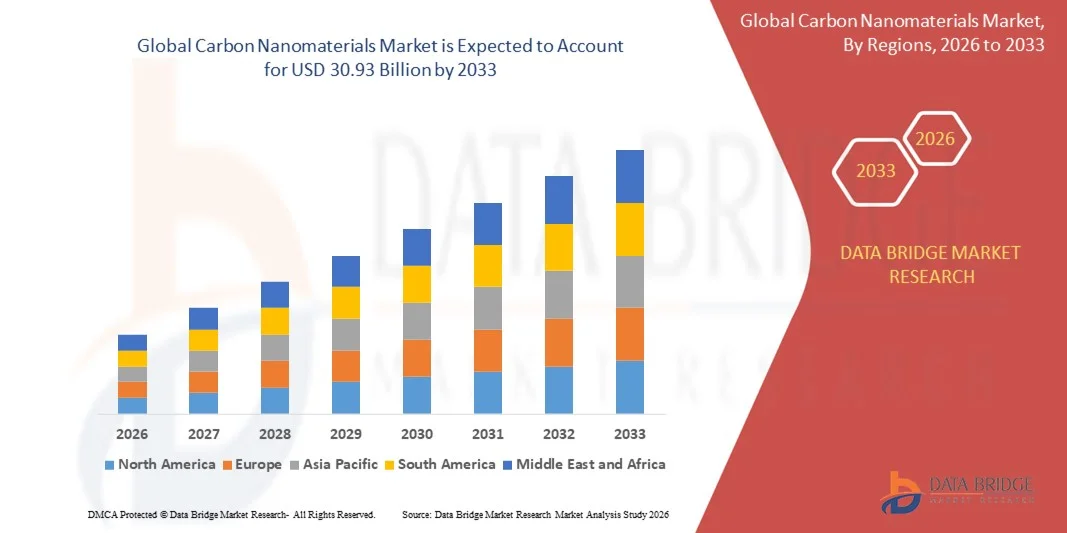
- As per Data Bridge Market Research Analysis the global carbon nanomaterials market size was valued at USD 5.47 billion in 2025 and is expected to reach USD 30.93 billion by 2033, at a CAGR of 24.18% during the forecast period
- The market growth is largely fueled by increasing adoption of advanced materials across electronics, automotive, energy storage, and aerospace industries, supported by continuous technological progress in nanotechnology and material science
- Furthermore, rising demand for lightweight, high-strength, and high-conductivity materials to improve performance, efficiency, and durability in end products is establishing carbon nanomaterials as critical enablers in next-generation applications. These converging factors are accelerating the adoption of carbon nanomaterials, thereby significantly boosting overall market growth
Market Size and Forecast:
- Global Market Value (2025):USD 5.47 billion
- Expected Market Value (2033): USD 30.93 billion
- Forecast CAGR (2026–2033): 24.18%
How Carbon Nanomaterials Market Analysed?
- Carbon nanomaterials, encompassing carbon nanotubes, graphene, fullerenes, and carbon nanofibers, are increasingly essential in modern industrial and technological applications due to their exceptional mechanical strength, electrical conductivity, and thermal stability
- The escalating demand for carbon nanomaterials is primarily driven by rapid growth in electric vehicles, advanced electronics, and energy storage systems, along with increasing investments in research and commercialization of high-performance nanomaterial-based solutions
- North America dominated the carbon nanomaterials market with a share of 39% in 2025, due to strong investments in advanced materials research, early adoption of nanotechnology, and extensive demand from electronics, aerospace, and energy storage industries
- Asia-Pacific is expected to be the fastest growing region in the carbon nanomaterials market during the forecast period due to rapid industrialization, expanding electronics manufacturing, and increasing investments in energy storage technologies
- Carbon nanotubes segment dominated the market with a market share of 63% in 2025, due to their exceptional mechanical strength, electrical conductivity, and thermal stability across multiple industries. Manufacturers widely adopt carbon nanotubes in composites, electronics, and energy applications due to their ability to enhance material performance at low loading levels. Their scalability in production and strong adoption in structural and conductive applications continue to support segment dominance
Report Scope and Carbon Nanomaterials Market Segmentation
|
Attributes |
Carbon Nanomaterials Key Market Insights |
|
Segments Covered |
|
|
Countries Covered |
North America
Europe
Asia-Pacific
Middle East and Africa
South America
|
|
Key Market Players |
|
|
Market Opportunities |
|
|
Value Added Data Infosets |
In addition to the insights on market scenarios such as market value, growth rate, segmentation, geographical coverage, and major players, the market reports curated by the Data Bridge Market Research also include import export analysis, production capacity overview, production consumption analysis, price trend analysis, climate change scenario, supply chain analysis, value chain analysis, raw material/consumables overview, vendor selection criteria, PESTLE Analysis, Porter Analysis, and regulatory framework. |
What are Carbon Nanomaterials Market Trends?
Rising Use of Carbon Nanomaterials in Energy Storage
- A key trend in the carbon nanomaterials market is the rising use of materials such as carbon nanotubes and graphene in energy storage systems, driven by the global push toward electric vehicles, renewable energy integration, and high-performance batteries. These materials enhance electrical conductivity, charge capacity, and cycle life, making them critical for next-generation lithium-ion batteries and supercapacitors
- For instance, LG Chem has increasingly integrated carbon nanotubes into battery electrode materials to improve energy density and charging efficiency in electric vehicle batteries. This integration supports higher performance requirements while maintaining durability under repeated charge–discharge cycles
- Battery manufacturers are adopting carbon nanomaterials to address limitations of conventional conductive additives, particularly in high-capacity and fast-charging applications. This is strengthening the role of carbon nanomaterials as enabling components in advanced energy storage architectures
- The demand for grid-scale energy storage solutions is also encouraging the use of graphene and carbon nanofibers to improve thermal stability and power delivery. These properties are critical for managing energy fluctuations associated with renewable power sources
- Research institutions and commercial producers are collaborating to optimize carbon nanomaterial formulations for scalable battery production. This trend is reinforcing long-term adoption across automotive, consumer electronics, and stationary energy storage markets
- The increasing reliance on efficient and durable energy storage technologies is positioning carbon nanomaterials as essential materials supporting the transition toward electrification and clean energy systems
What are Carbon Nanomaterials Market Dynamics?
Driver
Growing Demand for High-Performance Lightweight Materials
- The growing demand for high-performance lightweight materials across automotive, aerospace, and electronics industries is a major driver of the carbon nanomaterials market. Manufacturers are actively seeking materials that deliver superior strength, conductivity, and durability while reducing overall weight and material usage
- For instance, Arkema S.A. supplies carbon nanotube-based additives that are used to enhance mechanical and electrical performance in lightweight polymer composites. These materials support automotive and aerospace manufacturers in meeting efficiency, performance, and emission reduction targets
- Lightweight carbon nanomaterials enable improved fuel efficiency and extended driving range in electric vehicles by reducing structural weight without compromising strength. This is accelerating adoption in both structural and functional components
- In electronics and semiconductors, demand for miniaturized and high-speed devices is driving the use of carbon nanomaterials for conductive films and thermal management solutions. These applications benefit from the materials’ ability to maintain performance at reduced thickness
- The emphasis on performance optimization across industries is consistently driving investments in carbon nanomaterial production and application development, strengthening their role in advanced manufacturing
Restraint/Challenge
High Production Costs and Complexity in Large-Scale Commercialization
- The carbon nanomaterials market faces challenges related to high production costs and complexity associated with large-scale manufacturing and quality consistency. Producing materials such as high-purity carbon nanotubes and graphene requires advanced equipment, precise process control, and significant capital investment
- For instance, Cabot Corporation employs specialized manufacturing processes to ensure uniform dispersion and consistent quality of carbon nanotubes, which increases operational complexity and cost. These requirements can limit cost competitiveness, particularly for price-sensitive applications
- Scaling production while maintaining material purity and performance remains technically challenging, as minor variations can significantly impact end-use performance. This creates barriers for mass adoption in certain industrial segments
- The need for stringent quality control and post-processing steps further extends production timelines and elevates manufacturing expenses. These factors place pressure on suppliers to balance performance requirements with economic feasibility
- Despite growing demand, overcoming cost and scalability challenges remains critical for expanding carbon nanomaterial adoption across mainstream industrial and consumer markets
What is Carbon Nanomaterials Market Scope?
The market is segmented on the basis of type, application, and end user.
- By Type
On the basis of type, the carbon nanomaterials market is segmented into carbon nanotubes, fullerenes, graphene, and carbon nanofibers. The carbon nanotubes segment dominated the market with the largest revenue share of 63% in 2025, driven by their exceptional mechanical strength, electrical conductivity, and thermal stability across multiple industries. Manufacturers widely adopt carbon nanotubes in composites, electronics, and energy applications due to their ability to enhance material performance at low loading levels. Their scalability in production and strong adoption in structural and conductive applications continue to support segment dominance.
The graphene segment is anticipated to witness the fastest growth from 2026 to 2033, fueled by rising demand for next-generation electronic materials and high-performance energy storage solutions. Graphene offers superior conductivity, flexibility, and surface area, making it highly suitable for batteries, sensors, and flexible electronics. Increasing R&D investments and commercialization efforts further accelerate its growth trajectory.
- By Application
On the basis of application, the carbon nanomaterials market is segmented into composite materials, electronics, energy storage, biomedical, and coatings. The composite materials segment dominated the market in 2025, supported by strong usage in automotive, aerospace, and construction industries to improve strength-to-weight ratios and durability. Carbon nanomaterials enhance mechanical properties, corrosion resistance, and fatigue performance, making them critical for high-performance composites. Growing emphasis on lightweight and fuel-efficient designs sustains demand in this segment.
The energy storage segment is expected to register the fastest growth during the forecast period, driven by expanding adoption of lithium-ion batteries, supercapacitors, and next-generation energy devices. Carbon nanomaterials improve charge capacity, conductivity, and cycle life, aligning with global focus on electric vehicles and renewable energy systems. Continuous advancements in battery technology further reinforce rapid segment growth.
- By End User
On the basis of end user, the carbon nanomaterials market is segmented into electronics & semiconductors, automotive, aerospace, energy, healthcare & biomedical, textile, construction, and defense & military. The electronics & semiconductors segment held the largest market share in 2025, driven by extensive use of carbon nanomaterials in transistors, conductive films, sensors, and thermal management solutions. Their ability to support miniaturization and high-speed performance aligns well with evolving electronic device requirements. Strong demand from consumer electronics and industrial electronics underpins segment leadership.
The energy segment is projected to witness the fastest growth from 2026 to 2033, supported by rising investments in energy storage, electric vehicles, and renewable power infrastructure. Carbon nanomaterials play a crucial role in improving efficiency and longevity of batteries and fuel cells. Global transition toward clean energy and electrification continues to accelerate growth in this end-user segment.
Which Region Holds the Largest Share of the Carbon Nanomaterials Market?
- North America dominated the carbon nanomaterials market with the largest revenue share of 39% in 2025, driven by strong investments in advanced materials research, early adoption of nanotechnology, and extensive demand from electronics, aerospace, and energy storage industries
- The region benefits from a well-established R&D ecosystem, presence of leading material science companies, and close collaboration between industry and academic institutions
- Growing focus on lightweight materials, electric vehicles, and high-performance energy storage solutions continues to strengthen carbon nanomaterial adoption across multiple end-use sectors
U.S. Carbon Nanomaterials Market Insight
The U.S. carbon nanomaterials market captured the largest revenue share within North America in 2025, supported by high commercialization of carbon nanotubes and graphene in electronics, aerospace, and automotive applications. Strong federal funding for nanotechnology research, coupled with rising demand for advanced composites and battery materials, is accelerating market growth. The presence of major semiconductor and EV manufacturers further reinforces sustained demand for carbon nanomaterials.
Europe Carbon Nanomaterials Market Insight
The Europe carbon nanomaterials market is projected to expand at a steady CAGR during the forecast period, driven by stringent regulations promoting lightweight, energy-efficient, and sustainable materials. Increasing adoption in automotive, renewable energy, and industrial manufacturing applications is supporting market expansion. Europe’s strong emphasis on innovation and material sustainability continues to encourage the use of carbon-based nanomaterials.
U.K. Carbon Nanomaterials Market Insight
The U.K. carbon nanomaterials market is anticipated to grow at a notable CAGR, fueled by rising research activities in advanced materials and increasing adoption in electronics and biomedical applications. Government-backed innovation programs and collaboration between universities and private companies are supporting commercialization. Demand for high-performance materials in aerospace and defense further contributes to market growth.
Germany Carbon Nanomaterials Market Insight
The Germany carbon nanomaterials market is expected to expand at a considerable CAGR, driven by strong demand from the automotive, industrial manufacturing, and energy sectors. Germany’s focus on precision engineering, electric mobility, and advanced composites supports the integration of carbon nanomaterials into next-generation products. The country’s robust industrial base and emphasis on material efficiency continue to accelerate adoption.
Asia-Pacific Carbon Nanomaterials Market Insight
The Asia-Pacific carbon nanomaterials market is poised to grow at the fastest CAGR during the forecast period, driven by rapid industrialization, expanding electronics manufacturing, and increasing investments in energy storage technologies. Strong demand from automotive, electronics, and construction sectors, supported by government initiatives promoting advanced manufacturing, is accelerating market growth. The region’s role as a global manufacturing hub significantly enhances production and consumption of carbon nanomaterials.
Japan Carbon Nanomaterials Market Insight
The Japan carbon nanomaterials market is gaining momentum due to the country’s advanced electronics industry and strong focus on innovation. High adoption of carbon nanomaterials in semiconductors, batteries, and precision components is supporting market expansion. Japan’s emphasis on miniaturization and high-performance materials continues to drive steady demand.
China Carbon Nanomaterials Market Insight
The China carbon nanomaterials market accounted for the largest revenue share in Asia-Pacific in 2025, attributed to large-scale manufacturing capabilities, rapid urbanization, and strong government support for nanotechnology development. Expanding use of carbon nanomaterials in electronics, energy storage, and construction applications is fueling growth. The presence of numerous domestic manufacturers and increasing exports further strengthen China’s leading position in the regional market.
Which are the Top Comapnies in Carbon Nanomaterials Market?
The carbon nanomaterials industry is primarily led by well-established companies, including:
- Arkema S.A. (France)
- Cabot Corporation (U.S.)
- Chasm Advanced Materials Inc. (U.S.)
- Cheap Tubes (U.S.)
- Hyperion Catalysis International (U.S.)
- Jiangsu Tiannai Technology Co. Ltd. (China)
- Klean Industries Inc. (Canada)
- Kumho Petrochemical (South Korea)
- LG Chem (South Korea)
- Nano-C (U.S.)
- Nanocyl SA (Belgium)
- OCSiAl (Luxembourg)
- Showa Denko K.K. (Japan)
- Toray Industries Inc. (Japan)
- Mitsui Chemicals Inc. (Japan)
- SGL Carbon SE (Germany)
What are the Latest Developments in Global Carbon Nanomaterials Market?
- In August 2025, Nanotherm and Battelle announced the formation of Novara, a jointly owned company focused on developing and commercializing next-generation heating solutions for automotive, industrial, and consumer markets. This move is expected to accelerate the adoption of carbon nanomaterials in advanced thermal management applications, thereby expanding their commercial footprint and value contribution across multiple end-use industries
- In May 2025, scientists from Japan’s RIKEN Center for Advanced Photonics reported a breakthrough showing that carbon nanotubes can emit more energetic light than they absorb, indicating strong potential for next-generation solar and optoelectronic technologies. This advancement enhances the long-term market outlook by positioning carbon nanotubes as a key material for high-efficiency energy and photonics applications
- In May 2024, LG Chem announced the expansion of its carbon nanotube production capacity to support rising demand from electric vehicle battery and energy storage manufacturers. This development strengthens the carbon nanomaterials market by ensuring stable supply, improving cost efficiency, and supporting large-scale commercialization in high-growth battery applications
- In November 2023, Sunrise New Energy revealed plans to establish a carbon nanotube conductive additive manufacturing facility in the U.S. to enhance production efficiency and profitability. This investment positively impacts the market by reinforcing regional supply chains and increasing availability of carbon nanotubes for lithium-ion battery applications
- In September 2023, Arkema announced progress in scaling its advanced graphene and carbon nanomaterial solutions for industrial and electronics applications. This development supports market growth by accelerating the transition of carbon nanomaterials from pilot-scale projects to broader commercial adoption across performance-critical industries

- Interactive Data Analysis Dashboard
- Company Analysis Dashboard for high growth potential opportunities
- Research Analyst Access for customization & queries
- Competitor Analysis with Interactive dashboard
- Latest News, Updates & Trend analysis
- Harness the Power of Benchmark Analysis for Comprehensive Competitor Tracking
Global Carbon Nanomaterials Market, Supply Chain Analysis and Ecosystem Framework
To support market growth and help clients navigate the impact of geopolitical shifts, DBMR has integrated in-depth supply chain analysis into its Global Carbon Nanomaterials Market research reports. This addition empowers clients to respond effectively to global changes affecting their industries. The supply chain analysis section includes detailed insights such as Global Carbon Nanomaterials Market consumption and production by country, price trend analysis, the impact of tariffs and geopolitical developments, and import and export trends by country and HSN code. It also highlights major suppliers with data on production capacity and company profiles, as well as key importers and exporters. In addition to research, DBMR offers specialized supply chain consulting services backed by over a decade of experience, providing solutions like supplier discovery, supplier risk assessment, price trend analysis, impact evaluation of inflation and trade route changes, and comprehensive market trend analysis.
Data collection and base year analysis are done using data collection modules with large sample sizes. The stage includes obtaining market information or related data through various sources and strategies. It includes examining and planning all the data acquired from the past in advance. It likewise envelops the examination of information inconsistencies seen across different information sources. The market data is analysed and estimated using market statistical and coherent models. Also, market share analysis and key trend analysis are the major success factors in the market report. To know more, please request an analyst call or drop down your inquiry.
The key research methodology used by DBMR research team is data triangulation which involves data mining, analysis of the impact of data variables on the market and primary (industry expert) validation. Data models include Vendor Positioning Grid, Market Time Line Analysis, Market Overview and Guide, Company Positioning Grid, Patent Analysis, Pricing Analysis, Company Market Share Analysis, Standards of Measurement, Global versus Regional and Vendor Share Analysis. To know more about the research methodology, drop in an inquiry to speak to our industry experts.
Data Bridge Market Research is a leader in advanced formative research. We take pride in servicing our existing and new customers with data and analysis that match and suits their goal. The report can be customized to include price trend analysis of target brands understanding the market for additional countries (ask for the list of countries), clinical trial results data, literature review, refurbished market and product base analysis. Market analysis of target competitors can be analyzed from technology-based analysis to market portfolio strategies. We can add as many competitors that you require data about in the format and data style you are looking for. Our team of analysts can also provide you data in crude raw excel files pivot tables (Fact book) or can assist you in creating presentations from the data sets available in the report.













