


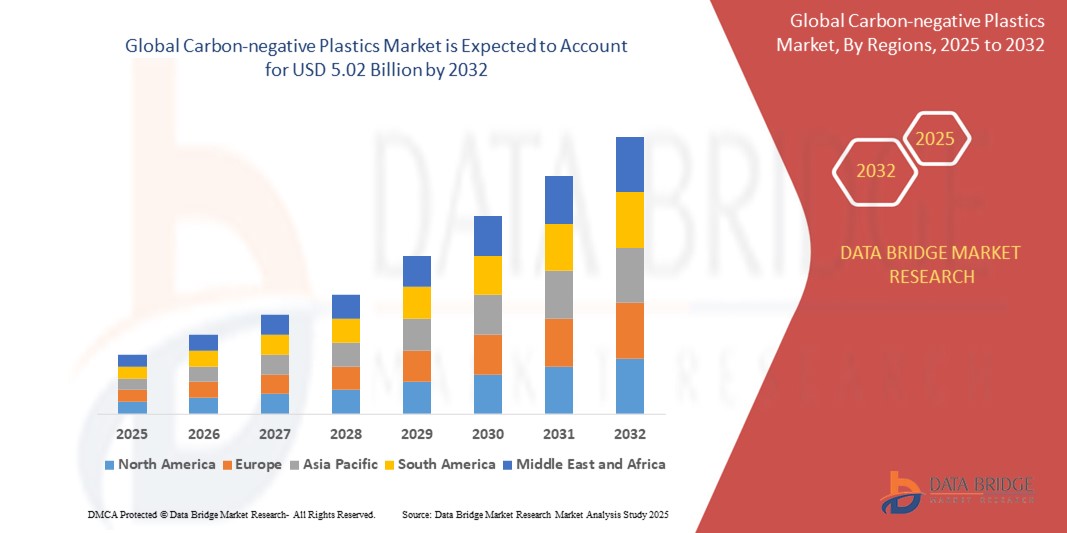
Carbon-negative Plastics Market Size
- The global carbon-negative plastics market size was valued at USD 3.20 billion in 2024 and is expected to reach USD 5.02 billion by 2032, at a CAGR of 5.8% during the forecast period
- The market growth is largely fuelled by the rising prevalence of abdominal aortic aneurysms and increasing adoption of minimally invasive surgical procedures
- Increasing demand for advanced access security across industries such as banking, healthcare, and government is accelerating the adoption of carbon-negative plastics solutions
Carbon-negative Plastics Market Analysis
- The carbon-negative plastics market is gaining traction as industries shift toward sustainable alternatives to reduce environmental footprints and meet consumer demand for eco-friendly products
- Companies are investing in innovative manufacturing processes that capture more carbon than they emit, making these plastics a viable solution for circular economy initiatives
- Europe dominated the carbon-negative plastics market in 2024 with the largest revenue share of 41.60%, driven by strict environmental regulations and strong government incentives promoting sustainable materials
- North America region is expected to witness the highest growth rate in the global carbon-negative plastics market, driven by the growing alignment between federal climate policy and private sector decarbonization strategies
- The carbon negative plant-based polyethylene segment holds the largest market revenue share in 2024, driven by its extensive use in packaging and consumer goods due to its durability and recyclability. This segment benefits from growing demand for sustainable alternatives to conventional polyethylene
Report Scope and Carbon-negative Plastics Market Segmentation
|
Attributes |
Carbon-negative Plastics Key Market Insights |
|
Segments Covered |
|
|
Countries Covered |
North America
Europe
Asia-Pacific
Middle East and Africa
South America
|
|
Key Market Players |
|
|
Market Opportunities |
|
|
Value Added Data Infosets |
In addition to the insights on market scenarios such as market value, growth rate, segmentation, geographical coverage, and major players, the market reports curated by the Data Bridge Market Research also include import export analysis, production capacity overview, production consumption analysis, price trend analysis, climate change scenario, supply chain analysis, value chain analysis, raw material/consumables overview, vendor selection criteria, PESTLE Analysis, Porter Analysis, and regulatory framework. |
Carbon-negative Plastics Market Trends
“Rising Integration of Bio-Based Feedstocks in Carbon-Negative Plastics Production”
- Manufacturers are increasingly adopting bio-based feedstocks such as agricultural waste and algae to produce carbon-negative plastics, helping reduce dependence on fossil resources
- The rise in demand for sustainable packaging, especially in the food and beverage sector, is pushing companies to innovate eco-friendly plastic solutions
- For instance, Avantium is advancing the development of polyethylene furanoate (PEF), a plant-based alternative to traditional plastics with better barrier properties and reduced environmental impact
- For instance, LanzaTech integrates captured industrial carbon emissions into polymer production, showcasing how carbon capture can be combined with bio-based inputs for plastic manufacturing
- For instance, Avantium is advancing the development of polyethylene furanoate (PEF), a plant-based alternative to traditional plastics with better barrier properties and reduced environmental impact
- Partnerships between biotechnology startups and large manufacturers are driving commercialization of green plastics
- For instance, BASF has partnered with Lactips to produce water-soluble, biodegradable plastics for single-use applications
Carbon-negative Plastics Market Dynamics
Driver
“Growing Global Focus on Sustainability and Carbon Neutrality”
- Increasing global emphasis on sustainability and climate targets is driving demand for carbon-negative plastics that help reduce greenhouse gas emissions
- These plastics, made using bio-based feedstocks or carbon capture methods, absorb more carbon during production than they emit, appealing to eco-conscious industries
- Sectors such as packaging, automotive, and consumer goods are adopting these materials to meet environmental goals and respond to regulatory pressure
- Technological advancements in biotechnology and materials science are making carbon-negative plastics more scalable and cost-efficient
- For instance, Coca-Cola has piloted plant-based plastic bottles to align with its carbon reduction strategy, showcasing industry commitment to sustainable alternatives
Restraint/Challenge
“High Production Costs and Scalability Issues”
- High production costs due to advanced biotechnological processes and carbon capture systems limit price competitiveness compared to traditional plastics
- Scaling up sustainable bio-based feedstock supply is challenging without impacting food security or land use
- Regulatory and certification complexities around carbon-negative claims vary by region, causing market confusion and slowing adoption
- Limited consumer awareness about carbon-negative plastics reduces demand and acceptance in mainstream markets
- For instance, the slow adoption of bioplastics in the automotive sector highlights industry concerns over performance consistency and supply reliability, delaying widespread transition
Carbon-negative Plastics Market Scope
The market is segmented on the basis of product type and end-use.
- By Product Type
On the basis of product type, the carbon-negative plastics market is segmented into carbon negative plant-based polyethylene, carbon negative plant-based polypropylene, carbon negative plant-based ethylene vinyl acetate, and others. The carbon negative plant-based polyethylene segment holds the largest market revenue share in 2024, driven by its extensive use in packaging and consumer goods due to its durability and recyclability. This segment benefits from growing demand for sustainable alternatives to conventional polyethylene.
The carbon negative plant-based polypropylene segment is expected to witness the fastest growth rate from 2025 to 2032, supported by increasing adoption in automotive and industrial applications where lightweight and high-performance plastics are essential.
- By End-use
On the basis of end-use, the carbon-negative plastics market is segmented into packaging, automotive components, construction materials, electronics components, textile processing, and others. Packaging segment accounts for the largest market revenue share of 53.47% in 2024, driven by rising consumer demand for eco-friendly packaging and strict regulations targeting single-use plastics. Carbon-negative plastics offer an effective way to reduce environmental impact in this sector.
The automotive components segment is expected to witness the fastest growth rate from 2025 to 2032, as manufacturers seek sustainable materials to improve fuel efficiency and meet emission standards. Innovations in bio-based polymers are facilitating the integration of carbon-negative plastics into automotive parts.
Carbon-negative Plastics Market Regional Analysis
- Europe dominated the carbon-negative plastics market in 2024 with the largest revenue share of 41.60%, driven by strict environmental regulations and strong government incentives promoting sustainable materials
- The region's commitment to circular economy principles and plastic waste reduction is encouraging widespread adoption across packaging, automotive, and construction sectors
- High consumer awareness and collaboration between research institutions and industry players further fuel market growth
U.K. Carbon-negative Plastics Market Insight
The U.K. market is expected to witness the fastest growth rate, supported by growing consumer demand for eco-friendly products and stringent policies targeting carbon reduction. Investments in bioplastic innovation and recycling infrastructure are helping strengthen local production capabilities. Government programs and industry partnerships are also accelerating the transition to carbon-negative plastics.
Germany Carbon-negative Plastics Market Insight
The Germany dominates the market due to its focus on sustainability, advanced research facilities, and strict regulations on plastic pollution. Industrial demand, particularly in automotive and construction sectors, drives the use of carbon-negative plastics. Continued innovation and government support are expected to maintain steady expansion.
North America Carbon-negative Plastics Market Insight
The North America holds a significant share of the market, bolstered by increasing environmental awareness and favourable policies. The region benefits from leading manufacturers developing advanced carbon-negative technologies and growing consumer preference for sustainable packaging and goods. Government incentives and corporate sustainability initiatives also propel market growth.
U.S. Carbon-negative Plastics Market Insight
The U.S. market is expected to witness the fastest growth rate due to increasing corporate commitments to sustainability and consumer demand for eco-friendly products. Strong government policies focused on carbon reduction and incentives for green technologies support industry expansion. Key sectors such as packaging, automotive, and construction are adopting carbon-negative plastics to meet environmental goals. Innovation by leading manufacturers is also driving broader market penetration.
Asia-Pacific Carbon-negative Plastics Market Insight
The Asia-Pacific is expected to witness the fastest growth rate driven by industrialization, urbanization, and rising environmental initiatives in countries such as China, Japan, and India. Increasing investments in bio-based feedstocks and government support for low-carbon materials contribute to expanding applications across various industries. The region’s growing middle class and demand for sustainable products further boost market adoption.
China Carbon-negative Plastics Market Insight
The China leads the Asia-Pacific market due to strong government backing for carbon neutrality and extensive manufacturing capabilities. The country’s focus on sustainable packaging and industrial materials, combined with a large consumer base increasingly demanding green products, accelerates market growth. Domestic innovation and expanding infrastructure support further development.
Japan Carbon-negative Plastics Market Insight
The Japan’s carbon-negative plastics market is expected to witness the fastest growth rate fuelled by the country’s emphasis on environmental conservation and technological innovation. Growing awareness of carbon footprint reduction among consumers and businesses is boosting demand. The integration of advanced bioplastics in packaging and electronics, combined with government initiatives promoting sustainable materials, is accelerating market growth. Japan’s aging population also encourages the adoption of safer, eco-friendly products.
Carbon-negative Plastics Market Share
The carbon-negative plastics industry is primarily led by well-established companies, including:
- Braskem (Brazil)
- Neste (Finland)
- LyondellBasell (Netherland)
- Mitsui Chemicals (Japan)
- Dow (U.S.)
- Borealis (Austria)
- LanzaTech (U.S.)
- UBQ Materials (Israel)
- Dama Bioplastics (U.K.)
Latest Developments in Global Carbon-negative Plastics Market
-
In February 2025, Dama Bioplastics introduced its new carbon-negative material, DAMA Black, at the JEC World Composites Expo. This renewable-resource-based material aims to help industries lower their carbon footprint while expanding Dama’s market reach. The innovation supports sustainability efforts across sectors by offering a versatile alternative to traditional plastics, reinforcing the growing demand for eco-friendly materials
- In July 2024, Mango Materials, a biomanufacturing company from California, developed a technology that utilizes methane-eating bacteria to convert methane emissions from wastewater treatment into biodegradable plastics known as polyhydroxyalkanoate. This breakthrough not only reduces greenhouse gas emissions but also produces fully biodegradable polyester pellets, contributing to the sustainable plastics market and encouraging the adoption of greener manufacturing processes

- Interactive Data Analysis Dashboard
- Company Analysis Dashboard for high growth potential opportunities
- Research Analyst Access for customization & queries
- Competitor Analysis with Interactive dashboard
- Latest News, Updates & Trend analysis
- Harness the Power of Benchmark Analysis for Comprehensive Competitor Tracking
Global Carbon Negative Plastics Market, Supply Chain Analysis and Ecosystem Framework
To support market growth and help clients navigate the impact of geopolitical shifts, DBMR has integrated in-depth supply chain analysis into its Global Carbon Negative Plastics Market research reports. This addition empowers clients to respond effectively to global changes affecting their industries. The supply chain analysis section includes detailed insights such as Global Carbon Negative Plastics Market consumption and production by country, price trend analysis, the impact of tariffs and geopolitical developments, and import and export trends by country and HSN code. It also highlights major suppliers with data on production capacity and company profiles, as well as key importers and exporters. In addition to research, DBMR offers specialized supply chain consulting services backed by over a decade of experience, providing solutions like supplier discovery, supplier risk assessment, price trend analysis, impact evaluation of inflation and trade route changes, and comprehensive market trend analysis.
Data collection and base year analysis are done using data collection modules with large sample sizes. The stage includes obtaining market information or related data through various sources and strategies. It includes examining and planning all the data acquired from the past in advance. It likewise envelops the examination of information inconsistencies seen across different information sources. The market data is analysed and estimated using market statistical and coherent models. Also, market share analysis and key trend analysis are the major success factors in the market report. To know more, please request an analyst call or drop down your inquiry.
The key research methodology used by DBMR research team is data triangulation which involves data mining, analysis of the impact of data variables on the market and primary (industry expert) validation. Data models include Vendor Positioning Grid, Market Time Line Analysis, Market Overview and Guide, Company Positioning Grid, Patent Analysis, Pricing Analysis, Company Market Share Analysis, Standards of Measurement, Global versus Regional and Vendor Share Analysis. To know more about the research methodology, drop in an inquiry to speak to our industry experts.
Data Bridge Market Research is a leader in advanced formative research. We take pride in servicing our existing and new customers with data and analysis that match and suits their goal. The report can be customized to include price trend analysis of target brands understanding the market for additional countries (ask for the list of countries), clinical trial results data, literature review, refurbished market and product base analysis. Market analysis of target competitors can be analyzed from technology-based analysis to market portfolio strategies. We can add as many competitors that you require data about in the format and data style you are looking for. Our team of analysts can also provide you data in crude raw excel files pivot tables (Fact book) or can assist you in creating presentations from the data sets available in the report.













