


What is the Carbonated Beverage Processing Equipment Market Size and Overview?
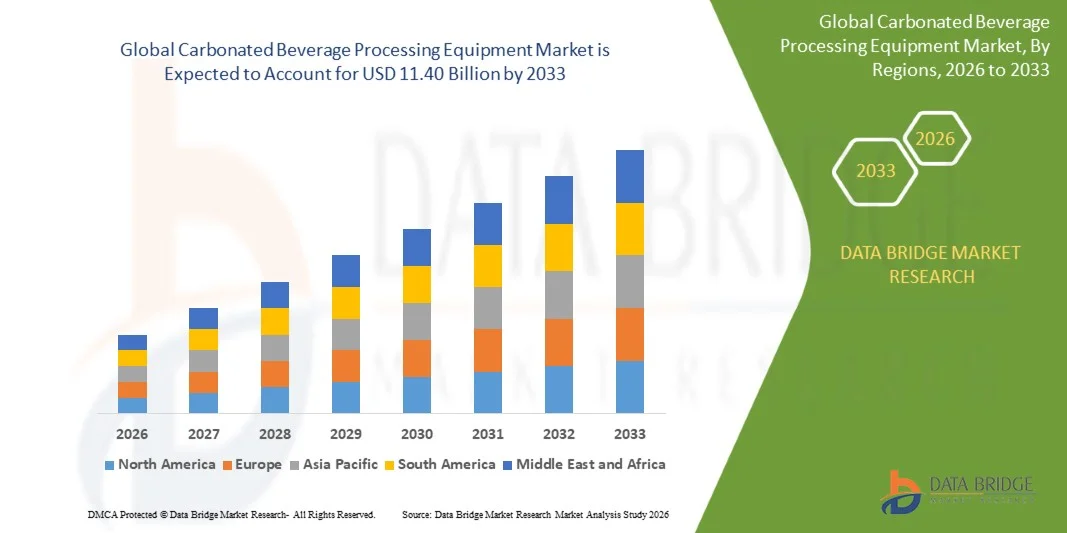
As per Data Bridge Market Research Analysis the global carbonated beverage processing equipment market was valued at USD 7.18 Billion in 2025 and is projected to reach USD 11.40 Billion by 2033, growing at a CAGR of 5.96% from 2026 to 2033. The market is experiencing consistent growth driven by rising global consumption of carbonated soft drinks, increasing demand for automated beverage production systems, and growing investments in high-efficiency carbonation and mixing technologies. Expanding adoption of smart manufacturing solutions, energy-efficient processing equipment, and modular beverage production lines is further supporting market growth across both developed and emerging economies.
The increasing shift toward healthier carbonated alternatives such as low-sugar, zero-calorie, and functional sparkling beverages, combined with strong growth in retail and food service distribution channels, is accelerating demand for advanced processing equipment. Beverage manufacturers are increasingly focusing on production efficiency, product consistency, and sustainability compliance, which is driving continuous upgrades of carbonation, blending, filtration, and heat exchange systems across global production facilities.
Market Size & Forecast
- Global Market Value (2025): USD 7.18 Billion
- Expected Market Value (2033): USD 11.40 Billion
- Forecast CAGR (2026–2033): 5.96%
- Leading Region in 2025: North America
- Fastest Growing Region: Asia-Pacific
Key Market Trends & Insights
- North America dominated the global carbonated beverage processing equipment market with the largest revenue share of 35.25% in 2025, supported by high beverage production automation, strong presence of large-scale carbonated soft drink manufacturers, and advanced adoption of energy-efficient processing technologies
- The non-alcoholic drinks segment led the market with a 48.6% share in 2025, driven by strong global consumption of carbonated soft drinks, sparkling water, and flavored sodas. High production volumes across established bottling networks are accelerating the deployment of advanced carbonation, mixing, and filtration systems
- Asia-Pacific is expected to be the fastest-growing region at a CAGR of 5.94% from 2026 to 2033, fueled by rapid urbanization, rising disposable incomes, and expanding beverage consumption across emerging economies
- Functional drinks are the fastest-growing beverage type, projected to register a CAGR of 5.91% from 2026 to 2033, supported by rising consumer preference for health-oriented carbonated beverages. Increasing demand for energy drinks, vitamin-infused sparkling beverages, and probiotic carbonated products is boosting the need for precision carbonation and advanced blending systems
- The carbonation equipment segment dominated the equipment category with a 35.35% revenue share in 2025, led by its critical role in defining product quality, taste consistency, and fizz retention in carbonated beverages
- Original Equipment Manufacturer (OEM) accounted for 32.4% of the market in 2025, preferred by large-scale installation of integrated processing lines in new beverage manufacturing facilities
- The blenders and mixers segment is the fastest-growing equipment category, with a CAGR of 5.42% from 2026 to 2033, driven by increasing demand for complex beverage formulations. Rising introduction of multi-flavor carbonated drinks and functional ingredient blends is accelerating adoption of advanced mixing systems
Report Scope and Global Carbonated Beverage Processing Equipment Market Segmentation
|
Attributes |
Carbonated Beverage Processing Equipment Key Market Insights |
|
Segments Covered |
|
|
Countries Covered |
North America
Europe
Asia-Pacific
Middle East and Africa
South America
|
|
Key Market Players |
|
|
Market Opportunities |
|
|
Value Added Data Infosets |
In addition to the insights on market scenarios such as market value, growth rate, segmentation, geographical coverage, and major players, the market reports curated by the Data Bridge Market Research also include in-depth expert analysis, pricing analysis, brand share analysis, consumer survey, demography analysis, supply chain analysis, value chain analysis, raw material/consumables overview, vendor selection criteria, PESTLE Analysis, Porter Analysis, and regulatory framework. |
What is the Key Trend in the Carbonated Beverage Processing Equipment Market?
Trend: Rising Adoption of Automated Carbonation Systems
Carbonated beverage manufacturers are increasingly deploying automated carbonation, blending, and filling systems to improve production efficiency, product consistency, and operational scalability. Integration of IoT-enabled monitoring, precision CO₂ dosing, and real-time quality control systems is enhancing manufacturing accuracy across high-volume bottling facilities. Growing demand for low-sugar, zero-calorie, and functional sparkling beverages is further accelerating modernization of production lines.
Krones AG has expanded its advanced beverage filling and carbonation systems globally, supporting high-speed production lines used by major soft drink manufacturers such as Coca-Cola bottling operations, improving throughput and reducing gas wastage in carbonation processes.
Global Carbonated Beverage Processing Equipment Market Dynamics
Key Market Driver: Growing Carbonated Beverage Consumption
Rising global consumption of carbonated soft drinks, sparkling water, and functional beverages is significantly driving demand for advanced processing equipment. Expanding urban populations, changing consumer lifestyles, and strong retail penetration are increasing large-scale production requirements for beverage manufacturers. Companies are investing in high-efficiency carbonation systems, mixers, and filtration equipment to meet rising output needs while maintaining product quality.
PepsiCo and The Coca-Cola Company continue to expand production capacity and upgrade bottling plants globally, strengthening demand for automated carbonation and high-speed beverage processing systems.
Key Restraint/Challenge: High Equipment Cost and Maintenance
The high capital investment required for advanced carbonation, mixing, and bottling equipment remains a key challenge for market expansion. Installation of fully automated beverage processing lines involves significant costs related to machinery, energy systems, and integration with digital monitoring technologies. In addition, ongoing maintenance, calibration, and compliance with food safety standards increase operational expenditure for manufacturers.
Mid-sized beverage producers and regional bottlers often face budget constraints in adopting high-end systems from OEMs such as GEA Group and KHS GmbH, limiting widespread adoption of advanced processing technologies.
Key Market Opportunity: Expansion of Modular Processing Lines
The rapid growth of functional carbonated beverages, including vitamin-infused sparkling drinks, probiotic sodas, and low-calorie formulations, is creating strong opportunities for equipment manufacturers. This shift is driving demand for flexible processing systems capable of handling sensitive ingredients and multiple product variations on the same production line. Beverage companies are increasingly investing in modular and adaptable equipment to support product innovation and small-batch production.
Nestlé and Danone are expanding their functional beverage portfolios, encouraging adoption of advanced blending and carbonation systems that enable precise formulation control and enhanced product differentiation.
How is the Carbonated Beverage Processing Equipment Market Segmented?
The carbonated beverage processing equipment market is segmented on the basis of beverage type, equipment, and distribution channel.
- By Beverage Type
On the basis of beverage type, the global Carbonated Beverage Processing Equipment market is segmented into functional drinks, alcoholic drinks, and non-alcoholic drinks. The Non-Alcoholic Drinks segment dominated the market with the largest share of 48.6% in 2025, driven by strong global consumption of carbonated soft drinks, sparkling water, and flavored sodas. High production volumes across established bottling networks are accelerating the deployment of advanced carbonation, mixing, and filtration systems. Manufacturers are increasingly investing in automated processing lines to ensure consistent taste, shelf stability, and high-speed output. Rising urbanization and strong retail penetration further reinforce segment dominance across both developed and emerging economies. Continuous product innovation in low-sugar and zero-calorie variants strengthens long-term demand for processing equipment.
The Functional Drinks segment is projected to register the fastest growth at a CAGR of 5.91% from 2026 to 2033, driven by rising consumer preference for health-oriented carbonated beverages. Increasing demand for energy drinks, vitamin-infused sparkling beverages, and probiotic carbonated products is boosting the need for precision carbonation and advanced blending systems. Manufacturers are adopting flexible processing equipment capable of handling sensitive ingredients and maintaining nutritional integrity. Expanding wellness trends and premiumization of functional beverages are further accelerating investments in advanced production technologies. Strong product diversification strategies by global beverage brands are expected to sustain rapid segment expansion.
- By Equipment
On the basis of equipment, the global Carbonated Beverage Processing Equipment market is segmented into heat exchangers, blenders and mixers, carbonation equipment, sugar dissolvers, and filtration equipment. The Carbonation Equipment segment dominated the market with a share of 35.35% in 2025, supported by its critical role in defining product quality, taste consistency, and fizz retention in carbonated beverages. High demand from large-scale bottling plants is driving continuous upgrades in high-efficiency carbonation systems. Manufacturers are focusing on precision control technologies to optimize CO₂ dissolution and reduce gas wastage. Expansion of high-volume soft drink production facilities further strengthens equipment deployment. Integration with automated production lines enhances operational efficiency and scalability.
The Blenders and Mixers segment is projected to register the fastest growth at a CAGR of 5.42% from 2026 to 2033, driven by increasing demand for complex beverage formulations. Rising introduction of multi-flavor carbonated drinks and functional ingredient blends is accelerating adoption of advanced mixing systems. Equipment manufacturers are developing high-shear and inline blending technologies to ensure uniform consistency and improved production efficiency. Growing focus on product customization and small-batch production is further supporting segment expansion. Increasing investments in flexible processing lines by beverage manufacturers continue to boost growth prospects.
- By Distribution Channel
On the basis of distribution channel, the global Carbonated Beverage Processing Equipment market is segmented into original equipment manufacturers and aftermarket sales. The Original Equipment Manufacturer segment dominated the market with a share of 32.4% in 2025, driven by large-scale installation of integrated processing lines in new beverage manufacturing facilities. Beverage producers prefer OEM solutions for their reliability, customization capabilities, and compatibility with automated production systems. Increasing investments in greenfield bottling plants and capacity expansion projects are further strengthening OEM demand. Strong partnerships between equipment manufacturers and beverage brands support long-term supply contracts. Continuous technological upgrades in processing systems reinforce OEM dominance across global markets.
The Aftermarket Sales segment is projected to register the fastest growth at a CAGR of 4.2% from 2026 to 2033, driven by rising demand for maintenance, retrofitting, and equipment upgrades in existing production facilities. Beverage manufacturers are increasingly focusing on extending equipment lifespan through modernization and efficiency enhancement solutions. Growing adoption of predictive maintenance technologies is boosting demand for replacement parts and service solutions. Expansion of aging bottling infrastructure in developed regions further supports aftermarket growth. Increasing emphasis on reducing downtime and improving operational efficiency continues to accelerate segment expansion.
Which Region Holds the Largest Share of the Carbonated Beverage Processing Equipment Market?
North America dominated the carbonated beverage processing equipment market and accounted for the largest revenue share of 35.25% in 2025, driven by high beverage production automation, strong presence of large-scale carbonated soft drink manufacturers, and advanced adoption of energy-efficient processing technologies. The region benefits from highly developed manufacturing infrastructure, widespread deployment of smart carbonation and mixing systems, and strong integration of IoT-enabled production monitoring across beverage plants. Beverage companies are increasingly investing in equipment modernization to improve production efficiency, product consistency, and sustainability performance. In addition, strong demand for functional carbonated beverages and low-sugar formulations is further supporting equipment upgrades across the region.
U.S. Carbonated Beverage Processing Equipment Market Insight
The U.S. Carbonated Beverage Processing Equipment market is experiencing steady expansion driven by large-scale production capacity, strong presence of global beverage brands, and continuous investments in automation-driven bottling facilities. Manufacturers are increasingly adopting advanced carbonation systems, high-efficiency heat exchangers, and precision blending technologies to enhance product quality and operational efficiency. Rising consumer demand for zero-calorie, flavored sparkling water, and functional carbonated drinks is further accelerating equipment upgrades. In addition, strong emphasis on sustainability and reduced energy consumption is pushing beverage producers toward next-generation processing solutions.
Canada Carbonated Beverage Processing Equipment Market Insight
The Canada Carbonated Beverage Processing Equipment market is witnessing stable growth supported by rising demand for packaged beverages and increasing modernization of production facilities. Beverage manufacturers are investing in automated processing lines to improve efficiency, hygiene standards, and production scalability. Growing consumer preference for healthier carbonated alternatives such as sparkling water and functional drinks is encouraging equipment innovation. In addition, expansion of retail and food service sectors is contributing to steady demand for advanced carbonation and mixing systems across the country.
Europe Carbonated Beverage Processing Equipment Market Insight
The Europe Carbonated Beverage Processing Equipment market is expanding steadily, supported by strong regulatory emphasis on sustainability, high demand for premium beverages, and advanced manufacturing capabilities. Beverage producers are increasingly focusing on energy-efficient carbonation systems and water-saving processing technologies to comply with environmental standards. The region’s well-established beverage industry and strong export-oriented production base are driving consistent equipment demand. In addition, rising adoption of automated and modular processing systems is supporting operational efficiency and product innovation across major European countries.
U.K. Carbonated Beverage Processing Equipment Market Insight
The U.K. Carbonated Beverage Processing Equipment market is growing steadily due to strong demand for soft drinks, sparkling water, and functional beverages. Beverage manufacturers are increasingly adopting advanced mixing, carbonation, and filtration systems to enhance product quality and consistency. The presence of a highly developed retail sector and strong consumer preference for premium and low-sugar beverages is driving equipment modernization. In addition, rising investment in sustainable production technologies is further supporting market expansion in the country.
Germany Carbonated Beverage Processing Equipment Market Insight
The Germany Carbonated Beverage Processing Equipment market is expanding due to strong industrial engineering capabilities, high focus on automation, and strict environmental regulations. Beverage producers are increasingly deploying energy-efficient heat exchangers and advanced carbonation systems to reduce emissions and improve production efficiency. The country’s strong manufacturing base for food and beverage machinery further supports equipment innovation and adoption. In addition, growing demand for high-quality and functional carbonated beverages is driving continuous investment in advanced processing technologies.
Asia-Pacific Carbonated Beverage Processing Equipment Market Insight
The Asia-Pacific Carbonated Beverage Processing Equipment market is projected to register the fastest growth with a CAGR of 5.94% from 2026 to 2033, driven by rapid urbanization, rising disposable incomes, and expanding beverage consumption across emerging economies. Countries such as China, India, Japan, and South Korea are witnessing strong investments in new bottling plants and large-scale production facilities. Increasing demand for affordable soft drinks and functional carbonated beverages is accelerating deployment of advanced processing equipment. In addition, growing adoption of automation and smart manufacturing technologies is further strengthening regional market expansion.
Japan Carbonated Beverage Processing Equipment Market Insight
The Japan Carbonated Beverage Processing Equipment market is witnessing steady growth supported by advanced manufacturing infrastructure, high demand for premium beverages, and strong focus on automation. Beverage companies are increasingly adopting precision carbonation systems and energy-efficient processing technologies to maintain product consistency and quality. The country’s strong emphasis on innovation and robotics integration in production facilities is further enhancing operational efficiency. In addition, rising demand for functional and low-calorie carbonated beverages is supporting equipment modernization.
China Carbonated Beverage Processing Equipment Market Insight
The China Carbonated Beverage Processing Equipment market is growing rapidly due to massive beverage production scale, expanding middle-class population, and strong growth in carbonated soft drink consumption. Beverage manufacturers are heavily investing in automated carbonation, blending, and filtration systems to improve production efficiency and meet rising demand. The country’s strong manufacturing ecosystem and presence of leading beverage brands are accelerating equipment deployment. In addition, increasing focus on health-oriented carbonated beverages and smart factory integration is further driving market growth.
Which are the Top Companies in Carbonated Beverage Processing Equipment Market?
The carbonated beverage processing equipment industry is primarily led by well-established companies, including:
- ALFA LAVAL (Sweden)
- VAN DER MOLEN GMBH (Germany)
- KHS GmbH (Germany)
- GEA Group Aktiengesellschaft (Germany)
- Krones AG (Germany)
- SPX Corporation (U.S.)
- Pentair plc (U.S.)
- Tetra Pak International S.A. (Switzerland)
- Shreeji Projects (India)
- Roquette Frères (France)
- Mitsui Sugar Co., Ltd. (Japan)
- ADM (U.S.)
- Tate & Lyle (U.K.)
- Pyure Brands LLC (U.S.)
- PureCircle (Malaysia)
- Ajinomoto Health & Nutrition North America, Inc. (U.S.)
- Alsiano (Denmark)
- NutraSweet Co. (U.S.)
- MAFCO Worldwide LLC (U.S.)
- Matsutani Chemical Industry Co., Ltd. (Japan)
What are Latest Developments in Carbonated Beverage Processing Equipment Market?
- In June 2025, Sojo Industries, an industrial automation company, secured USD 40 million in funding from S2G Investments to scale its modular robotic packaging systems and track-and-trace software. This development is strengthening automation capabilities in beverage processing and packaging workflows, enabling manufacturers to improve production flexibility, reduce operational downtime, and enhance supply chain traceability. It is also expected to accelerate adoption of modular and smart packaging solutions across high-volume carbonated beverage production facilities
- In January 2025, a leading beverage equipment manufacturer introduced an upgraded high-efficiency carbonation and blending line designed for large-scale soft drink producers. This development is enhancing production throughput while improving CO₂ utilization efficiency and reducing energy consumption during carbonation processes. It is further supporting beverage companies in meeting sustainability targets and increasing demand for consistent, high-quality carbonated beverages across global markets
- In October 2024, Thermal Kitchen, a food and beverage co-manufacturer, introduced its advanced beverage canning line capable of processing both pasteurized carbonated and non-carbonated beverages. This expansion is increasing production capacity and enabling beverage brands to scale outsourced manufacturing with improved quality control and operational efficiency. It is also supporting growing demand for flexible co-packing solutions in the carbonated beverage industry
- In April 2024, Rotarex Solutions launched the BubbleBox Carbo Pro, an inline carbonation system designed for hospitality applications. The system delivers continuous carbonated water supply directly from the tap, enabling compact and efficient carbonation without traditional bulky equipment. This innovation is improving accessibility of carbonation technology and supporting decentralized beverage preparation in commercial settings
- In January 2024, Krones completed the acquisition of Netstal Maschinen AG from KraussMaffei, strengthening its position in beverage production machinery, particularly in molding technologies used for bottle manufacturing. This acquisition is enhancing Krones’ integrated equipment portfolio, enabling more efficient end-to-end beverage production solutions from container molding to filling and packaging. It is also reinforcing consolidation trends within the global beverage processing equipment market

- Interactive Data Analysis Dashboard
- Company Analysis Dashboard for high growth potential opportunities
- Research Analyst Access for customization & queries
- Competitor Analysis with Interactive dashboard
- Latest News, Updates & Trend analysis
- Harness the Power of Benchmark Analysis for Comprehensive Competitor Tracking
Global Carbonated Beverage Processing Equipment Market, Supply Chain Analysis and Ecosystem Framework
To support market growth and help clients navigate the impact of geopolitical shifts, DBMR has integrated in-depth supply chain analysis into its Global Carbonated Beverage Processing Equipment Market research reports. This addition empowers clients to respond effectively to global changes affecting their industries. The supply chain analysis section includes detailed insights such as Global Carbonated Beverage Processing Equipment Market consumption and production by country, price trend analysis, the impact of tariffs and geopolitical developments, and import and export trends by country and HSN code. It also highlights major suppliers with data on production capacity and company profiles, as well as key importers and exporters. In addition to research, DBMR offers specialized supply chain consulting services backed by over a decade of experience, providing solutions like supplier discovery, supplier risk assessment, price trend analysis, impact evaluation of inflation and trade route changes, and comprehensive market trend analysis.
Data collection and base year analysis are done using data collection modules with large sample sizes. The stage includes obtaining market information or related data through various sources and strategies. It includes examining and planning all the data acquired from the past in advance. It likewise envelops the examination of information inconsistencies seen across different information sources. The market data is analysed and estimated using market statistical and coherent models. Also, market share analysis and key trend analysis are the major success factors in the market report. To know more, please request an analyst call or drop down your inquiry.
The key research methodology used by DBMR research team is data triangulation which involves data mining, analysis of the impact of data variables on the market and primary (industry expert) validation. Data models include Vendor Positioning Grid, Market Time Line Analysis, Market Overview and Guide, Company Positioning Grid, Patent Analysis, Pricing Analysis, Company Market Share Analysis, Standards of Measurement, Global versus Regional and Vendor Share Analysis. To know more about the research methodology, drop in an inquiry to speak to our industry experts.
Data Bridge Market Research is a leader in advanced formative research. We take pride in servicing our existing and new customers with data and analysis that match and suits their goal. The report can be customized to include price trend analysis of target brands understanding the market for additional countries (ask for the list of countries), clinical trial results data, literature review, refurbished market and product base analysis. Market analysis of target competitors can be analyzed from technology-based analysis to market portfolio strategies. We can add as many competitors that you require data about in the format and data style you are looking for. Our team of analysts can also provide you data in crude raw excel files pivot tables (Fact book) or can assist you in creating presentations from the data sets available in the report.













