


Carburetors Market Size
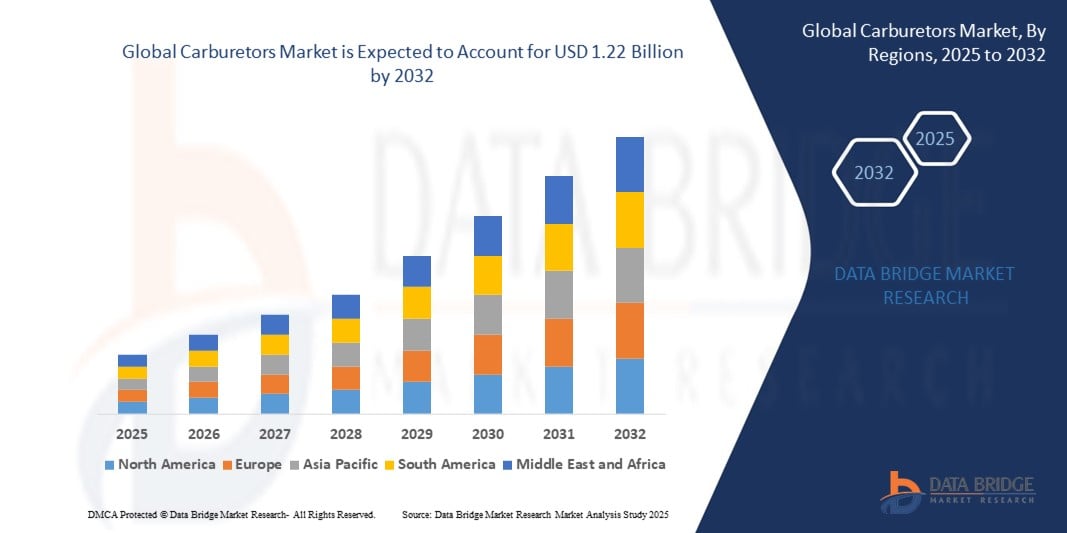
- The global carburetors market size was valued at USD 1.11 billion in 2024 and is expected to reach USD 1.22 billion by 2032, at a CAGR of 1.20% during the forecast period
- The market growth is largely fuelled by the ongoing demand for cost-effective fuel delivery systems in small engines, motorcycles, and off-road vehicles, as well as the continued use of carburetors in regions with less stringent emission regulations
- Growing replacement and aftermarket demand for carburetors in legacy vehicles also contributes to steady market expansion
Carburetors Market Analysis
- The market is segmented based on type, application, and region to evaluate demand patterns, technological preferences, and regional adoption trends
- Increasing focus on fuel efficiency and maintenance simplicity is influencing consumer preference for carburetors, particularly in developing regions where modern fuel injection systems are less prevalent
- North America dominated the carburetors market with the largest revenue share of 38.5% in 2024, driven by the established automotive industry, high demand for motorcycles and small engines, and the preference for reliable, cost-effective fuel delivery systems
- Asia-Pacific region is expected to witness the highest growth rate in the global carburetors market, driven by rising vehicle production, expanding middle-class population, and increased manufacturing of carburetors for both domestic and export markets
- The Float-Feed Carburetor segment held the largest market revenue share in 2024, driven by its widespread use in motorcycles, scooters, and small gasoline engines. Float-feed carburetors are favored for their simple design, ease of maintenance, and reliable fuel delivery, making them a popular choice for cost-sensitive vehicle segments
Report Scope and Carburetors Market Segmentation
|
Attributes |
Carburetors Key Market Insights |
|
Segments Covered |
|
|
Countries Covered |
North America
Europe
Asia-Pacific
Middle East and Africa
South America
|
|
Key Market Players |
|
|
Market Opportunities |
• Expansion Of Aftermarket Services For Carburetors |
|
Value Added Data Infosets |
In addition to the market insights such as market value, growth rate, market segments, geographical coverage, market players, and market scenario, the market report curated by the Data Bridge Market Research team includes in-depth expert analysis, import/export analysis, pricing analysis, production consumption analysis, and pestle analysis. |
Carburetors Market Trends
Shift Towards Fuel-Efficient and Low-Emission Carburetors
• The growing emphasis on fuel efficiency and emission reduction is transforming the carburetors market by encouraging the development of precision fuel delivery systems. Advanced carburetors enable optimized air-fuel mixing, improving engine performance and reducing fuel consumption, which is critical for meeting global emission standards
• Increasing demand in remote and developing regions for affordable and easy-to-maintain carburetors is accelerating adoption in motorcycles, scooters, and small vehicles. These carburetors provide reliable performance where advanced fuel injection systems may be cost-prohibitive or difficult to service
• The simplicity, durability, and low maintenance requirements of modern carburetors are making them attractive for small-scale and mid-range vehicles, supporting widespread usage. Vehicle owners benefit from reduced repair costs and improved engine longevity, enhancing overall operational efficiency
• For instance, in 2023, several two-wheeler manufacturers in Southeast Asia reported improved fuel economy and engine reliability after upgrading to modern carburetor models, leading to higher customer satisfaction and repeat purchases
• While carburetors continue to support reliable fuel delivery, their market impact depends on continuous innovation, regulatory compliance, and the adoption of hybrid and electric vehicles. Manufacturers must focus on performance optimization and localized deployment strategies to sustain growth
Carburetors Market Dynamics
Driver
Rising Demand For Fuel-Efficient Vehicles And Cost-Effective Engine Components
• The increasing focus on fuel economy and cost efficiency is driving manufacturers to adopt advanced carburetors. These devices help optimize combustion, reduce fuel consumption, and extend engine life, meeting both regulatory and consumer expectations. In addition, improved carburetor designs allow for better performance in varying altitudes and climatic conditions, further enhancing vehicle efficiency
• Vehicle owners in emerging markets are increasingly seeking affordable and reliable solutions for motorcycles, scooters, and small engines, fueling demand for carburetors. The balance of performance and low maintenance costs positions carburetors as a preferred choice in cost-sensitive regions. Moreover, the ease of repairing and servicing carburetors locally strengthens their adoption among small-scale operators and fleet owners
• Supportive government initiatives, such as subsidies for fuel-efficient vehicles and incentives for small engine manufacturing, are further boosting the carburetor market. Regulatory pressure to comply with emission standards encourages innovation and adoption. These initiatives are also pushing manufacturers to invest in research and development for more precise and durable carburetor models
• For instance, in 2022, India introduced updated fuel efficiency regulations for two-wheelers and small engines, increasing the adoption of precision carburetors that meet emission and performance standards. This also led to partnerships between local manufacturers and global suppliers to improve carburetor quality and meet compliance standards
• While demand for fuel-efficient carburetors is rising, the market still requires adaptation to hybrid and electric vehicle trends. Manufacturers must focus on cost-effective, efficient, and environmentally compliant solutions to maintain competitiveness. Simultaneously, training programs for mechanics and technicians on modern carburetor systems are essential to support market growth
Restraint/Challenge
Declining Adoption Due To Fuel Injection Systems And Technological Advancements
• The rising adoption of electronic fuel injection (EFI) systems, which provide better fuel efficiency and lower emissions, is limiting the growth of traditional carburetors. EFI systems are gradually replacing carburetors in modern vehicles, particularly in developed markets. In addition, consumers are becoming more aware of the long-term savings associated with EFI engines, further discouraging carburetor usage
• High-performance vehicles and stringent emission regulations are favoring fuel injection systems over carburetors, reducing market penetration in key segments. Consumers increasingly prefer EFI-equipped engines for reliability and compliance. This shift also pressures carburetor manufacturers to innovate rapidly or focus on niche segments where EFI is less practical
• Supply chain challenges for precision carburetor components in remote regions can restrict availability, delaying vehicle assembly and impacting production schedules. This is particularly challenging for small-scale manufacturers. Logistics issues, coupled with fluctuating raw material costs, further add to production and pricing pressures in emerging markets
• For instance, in 2023, automotive suppliers in Europe reported reduced carburetor orders as regulatory mandates encouraged the shift toward EFI engines, affecting traditional carburetor manufacturers’ revenues. Several companies responded by diversifying their product lines to include EFI-compatible solutions, reflecting the changing market dynamics
• While carburetors remain relevant for cost-sensitive and small-engine vehicles, overcoming technological replacement and maintaining market relevance requires innovation, cost optimization, and niche targeting strategies. Investment in hybrid-compatible carburetors and modular designs could offer a bridge for traditional manufacturers to retain market share
Carburetors Market Scope
The market is segmented on the basis of type, application, and sales channel.
- By Type
On the basis of type, the carburetors market is segmented into Diaphragm Carburetor and Float-Feed Carburetor. The Float-Feed Carburetor segment held the largest market revenue share in 2024, driven by its widespread use in motorcycles, scooters, and small gasoline engines. Float-feed carburetors are favored for their simple design, ease of maintenance, and reliable fuel delivery, making them a popular choice for cost-sensitive vehicle segments.
The Diaphragm Carburetor segment is expected to witness the fastest growth rate from 2025 to 2032, driven by its suitability for portable and small-engine applications, including lawn equipment, generators, and two-wheelers. Diaphragm carburetors are particularly appreciated for their compact design, consistent performance in varied orientations, and adaptability in low-pressure fuel systems, making them ideal for specialized applications.
- By Application
On the basis of application, the market is segmented into Automotive, Universal Gasoline Engines, and Others. The Automotive segment held the largest market share in 2024, driven by the high adoption of carbureted engines in motorcycles, scooters, and small cars, where simplicity and cost-effectiveness are key factors.
The Universal Gasoline Engines segment is expected to witness the fastest growth rate from 2025 to 2032, fueled by increasing demand for generators, lawn equipment, and portable machinery in emerging markets.
- By Sales Channel
On the basis of sales channel, the market is segmented into OEMs and Aftermarket. The OEM segment held the largest revenue share in 2024, attributed to the integration of carburetors during engine manufacturing and rising preference for factory-fitted components ensuring optimal performance.
The Aftermarket segment is expected to witness the fastest growth rate from 2025 to 2032, driven by growing maintenance requirements, spare part replacement, and retrofitting in older engine models across residential and commercial sectors.
Carburetors Market Regional Analysis
• North America dominated the carburetors market with the largest revenue share of 38.5% in 2024, driven by the established automotive industry, high demand for motorcycles and small engines, and the preference for reliable, cost-effective fuel delivery systems.
• Consumers in the region highly value the durability, ease of maintenance, and performance consistency offered by carburetors in motorcycles, scooters, and small gasoline engines.
• This widespread adoption is further supported by high disposable incomes, a technologically advanced population, and the presence of major OEMs, establishing carburetors as a key component in both automotive and small engine applications.
U.S. Carburetors Market Insight
The U.S. carburetors market captured the largest revenue share in 2024 within North America, fueled by the ongoing demand for motorcycles, recreational vehicles, and portable engines. Consumers increasingly prioritize the efficiency, simplicity, and reliability offered by carbureted engines. The growing aftermarket demand for replacement and performance-enhancing carburetors further propels the market. Moreover, the presence of established automotive and engine manufacturers supporting OEM and aftermarket channels significantly contributes to market growth.
Europe Carburetors Market Insight
The Europe carburetors market is expected to witness the fastest growth rate from 2025 to 2032, primarily driven by stringent emission norms and the continued use of carburetors in motorcycles, scooters, and small utility engines. Urbanization, coupled with the demand for fuel-efficient and durable engines, is fostering the adoption of carburetors. European consumers are also attracted to cost-effective and easy-to-maintain engine solutions. The region is witnessing growth across automotive, universal gasoline engines, and industrial applications.
U.K. Carburetors Market Insight
The U.K. carburetors market is expected to witness the fastest growth rate from 2025 to 2032, driven by demand for motorcycles, portable generators, and small gasoline-powered equipment. In addition, the preference for affordable and reliable fuel delivery solutions is encouraging both commercial and residential users to adopt carburetors. The U.K.’s strong automotive and aftermarket infrastructure continues to support the market expansion.
Germany Carburetors Market Insight
The Germany carburetors market is expected to witness the fastest growth rate from 2025 to 2032, fueled by the country’s well-developed automotive and small engine sectors. Germany’s emphasis on engineering precision and performance reliability promotes carburetor adoption, particularly in motorcycles, scooters, and utility engines. Integration of carburetors with small gasoline engines remains prevalent, driven by consumer preference for durable and easy-to-service solutions.
Asia-Pacific Carburetors Market Insight
The Asia-Pacific carburetors market is expected to witness the fastest growth rate from 2025 to 2032, driven by increasing vehicle production, rising demand for motorcycles, and the presence of a large manufacturing base in countries such as China, India, and Japan. The region's growing middle class, expanding rural markets, and affordability of carbureted engines are accelerating adoption. Furthermore, APAC serves as a hub for both OEM and aftermarket carburetor production, improving accessibility and boosting market penetration.
Japan Carburetors Market Insight
The Japan carburetors market is expected to witness the fastest growth rate from 2025 to 2032 due to the country’s advanced manufacturing ecosystem, high demand for motorcycles, and focus on small gasoline engines. Japanese consumers value performance reliability and ease of maintenance, particularly in motorcycles, scooters, and generators. The integration of carburetors with high-efficiency engines and the preference for compact, durable designs is fueling market growth.
China Carburetors Market Insight
The China carburetors market accounted for the largest market revenue share in Asia Pacific in 2024, attributed to rapid urbanization, growing motorcycle and generator demand, and high domestic production of carburetors. China is a leading hub for small engine and automotive manufacturing, and carburetors are increasingly used in motorcycles, scooters, and portable engines. Government support for industrialization and the availability of cost-effective carburetor options, alongside strong OEM and aftermarket channels, are key factors driving market expansion in China.
Carburetors Market Share
The Carburetors industry is primarily led by well-established companies, including:
- Mikuni Corporation (Japan)
- Hitachi Astemo Indiana, Inc. (U.S.)
- Fujian FuDing JingKe Carburetor (Japan)
- Holley Performance Products, Inc. (U.S.)
- Edelbrock, LLC (U.S.)
- Walbro, LLC (U.S.)
- Dell'Orto S.p.A. (Italy)
- Nikki Co., Ltd. (Japan)
- Tillotson (Ireland)
- Rotary Corporation (U.S.)
- Carter Carburetor (U.S.)
- Bendix-Stromberg (U.S.)
- Autolite (U.S.)
- Claudel-Hobson (U.S.)
- Amal Ltd. (U.K.)
- Dell'Orto India Pvt. Ltd. (India)
- Shinsei Kogyo Co., Ltd. (Japan)
- Keihin Corporation (Japan)
- Solex Carburetors (France)
- Bing Power Systems (Germany)

- Interactive Data Analysis Dashboard
- Company Analysis Dashboard for high growth potential opportunities
- Research Analyst Access for customization & queries
- Competitor Analysis with Interactive dashboard
- Latest News, Updates & Trend analysis
- Harness the Power of Benchmark Analysis for Comprehensive Competitor Tracking
Data collection and base year analysis are done using data collection modules with large sample sizes. The stage includes obtaining market information or related data through various sources and strategies. It includes examining and planning all the data acquired from the past in advance. It likewise envelops the examination of information inconsistencies seen across different information sources. The market data is analysed and estimated using market statistical and coherent models. Also, market share analysis and key trend analysis are the major success factors in the market report. To know more, please request an analyst call or drop down your inquiry.
The key research methodology used by DBMR research team is data triangulation which involves data mining, analysis of the impact of data variables on the market and primary (industry expert) validation. Data models include Vendor Positioning Grid, Market Time Line Analysis, Market Overview and Guide, Company Positioning Grid, Patent Analysis, Pricing Analysis, Company Market Share Analysis, Standards of Measurement, Global versus Regional and Vendor Share Analysis. To know more about the research methodology, drop in an inquiry to speak to our industry experts.
Data Bridge Market Research is a leader in advanced formative research. We take pride in servicing our existing and new customers with data and analysis that match and suits their goal. The report can be customized to include price trend analysis of target brands understanding the market for additional countries (ask for the list of countries), clinical trial results data, literature review, refurbished market and product base analysis. Market analysis of target competitors can be analyzed from technology-based analysis to market portfolio strategies. We can add as many competitors that you require data about in the format and data style you are looking for. Our team of analysts can also provide you data in crude raw excel files pivot tables (Fact book) or can assist you in creating presentations from the data sets available in the report.













