


Carcinoid Syndrome Drug Market Size
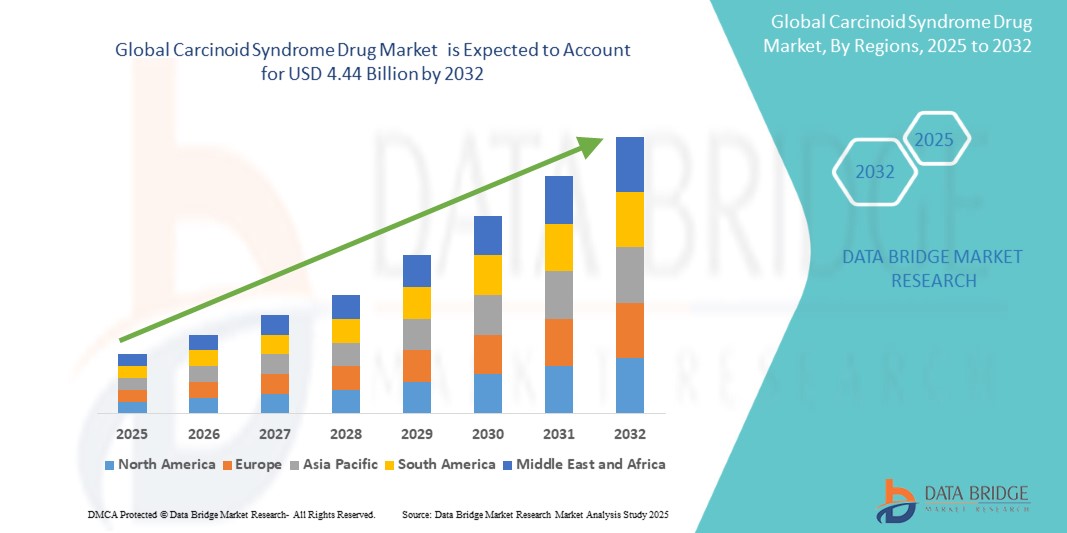
- The Global Carcinoid Syndrome Drug Market size was valued at USD 2.18 billion in 2024 and is expected to reach USD 4.44 billion by 2032, at a CAGR of 9.8% during the forecast period
- This growth is driven by factors such as the aging population, increasing prevalence of carcinoid tumors, and advancements in targeted therapies and diagnostic technologies.
Carcinoid Syndrome Drug Market Analysis
- Carcinoid syndromes include the signs and symptoms such as debilitating diarrhea, flushing of the face, intestinal bleeding, fast heartbeat, asthma caused due to vasoconstriction, sweating, shortness of breath, unexplained weight gain and so forth which are settled in secondary to the carcinoid tumor.
- The demand for Carcinoid Syndrome drugs is significantly driven by the increasing prevalence of carcinoid tumors and advancements in treatment options.
- North America is expected to dominate the Carcinoid Syndrome Drug market due to its advanced healthcare infrastructure, higher diagnosis rates, and increasing demand for targeted therapies
- Asia-Pacific is projected to be the fastest-growing region in the Carcinoid Syndrome Drug market during the forecast period, driven by rising awareness and improving healthcare infrastructure
- Small Intestine segment is expected to dominate the market with a market share of 56.22% due to the high prevalence of carcinoid tumors affecting the digestive system and the increasing demand for targeted therapies. Advancements in drug formulations and treatment protocols are further enhancing therapeutic outcomes and contributing to market growth
Report Scope and Carcinoid Syndrome Drug Market Segmentation
|
Attributes |
Carcinoid Syndrome Drug Key Market Insights |
|
Segments Covered |
|
|
Countries Covered |
North America
Europe
Asia-Pacific
Middle East and Africa
South America
|
|
Key Market Players |
|
|
Market Opportunities |
|
|
Value Added Data Infosets |
In addition to the insights on market scenarios such as market value, growth rate, segmentation, geographical coverage, and major players, the market reports curated by the Data Bridge Market Research also include import export analysis, production capacity overview, production consumption analysis, price trend analysis, climate change scenario, supply chain analysis, value chain analysis, raw material/consumables overview, vendor selection criteria, PESTLE Analysis, Porter Analysis, and regulatory framework. |
Carcinoid Syndrome Drug Market Trends
“Increasing Adoption of Biological Therapies in Carcinoid Syndrome Treatment”
- One prominent trend in the Global Carcinoid Syndrome Drug Market is the increasing adoption of biological therapies in the treatment of the condition
- These therapies, including targeted biologics and monoclonal antibodies, are improving treatment efficacy by offering more personalized and effective options for patients, leading to better clinical outcomes and reduced side effects.
- In March 2023, the U.S. FDA approved Lanreotide Autogel, a next-generation somatostatin analog, for the treatment of carcinoid syndrome. This approval followed extensive clinical trials showing significant improvements in symptom control and overall quality of life for patients, highlighting the growing potential of biologic therapies in offering more precise, targeted treatment options for carcinoid syndrome.
- These advancements are transforming the treatment landscape for carcinoid syndrome, improving patient outcomes, and driving the demand for next-generation biologic therapies with enhanced precision and targeted action.
Carcinoid Syndrome Drug Market Dynamics
Driver
“Rising Awareness and Improved Diagnostic Techniques Boosting Demand for Carcinoid Syndrome Drugs”
- The rising awareness about carcinoid syndrome, coupled with advancements in diagnostic techniques, is significantly contributing to the increased demand for Carcinoid Syndrome Drugs
- As healthcare professionals become better equipped to identify and diagnose carcinoid syndrome earlier, patients are more likely to seek treatment at earlier stages, leading to a growing market for targeted drug therapies
- With greater patient awareness and improved diagnostic capabilities, the demand for drugs with higher precision and better outcomes is rising, boosting the overall growth of the Carcinoid Syndrome Drug market
For instance,
- In June 2021, Ipsen Biopharmaceuticals announced the approval of its drug Somatuline Depot (lanreotide) by the U.S. Food and Drug Administration (FDA) for the treatment of carcinoid syndrome. This approval was based on improved diagnostic methods that allowed for better identification and management of the condition, ensuring more patients received the appropriate therapy.
- Rising awareness about carcinoid syndrome and advancements in diagnostic techniques are significantly boosting the demand for Carcinoid Syndrome Drugs. Improved early detection and better understanding of the condition are enabling timely interventions and more effective treatments, leading to better patient outcomes.
Opportunity
“Personalized Medicine and Targeted Therapies for Carcinoid Syndrome”
- Personalized medicine and targeted therapies for carcinoid syndrome are gaining momentum due to advances in molecular profiling and precision oncology
- These therapies aim to tailor treatment options based on individual genetic profiles, allowing for more effective management of the disease by targeting specific mutations or pathways involved in carcinoid tumor development
- Additionally, the use of biomarker-driven approaches in clinical trials is enhancing the ability to predict treatment responses, improving patient outcomes and minimizing unnecessary side effects
For instance,
- In December 2023, Novartis announced the successful completion of phase III trials for its targeted therapy, which is designed to specifically inhibit the pathways associated with carcinoid syndrome. The drug demonstrated a significant reduction in symptoms and improved quality of life for patients, marking a major advancement in the treatment of the condition.
- This innovation exemplifies the growing trend of personalized treatments in carcinoid syndrome, leading to more effective management and improved patient outcomes in the global market.
Restraint/Challenge
“High Treatment Costs and Limited Accessibility ”
- The high cost of Carcinoid Syndrome drugs presents a significant challenge for the market, limiting the accessibility of treatment for many patients, particularly in low-income and developing regions.
- The price of advanced biologic therapies and long-term treatment options can be prohibitively expensive, placing financial strain on both healthcare providers and patients.
- This financial barrier may hinder widespread adoption of these therapies, slowing market penetration and potentially contributing to unequal access to treatment, especially in resource-constrained environments
For instance,
- In 2020, the Canadian Agency for Drugs and Technologies in Health reported that the annual cost of telotristat ethyl (Xermelo), a drug used to treat refractory carcinoid syndrome diarrhea, was approximately CAD 92,199. In contrast, standard-dose somatostatin analogs like octreotide acetate and lanreotide cost between CAD 27,756 and CAD 28,464 annually. This significant price disparity underscores the financial burden associated with advanced therapies, potentially limiting their accessibility and adoption, particularly in regions with constrained healthcare budgets.
- Consequently, such high treatment costs can lead to significant disparities in access to advanced carcinoid syndrome therapies, restricting patient access in lower-income regions and ultimately impeding the overall growth of the Global Carcinoid Syndrome Drug Market.
Carcinoid Syndrome Drug Market Scope
The market is segmented on the basis organ affected, therapy type, treatment type, drug, route of administration, distribution channel type and end users.
|
Segmentation |
Sub-Segmentation |
|
By Organ Affected |
|
|
By Therapy Type |
|
|
By Treatment Type |
|
|
By Drug
|
|
|
By Route of Administration |
|
|
By Distribution Channel
|
|
|
By End User |
|
In 2025, the Chemotherapy is projected to dominate the market with a largest share in therapy type segment
The Chemotherapy segment is expected to dominate the Carcinoid Syndrome Drug market with the largest share of 56.22% in 2025 due to its widespread use in managing advanced carcinoid tumors and symptom control. Its effectiveness in reducing tumor progression and improving patient outcomes, coupled with ongoing advancements in drug formulations and targeted delivery systems, continues to support its leading market position. Additionally, the rising prevalence of neuroendocrine tumors and increasing geriatric population contribute to the segment's sustained growth.
The Small Intestine is expected to account for the largest share during the forecast period in organ affected market
In 2025, the hybrid microscopes segment is expected to dominate the market with the largest market share of 51.31% due to its critical role in managing advanced stages of carcinoid tumors. The increasing demand for effective systemic therapies, coupled with advancements in chemotherapy agents and combination treatment approaches, is enhancing patient outcomes. Furthermore, the growing incidence of carcinoid syndrome and late-stage diagnoses is contributing to the segment’s continued market dominance.
Carcinoid Syndrome Drug Market Regional Analysis
“North America Holds the Largest Share in the Carcinoid Syndrome Drug Market”
- North America dominates the Carcinoid Syndrome Drug market, driven by advanced healthcare infrastructure, early disease detection capabilities, and the strong presence of major pharmaceutical companies
- The U.S. holds a significant share due to high awareness levels, availability of targeted therapies, and increased prevalence of neuroendocrine tumors associated with carcinoid syndrome
- The availability of well-established reimbursement policies and growing investments in research & development by leading medical device companies further strengthen the market.
- In addition, the growing adoption of personalized medicine and biologic treatments in the region supports continued expansion of the Carcinoid Syndrome Drug Market
“Asia-Pacific is Projected to Register the Highest CAGR in the Carcinoid Syndrome Drug Market”
- The Asia-Pacific region is expected to witness the highest growth rate in the Carcinoid Syndrome Drug market, driven by improving healthcare infrastructure, increasing awareness of rare diseases, and rising healthcare expenditures
- Countries such as China, India, and Japan are emerging as key markets due to a growing patient pool, an aging population, and improved diagnostic capabilities for neuroendocrine tumors associated with carcinoid syndrome
- Japan, known for its innovation in biotechnology and pharmaceuticals, continues to lead in adopting advanced treatments and targeted biologics, making it a vital contributor to market growth
- China and India, with their large populations and rising incidence of gastrointestinal and endocrine-related disorders, are seeing increased government and private sector initiatives aimed at expanding access to specialty drugs, further supporting market expansion in the region
Carcinoid Syndrome Drug Market Share
The market competitive landscape provides details by competitor. Details included are company overview, company financials, revenue generated, market potential, investment in research and development, new market initiatives, global presence, production sites and facilities, production capacities, company strengths and weaknesses, product launch, product width and breadth, application dominance. The above data points provided are only related to the companies' focus related to market.
The Major Market Leaders Operating in the Market Are:
- Novartis AG (Switzerland)
- Teva Pharmaceutical Industries Ltd. (Israel)
- Mylan N.V. (U.S.)
- LEXICON PHARMACEUTICALS, INC (U.S.)
- Ipsen Biopharmaceuticals, Inc (U.S.)
- Sirtex SIR-Spheres Pty Ltd (Australia)
- BTG International Ltd (U.K.)
- WOCKHARDT (India)
- Sun Pharmaceutical Industries Ltd (India)
- Amgen Inc (U.S.)
- Entrinsic Health Solutions, Inc. (U.S.)
- Camurus AB (Sweden)
- Endo Pharmaceuticals Inc. (U.S.)
- Pharmascience (Canada)

- Interactive Data Analysis Dashboard
- Company Analysis Dashboard for high growth potential opportunities
- Research Analyst Access for customization & queries
- Competitor Analysis with Interactive dashboard
- Latest News, Updates & Trend analysis
- Harness the Power of Benchmark Analysis for Comprehensive Competitor Tracking
Data collection and base year analysis are done using data collection modules with large sample sizes. The stage includes obtaining market information or related data through various sources and strategies. It includes examining and planning all the data acquired from the past in advance. It likewise envelops the examination of information inconsistencies seen across different information sources. The market data is analysed and estimated using market statistical and coherent models. Also, market share analysis and key trend analysis are the major success factors in the market report. To know more, please request an analyst call or drop down your inquiry.
The key research methodology used by DBMR research team is data triangulation which involves data mining, analysis of the impact of data variables on the market and primary (industry expert) validation. Data models include Vendor Positioning Grid, Market Time Line Analysis, Market Overview and Guide, Company Positioning Grid, Patent Analysis, Pricing Analysis, Company Market Share Analysis, Standards of Measurement, Global versus Regional and Vendor Share Analysis. To know more about the research methodology, drop in an inquiry to speak to our industry experts.
Data Bridge Market Research is a leader in advanced formative research. We take pride in servicing our existing and new customers with data and analysis that match and suits their goal. The report can be customized to include price trend analysis of target brands understanding the market for additional countries (ask for the list of countries), clinical trial results data, literature review, refurbished market and product base analysis. Market analysis of target competitors can be analyzed from technology-based analysis to market portfolio strategies. We can add as many competitors that you require data about in the format and data style you are looking for. Our team of analysts can also provide you data in crude raw excel files pivot tables (Fact book) or can assist you in creating presentations from the data sets available in the report.












