


Cardiac Holter Monitor Market Overview
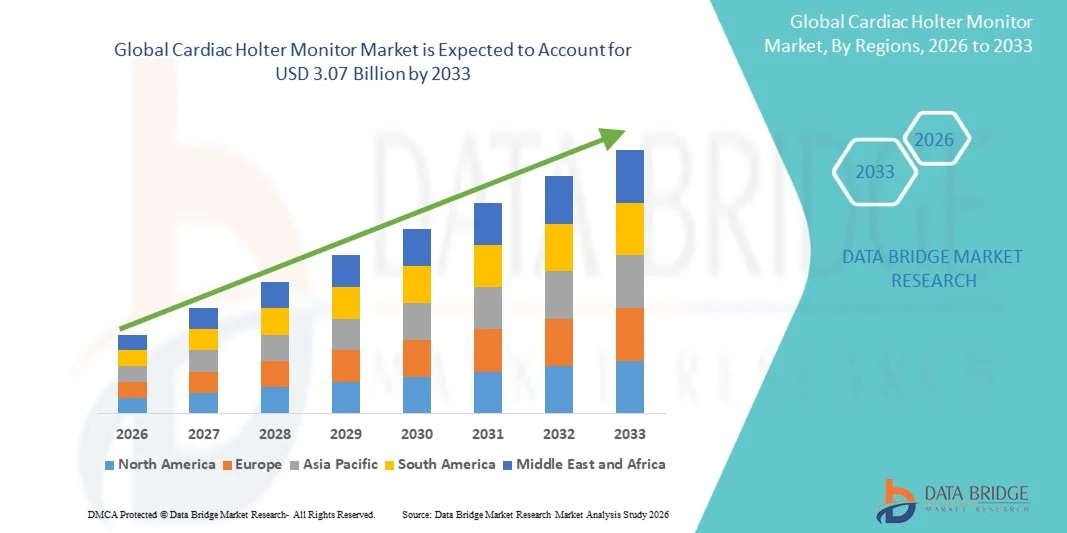
The Cardiac Holter Monitor Market was valued at USD 1.28 billion in 2025 and is projected to reach USD 3.07 billion by 2033, growing at a CAGR of 11.60% from 2026 to 2033. The market is experiencing steady growth driven by the rising prevalence of cardiovascular diseases, increasing demand for continuous ambulatory cardiac monitoring, and ongoing advancements in wearable cardiac diagnostic technologies.
The growing burden of arrhythmias, atrial fibrillation, and other cardiac disorders worldwide, coupled with an aging population and increasing awareness of preventive cardiac care, is encouraging healthcare providers to adopt advanced Holter monitoring solutions. Wireless, patch-based, and AI-enabled Holter monitors are increasingly replacing conventional monitoring systems in many healthcare settings, offering improved patient comfort, extended monitoring duration, and enhanced diagnostic accuracy for early detection and management of cardiovascular conditions.
Key Market Trends & Insights
- North America dominated the Cardiac Holter Monitor Market with the largest revenue share of 38.42% in 2025, supported by a high prevalence of cardiovascular diseases, advanced healthcare infrastructure, and widespread adoption of ambulatory cardiac monitoring technologies.
- The 3-Channel segment led the market with a 36.84% share in 2025, driven by its optimal balance between diagnostic accuracy, affordability, and ease of use.
- Asia-Pacific is expected to be the fastest-growing region at a CAGR of 12.9% from 2026 to 2033, fueled by expanding healthcare access, increasing cardiovascular disease burden, and rising investments in digital health technologies across China, India, and Southeast Asia.
- 12-Channel are the fastest-growing product type, projected to register a CAGR of 13.2%, reflecting the surge in demand for comprehensive cardiac diagnostics and advanced rhythm analysis
- The Holter Monitoring Devices segment dominated the component type category with a 44.27% revenue share in 2025, led by their essential role in continuous ambulatory cardiac monitoring.
- Arrhythmia Detection accounted for 39.68% of the market, preferred by the widespread use of Holter monitors for identifying intermittent and asymptomatic rhythm disorders
- The Atrial Fibrillation Monitoring segment is the fastest-growing application category, with a CAGR of 14.5%, driven by the rapidly increasing prevalence of atrial fibrillation globally.
Market Size & Forecast
- Global Market Value (2025): USD 1.28 Billion
- Expected Market Value (2033): USD 3.07 Billion
- Forecast CAGR (2026–2033): 11.60%
- Leading Region in 2025: North America
- Fastest Growing Region: Asia Pacific
Report Scope and Cardiac Holter Monitor Market Segmentation
|
Attributes |
Cardiac Holter Monitor Key Market Insights |
|
Segments Covered |
|
|
Countries Covered |
North America · U.S. · Canada · Mexico Europe · Germany · France · U.K. · Netherlands · Switzerland · Belgium · Russia · Italy · Spain · Turkey · Rest of Europe Asia-Pacific · China · Japan · India · South Korea · Singapore · Malaysia · Australia · Thailand · Indonesia · Philippines · Rest of Asia-Pacific Middle East and Africa · Saudi Arabia · U.A.E. · South Africa · Egypt · Israel · Rest of Middle East and Africa South America · Brazil · Argentina · Rest of South America |
|
Key Market Players |
· Philips (Netherlands) · GE HealthCare (U.S.) · NIHON KOHDEN CORPORATION (Japan) · SCHILLER AG (Switzerland) · Hillrom (U.S.) · Spacelabs Healthcare (U.S.) · BPL Medical Technologies (India) · Cardiac Insight, Inc. (U.S.) · iRhythm Technologies, Inc. (U.S.) · Norav Medical Ltd. (Israel) · Bionet Co., Ltd. (South Korea) · Edan Instruments, Inc. (China) · Shenzhen Mindray Bio-Medical Electronics Co., Ltd. (China) · Compumedics Limited (Australia) · ACS Diagnostics, Inc. (U.S.) · ScottCare Corporation (U.S.) · Biomedical Instruments Co., Ltd. (China) · Labtech Ltd. (Hungary) · GETEMED Medizin- und Informationstechnik AG (Germany) · VivaLNK, Inc. (U.S.) |
|
Market Opportunities |
· Expansion of remote patient monitoring programs · Growing adoption of AI-powered arrhythmia detection algorithms · Increasing penetration in emerging markets |
|
Value Added Data Infosets |
In addition to the insights on market scenarios such as market value, growth rate, segmentation, geographical coverage, and major players, the market reports curated by the Data Bridge Market Research also include in-depth expert analysis, patient epidemiology, pipeline analysis, pricing analysis, and regulatory framework. |
Cardiac Holter Monitor Market Trends
Trend: Rising Adoption of Wearable and Patch-Based Cardiac Monitoring
Healthcare providers are increasingly adopting wearable and patch-based Holter monitors to improve patient comfort, enhance diagnostic accuracy, and support long-term cardiac rhythm monitoring outside traditional clinical environments. The integration of wireless connectivity enables seamless data transmission and continuous physician oversight. Hospitals and cardiology clinics are similarly leveraging compact monitoring devices to detect intermittent arrhythmias through extended observation periods, while AI-powered analytics platforms create efficient workflows that closely support real-world cardiovascular disease management.
For instance, in May 2024, Royal Philips expanded its connected cardiac monitoring portfolio with advanced ambulatory monitoring solutions designed to improve remote cardiac diagnostics and patient engagement.
Cardiac Holter Monitor Market Dynamics
Key Market Driver: Growing Prevalence of Cardiovascular Diseases and Arrhythmias
The increasing prevalence of cardiovascular diseases and cardiac rhythm disorders has created substantial demand for advanced Holter monitoring systems that can identify intermittent arrhythmias, evaluate treatment effectiveness, and support early clinical intervention. Hospitals, diagnostic centers, and cardiology practices are deploying Holter monitors as a core component of cardiac assessment pathways, improving diagnostic efficiency, expanding monitoring coverage, and enhancing patient outcomes through continuous ambulatory observation.
For instance, in January 2024, iRhythm Technologies continued expanding adoption of its long-term cardiac monitoring services, reflecting growing demand for ambulatory arrhythmia detection solutions.
Key Restraint/Challenge: High Cost of Advanced Monitoring Systems and Data Management
A significant restraint in the Cardiac Holter Monitor Market is the high upfront investment required for advanced monitoring platforms. Modern systems integrate wireless communication modules, cloud-based data storage, AI-assisted analysis software, and secure connectivity infrastructure, demanding substantial expenditure on procurement, deployment, and ongoing maintenance. The total cost of ownership extends to software subscriptions, cybersecurity compliance requirements, and technical support, making adoption difficult for smaller healthcare facilities, diagnostic centers, and resource-constrained organizations.
For instance, in September 2024, healthcare providers evaluating next-generation remote cardiac monitoring platforms highlighted infrastructure integration and long-term data management costs as major considerations influencing purchasing decisions, reflecting the broader challenge of adoption beyond well-funded institutions.
Key Market Opportunity: Integration of Artificial Intelligence and Remote Cardiac Monitoring Platforms
The integration of artificial intelligence in cardiac monitoring presents a significant market opportunity. AI-enabled platforms can automate arrhythmia detection, provide real-time diagnostic insights, and support large-scale management of cardiovascular patients through continuous monitoring programs. The development of cloud-connected monitoring ecosystems and telecardiology services is further expanding access to advanced diagnostics, opening growth opportunities across underserved healthcare markets in Asia-Pacific, Latin America, and the Middle East.
For instance, in February 2025, Boston Scientific advanced digital cardiac monitoring capabilities through connected patient management technologies designed to strengthen remote cardiovascular care and clinical decision-making.
Cardiac Holter Monitor Market Scope
The cardiac holter monitor market is segmented on the basis of product type, component, application, and end user.
- By Product Type
On the basis of product type, the Cardiac Holter Monitor Market is segmented into 1-Channel, 2-Channel, 3-Channel, 12-Channel, and Others. The 3-Channel segment dominated the market with a 36.84% share in 2025, owing to its optimal balance between diagnostic accuracy, affordability, and ease of use. These monitors are widely utilized in hospitals and cardiology clinics for routine ambulatory ECG monitoring and arrhythmia detection. They provide sufficient cardiac signal coverage for most clinical applications while remaining cost-effective compared to high-channel systems. The segment benefits from widespread physician familiarity and established reimbursement frameworks. Growing demand for outpatient cardiac monitoring is further supporting adoption. Their versatility across a broad range of cardiovascular conditions continues to strengthen market leadership.
The 12-Channel segment is projected to register the fastest growth at a CAGR of 13.2% from 2026 to 2033, driven by increasing demand for comprehensive cardiac diagnostics and advanced rhythm analysis. These systems provide detailed multi-lead ECG recordings that improve the detection of complex arrhythmias and ischemic events. Rising prevalence of cardiovascular diseases is encouraging healthcare providers to invest in high-precision monitoring technologies. Technological advancements in data processing and miniaturization are enhancing usability and patient comfort. Growing adoption in specialized cardiology centers and research institutions is further accelerating demand. Expanding focus on early diagnosis and preventive cardiology is expected to support long-term growth.
- By Component
On the basis of component, the Cardiac Holter Monitor Market is segmented into holter monitoring devices, event monitoring devices, holter analysis system, and software. The Holter Monitoring Devices segment dominated the market with a 44.27% share in 2025, driven by their essential role in continuous ambulatory cardiac monitoring. These devices remain the primary hardware component used for diagnosing arrhythmias and evaluating cardiac abnormalities over extended periods. Increasing cardiovascular disease prevalence and growing physician reliance on long-term ECG monitoring are supporting demand. Continuous improvements in battery life, portability, and wireless connectivity are enhancing device performance. Healthcare facilities continue to prioritize investments in advanced monitoring equipment. The segment’s critical importance in cardiac diagnostics ensures its leading market position.
The Software segment is anticipated to witness the fastest growth at a CAGR of 14.1% from 2026 to 2033, fueled by increasing integration of artificial intelligence and automated ECG interpretation tools. Advanced software platforms help physicians analyze large volumes of cardiac data more efficiently and accurately. Growing adoption of cloud-based healthcare systems is improving accessibility and remote monitoring capabilities. Healthcare providers are increasingly utilizing software solutions to reduce diagnostic workload and improve clinical outcomes. The shift toward digital health ecosystems is creating strong demand for intelligent analytics platforms. Continuous innovation in predictive cardiac diagnostics is further driving segment expansion.
- By Application
On the basis of application, the Cardiac Holter Monitor Market is segmented into arrhythmia detection, atrial fibrillation monitoring, cardiac disease diagnosis, post-myocardial infarction monitoring, pacemaker evaluation, and other cardiac monitoring applications. The Arrhythmia Detection segment accounted for the largest market share of 39.68% in 2025, owing to the widespread use of Holter monitors for identifying intermittent and asymptomatic rhythm disorders. Increasing incidence of cardiac arrhythmias across aging populations is significantly driving demand. Holter monitoring provides continuous ECG recordings that improve diagnostic accuracy compared to standard electrocardiograms. Physicians frequently rely on these systems for evaluating unexplained palpitations, dizziness, and syncope. Rising awareness regarding early cardiac diagnosis is further supporting adoption. The segment remains central to most ambulatory cardiac monitoring programs worldwide.
The Atrial Fibrillation Monitoring segment is expected to grow at the fastest CAGR of 14.5% from 2026 to 2033, driven by the rapidly increasing prevalence of atrial fibrillation globally. Early detection of atrial fibrillation is critical for preventing stroke and other cardiovascular complications. Healthcare providers are increasingly implementing prolonged monitoring strategies to identify previously undiagnosed cases. Technological advancements in wearable and patch-based monitoring devices are improving patient compliance and detection rates. Growing investments in preventive cardiovascular care programs are also supporting market growth. Expanding adoption of remote monitoring solutions continues to strengthen the segment’s outlook.
- By End User
On the basis of end user, the Cardiac Holter Monitor Market is segmented into hospitals and clinics, ambulatory surgical centers (ASCS), homecare, and others. The Hospitals and Clinics segment dominated the market with a 52.43% share in 2025, driven by high patient volumes, advanced diagnostic capabilities, and the availability of specialized cardiology services. These facilities represent the primary setting for cardiac disease diagnosis and long-term patient management. Access to trained healthcare professionals and sophisticated monitoring infrastructure supports extensive utilization of Holter monitoring systems. Increasing cardiovascular admissions and routine cardiac screening programs are further driving demand. Hospitals also serve as key adopters of next-generation monitoring technologies. Their comprehensive care capabilities continue to reinforce segment leadership.
The Homecare segment is projected to experience the fastest growth at a CAGR of 14.8% from 2026 to 2033, fueled by rising demand for remote patient monitoring and decentralized healthcare delivery models. Advances in wireless connectivity and wearable cardiac monitoring technologies are enabling patients to undergo extended monitoring from home. Home-based monitoring improves convenience, reduces hospital visits, and supports continuous observation of high-risk patients. Increasing healthcare digitization and telemedicine adoption are creating favorable conditions for growth. Aging populations and the growing burden of chronic cardiovascular diseases are further accelerating demand. The shift toward patient-centric healthcare solutions is expected to drive significant expansion in this segment.
Cardiac Holter Monitor Market Regional Analysis
North America dominated the Cardiac Holter Monitor Market with the largest revenue share of 38.42% in 2025, supported by a high prevalence of cardiovascular diseases, advanced healthcare infrastructure, and widespread adoption of ambulatory cardiac monitoring technologies. The region also benefits from favorable reimbursement frameworks, widespread availability of specialized cardiology services, and the presence of leading medical device manufacturers. Increasing utilization of wireless and AI-enabled Holter monitoring systems across hospitals, clinics, and remote patient monitoring programs is further driving market growth. Growing emphasis on early arrhythmia detection and preventive cardiovascular care continues to strengthen North America's leadership position in the global market.
U.S. Cardiac Holter Monitor Market Insight
The U.S. Cardiac Holter Monitor market is witnessing strong growth due to rising prevalence of cardiovascular diseases, increasing adoption of remote patient monitoring programs, and growing demand for advanced ambulatory cardiac diagnostic technologies. The country’s well-established healthcare infrastructure, along with increasing utilization of AI-enabled, wireless, and cloud-connected monitoring systems, is driving demand across hospitals, cardiology clinics, and homecare settings. In addition, growing emphasis on early arrhythmia detection and preventive cardiac care is accelerating Holter monitor adoption among healthcare providers and patients.
Europe Cardiac Holter Monitor Market Insight
The Europe Cardiac Holter Monitor market remains a major contributor to global revenue, driven by strong healthcare infrastructure, technological innovation, and high demand for advanced cardiac monitoring solutions. The widespread use of ambulatory ECG monitoring devices in hospitals, specialty cardiac centers, and outpatient care facilities is supporting market expansion across the region. Increasing investments in digital healthcare technologies, coupled with growing cardiovascular disease awareness and favorable reimbursement policies, continue to enhance the adoption of Holter monitoring systems throughout Europe.
U.K. Cardiac Holter Monitor Market Insight
The U.K. Cardiac Holter Monitor market is experiencing steady growth, supported by rising adoption of remote cardiac monitoring technologies, increasing cardiovascular disease screening programs, and growing demand for patient-centric diagnostic solutions. Increasing investments in advanced monitoring infrastructure and growing demand for cost-effective, continuous cardiac assessment tools are contributing to market growth. Furthermore, integration of AI-powered analytics, wireless connectivity, and telehealth platforms is improving diagnostic efficiency and patient outcomes, positioning the U.K. as a key innovation hub in the cardiac monitoring industry.
Germany Cardiac Holter Monitor Market Insight
The Germany Cardiac Holter Monitor market is expanding steadily due to the country’s advanced healthcare system, strong medical device industry, and increasing adoption of next-generation cardiac monitoring technologies. Hospitals, cardiology centers, and diagnostic facilities are increasingly utilizing Holter monitors for arrhythmia detection, cardiovascular risk assessment, and long-term patient management. Continuous advancements in wearable monitoring devices, AI-assisted diagnostics, and digital healthcare platforms, along with strong government focus on preventive healthcare and innovation, are further driving market growth in Germany.
Asia-Pacific Cardiac Holter Monitor Market Insight
The Asia-Pacific Cardiac Holter Monitor market is expected to witness rapid growth, driven by increasing cardiovascular disease prevalence, expanding healthcare infrastructure, and rising investments in cardiac care services across countries such as China, India, and Japan. Growing awareness regarding early diagnosis of heart disorders, rising adoption of advanced monitoring technologies, and increasing demand for accessible and cost-effective diagnostic solutions are supporting regional market expansion. In addition, the growing presence of healthcare technology providers and digital health initiatives is accelerating Holter monitor adoption across hospitals and community healthcare settings.
Japan Cardiac Holter Monitor Market Insight
The Japan Cardiac Holter Monitor market is witnessing consistent growth due to rising investments in advanced cardiac monitoring technologies, healthcare innovation, and preventive cardiovascular care initiatives. Healthcare providers, research institutions, and specialty cardiac centers are increasingly adopting high-performance Holter monitoring systems for arrhythmia detection, patient management, and clinical research purposes. Moreover, increasing integration of wearable monitoring technologies and the country’s focus on efficient and high-quality healthcare delivery are further contributing to market growth.
China Cardiac Holter Monitor Market Insight
The China Cardiac Holter Monitor market is growing rapidly, driven by increasing cardiovascular disease burden, expanding healthcare infrastructure, and rising government focus on chronic disease management and early diagnosis. Growing adoption of AI-enabled and wireless cardiac monitoring platforms across hospitals, clinics, and community healthcare centers is significantly boosting market demand. In addition, rising investments in healthcare modernization, increasing awareness regarding preventive cardiac care, and rapid technological advancements are positioning China as one of the fastest-growing markets for cardiac Holter monitors globally.
Cardiac Holter Monitor Market Share
The cardiac holter monitor industry is primarily led by well-established companies, including:
- Philips (Netherlands)
- GE HealthCare (U.S.)
- NIHON KOHDEN CORPORATION (Japan)
- SCHILLER AG (Switzerland)
- Hillrom (U.S.)
- Spacelabs Healthcare (U.S.)
- BPL Medical Technologies (India)
- Cardiac Insight, Inc. (U.S.)
- iRhythm Technologies, Inc. (U.S.)
- Norav Medical Ltd. (Israel)
- Bionet Co., Ltd. (South Korea)
- Edan Instruments, Inc. (China)
- Shenzhen Mindray Bio-Medical Electronics Co., Ltd. (China)
- Compumedics Limited (Australia)
- ACS Diagnostics, Inc. (U.S.)
- ScottCare Corporation (U.S.)
- Biomedical Instruments Co., Ltd. (China)
- Labtech Ltd. (Hungary)
- GETEMED Medizin- und Informationstechnik AG (Germany)
- VivaLNK, Inc. (U.S.)
Latest Developments in Cardiac Holter Monitor Market
- In September 2025, Philips launched its next-generation Telemetry Monitor 5500 as part of a new smart telemetry platform for cardiac monitoring. The platform provides continuous enterprise-wide connectivity and enhanced monitoring capabilities for patients beyond the bedside. The innovation is designed to improve operational efficiency, patient management, and real-time cardiac monitoring across healthcare facilities
- In July 2025, Philips announced the launch of its ECG AI Marketplace, a new platform that enables healthcare providers to access AI-powered cardiac diagnostic tools through Philips’ ECG ecosystem. The first solution integrated into the marketplace was Anumana’s FDA-cleared ECG-AI algorithm for low ejection fraction detection. This development strengthens the use of artificial intelligence in ambulatory cardiac monitoring and enhances early diagnosis of cardiovascular diseases
- In July 2025, Philips announced a collaboration with Epic to integrate Philips’ ambulatory cardiac monitoring and diagnostic services into Epic’s Aura platform. The partnership enables healthcare providers to order and review cardiac monitoring results directly within electronic health records, improving workflow efficiency and expanding access to Holter and extended cardiac monitoring solutions
- In September 2024, iRhythm Technologies unveiled real-world performance data for its next-generation Zio® Monitor at the HRX 2024 meeting. The study demonstrated longer wear duration and greater analyzable ECG recording time compared with the previous-generation device, supporting improved diagnostic yield for long-term ambulatory cardiac monitoring and arrhythmia detection
- In August 2024, iRhythm Technologies expanded the availability of its Zio® Cardiac Arrhythmia Monitoring Service into Austria, the Netherlands, Switzerland, and Spain. The service combines a next-generation patch ECG monitor, AI-powered analysis software, and comprehensive reporting capabilities, offering up to 14 days of continuous cardiac monitoring and expanding access to advanced ambulatory monitoring technologies across Europe

- Interactive Data Analysis Dashboard
- Company Analysis Dashboard for high growth potential opportunities
- Research Analyst Access for customization & queries
- Competitor Analysis with Interactive dashboard
- Latest News, Updates & Trend analysis
- Harness the Power of Benchmark Analysis for Comprehensive Competitor Tracking
Data collection and base year analysis are done using data collection modules with large sample sizes. The stage includes obtaining market information or related data through various sources and strategies. It includes examining and planning all the data acquired from the past in advance. It likewise envelops the examination of information inconsistencies seen across different information sources. The market data is analysed and estimated using market statistical and coherent models. Also, market share analysis and key trend analysis are the major success factors in the market report. To know more, please request an analyst call or drop down your inquiry.
The key research methodology used by DBMR research team is data triangulation which involves data mining, analysis of the impact of data variables on the market and primary (industry expert) validation. Data models include Vendor Positioning Grid, Market Time Line Analysis, Market Overview and Guide, Company Positioning Grid, Patent Analysis, Pricing Analysis, Company Market Share Analysis, Standards of Measurement, Global versus Regional and Vendor Share Analysis. To know more about the research methodology, drop in an inquiry to speak to our industry experts.
Data Bridge Market Research is a leader in advanced formative research. We take pride in servicing our existing and new customers with data and analysis that match and suits their goal. The report can be customized to include price trend analysis of target brands understanding the market for additional countries (ask for the list of countries), clinical trial results data, literature review, refurbished market and product base analysis. Market analysis of target competitors can be analyzed from technology-based analysis to market portfolio strategies. We can add as many competitors that you require data about in the format and data style you are looking for. Our team of analysts can also provide you data in crude raw excel files pivot tables (Fact book) or can assist you in creating presentations from the data sets available in the report.













