


Cardiac Pacemakers Market Size
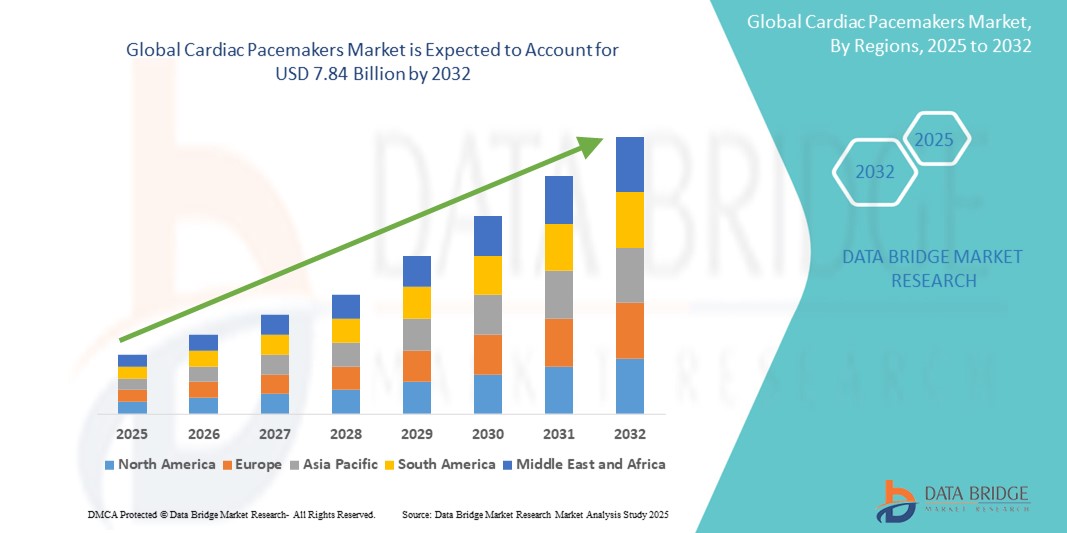
- The global cardiac pacemakers market size was valued at USD 5.31 billion in 2024 and is expected to reach USD 7.84 billion by 2032, at a CAGR of 4.99% during the forecast period
- This growth is driven by factors such as the increasing prevalence of cardiovascular diseases, the aging global population, technological advancements in pacemaker devices, and rising healthcare awareness
Cardiac Pacemakers Market Analysis
- Cardiac pacemakers are crucial medical devices used to regulate heart rhythms, ensuring the heart maintains a normal pace. These devices are essential for patients with arrhythmias, bradycardia, or heart block, and are typically used in procedures like pacemaker implantation and heart rhythm management
- The demand for cardiac pacemakers is primarily driven by the increasing prevalence of cardiovascular diseases, an aging population, and technological advancements in pacemaker devices that offer better functionality, miniaturization, and longer battery life
- North America is expected to dominate the cardiac pacemakers market with a largest market share of 43.5% due to its advanced healthcare infrastructure, high healthcare expenditure, and the growing number of cardiac disease patients
- Asia-Pacific is expected to be the fastest growing region in the cardiac pacemakers market during the forecast period due to improving healthcare infrastructure, increasing access to cardiac care, and rising awareness of heart diseases
- Implantable pacemaker segment is expected to dominate the market with a largest market share of 68.1% due to their widespread use in treating chronic heart conditions. The segment benefits from advancements in device technology, including leadless pacemakers and MRI-compatible devices, leading to improved patient outcomes and reduced complications
Report Scope and Cardiac Pacemakers Market Segmentation
|
Attributes |
Cardiac Pacemakers Key Market Insights |
|
Segments Covered |
|
|
Countries Covered |
North America
Europe
Asia-Pacific
Middle East and Africa
South America
|
|
Key Market Players |
|
|
Market Opportunities |
|
|
Value Added Data Infosets |
In addition to the insights on market scenarios such as market value, growth rate, segmentation, geographical coverage, and major players, the market reports curated by the Data Bridge Market Research also include in-depth expert analysis, patient epidemiology, pipeline analysis, pricing analysis, and regulatory framework. |
Cardiac Pacemakers Market Trends
“Technological Integration & Remote Monitoring in Cardiac Pacemakers”
- One prominent trend in the cardiac pacemaker market is the increasing integration of advanced technologies such as remote monitoring and real-time data transmission
- These innovations enhance patient care by allowing healthcare providers to remotely track pacemaker performance and monitor heart rhythm abnormalities in real-time, ensuring prompt intervention when necessary
- For instance, modern pacemaker systems are now equipped with wireless communication capabilities that enable continuous monitoring of patients, offering more personalized treatment and reducing hospital visits
- This trend is significantly improving patient outcomes by providing continuous oversight of device functionality and heart health, driving the demand for advanced pacemaker models with integrated monitoring systems
Cardiac Pacemakers Market Dynamics
Driver
“Growing Need Due to Rising Prevalence of Cardiovascular Diseases”
- The increasing prevalence of cardiovascular diseases such as heart failure, arrhythmias, and coronary artery disease is significantly driving the demand for cardiac pacemakers
- As the global population continues to age, the incidence of these heart conditions increases, particularly among older adults who are more prone to heart rhythm disorders that require pacemaker interventions
- With a growing number of individuals requiring treatment for these conditions, the demand for cardiac pacemakers rises, ensuring improved heart function, reducing the risks of severe cardiovascular events, and enhancing patient quality of life
For instance,
- In a report published by the World Health Organization (WHO) in 2020, cardiovascular diseases remain the leading cause of death worldwide, accounting for 32% of all global deaths. As the global aging population continues to expand, the burden of heart disease grows, further driving the need for pacemaker interventions
- As a result of the rising prevalence of cardiovascular conditions, the demand for cardiac pacemakers has seen significant growth, contributing to the advancement of heart health technologies and improved patient outcomes
Opportunity
“Advancing Cardiac Care with Artificial Intelligence Integration”
- AI-powered cardiac pacemakers can enhance the personalization of treatment, improve the accuracy of heart rhythm monitoring, and allow for real-time adjustments, leading to optimized heart function and improved patient outcomes
- AI algorithms can continuously analyze real-time data from pacemakers, detecting abnormal heart rhythms and providing instant feedback, enabling healthcare providers to make informed decisions about necessary interventions
- In addition, AI-powered pacemakers can assist in predictive analytics, allowing doctors to monitor trends in patients’ heart rhythms, forecast potential issues, and adjust settings proactively to prevent complications
For instance,
- In February 2025, according to a study published in the Journal of Cardiac Electrophysiology, AI algorithms used in cardiac pacemakers can detect subtle changes in heart rhythms that may go unnoticed by traditional monitoring methods. These systems can automatically adjust pacemaker settings in response to real-time data, preventing episodes of arrhythmia and improving overall heart health
- The integration of AI in cardiac pacemakers presents an opportunity for better management of heart disease, reducing hospitalizations, and improving long-term quality of life. By utilizing AI’s predictive capabilities, doctors can optimize pacemaker settings and intervene earlier in the event of complications, ultimately leading to enhanced patient care and outcomes
Restraint/Challenge
“High Equipment Costs Hindering Market Penetration”
- The high cost of cardiac pacemakers is a significant challenge for the market, especially affecting the purchasing decisions of healthcare facilities, particularly in developing regions with limited financial resources
- Cardiac pacemakers, which are vital for managing heart conditions such as arrhythmias and heart failure, can often cost thousands of dollars, including the cost of implantation procedures, maintenance, and follow-up care
- This substantial financial barrier can deter smaller clinics and hospitals with limited budgets from upgrading their equipment or investing in the latest pacemaker technologies, leading to reliance on older models or less effective solutions
For instance,
- In December 2024, according to a report by the International Journal of Cardiology, the high costs associated with cardiac pacemakers and implantation procedures are a major concern for healthcare systems in low-income countries. This financial burden limits the availability of advanced pacemakers, leading to inequalities in treatment access and patient outcomes across different regions
- As a result, these cost limitations can contribute to disparities in access to essential heart health treatments, hindering the overall growth and expansion of the cardiac pacemaker market and preventing broader adoption of life-saving technologies
Cardiac Pacemakers Market Scope
The market is segmented on the basis of type, technology, application, and end-user.
|
Segmentation |
Sub-Segmentation |
|
By Type |
|
|
By Technology |
|
|
By Application |
|
|
By End-User |
|
In 2025, the implantable pacemaker is projected to dominate the market with a largest share in type segment
The implantable pacemaker segment is expected to dominate the cardiac pacemakers market with the largest share of 68.1% due to their widespread use in treating chronic heart conditions. The segment benefits from advancements in device technology, including leadless pacemakers and MRI-compatible devices, leading to improved patient outcomes and reduced complications.
The bradycardia is expected to account for the largest share during the forecast period in application segment
In 2025, the bradycardia segment is expected to dominate the market with the largest market share of 27.6% due to its widespread occurrence, particularly in aging populations. As a condition that causes the heart to beat too slowly, it can lead to fatigue, dizziness, and more serious health risks. Pacemakers are the primary solution to manage bradycardia, providing patients with a reliable means to restore normal heart function.
Cardiac Pacemakers Market Regional Analysis
“North America Holds the Largest Share in the Cardiac Pacemaker Market”
- North America dominates the cardiac pacemaker market with a largest market share of 43.5%, driven by advanced healthcare infrastructure, high adoption of innovative medical technologies, and the presence of leading market players
- The U.S. holds a significant share of 38.4%, due to the increased demand for pacemakers driven by the rising prevalence of heart diseases such as arrhythmias and heart failure, as well as continuous advancements in cardiac treatment technologies
- The availability of well-established reimbursement policies and a strong focus on research and development by major medical device companies further strengthens the market in North America
- In addition, the high rate of adoption of advanced pacemaker technologies, including leadless pacemakers and devices with remote monitoring capabilities, contributes to market growth in the region
“Asia-Pacific is Projected to Register the Highest CAGR in the Cardiac Pacemaker Market”
- The Asia-Pacific region is expected to experience the highest growth rate in the cardiac pacemaker market, driven by rapid improvements in healthcare infrastructure, rising awareness about heart health, and increasing surgical volumes
- Countries such as China, India, and Japan are emerging as key markets due to the growing aging population, which is more susceptible to cardiovascular diseases, including arrhythmias and heart failure
- Japan, with its advanced healthcare system and high adoption rate of cutting-edge cardiac devices, remains a critical market for pacemakers, continuing to lead in the use of innovative technologies to improve patient outcomes
- China and India, with their large populations and rising cases of cardiovascular conditions, are witnessing increased investments from both the government and private sector in modern cardiac care facilities. The expanding presence of global medical device manufacturers, along with improving access to advanced heart health technologies, further drives market growth in these countries
Cardiac Pacemakers Market Share
The market competitive landscape provides details by competitor. Details included are company overview, company financials, revenue generated, market potential, investment in research and development, new market initiatives, global presence, production sites and facilities, production capacities, company strengths and weaknesses, product launch, product width and breadth, application dominance. The above data points provided are only related to the companies' focus related to market.
The Major Market Leaders Operating in the Market Are:
- Medtronic (Ireland)
- Abbott Laboratories (U.S.)
- Boston Scientific (U.S.)
- Biotronik (Germany)
- St. Jude Medical (now part of Abbott) (U.S.)
- Philips Healthcare (Netherlands)
- LivaNova (U.K.)
- Medico S.p.A. (Italy)
- Osypka AG (Germany)
- Schiller AG (Switzerland)
- MicroPort Scientific Corporation (China)
- Zoll Medical Corporation (U.S.)
- Nevro Corp. (U.S.)
- HeartWare International (now part of Medtronic) (U.S.)
- Biotronik SE & Co. KG (Germany)
- Sorin Group (now part of LivaNova) (Italy)
- Aetna Inc. (U.S.)
- Cordis (a Cardinal Health company) (U.S.)
- Cook Medical (U.S.)
- Elekta (Sweden)
Latest Developments in Global Cardiac Pacemakers Market
- In September 2024, Boston Scientific Corporation received FDA approval to expand the indications for its INGEVITY+ Pacing Leads, now authorized for use in conduction system pacing (CSP) and for sensing the left bundle branch area (LBBA). This innovative technique offers a promising alternative to traditional right ventricular pacing for patients with symptomatic bradycardia. This approval underscores Boston Scientific’s commitment to advancing cardiac care and represents a significant development within the global cardiac pacemaker market
- In June 2024, Abbott received CE Mark approval for its AVEIR Dual Chamber (DR) Leadless Pacemaker, marking a significant milestone as the first leadless pacemaker system designed for dual-chamber treatment of abnormal heart rhythms. This innovative system comprises two small devices—AVEIR VR for the right ventricle and AVEIR AR for the right atrium—that communicate wirelessly to deliver coordinated therapy. The approval of the AVEIR system not only addresses the growing demand for minimally invasive solutions but also aligns with the market's shift towards leadless pacemakers, which offer reduced complications and faster recovery times
- In March 2024, MicroPort CRM launched the ALIZEA Bluetooth pacemaker system in the U.S., marking a significant advancement in cardiac care. The first implantation of the system was successfully performed at PIH Health Downey Hospital. The ALIZEA system features a cutting-edge pacemaker paired with VEGA pacing leads, enabling real-time monitoring and management of heart rhythms. This development contributes to the global cardiac pacemakers market by addressing the increasing demand for remote patient management solutions and enhancing the overall patient experience
- In June 2021, Medtronic launched the Micra AV, a compact and self-contained pacemaker engineered to deliver advanced pacing technology for patients with atrioventricular (AV) block. This device features a minimally invasive implantation procedure, highlighting Medtronic's innovative approach to enhancing cardiac care. It addresses the growing demand for less invasive, efficient solutions in the management of heart rhythm disorders
- In January 2021, Boston Scientific Corporation announced its intention to acquire Preventice Solutions, a leading developer specializing in remote cardiac monitoring technologies. This acquisition contributes to the global cardiac pacemakers market, as it underscores the growing trend towards integrated cardiac care solutions that combine device technology with remote monitoring capabilities

- Interactive Data Analysis Dashboard
- Company Analysis Dashboard for high growth potential opportunities
- Research Analyst Access for customization & queries
- Competitor Analysis with Interactive dashboard
- Latest News, Updates & Trend analysis
- Harness the Power of Benchmark Analysis for Comprehensive Competitor Tracking
Data collection and base year analysis are done using data collection modules with large sample sizes. The stage includes obtaining market information or related data through various sources and strategies. It includes examining and planning all the data acquired from the past in advance. It likewise envelops the examination of information inconsistencies seen across different information sources. The market data is analysed and estimated using market statistical and coherent models. Also, market share analysis and key trend analysis are the major success factors in the market report. To know more, please request an analyst call or drop down your inquiry.
The key research methodology used by DBMR research team is data triangulation which involves data mining, analysis of the impact of data variables on the market and primary (industry expert) validation. Data models include Vendor Positioning Grid, Market Time Line Analysis, Market Overview and Guide, Company Positioning Grid, Patent Analysis, Pricing Analysis, Company Market Share Analysis, Standards of Measurement, Global versus Regional and Vendor Share Analysis. To know more about the research methodology, drop in an inquiry to speak to our industry experts.
Data Bridge Market Research is a leader in advanced formative research. We take pride in servicing our existing and new customers with data and analysis that match and suits their goal. The report can be customized to include price trend analysis of target brands understanding the market for additional countries (ask for the list of countries), clinical trial results data, literature review, refurbished market and product base analysis. Market analysis of target competitors can be analyzed from technology-based analysis to market portfolio strategies. We can add as many competitors that you require data about in the format and data style you are looking for. Our team of analysts can also provide you data in crude raw excel files pivot tables (Fact book) or can assist you in creating presentations from the data sets available in the report.













