


What is the Cardiovascular OCT Imaging Market Size and Growth Rate?
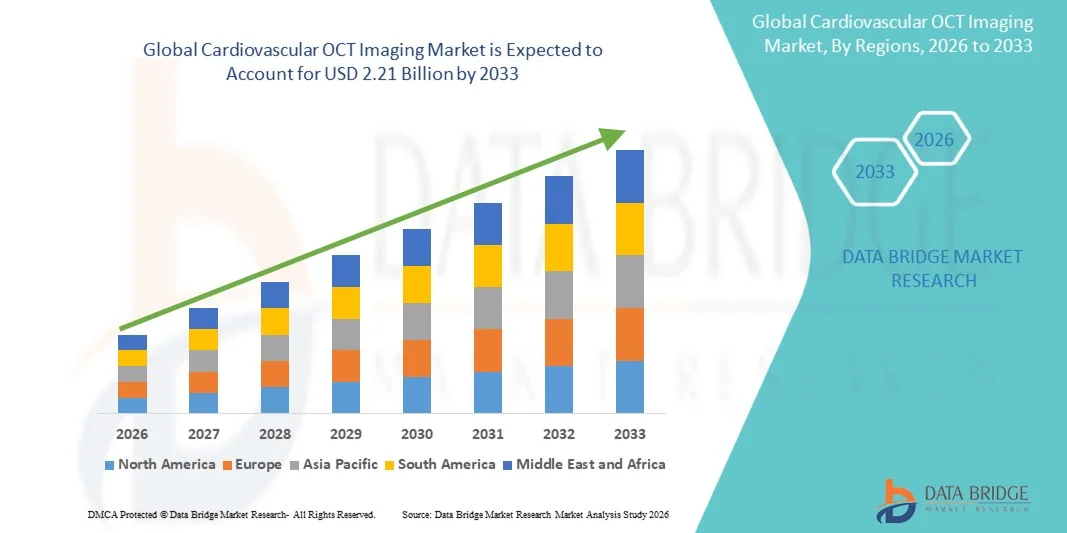
- As per Data Bridge Market Research analysis, the cardiovascular OCT imaging market was valued at USD 1.14 billion in 2025 and is projected to reach USD 2.21 billion by 2033, growing at a CAGR of 8.65% from 2026 to 2033.
- The market is experiencing consistent growth driven by rising demand for high-resolution intravascular imaging, increasing adoption of minimally invasive cardiovascular procedures, and expanding applications of OCT technology in coronary artery disease diagnosis, plaque characterization, and stent optimization.
- The increasing prevalence of cardiovascular diseases globally, combined with growing demand for accurate lesion assessment and improved outcomes in percutaneous coronary intervention (PCI), is compelling hospitals and cardiac centers to adopt advanced OCT imaging technologies. High-resolution imaging, real-time vessel visualization, and technological advancements in intravascular OCT systems are supporting wider adoption across developed and emerging markets.
Market Size & Forecast
- Global Market Value (2025): USD 1.14 Billion
- Expected Market Value (2033): USD 2.21 Billion
- Forecast CAGR (2026–2033): 8.65%
- Leading Region in 2025: North America
- Fastest Growing Region: Asia Pacific
What are the Major Takeaways of the Cardiovascular OCT Imaging Market?
- North America dominated the cardiovascular OCT imaging market with the largest revenue share of 39.21% in 2025, supported by advanced cardiac care infrastructure, high adoption of intravascular imaging, and strong presence of leading medical device manufacturers.
- Asia-Pacific is expected to be the fastest-growing region at a CAGR of 10.2% from 2026 to 2033, fueled by rising cardiovascular disease prevalence, improving healthcare infrastructure, increasing healthcare expenditure, and growing adoption of advanced coronary imaging technologies.
- The intravascular OCT imaging systems segment led the market with a 58.66% share in 2025, driven by substantial investment in OCT consoles, imaging hardware, software, and catheterization-laboratory infrastructure.
- OCT imaging catheters are the fastest-growing product type, projected to register a CAGR of 10.12%, reflecting the surge in PCI procedure volumes and recurring catheter replacement requirements.
- The frequency-domain OCT segment dominated the technology category with a 47.76% revenue share in 2025, led by its established clinical evidence base and broad commercial availability
- Acute coronary syndrome and MINOCA assessment accounted for 55.66% of the market share in 2025, preferred by OCT's ability to visualize culprit lesions and detailed coronary pathology that may not be apparent with conventional angiography.
- The stent optimization segment is the fastest-growing software category, with a CAGR of 11.45%, driven by increasing emphasis on accurate stent sizing, expansion, apposition, and landing-zone assessment.
Report Scope and Cardiovascular OCT Imaging Market Segmentation
|
Attributes |
Cardiovascular OCT Imaging Key Market Insights |
|
Segments Covered |
|
|
Countries Covered |
North America
Europe
Asia-Pacific
Middle East and Africa
South America
|
|
Key Market Players |
|
|
Market Opportunities |
|
|
Value Added Data Infosets |
In addition to the insights on market scenarios such as market value, growth rate, segmentation, geographical coverage, and major players, the market reports curated by the Data Bridge Market Research also include in-depth expert analysis, patient epidemiology, pipeline analysis, pricing analysis, and regulatory framework. |
What is the Key Trend in the Cardiovascular OCT Imaging Market?
- Artificial intelligence integration is increasingly transforming cardiovascular OCT imaging by automating plaque classification, vessel segmentation, stent assessment, and image interpretation, reducing dependence on manual analysis and supporting faster, more consistent decision-making during complex coronary interventions.
- For instance, in March 2025, PubMed published research on AI-based analysis of intracoronary OCT images, demonstrating the growing use of artificial intelligence for automated plaque characterization and coronary lesion assessment. P
- High-resolution OCT-guided PCI is gaining importance as cardiologists increasingly use detailed intravascular visualization to evaluate plaque morphology, vessel dimensions, stent expansion, malapposition, and procedural complications that may remain difficult to identify through conventional angiography.
- Growing adoption of OCT for complex coronary lesions is supporting market expansion, particularly for calcified lesions, bifurcations, long lesions, and stent failure, where detailed visualization can improve lesion preparation and guide more precise device deployment.
- For instance, in August 2022, Scientific Reports published a study demonstrating an artificial-intelligence approach for identifying vulnerable coronary plaques from intracoronary OCT images, supporting the growing integration of AI with OCT imaging.
- Integration of automated quantitative analysis is emerging as a key technology trend, enabling rapid measurement of lumen dimensions, plaque characteristics, calcium, lipid burden, and fibrous-cap thickness while improving reproducibility across operators and clinical research environments.
What are the Key Drivers of the Cardiovascular OCT Imaging Market?
- The rising prevalence of coronary artery disease and increasing volume of percutaneous coronary interventions are driving demand for high-resolution intravascular imaging that enables physicians to characterize lesions, select appropriate stents, and optimize coronary interventions more precisely.
- For instance, in October 2023, the New England Journal of Medicine published the ILUMIEN IV randomized trial involving 2,487 patients, showing that OCT-guided PCI achieved a larger minimum stent area than angiography-guided PCI, supporting growing clinical adoption of OCT for precision stent optimization.
- Growing clinical evidence supporting OCT-guided PCI is encouraging hospitals and cardiac centers to incorporate intravascular imaging into complex coronary procedures, particularly where angiography alone provides insufficient information regarding plaque morphology, stent expansion, or vessel-wall characteristics.
- Increasing emphasis on improving PCI outcomes is accelerating adoption because OCT enables detailed post-stent assessment and identification of underexpansion, malapposition, edge dissection, and residual disease, supporting corrective intervention before patients leave the catheterization laboratory.
- For instance, in September 2024, the European Society of Cardiology reported results from the OCCUPI randomized trial showing that OCT-guided PCI reduced the combined risk of cardiac death, myocardial infarction, stent thrombosis, and repeat revascularization by 38% compared with conventional angiography in patients with complex coronary lesions.
- Technological advancements in OCT systems, including faster image acquisition, improved catheter design, automated analysis, and AI-based interpretation, are improving workflow efficiency and expanding the potential clinical applications of cardiovascular OCT across increasingly complex coronary interventions.
Which Factors are Challenging the Growth of the Cardiovascular OCT Imaging Market?
- High equipment and disposable costs remain important barriers to OCT adoption, particularly for smaller hospitals and healthcare systems where catheterization laboratories operate under constrained budgets and must justify additional imaging expenditure alongside conventional angiography.
- For instance, in October 2024, Catheterization and Cardiovascular Interventions published a survey of 101 cardiac catheterization laboratory professionals reporting that increased procedure time (58%) and procedural cost (48%) were major barriers to intravascular imaging adoption, limiting routine use of OCT.
- Additional procedural time and workflow complexity can restrict routine OCT utilization because imaging requires catheter positioning, blood clearance, image acquisition, interpretation, and sometimes repeated imaging during PCI, increasing procedural demands on catheterization laboratory teams.
- Contrast-volume requirements can limit OCT use among patients with renal impairment because coronary OCT generally requires blood clearance using contrast or alternative flushing agents, creating additional considerations when clinicians assess patients at elevated kidney-risk.
- For instance, in December 2024, IJC Heart & Vasculature reported that conventional coronary OCT requires contrast-agent injection and noted that excessive contrast exposure may adversely affect renal function and increase the risk of contrast-induced complications, creating a limitation for patients with renal impairment.
- Limited operator expertise and training requirements can constrain adoption because accurate interpretation of OCT images requires familiarity with plaque morphology, stent optimization criteria, artifacts, and quantitative measurements, particularly in hospitals with lower procedural volumes.
How is the Cardiovascular OCT Imaging Market Segmented?
The cardiovascular OCT imaging market is segmented on the basis of product type, technology, application, and end user.
- By Product Type
On the basis of product type, the cardiovascular OCT imaging market is segmented into intravascular OCT imaging systems, OCT imaging catheters, and accessories and consumables. The intravascular OCT imaging systems segment dominated the market with a 58.66% revenue share in 2025, owing to substantial investment in OCT consoles, imaging hardware, software, and catheterization-laboratory infrastructure. Hospitals typically purchase these systems together with service agreements, software upgrades, and clinical training, strengthening long-term vendor relationships. The installed base of OCT systems also creates recurring demand for compatible catheters and consumables. Increasing adoption of high-resolution intravascular imaging for complex coronary interventions is further supporting demand for these systems. Integration of advanced analytics and improved workflow capabilities is strengthening their clinical utility. The established installed base and high upfront value of imaging consoles continue to make this the leading product category globally.
The OCT imaging catheters segment is projected to be the fastest-growing product category, registering a CAGR of 10.12% from 2026 to 2033, driven by rising PCI procedure volumes and recurring catheter replacement requirements. Unlike imaging consoles, catheters are consumable products and therefore generate repeat purchases with each procedure. Increasing use of OCT for lesion assessment, stent sizing, and post-PCI optimization is expanding catheter utilization across cardiac centers. Advances in catheter design are also improving access to narrow and complex coronary lesions. Continued product innovation, increasing procedural adoption, and recurring replacement cycles are expected to accelerate catheter demand globally.
- By Technology
On the basis of technology, the cardiovascular OCT imaging market is segmented into frequency-domain OCT, optical frequency-domain imaging, high-frequency OCT, OCT-NIRS hybrid imaging, and OCT-IVUS hybrid imaging. The frequency-domain OCT segment dominated the market with a 47.76% revenue share in 2025, supported by its established clinical evidence base and broad commercial availability. Frequency-domain systems provide rapid image acquisition and high-resolution visualization of coronary vessel structures. These capabilities make the technology widely applicable for plaque assessment, vessel sizing, and stent optimization during PCI. The technology has also benefited from extensive clinical experience and established integration into catheterization-laboratory workflows. However, requirements for blood clearance and limitations in imaging through some heavily calcified or lipid-rich lesions remain important considerations. Its mature clinical adoption and broad availability continue to maintain its leading position in the technology category.
The high-frequency OCT segment is projected to be the fastest-growing technology category, with a CAGR of 9.80% through 2033, driven by smaller catheter profiles and reduced vessel-preparation requirements. High-frequency OCT systems can support imaging in severely stenotic vessels where conventional approaches may require additional preparation before imaging. Smaller catheter profiles can potentially improve procedural flexibility and expand access to challenging lesions. Technological advances are also improving imaging speed and supporting more efficient intravascular assessment. Continued development of compact catheters and high-speed imaging is expected to support increasing adoption of high-frequency OCT in complex coronary procedures.
- By Application
On the basis of application, the cardiovascular OCT imaging market is segmented into pre-PCI lesion and vessel assessment, stent optimization, stent expansion failure assessment, atherosclerotic plaque characterization and vulnerable plaque assessment, and acute coronary syndrome and MINOCA assessment. The acute coronary syndrome and MINOCA assessment segment dominated the market with a 55.66% revenue share in 2025, supported by OCT's ability to visualize culprit lesions and detailed coronary pathology that may not be apparent with conventional angiography. OCT can help identify plaque rupture, plaque erosion, thrombus, and other structural causes associated with acute coronary presentations. Its high-resolution imaging capabilities are particularly valuable when angiography demonstrates non-obstructive coronary arteries. Growing use of advanced intravascular imaging in challenging acute coronary cases continues to support the dominance of this application segment.
The stent optimization segment is projected to be the fastest-growing application, registering a CAGR of 11.45% through 2033, driven by increasing emphasis on accurate stent sizing, expansion, apposition, and landing-zone assessment. OCT provides detailed visualization of stent struts and vessel morphology, enabling physicians to identify underexpansion and malapposition more precisely. Its use can support immediate corrective intervention when suboptimal stent deployment is detected. Increasing clinical evidence linking imaging-guided PCI with improved procedural optimization is further encouraging adoption. The growing focus on procedural quality and reducing repeat intervention risk is expected to make stent optimization an increasingly important application for cardiovascular OCT imaging.
- By End User
On the basis of end user, the cardiovascular OCT imaging market is segmented into hospitals and tertiary care centers, ambulatory surgical centers, specialty cardiology clinics, diagnostic laboratories, academic and research institutes, and others. The hospitals and tertiary care centers segment dominated the market with a 53.56% share in 2025, owing to the high concentration of complex PCI procedures and advanced catheterization laboratories in these facilities. Hospitals are also better positioned to make the capital investments required for OCT imaging consoles and supporting infrastructure. Tertiary cardiac centers frequently manage multivessel disease, acute coronary syndromes, and complex lesions requiring advanced intravascular imaging. Integration of OCT into established interventional cardiology workflows further supports utilization in these settings. In addition, hospitals commonly provide the clinical expertise and multidisciplinary teams required for interpreting high-resolution intravascular images.
The specialty cardiology clinics segment is projected to be the fastest-growing end-user category, expanding at a CAGR of 10.56% through 2033, supported by increasing specialization of cardiovascular care and the expansion of advanced interventional services. Specialty cardiology facilities are increasingly incorporating advanced diagnostic and intravascular imaging technologies to manage complex coronary cases. Growth in outpatient and specialized cardiac-care models is creating opportunities for OCT utilization outside large tertiary hospitals. These clinics can benefit from compact imaging platforms, improved workflow integration, and increasingly automated image-analysis capabilities. Rising demand for precise lesion assessment and stent optimization is also encouraging specialized centers to adopt intravascular imaging.
Which Region Holds the Largest Share of the Cardiovascular OCT Imaging Market?
- North America dominated the cardiovascular OCT imaging market with the largest revenue share of 39.21% in 2025, supported by advanced cardiac care infrastructure, high adoption of intravascular imaging, and strong presence of leading medical device manufacturers.
- The region also benefits from high clinical adoption of OCT-guided PCI, extensive participation in cardiovascular clinical trials, and the presence of leading medical device companies. Increasing use of intravascular imaging for complex coronary lesions, favorable clinical recommendations, and continued investment in advanced cardiac-care facilities are further strengthening North America's leadership in the global cardiovascular OCT imaging market.
U.S. Cardiovascular OCT Imaging Market Insight
The U.S. cardiovascular OCT imaging market is witnessing strong growth due to rising adoption of intravascular imaging in complex percutaneous coronary interventions, increasing cardiovascular disease burden, and advanced cardiac-care infrastructure. The country’s mature interventional cardiology ecosystem, along with increasing adoption of high-resolution OCT-guided PCI and AI-assisted image analysis, is driving demand across hospitals, cardiac centers, and research institutions. In addition, growing clinical evidence supporting OCT-guided stent optimization and improved procedural outcomes is accelerating adoption among cardiologists and specialized cardiac-care facilities.
Asia-Pacific Cardiovascular OCT Imaging Market Insight
The Asia-Pacific cardiovascular OCT imaging market is expected to witness rapid growth, driven by increasing cardiovascular disease prevalence, expanding healthcare infrastructure, and rising investments in advanced cardiac catheterization facilities across countries such as China, India, and Japan. Growing awareness regarding intravascular imaging, rising PCI volumes, and increasing adoption of minimally invasive cardiovascular procedures are supporting regional market expansion. In addition, improving access to advanced medical technologies and increasing healthcare expenditure are accelerating OCT adoption across hospitals, specialty cardiac centers, and academic institutions.
Japan Cardiovascular OCT Imaging Market Insight
The Japan cardiovascular OCT imaging market is witnessing consistent growth due to rising investments in advanced cardiovascular diagnostics, an aging population, and increasing demand for precise coronary intervention technologies. Hospitals and cardiac centers are increasingly adopting high-resolution OCT systems for plaque characterization, lesion assessment, and stent optimization during PCI procedures. Moreover, increasing integration of automated image analysis and Japan’s focus on advanced minimally invasive cardiac care are further contributing to market growth.
China Cardiovascular OCT Imaging Market Insight
The China cardiovascular OCT imaging market is growing rapidly, driven by increasing cardiovascular disease prevalence, expanding healthcare infrastructure, and rising demand for advanced coronary intervention technologies. Growing adoption of intravascular imaging across hospitals and tertiary cardiac centers is significantly boosting market demand. In addition, increasing investments in cardiovascular research, rising PCI procedure volumes, and improvements in access to advanced medical devices are positioning China as one of the fastest-growing markets for cardiovascular OCT imaging globally.
U.K. Cardiovascular OCT Imaging Market Insight
The U.K. cardiovascular OCT imaging market is experiencing steady growth, supported by rising adoption of intravascular imaging in complex coronary interventions and increasing emphasis on improving PCI outcomes. Increasing investments in advanced cardiac-care infrastructure and growing demand for high-resolution lesion assessment are contributing to market growth. Furthermore, the integration of automated image analysis, clinical research, and evidence-based OCT-guided intervention is improving procedural precision and supporting wider adoption across hospitals and specialist cardiac centers.
Germany Cardiovascular OCT Imaging Market Insight
The Germany cardiovascular OCT imaging market is expanding steadily due to the country’s advanced healthcare infrastructure, strong cardiovascular research capabilities, and increasing adoption of next-generation intravascular imaging technologies. Hospitals, university medical centers, and specialized cardiac facilities are increasingly utilizing OCT for plaque characterization, lesion assessment, and stent optimization. Continuous advancements in imaging resolution, automated analysis, and catheter technology, along with Germany’s strong focus on high-quality cardiovascular care and minimally invasive interventions, are further driving market growth.
Which are the Top Companies in Cardiovascular OCT Imaging Market?
The cardiovascular OCT imaging industry is primarily led by well-established companies, including:
- Abbott (U.S.)
- Boston Scientific Corporation (U.S.)
- Terumo Corporation (Japan)
- Conavi Medical Inc. (Canada)
- Gentuity, LLC (U.S.)
- Medtronic (Ireland)
- Koninklijke Philips N.V. (Netherlands)
- CANON MEDICAL SYSTEMS CORPORATION (Japan)
- Leica Microsystems GmbH (Germany)
- Carl Zeiss Meditec AG (Germany)
- Heidelberg Engineering GmbH (Germany)
- MicroPort Scientific Corporation (China)
- NIPRO CORPORATION (Japan)
- Olympus Corporation (Japan)
- Shenzhen Vivolight Medical Device & Technology Co., Ltd. (China)
- santec Corporation (Japan)
- Thorlabs, Inc. (U.S.)
- TOPCON CORPORATION (Japan)
- NIDEK CO., LTD. (Japan)
- Avinger, Inc. (U.S.)
What are Latest Developments in Cardiovascular OCT Imaging Market?
- In October 2024, Gentuity announced FDA 510(k) clearance for its Gentuity HF-OCT Imaging System, featuring the Vis-Rx Micro-Imaging Catheter for pre- and post-coronary intervention imaging. The high-frequency OCT platform uses a small 1.8F catheter and is designed to provide high-resolution imaging of coronary arteries, including challenging lesions. The product development represents an important advancement in compact, high-frequency cardiovascular OCT technology and expands options for intravascular coronary imaging.
- In October 2023, Abbott launched its Ultreon 1.0-powered vascular imaging platform in India, combining optical coherence tomography (OCT) with artificial intelligence to provide physicians with automated information on coronary blood flow, blockages, vessel dimensions, and calcium. The platform was designed to support more precise decision-making during coronary interventions and represents the increasing integration of AI with cardiovascular OCT imaging.
- In April 2022, Conavi Medical's Novasight Hybrid System entered clinical use at Sunnybrook Health Sciences Centre, providing simultaneous intravascular ultrasound (IVUS) and OCT imaging through a single catheter. The hybrid platform combines the high resolution of OCT with the deeper imaging capability and larger field of view of IVUS, supporting assessment of complex coronary anatomy and lesions.
- In April 2021, Abbott launched its new coronary imaging platform powered by Ultreon 1.0 Software in Europe, combining OCT imaging with artificial intelligence and automated image analysis. The platform was designed to automatically detect and quantify blood-vessel characteristics, including calcium and vessel dimensions, helping physicians make more informed decisions during coronary stenting procedures.
- In August 2021, Abbott received FDA clearance for its Ultreon Software, an AI-enhanced OCT imaging technology designed to automatically detect calcium-based blockages and measure vessel diameter during coronary interventions. The technology combined OCT's high-resolution intravascular imaging with AI-based analysis to provide physicians with automated information for treatment planning and stent placement.

- Interactive Data Analysis Dashboard
- Company Analysis Dashboard for high growth potential opportunities
- Research Analyst Access for customization & queries
- Competitor Analysis with Interactive dashboard
- Latest News, Updates & Trend analysis
- Harness the Power of Benchmark Analysis for Comprehensive Competitor Tracking
Data collection and base year analysis are done using data collection modules with large sample sizes. The stage includes obtaining market information or related data through various sources and strategies. It includes examining and planning all the data acquired from the past in advance. It likewise envelops the examination of information inconsistencies seen across different information sources. The market data is analysed and estimated using market statistical and coherent models. Also, market share analysis and key trend analysis are the major success factors in the market report. To know more, please request an analyst call or drop down your inquiry.
The key research methodology used by DBMR research team is data triangulation which involves data mining, analysis of the impact of data variables on the market and primary (industry expert) validation. Data models include Vendor Positioning Grid, Market Time Line Analysis, Market Overview and Guide, Company Positioning Grid, Patent Analysis, Pricing Analysis, Company Market Share Analysis, Standards of Measurement, Global versus Regional and Vendor Share Analysis. To know more about the research methodology, drop in an inquiry to speak to our industry experts.
Data Bridge Market Research is a leader in advanced formative research. We take pride in servicing our existing and new customers with data and analysis that match and suits their goal. The report can be customized to include price trend analysis of target brands understanding the market for additional countries (ask for the list of countries), clinical trial results data, literature review, refurbished market and product base analysis. Market analysis of target competitors can be analyzed from technology-based analysis to market portfolio strategies. We can add as many competitors that you require data about in the format and data style you are looking for. Our team of analysts can also provide you data in crude raw excel files pivot tables (Fact book) or can assist you in creating presentations from the data sets available in the report.













