


What is the Care Services Market Size and Growth Rate?
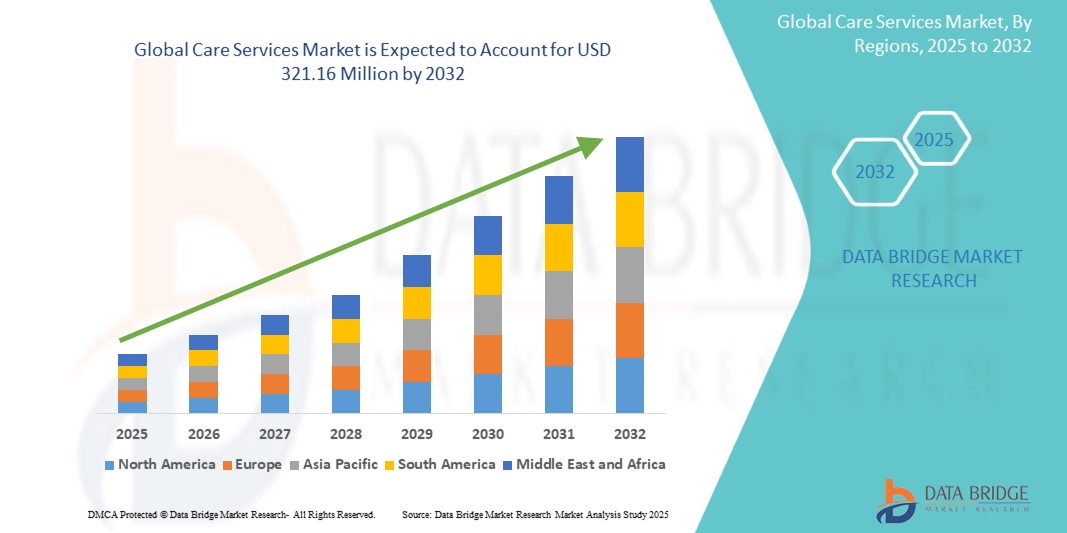
- As per Data Bridge Market Research Analysis the global care services market was valued at USD 163.56 million in 2024 and is expected to reach USD 321.16 million by 2032
- During the forecast period of 2025 to 2032 the market is likely to grow at a CAGR of 8.80%, primarily driven by factors such as the aging global population and technological advancements
- This growth is fueled by the increasing demand for elderly care, especially home care and nursing services, as well as innovations like telemedicine and remote monitoring technologies
Market Size & Forecast
Global Market Value (2024): USD 163.56 million
Expected Market Value (2032): USD 321.16 million
Forecast CAGR (2025–2032): 8.80%
What are the Major Takeaways of Care Services Market?
- The global care services market encompasses a broad range of healthcare services, including home healthcare, elderly care, palliative care, and rehabilitation services. These services are essential for managing chronic diseases, post-surgical recovery, and long-term healthcare needs
- Demand for care services is primarily driven by the growing aging population, increasing prevalence of chronic diseases, and a shift towards value-based care models. Governments and healthcare organizations worldwide are focusing on expanding care services to reduce hospital readmissions and improve patient outcomes
- The North America region leads in care services market growth, supported by strong healthcare policies, insurance coverage, and an increasing preference for home-based care solutions
- For instance, in the U.S., the home healthcare market has experienced significant expansion due to Medicare and private insurance reimbursements, enabling more patients to receive care outside of hospital settings
- Globally, home healthcare services rank among the fastest-growing segments in the care services market, driven by advancements in telehealth, remote monitoring, and caregiver support technologies. These innovations enhance accessibility, affordability, and efficiency in delivering healthcare services
Report Scope and Care Services Market Segmentation
|
Attributes |
Care Services Key Market Insights |
|
Segments Covered |
|
|
Countries Covered |
North America
Europe
Asia-Pacific
Middle East and Africa
South America
|
|
Key Market Players |
|
|
Market Opportunities |
|
|
Value Added Data Infosets |
In addition to the insights on market scenarios such as market value, growth rate, segmentation, geographical coverage, and major players, the market reports curated by the Data Bridge Market Research also include import export analysis, production capacity overview, production consumption analysis, price trend analysis, climate change scenario, supply chain analysis, value chain analysis, raw material/consumables overview, vendor selection criteria, PESTLE Analysis, Porter Analysis, and regulatory framework. |
What is the Key Trend in the Care Services Market?
“Increased Adoption of Telemedicine and Remote Monitoring Technologies”
- One prominent trend in the global care services market is the growing adoption of telemedicine and remote monitoring technologies
- These advancements enhance the accessibility and efficiency of care services by enabling healthcare providers to monitor patients remotely and deliver consultations through digital platforms
- For instance, telemedicine allows patients to receive medical advice and treatment from the comfort of their homes, reducing the need for physical visits and improving convenience
- Remote monitoring technologies facilitate continuous tracking of patients' health metrics, such as heart rate, blood pressure, and glucose levels, which is crucial for managing chronic conditions
- This trend is revolutionizing the way ophthalmic surgeries are performed, improving patient outcomes and increasing the demand for technologically advanced microscopes in the This trend is transforming the delivery of care services, improving patient outcomes, and increasing the demand for innovative digital solutions in the market
Care Services Market Dynamics
Driver
“Growing Need Due to Aging Population and Chronic Disease Prevalence”
- The rising global elderly population is a significant factor driving the demand for care services, including home healthcare, assisted living, nursing care, and palliative car
- With advancements in healthcare prolonging life expectancy, a growing number of individuals require long-term care and specialized medical attention, leading to an expansion in the care services sector
- Chronic diseases such as Alzheimer's, Parkinson’s, cardiovascular diseases, and diabetes are becoming more prevalent, necessitating continuous medical and non-medical care, thus increasing the demand for professional caregiving services
- Technological advancements in healthcare delivery, such as telehealth, remote monitoring, and AI-assisted care management, further enhance the quality and accessibility of care services
- The shortage of skilled caregivers and nurses in many regions has led to higher investments in training programs and recruitment efforts to meet the growing demand for professional care services
For instance,
- In July 2022, according to an article published by the National Center for Biotechnology Information (NCBI), the proportion of the elderly population is increasing rapidly, with individuals aged 65 years and older projected to account for 16% of the global population by 2050. This demographic shift highlights the growing need for elderly care services, including home-based and institutional care, driving market expansion
- In December 2021, an NCBI article reported that in countries such as the U.S., Japan, and Germany, the number of individuals aged 80 years and older is expected to double by 2050, significantly increasing healthcare needs and long-term care requirements. This trend acts as a key driver for the global care services market, emphasizing the need for sustainable care solutions to cater to the aging population
- As the aging population and prevalence of chronic diseases continue to rise, the demand for comprehensive care services, including home healthcare, nursing homes, and elderly assistance programs, is expected to experience significant growth
Opportunity
“Revolutionizing Care Services with Artificial Intelligence Integration”
- AI-powered solutions in the care services market are transforming patient care, improving efficiency, and enhancing personalized healthcare delivery. AI-driven analytics can predict patient deterioration, optimize care plans, and assist caregivers in providing better, more targeted support
- AI-based virtual assistants and chatbots are increasingly being used in elder care and home healthcare settings to monitor patients, remind them to take medications, and provide instant medical guidance
- Predictive analytics powered by AI can help healthcare providers anticipate health declines in elderly patients, enabling early interventions that improve long-term health outcomes
- AI-driven robotic caregivers and smart monitoring systems are improving patient mobility, ensuring safety, and reducing the workload for human caregivers, leading to better quality care
- The integration of AI in electronic health records (EHR) and remote patient monitoring (RPM) allows for real-time data analysis, ensuring timely medical decisions and reducing hospital readmissions
For instance,
- In January 2025, according to an article published in the JMA Journal, AI-based predictive models have demonstrated the ability to assess patient health data in real time, allowing care providers to anticipate health declines in elderly patients and prevent hospitalizations. The use of AI in care services is revolutionizing chronic disease management, enabling proactive interventions
- In November 2023, according to an article published in the National Library of Medicine, AI-powered virtual assistants have been shown to enhance elderly care by providing medication reminders, monitoring vital signs, and detecting emergencies such as falls. These systems have improved response times and reduced health risks for elderly individuals receiving home care
- The adoption of AI in the care services market is driving improved patient outcomes, enhanced operational efficiency, and reduced caregiver burden. By leveraging AI-powered predictive analytics, robotic assistance, and smart monitoring tools, care providers can deliver more effective, personalized, and proactive care, ultimately enhancing the quality of life for aging populations and individuals with chronic conditions
Restraint/Challenge
“High Service Costs Hindering Market Accessibility”
- The high cost of care services poses a significant challenge for market expansion, particularly affecting the affordability of services for lower-income individuals and families
- Long-term care services, including nursing homes, assisted living, and home healthcare, require substantial financial investment, making them inaccessible for many individuals without adequate insurance or government support
- The rising costs of skilled nursing care, home health aides, and specialized medical services further contribute to financial burdens on both patients and caregivers, limiting the widespread adoption of professional care services
- Many elderly individuals rely on fixed incomes, making it difficult to afford quality care without significant financial assistance, leading to disparities in access to essential services
For instance,
- In November 2024, according to an article published by the World Health Organization (WHO), one of the main concerns surrounding the rising cost of care services is its potential impact on accessibility and affordability. The financial burden associated with long-term care services, particularly in private facilities, often prevents lower-income individuals from receiving adequate care, thereby exacerbating healthcare inequalities
- Consequently, such financial barriers contribute to disparities in the availability and quality of care, particularly in underprivileged communities. The high cost of care services hinders market growth, limiting access to essential healthcare for aging populations and individuals with chronic conditions
How is the Care Services Market Segmented?
The market is segmented on the basis components, delivery model, application, and end use.
|
Segmentation |
Sub-Segmentation |
|
By Components |
|
|
By Delivery Mode |
|
|
By Application |
|
|
By End Use |
|
Which Region Holds the Largest Share of the Care Services Market?
“North America is the Dominant Region in the Care Services Market”
- North America leads the global care services market, driven by a well-developed healthcare system, increasing aging population, and high demand for long-term and home-based care services
- The U.S. holds a significant market share due to its growing elderly population, rising prevalence of chronic diseases, and increasing government support for elderly and disability care programs
- Favorable reimbursement policies and strong insurance coverage for long-term care services further contribute to market growth, enabling more individuals to access professional care
- The presence of key industry players, along with continuous investments in healthcare infrastructure and technological advancements such as AI-driven monitoring systems and telehealth solutions, supports market expansion
- Additionally, the rising adoption of personalized and home-based care solutions, coupled with a preference for aging in place, is fueling the growth of home healthcare services across the region
“Asia-Pacific is Projected to Register the Highest Growth Rate”
- The Asia-Pacific region is expected to experience the highest growth in the care services market, driven by the rapid expansion of healthcare infrastructure, increasing awareness about elderly and chronic disease management, and rising demand for long-term care services
- Countries like China, India, and Japan are becoming significant markets due to their aging populations, which are more vulnerable to conditions requiring continuous care and support, such as dementia, cardiovascular diseases, and mobility issues
- Japan continues to lead in the adoption of advanced care technologies, including robotic caregivers and AI-powered monitoring systems, to support elderly care and improve patient outcomes
- In China and India, the growing demand for elderly care services is supported by both government initiatives and private sector investments. The expansion of healthcare facilities and increased access to care services are contributing to market growth in these countries
Which are the Top Companies in Care Services Market?
The market competitive landscape provides details by competitor. Details included are company overview, company financials, revenue generated, market potential, investment in research and development, new market initiatives, global presence, production sites and facilities, production capacities, company strengths and weaknesses, product launch, product width and breadth, application dominance. The above data points provided are only related to the companies' focus related to market.
The Major Market Leaders Operating in the Market Are:
- ExlService Holdings, Inc. (U.S.)
- Casenet, LLC (U.S.)
- Medecision (U.S.)
- ZeOmega (U.S.)
- Cognizant (U.S.)
- Oracle (U.S.)
- Allscripts Healthcare, LLC (U.S.)
- Tata Consultancy Services Limited (India)
- Koninklijke Philips N.V (Netherlands)
- Axispoint, Inc. (U.S.)
- McKesson Corporation (U.S.)
- i2i Systems (U.S.)
- Epic Systems Corporation (U.S.)
- IBM Corporation (U.S.)
- Health Catalyst (U.S.)
- Pegasystems Inc. (U.S.)
- A&D Company Limited (Japan)
What are Latest Developments in Care Services Market?
- In July 2024, Genesis HealthCare, Inc., one of the largest post-acute care providers in the nation, announced that three of its affiliated locations were recognized as 2024 recipients of the Silver–Commitment to Quality Award by the American Health Care Association and National Center for Assisted Living (AHCA/NCAL). This award honors their dedication to improving the lives of residents through quality care. The Silver Award is the second of three distinctions available through the AHCA/NCAL National Quality Award Program, which recognizes organizations that meet increasingly rigorous standards of performance to enhance the lives of both residents and staff in long-term care and senior living settings
- In January 2024, McKesson acquired Compile, a healthcare data platform that integrates data from across the U.S. healthcare system. This acquisition is expected to assist McKesson in commercializing data and providing valuable insights to its biopharma customers.
- In September 2024, Baxter International Inc. introduced its next-generation airway clearance system, the Vest Advanced Pulmonary Experience (APX) System, at the North American Cystic Fibrosis Conference. Designed for adults and children with chronic lung conditions, the APX system retains reliable airflow technology while improving comfort and integrating feedback from clinicians and patients
- In 2024, Health Catalyst announced its acquisition of Lumeon, a digital health company that assists provider organizations in improving care coordinatio

- Interactive Data Analysis Dashboard
- Company Analysis Dashboard for high growth potential opportunities
- Research Analyst Access for customization & queries
- Competitor Analysis with Interactive dashboard
- Latest News, Updates & Trend analysis
- Harness the Power of Benchmark Analysis for Comprehensive Competitor Tracking
Table of Content
1 INTRODUCTION
1.1 OBJECTIVES OF THE STUDY
1.2 MARKET DEFINITION
1.3 OVERVIEW OF GLOBAL CARE SERVICES MARKET
1.4 CURRENCY AND PRICING
1.5 LIMITATION
1.6 MARKETS COVERED
2 MARKET SEGMENTATION
2.1 KEY TAKEAWAYS
2.2 ARRIVING AT THE GLOBAL NUCLEIC ACID BASED DRUGS SIZE
2.2.1 VENDOR POSITIONING GRID
2.2.2 TECHNOLOGY LIFE LINE CURVE
2.2.3 TRIPOD DATA VALIDATION MODEL
2.2.4 MARKET GUIDE
2.2.5 MULTIVARIATE MODELLING
2.2.6 TOP TO BOTTOM ANALYSIS
2.2.7 CHALLENGE MATRIX
2.2.8 APPLICATION COVERAGE GRID
2.2.9 STANDARDS OF MEASUREMENT
2.2.10 VENDOR SHARE ANALYSIS
2.2.11 DATA POINTS FROM KEY PRIMARY INTERVIEWS
2.2.12 DATA POINTS FROM KEY SECONDARY DATABASES
2.3 GLOBAL CARE SERVICES MARKET: RESEARCH SNAPSHOT
2.4 ASSUMPTIONS
3 EXECUTIVE SUMMARY
4 PREMIUM INSIGHTS
4.1 PESTEL ANALYSIS
4.2 PORTER’S FIVE FORCES MODEL
5 INDUSTRY INSIGHTS
5.1 PATENT ANALYSIS
5.1.1 PATENT LANDSCAPE
5.1.2 USPTO NUMBER
5.1.3 PATENT EXPIRY
5.1.4 EPIO NUMBER
5.1.5 PATENT STRENGTH AND QUALITY
5.1.6 PATENT CLAIMS
5.1.7 PATENT CITATIONS
5.1.8 PATENT LITIGATION AND LICENSING
5.1.9 FILE OF PATENT
5.1.10 PATENT RECEIVED CONTRIES
5.1.11 TECHNOLOGY BACKGROUND
5.2 DRUG TREATMENT RATE BY MATURED MARKETS
5.3 DEMOGRAPHIC TRENDS: IMPACTS ON ALL INCIDENCE RATES
5.4 PATIENT FLOW DIAGRAM
5.5 KEY PRICING STRATEGIES
5.6 KEY PATIENT ENROLLMENT STRATEGIES
5.7 INTERVIEWS WITH SPECIALIST
5.8 OTHER KOL SNAPSHOTS
6 MERGERS AND ACQUISITION
6.1 LICENSING
6.2 COMMERCIALIZATION AGREEMENTS
7 REGULATORY FRAMEWORK
7.1 REGULATORY APPROVAL PROCESS
7.2 GEOGRAPHIES’ EASE OF REGULATORY APPROVAL
7.3 REGULATORY APPROVAL PATHWAYS
7.4 LICENSING AND REGISTRATION
7.5 POST-MARKETING SURVEILLANCE
8 MARKET OVERVIEW
8.1 DRIVERS
8.2 RESTRAINTS
8.3 OPPORTUNITIES
8.4 CHALLENGES
9 GLOBAL CARE SERVICES MARKET, BY COMPONENT
9.1 OVERVIEW
9.2 SOFTWARE
9.2.1 BY TYPE
9.2.1.1. CARE MANAGEMENT PLATFORMS
9.2.1.2. PATIENT ENGAGEMENT SOLUTIONS
9.2.1.3. ANALYTICS AND REPORTING TOOLS
9.2.1.4. WORKFLOW AUTOMATION TOOLS
9.2.1.5. OTHERS
9.2.2 BY MODE
9.2.2.1. INTEGRATED
9.2.2.2. STANDALONE
9.2.3 BY OPERATING SYSTEM
9.2.3.1. ANDROID
9.2.3.2. WINDOWS
9.2.3.3. IOS
9.2.3.4. OTHERS
9.3 SERVICES
9.3.1 CONSULTING AND TRAINING
9.3.2 IMPLEMENTATION SERVICES
9.3.3 SUPPORT AND MAINTENANCE
9.3.4 MANAGED SERVICES
9.3.5 OTHERS
10 GLOBAL CARE SERVICES MARKET, BY DELIVERY MODE
10.1 OVERVIEW
10.2 ON-PREMISE
10.3 CLOUD-BASED
10.3.1 PUBLIC CLOUD
10.3.2 PRIVATE CLOUD
10.3.3 HYBRID CLOUD
10.4 OTHERS
11 GLOBAL CARE SERVICES MARKET , BY APPLICATION
11.1 OVERVIEW
11.2 DISEASE MANAGEMENT
11.2.1 CHRONIC DISEASE MANAGEMENT
11.2.1.1. DIABETES MANAGEMENT PROGRAMS
11.2.1.1.1. INSULIN THERAPY OPTIMIZATION
11.2.1.1.2. CONTINUOUS GLUCOSE MONITORING (CGM) TRAINING
11.2.1.1.3. DIABETIC DIET AND NUTRITION COUNSELING
11.2.1.1.4. OTHERS
11.2.1.2. HYPERTENSION CONTROL INITIATIVES
11.2.1.2.1. MEDICATION ADHERENCE SUPPORT
11.2.1.2.2. BLOOD PRESSURE MONITORING WORKSHOPS
11.2.1.2.3. SALT-INTAKE REDUCTION EDUCATION
11.2.1.2.4. OTHERS
11.2.1.3. COPD AND ASTHMA CARE PLANS
11.2.1.3.1. INHALER USAGE TRAINING
11.2.1.3.2. PULMONARY REHABILITATION PROGRAMS
11.2.1.3.3. EMERGENCY ACTION PLANS FOR EXACERBATIONS
11.2.1.4. OTHERS
11.2.2 PREVENTIVE CARE
11.2.2.1. VACCINATION CAMPAIGNS
11.2.2.1.1. FLU VACCINATION DRIVES
11.2.2.1.2. SCHOOL-BASED IMMUNIZATION PROGRAMS
11.2.2.1.3. ADULT VACCINATION AWARENESS CAMPAIGNS
11.2.2.1.4. OTHERS
11.2.2.2. HEALTH SCREENINGS AND ASSESSMENTS
11.2.2.2.1. ANNUAL PHYSICAL EXAMS
11.2.2.2.2. CANCER SCREENING INITIATIVES
11.2.2.2.3. CARDIOVASCULAR RISK ASSESSMENTS
11.2.2.2.4. OTHERS
11.2.2.3. LIFESTYLE MODIFICATION PROGRAMS
11.2.2.3.1. SMOKING CESSATION PROGRAMS
11.2.2.3.2. WEIGHT MANAGEMENT CLINICS
11.2.2.3.3. STRESS MANAGEMENT TECHNIQUES
11.2.2.3.4. OTHERS
11.2.2.4. OTHERS
11.2.3 POST-ACUTE CARE MANAGEMENT
11.2.3.1. REHABILITATION SERVICES
11.2.3.1.1. PHYSICAL THERAPY SESSIONS
11.2.3.1.2. SPEECH AND LANGUAGE THERAPY
11.2.3.1.3. OCCUPATIONAL THERAPY FOR DAILY LIVING
11.2.3.1.4. OTHERS
11.2.3.2. HOME-BASED RECOVERY PROGRAMS
11.2.3.2.1. POST-SURGICAL CARE AT HOME
11.2.3.2.2. NUTRITIONAL SUPPORT SERVICES
11.2.3.2.3. REMOTE PHYSIOTHERAPY ASSISTANCE
11.2.3.2.4. OTHERS
11.2.3.3. TRANSITIONAL CARE COORDINATION
11.2.3.3.1. DISCHARGE PLANNING SERVICES
11.2.3.3.2. FOLLOW-UP APPOINTMENT SCHEDULING
11.2.3.3.3. MEDICATION RECONCILIATION AND EDUCATION
11.2.3.3.4. OTHERS
11.2.3.4. OTHERS
11.3 CASE MANAGEMENT
11.3.1 INDIVIDUAL CASE MANAGEMENT
11.3.1.1. PERSONALIZED CARE PLANS
11.3.1.1.1. TAILORED TREATMENT PROTOCOLS
11.3.1.1.2. HOLISTIC WELLNESS APPROACHES
11.3.1.1.3. BEHAVIORAL HEALTH INTEGRATION
11.3.1.1.4. OTHERS
11.3.1.2. ONE-ON-ONE COUNSELING SERVICES
11.3.1.2.1. PSYCHOLOGICAL SUPPORT FOR CHRONIC ILLNESS
11.3.1.2.2. FINANCIAL AND INSURANCE GUIDANCE
11.3.1.2.3. CAREGIVER EDUCATION SESSIONS
11.3.1.2.4. OTHERS
11.3.1.3. FINANCIAL ASSISTANCE COORDINATION
11.3.1.3.1. CHARITY AND GRANT APPLICATION ASSISTANCE
11.3.1.3.2. PAYMENT PLAN NEGOTIATIONS
11.3.1.3.3. EXPENSE TRACKING AND BUDGETING TOOLS
11.3.1.3.4. OTHERS
11.3.1.4. OTHERS
11.3.2 GROUP CASE MANAGEMENT
11.3.2.1. SUPPORT GROUP COORDINATION
11.3.2.1.1. PEER-TO-PEER COUNSELING PROGRAMS
11.3.2.1.2. SHARED DECISION-MAKING WORKSHOPS
11.3.2.1.3. CHRONIC ILLNESS RESOURCE HUBS
11.3.2.1.4. OTHERS
11.3.2.2. DISEASE-SPECIFIC COMMUNITY PROGRAMS
11.3.2.2.1. CANCER SURVIVOR NETWORKS
11.3.2.2.2. DIABETES PREVENTION ALLIANCES
11.3.2.2.3. CARDIAC REHAB SUPPORT GROUPS
11.3.2.2.4. OTHERS
11.3.2.3. RESOURCE SHARING PLATFORMS
11.3.2.3.1. DIGITAL HEALTH LIBRARIES
11.3.2.3.2. COMMUNITY CARE APPS
11.3.2.3.3. VIRTUAL COLLABORATION PORTALS
11.3.2.3.4. OTHERS
11.3.2.4. OTHERS
11.4 UTILIZATION MANAGEMENT
11.4.1 MEDICAL NECESSITY REVIEW
11.4.1.1. PRE-AUTHORIZATION PROCEDURES
11.4.1.1.1. SPECIALIST REFERRAL VERIFICATION
11.4.1.1.2. TREATMENT PLAN APPROVALS
11.4.1.1.3. COVERAGE ELIGIBILITY ASSESSMENTS
11.4.1.1.4. OTHERS
11.4.1.2. CONCURRENT REVIEW PROCESSES
11.4.1.2.1. INPATIENT STAY EVALUATIONS
11.4.1.2.2. LENGTH OF STAY OPTIMIZATION
11.4.1.2.3. THERAPY PROGRESS MONITORING
11.4.1.2.4. OTHERS
11.4.1.3. RETROSPECTIVE REVIEW MECHANISMS
11.4.1.3.1. CLAIMS ANALYSIS FOR PAST TREATMENTS
11.4.1.3.2. AUDIT AND FRAUD DETECTION
11.4.1.3.3. OUTCOME-BASED REIMBURSEMENT MODELS
11.4.1.3.4. OTHERS
11.4.1.4. OTHERS
11.4.2 COST CONTAINMENT ANALYSIS
11.4.2.1. COMPARATIVE COST ANALYTICS
11.4.2.1.1. BENCHMARKING AGAINST INDUSTRY STANDARDS
11.4.2.1.2. PRICING TRANSPARENCY TOOLS
11.4.2.1.3. DATA-DRIVEN CONTRACT NEGOTIATIONS
11.4.2.1.4. OTHERS
11.4.2.2. ALTERNATIVE TREATMENT EVALUATIONS
11.4.2.2.1. GENERIC VS. BRAND MEDICATION STUDIES
11.4.2.2.2. HOME-BASED VS. FACILITY-BASED CARE ANALYSES
11.4.2.2.3. EMERGING THERAPY COST ASSESSMENTS
11.4.2.2.4. OTHERS
11.4.2.3. NETWORK OPTIMIZATION STRATEGIES
11.4.2.3.1. PROVIDER NETWORK TIERING
11.4.2.3.2. CONTRACT RENEGOTIATION STRATEGIES
11.4.2.3.3. REGIONAL CARE COORDINATION MODELS
11.4.2.3.4. OTHERS
11.4.2.4. OTHERS
11.5 OTHERS
12 GLOBAL CARE SERVICES MARKET , BY PURCHASE MODE
12.1 OVERVIEW
12.1.1 GROUP PURCHASE ORGANIZATION
12.1.2 INDIVIDUAL PURCHASE
13 GLOBAL CARE SERVICES MARKET , BY END USER
13.1 OVERVIEW
13.2 PAYERS
13.3 PROVIDERS
13.3.1 HOSPITAL
13.3.2 SPECIALITY CLINICS
13.3.3 OTHERS
13.4 OTHERS
14 GLOBAL CARE SERVICES MARKET , SWOT AND DBMR ANALYSIS
15 GLOBAL CARE SERVICES MARKET , COMPANY LANDSCAPE
15.1 COMPANY SHARE ANALYSIS: GLOBAL
15.2 COMPANY SHARE ANALYSIS: NORTH AMERICA
15.3 COMPANY SHARE ANALYSIS: EUROPE
15.4 COMPANY SHARE ANALYSIS: ASIA-PACIFIC
15.5 MERGERS & ACQUISITIONS
15.6 NEW PRODUCT DEVELOPMENT & APPROVALS
15.7 EXPANSIONS
15.8 REGULATORY CHANGES
15.9 PARTNERSHIP AND OTHER STRATEGIC DEVELOPMENTS
16 GLOBAL CARE SERVICES MARKET , BY REGION
GLOBAL CARE SERVICES MARKET , (ALL SEGMENTATION PROVIDED ABOVE IS REPRESENTED IN THIS CHAPTER BY COUNTRY)
16.1 NORTH AMERICA
16.1.1 U.S.
16.1.2 CANADA
16.1.3 MEXICO
16.2 EUROPE
16.2.1 GERMANY
16.2.2 U.K.
16.2.3 ITALY
16.2.4 FRANCE
16.2.5 SPAIN
16.2.6 RUSSIA
16.2.7 SWITZERLAND
16.2.8 TURKEY
16.2.9 BELGIUM
16.2.10 NETHERLANDS
16.2.11 DENMARK
16.2.12 SWEDEN
16.2.13 POLAND
16.2.14 NORWAY
16.2.15 FINLAND
16.2.16 REST OF EUROPE
16.3 ASIA-PACIFIC
16.3.1 JAPAN
16.3.2 CHINA
16.3.3 SOUTH KOREA
16.3.4 INDIA
16.3.5 SINGAPORE
16.3.6 THAILAND
16.3.7 INDONESIA
16.3.8 MALAYSIA
16.3.9 PHILIPPINES
16.3.10 AUSTRALIA
16.3.11 NEW ZEALAND
16.3.12 VIETNAM
16.3.13 TAIWAN
16.3.14 REST OF ASIA-PACIFIC
16.4 SOUTH AMERICA
16.4.1 BRAZIL
16.4.2 ARGENTINA
16.4.3 REST OF SOUTH AMERICA
16.5 MIDDLE EAST AND AFRICA
16.5.1 SOUTH AFRICA
16.5.2 EGYPT
16.5.3 BAHRAIN
16.5.4 UNITED ARAB EMIRATES
16.5.5 KUWAIT
16.5.6 OMAN
16.5.7 QATAR
16.5.8 SAUDI ARABIA
16.5.9 REST OF MEA
16.6 KEY PRIMARY INSIGHTS: BY MAJOR COUNTRIES
17 GLOBAL CARE SERVICES MARKET , COMPANY PROFILE
17.1 EXLSERVICE HOLDINGS, INC.
17.1.1 COMPANY OVERVIEW
17.1.2 REVENUE ANALYSIS
17.1.3 GEOGRAPHIC PRESENCE
17.1.4 PRODUCT PORTFOLIO
17.1.5 RECENT DEVELOPMENTS
17.2 ZYTER
17.2.1 COMPANY OVERVIEW
17.2.2 REVENUE ANALYSIS
17.2.3 GEOGRAPHIC PRESENCE
17.2.4 PRODUCT PORTFOLIO
17.2.5 RECENT DEVELOPMENTS
17.3 MEDECISION
17.3.1 COMPANY OVERVIEW
17.3.2 REVENUE ANALYSIS
17.3.3 GEOGRAPHIC PRESENCE
17.3.4 PRODUCT PORTFOLIO
17.3.5 RECENT DEVELOPMENTS
17.4 ZEOMEGA
17.4.1 COMPANY OVERVIEW
17.4.2 REVENUE ANALYSIS
17.4.3 GEOGRAPHIC PRESENCE
17.4.4 PRODUCT PORTFOLIO
17.4.5 RECENT DEVELOPMENTS
17.5 COGNIZANT
17.5.1 COMPANY OVERVIEW
17.5.2 REVENUE ANALYSIS
17.5.3 GEOGRAPHIC PRESENCE
17.5.4 PRODUCT PORTFOLIO
17.5.5 RECENT DEVELOPMENTS
17.6 ORACLE
17.6.1 COMPANY OVERVIEW
17.6.2 REVENUE ANALYSIS
17.6.3 GEOGRAPHIC PRESENCE
17.6.4 PRODUCT PORTFOLIO
17.6.5 RECENT DEVELOPMENTS
17.7 DXC TECHNOLOGY
17.7.1 COMPANY OVERVIEW
17.7.2 REVENUE ANALYSIS
17.7.3 GEOGRAPHIC PRESENCE
17.7.4 PRODUCT PORTFOLIO
17.7.5 RECENT DEVELOPMENTS
17.8 CERNER CORPORATION
17.8.1 COMPANY OVERVIEW
17.8.2 REVENUE ANALYSIS
17.8.3 GEOGRAPHIC PRESENCE
17.8.4 PRODUCT PORTFOLIO
17.8.5 RECENT DEVELOPMENTS
17.9 MEDTRONIC
17.9.1 COMPANY OVERVIEW
17.9.2 REVENUE ANALYSIS
17.9.3 GEOGRAPHIC PRESENCE
17.9.4 PRODUCT PORTFOLIO
17.9.5 RECENT DEVELOPMENTS
17.1 SIEMENS HEALTHINEERS
17.10.1 COMPANY OVERVIEW
17.10.2 REVENUE ANALYSIS
17.10.3 GEOGRAPHIC PRESENCE
17.10.4 PRODUCT PORTFOLIO
17.10.5 RECENT DEVELOPMENTS
17.11 GE HEALTHCARE
17.11.1 COMPANY OVERVIEW
17.11.2 REVENUE ANALYSIS
17.11.3 GEOGRAPHIC PRESENCE
17.11.4 PRODUCT PORTFOLIO
17.11.5 RECENT DEVELOPMENTS
17.12 VERINT SYSTEMS
17.12.1 COMPANY OVERVIEW
17.12.2 REVENUE ANALYSIS
17.12.3 GEOGRAPHIC PRESENCE
17.12.4 PRODUCT PORTFOLIO
17.12.5 RECENT DEVELOPMENTS
17.13 CHANGE HEALTHCARE
17.13.1 COMPANY OVERVIEW
17.13.2 REVENUE ANALYSIS
17.13.3 GEOGRAPHIC PRESENCE
17.13.4 PRODUCT PORTFOLIO
17.13.5 RECENT DEVELOPMENTS
17.14 INTELLISOFT GROUP
17.14.1 COMPANY OVERVIEW
17.14.2 REVENUE ANALYSIS
17.14.3 GEOGRAPHIC PRESENCE
17.14.4 PRODUCT PORTFOLIO
17.14.5 RECENT DEVELOPMENTS
17.15 OPTUM
17.15.1 COMPANY OVERVIEW
17.15.2 REVENUE ANALYSIS
17.15.3 GEOGRAPHIC PRESENCE
17.15.4 PRODUCT PORTFOLIO
17.15.5 RECENT DEVELOPMENTS
17.16 NEXTGEN HEALTHCARE
17.16.1 COMPANY OVERVIEW
17.16.2 REVENUE ANALYSIS
17.16.3 GEOGRAPHIC PRESENCE
17.16.4 PRODUCT PORTFOLIO
17.16.5 RECENT DEVELOPMENTS
17.17 LUMEN TECHNOLOGIES
17.17.1 COMPANY OVERVIEW
17.17.2 REVENUE ANALYSIS
17.17.3 GEOGRAPHIC PRESENCE
17.17.4 PRODUCT PORTFOLIO
17.17.5 RECENT DEVELOPMENTS
17.18 INFOR HEALTHCARE
17.18.1 COMPANY OVERVIEW
17.18.2 REVENUE ANALYSIS
17.18.3 GEOGRAPHIC PRESENCE
17.18.4 PRODUCT PORTFOLIO
17.18.5 RECENT DEVELOPMENTS
17.19 ATOS
17.19.1 COMPANY OVERVIEW
17.19.2 REVENUE ANALYSIS
17.19.3 GEOGRAPHIC PRESENCE
17.19.4 PRODUCT PORTFOLIO
17.19.5 RECENT DEVELOPMENTS
17.2 MEDISOLV
17.20.1 COMPANY OVERVIEW
17.20.2 REVENUE ANALYSIS
17.20.3 GEOGRAPHIC PRESENCE
17.20.4 PRODUCT PORTFOLIO
17.20.5 RECENT DEVELOPMENTS
17.21 CIGNA HEALTH SERVICES
17.21.1 COMPANY OVERVIEW
17.21.2 REVENUE ANALYSIS
17.21.3 GEOGRAPHIC PRESENCE
17.21.4 PRODUCT PORTFOLIO
17.21.5 RECENT DEVELOPMENTS
17.22 WIPRO
17.22.1 COMPANY OVERVIEW
17.22.2 REVENUE ANALYSIS
17.22.3 GEOGRAPHIC PRESENCE
17.22.4 PRODUCT PORTFOLIO
17.22.5 RECENT DEVELOPMENTS
17.23 ACCUHEALTH
17.23.1 COMPANY OVERVIEW
17.23.2 REVENUE ANALYSIS
17.23.3 GEOGRAPHIC PRESENCE
17.23.4 PRODUCT PORTFOLIO
17.23.5 RECENT DEVELOPMENTS
17.24 PHILIPS HEALTHCARE
17.24.1 COMPANY OVERVIEW
17.24.2 REVENUE ANALYSIS
17.24.3 GEOGRAPHIC PRESENCE
17.24.4 PRODUCT PORTFOLIO
17.24.5 RECENT DEVELOPMENTS
17.25 IBM
17.25.1 COMPANY OVERVIEW
17.25.2 REVENUE ANALYSIS
17.25.3 GEOGRAPHIC PRESENCE
17.25.4 PRODUCT PORTFOLIO
17.25.5 RECENT DEVELOPMENTS
17.26 TATA CONSULTANCY SERVICES
17.26.1 COMPANY OVERVIEW
17.26.2 REVENUE ANALYSIS
17.26.3 GEOGRAPHIC PRESENCE
17.26.4 PRODUCT PORTFOLIO
17.26.5 RECENT DEVELOPMENTS
17.27 MCKESSON CORPORATION
17.27.1 COMPANY OVERVIEW
17.27.2 REVENUE ANALYSIS
17.27.3 GEOGRAPHIC PRESENCE
17.27.4 PRODUCT PORTFOLIO
17.27.5 RECENT DEVELOPMENTS
17.28 HEALTH CATALYST
17.28.1 COMPANY OVERVIEW
17.28.2 REVENUE ANALYSIS
17.28.3 GEOGRAPHIC PRESENCE
17.28.4 PRODUCT PORTFOLIO
17.28.5 RECENT DEVELOPMENTS
17.29 PEGASYSTEMS INC
17.29.1 COMPANY OVERVIEW
17.29.2 REVENUE ANALYSIS
17.29.3 GEOGRAPHIC PRESENCE
17.29.4 PRODUCT PORTFOLIO
17.29.5 RECENT DEVELOPMENTS
17.3 A&D COMPANY LIMITED
18 RELATED REPORTS
19 CONCLUSION
20 QUESTIONNAIRE
21 ABOUT DATA BRIDGE MARKET RESEARCH

Data collection and base year analysis are done using data collection modules with large sample sizes. The stage includes obtaining market information or related data through various sources and strategies. It includes examining and planning all the data acquired from the past in advance. It likewise envelops the examination of information inconsistencies seen across different information sources. The market data is analysed and estimated using market statistical and coherent models. Also, market share analysis and key trend analysis are the major success factors in the market report. To know more, please request an analyst call or drop down your inquiry.
The key research methodology used by DBMR research team is data triangulation which involves data mining, analysis of the impact of data variables on the market and primary (industry expert) validation. Data models include Vendor Positioning Grid, Market Time Line Analysis, Market Overview and Guide, Company Positioning Grid, Patent Analysis, Pricing Analysis, Company Market Share Analysis, Standards of Measurement, Global versus Regional and Vendor Share Analysis. To know more about the research methodology, drop in an inquiry to speak to our industry experts.
Data Bridge Market Research is a leader in advanced formative research. We take pride in servicing our existing and new customers with data and analysis that match and suits their goal. The report can be customized to include price trend analysis of target brands understanding the market for additional countries (ask for the list of countries), clinical trial results data, literature review, refurbished market and product base analysis. Market analysis of target competitors can be analyzed from technology-based analysis to market portfolio strategies. We can add as many competitors that you require data about in the format and data style you are looking for. Our team of analysts can also provide you data in crude raw excel files pivot tables (Fact book) or can assist you in creating presentations from the data sets available in the report.













