


Cascara Tea Market Overview
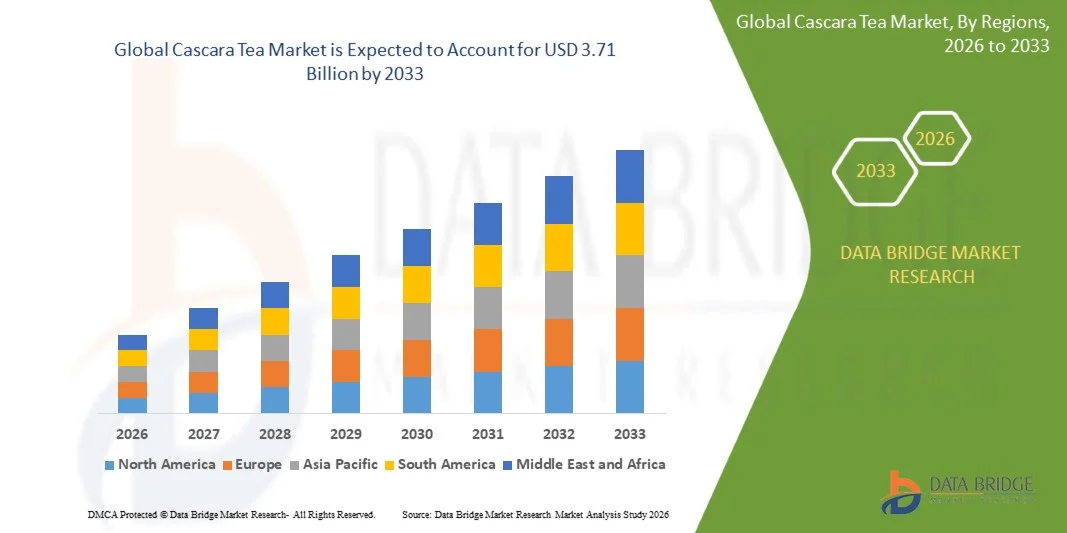
As per Data Bridge Market Research analysis The cascara tea market was valued at USD 1.72 billion in 2025 and is projected to reach USD 3.71 billion by 2033, growing at a CAGR of 10.10% from 2026 to 2033. The market is experiencing steady growth driven by increasing consumer preference for natural and functional beverages, rising awareness of sustainable coffee by-products, and growing demand for antioxidant-rich tea alternatives.
The expanding trend toward health-conscious consumption, coupled with the growing popularity of specialty teas and clean-label products, is encouraging beverage manufacturers and coffee producers to introduce innovative cascara tea offerings. Organic and flavored cascara tea variants are gaining traction among consumers seeking unique taste profiles and wellness benefits. In addition, the emphasis on reducing food waste and promoting circular economy practices within the coffee industry is supporting the adoption of cascara-based beverages across retail, foodservice, and online distribution channels worldwide.
Market Size & Forecast
- Global Market Value (2025): USD 1.72 Billion
- Expected Market Value (2033): USD 3.71 Billion
- Forecast CAGR (2026–2033): 10.10%
- Leading Region in 2025: North America
- Fastest Growing Region: Asia Pacific
Key Market Trends & Insights
- North America dominated the cascara tea market with the largest revenue share of 35.12% in 2025, supported by strong consumer demand for functional beverages, widespread specialty coffee culture, and growing adoption of sustainable food products.
- The Loose Cascara Tea segment led the market with a 43.28% share in 2025, driven by strong consumer preference for premium and authentic tea experiences.
- Asia-Pacific is expected to be the fastest-growing region at a CAGR of 7.4% from 2026 to 2033, fueled by rising health awareness, growing tea consumption, and increasing demand for innovative plant-based beverages across China, India, and Japan.
- Ready-to-Drink (RTD) Cascara Tea are the fastest-growing product type, projected to register a CAGR of 7.3%, reflecting the surge in demand for convenient and on-the-go functional beverages.
- The Conventional segment dominated the nature category with a 68.45% revenue share in 2025, led by its broad availability, established supply chains, and competitive pricing.
- Tea Bags accounted for 39.84% of the market, preferred by household consumers, office users, and foodservice establishments due to their convenience, consistent brewing quality, easy storage, and suitability for daily consumption.
- The Bottles segment is the fastest-growing software category, with a CAGR of 7.5%, driven by increasing popularity of ready-to-drink cascara tea beverages.
Report Scope and Cascara Tea Market Segmentation
|
Attributes |
Cascara Tea Key Market Insights |
|
Segments Covered |
|
|
Countries Covered |
North America · U.S. · Canada · Mexico Europe · Germany · France · U.K. · Netherlands · Switzerland · Belgium · Russia · Italy · Spain · Turkey · Rest of Europe Asia-Pacific · China · Japan · India · South Korea · Singapore · Malaysia · Australia · Thailand · Indonesia · Philippines · Rest of Asia-Pacific Middle East and Africa · Saudi Arabia · U.A.E. · South Africa · Egypt · Israel · Rest of Middle East and Africa South America · Brazil · Argentina · Rest of South America |
|
Key Market Players |
· Nestlé (Switzerland) · Starbucks Coffee Company (U.S.) · Stumptown Coffee Roasters (U.S.) · Counter Culture Coffee, Inc. (U.S.) · Blue Bottle Coffee Inc. (U.S.) · PT's Coffee Roasting Co. (U.S.) · Royal Coffee, Inc. (U.S.) · Volcafe Ltd (Switzerland) · Caraya Coffee GmbH (Germany) · Principio Coffee Inc. (Canada) · Cherrycol (India) · Wild Husk Ltd (U.K.) · Pumuen (Thailand) · CAS Drinks Ltd (U.K.) · Coffee Bean Corral (U.S.) · Sweet Maria's Coffee (U.S.) · Coffee Collective ApS (Denmark) · Ozone Coffee Roasters Ltd (New Zealand) · Square Mile Coffee Roasters Ltd (U.K.) · Equator Coffees (U.S.) |
|
Market Opportunities |
· Expansion of cascara-based functional beverages · Growing adoption of circular economy practices in the coffee industry · Rising demand for premium and specialty tea products through e-commerce channels |
|
Value Added Data Infosets |
In addition to the insights on market scenarios such as market value, growth rate, segmentation, geographical coverage, and major players, the market reports curated by the Data Bridge Market Research also include in-depth expert analysis, pricing analysis, brand share analysis, consumer survey, demography analysis, supply chain analysis, value chain analysis, raw material/consumables overview, vendor selection criteria, PESTLE Analysis, Porter Analysis, and regulatory framework. |
Cascara Tea Market Trends
Trend: Rising Consumer Preference for Sustainable Functional Beverages
Health-conscious consumers are increasingly adopting cascara tea as a natural, antioxidant-rich beverage that combines wellness benefits with sustainability credentials. Derived from the dried husk of coffee cherries, cascara supports waste reduction initiatives while offering a unique flavor profile that appeals to specialty tea and coffee enthusiasts. Beverage brands and specialty cafés are similarly incorporating cascara-based products into their portfolios to meet growing demand for clean-label and environmentally responsible drinks, while product innovation in flavored and ready-to-drink formats is expanding consumer accessibility and market reach.
For instance, in 2024, several specialty coffee and tea brands across North America and Europe expanded their cascara beverage offerings, reflecting growing consumer interest in sustainable upcycled ingredients.
Cascara Tea Market Dynamics
Key Market Driver: Growing Demand for Natural and Antioxidant-Rich Beverages
The increasing consumer focus on health, wellness, and preventive nutrition has created substantial demand for cascara tea as a functional beverage containing antioxidants, polyphenols, and naturally occurring bioactive compounds. Beverage manufacturers, specialty tea brands, and coffee producers are introducing cascara-based products to capitalize on shifting preferences toward plant-based and minimally processed drinks. This trend is supporting product diversification, expanding retail availability, and enhancing consumer awareness, thereby accelerating market growth across both developed and emerging economies.
For instance, in 2024, multiple beverage companies introduced organic and flavored cascara tea variants targeting consumers seeking healthier alternatives to conventional soft drinks and caffeinated beverages.
Key Restraint/Challenge: Limited Consumer Awareness and Regulatory Variability
A significant restraint in the cascara tea market is the relatively low level of consumer awareness regarding cascara products and their health benefits. Market growth is further constrained by varying regulatory frameworks governing the commercialization of coffee cherry by-products across different countries. The challenge extends to educating consumers, obtaining regulatory approvals, and establishing reliable supply chains, making large-scale market penetration difficult for manufacturers operating in regions where cascara remains a niche product category.
For instance, despite gaining approval in several major markets, regulatory requirements and labeling standards for cascara-based products continue to differ across regions, creating barriers for international expansion.
Key Market Opportunity: Expansion of Premium Functional and Ready-to-Drink Beverages
The integration of cascara into premium functional beverages presents a significant market opportunity. Cascara-based formulations can deliver distinctive flavor profiles, natural antioxidant content, and sustainability benefits that align with evolving consumer preferences. The development of ready-to-drink products, flavored infusions, and wellness-oriented beverage blends is further broadening market appeal, opening growth opportunities across specialty retail, e-commerce platforms, and foodservice channels in North America, Asia-Pacific, and Europe.
For instance, in 2024, several beverage innovators launched ready-to-drink cascara tea products and functional blends aimed at expanding consumption beyond traditional specialty tea consumers.
Cascara Tea Market Scope
The cascara tea market is segmented on the basis of product type, nature, packaging type, and distribution channel.
- By Product Type
On the basis of product type, the cascara tea market is segmented into loose cascara tea, cascara tea bags, ready-to-drink (RTD) cascara tea, and instant cascara tea. The Loose Cascara Tea segment dominated the market with a 43.28% share in 2025, driven by strong consumer preference for premium and authentic tea experiences. Loose cascara tea is widely favored by specialty tea enthusiasts due to its richer flavor profile and customizable brewing process. Specialty cafés and artisanal beverage retailers extensively offer loose variants to attract consumers seeking high-quality products. The segment also benefits from growing demand for minimally processed and natural beverages. Premium positioning and higher perceived product value further support revenue generation. Increasing popularity of specialty coffee-derived beverages continues to reinforce the segment’s market leadership.
The Ready-to-Drink (RTD) Cascara Tea segment is projected to register the fastest growth at a CAGR of 7.3% from 2026 to 2033, driven by rising demand for convenient and on-the-go functional beverages. Consumers increasingly prefer ready-to-consume products that fit modern lifestyles without requiring preparation time. Manufacturers are introducing innovative flavors and health-focused formulations to expand consumer appeal. Growing penetration of RTD beverages through supermarkets, convenience stores, and online channels is accelerating market expansion. Rising urbanization and busy work schedules are further supporting product adoption. Increasing investments in sustainable beverage packaging and product innovation are expected to strengthen future growth.
- By Nature
On the basis of nature, the cascara tea market is segmented into organic and conventional. The Conventional segment dominated the market with a 68.45% share in 2025 due to its broad availability, established supply chains, and competitive pricing. Conventional cascara tea products are widely distributed across retail and foodservice channels, making them accessible to a larger consumer base. Manufacturers benefit from lower production and certification costs compared to organic alternatives. The segment also enjoys strong demand in developing regions where affordability remains a key purchasing factor. Growing awareness of cascara as a sustainable beverage ingredient is supporting overall category expansion. Extensive product availability continues to sustain the segment’s leading market position.
The Organic segment is expected to witness the fastest growth at a CAGR of 7.1% from 2026 to 2033, driven by increasing consumer preference for clean-label and environmentally responsible products. Health-conscious consumers are actively seeking beverages free from synthetic chemicals and pesticides. Organic certification enhances product credibility and appeals to premium market segments. Growing demand for sustainable agriculture practices is encouraging producers to expand organic cascara cultivation. Rising disposable incomes and wellness trends are further supporting adoption. Expanding availability of organic beverages through specialty retailers and e-commerce platforms is accelerating segment growth.
- By Packaging Type
On the basis of packaging type, the cascara tea market is segmented into tea bags, pouches, bottles, cans, and bulk packaging. The Tea Bags segment dominated the market with a 39.84% share in 2025 owing to their convenience, portability, and widespread consumer acceptance. Tea bags offer easy preparation and consistent flavor extraction, making them popular among both household and commercial users. Retailers favor tea bag formats due to efficient shelf placement and packaging standardization. The segment also benefits from strong demand among first-time cascara tea consumers seeking familiar consumption formats. Continuous improvements in biodegradable and sustainable packaging materials are enhancing product appeal. Broad availability across supermarkets and specialty stores further supports segment dominance.
The Bottles segment is projected to register the fastest growth at a CAGR of 7.5% from 2026 to 2033, driven by increasing popularity of ready-to-drink cascara tea beverages. Bottled formats align with growing consumer demand for convenience and functional beverage consumption. Beverage companies are introducing innovative formulations enriched with natural ingredients and wellness-focused benefits. Expansion of cold brew and premium beverage categories is further supporting demand. Growing penetration in convenience stores, cafés, and fitness-oriented retail outlets is accelerating adoption. Sustainability initiatives involving recyclable packaging materials are also contributing to long-term segment growth.
- By Distribution Channel
On the basis of distribution channel, the cascara tea market is segmented into supermarkets & hypermarkets, specialty stores, convenience stores, online retail, cafés & coffee shops, and others. The Supermarkets & Hypermarkets segment dominated the market with a 36.72% share in 2025 due to extensive product visibility, broad consumer reach, and established retail infrastructure. These outlets provide consumers with convenient access to multiple cascara tea brands and product varieties. Strong promotional activities and in-store marketing campaigns support purchasing decisions. The segment also benefits from growing shelf space dedicated to specialty and functional beverages. Consumers prefer supermarkets for product comparison and immediate availability. Expanding modern retail networks continue to reinforce the segment’s leadership position.
The Online Retail segment is expected to witness the fastest growth at a CAGR of 7.8% from 2026 to 2033, driven by increasing digitalization and changing consumer purchasing behavior. E-commerce platforms offer consumers access to a wider variety of cascara tea products than traditional retail channels. Online channels enable direct-to-consumer sales strategies and personalized marketing initiatives. Growing smartphone penetration and secure digital payment systems are supporting market expansion. Subscription-based beverage services and targeted promotions are further enhancing customer engagement. Rising demand for convenience and home delivery solutions is expected to drive sustained growth in this segment.
Cascara Tea Market Regional Analysis
North America dominated the cascara tea market with the largest revenue share of 35.12% in 2025, supported by strong consumer demand for functional beverages, widespread specialty coffee culture, and growing adoption of sustainable food products. The region also benefits from high adoption of premium tea offerings, widespread availability through organized retail channels, and growing interest in clean-label and antioxidant-rich beverages. Rising investments in innovative beverage formulations, expanding e-commerce penetration, and increasing popularity of upcycled ingredients across the food and beverage industry continue to strengthen North America's leadership position in the global market.
U.S. Cascara Tea Market Insight
The U.S. cascara tea market is witnessing strong growth due to rising demand for functional beverages, sustainable food products, and specialty coffee-derived drinks. The country’s mature health and wellness industry, along with increasing consumer preference for antioxidant-rich and clean-label beverages, is driving demand across retail and foodservice channels. In addition, growing emphasis on sustainable consumption and upcycled ingredients is accelerating cascara tea adoption among health-conscious consumers and specialty beverage manufacturers.
Europe Cascara Tea Market Insight
The Europe cascara tea market remains a major contributor to global revenue, driven by strong consumer awareness, sustainability initiatives, and high demand for premium beverage solutions. The widespread popularity of organic and specialty tea products across cafés, retail stores, and wellness-focused distribution channels is supporting market expansion throughout the region. Increasing investments in sustainable sourcing practices, coupled with growing preference for natural ingredients and environmentally responsible products, continue to enhance the adoption of cascara tea across Europe.
U.K. Cascara Tea Market Insight
The U.K. cascara tea market is experiencing steady growth, supported by rising consumer interest in specialty beverages, functional nutrition, and sustainable consumption trends. Increasing availability of cascara tea through premium retail outlets, cafés, and online platforms is contributing to market growth. Furthermore, growing demand for clean-label products and innovative tea formulations is improving product visibility and consumer acceptance, positioning the U.K. as a key market for cascara tea innovation and adoption.
Germany Cascara Tea Market Insight
The Germany cascara tea market is expanding steadily due to the country’s strong preference for organic beverages, advanced retail infrastructure, and increasing adoption of sustainable food products. Beverage manufacturers, specialty tea brands, and health-focused retailers are increasingly promoting cascara tea as a natural and environmentally responsible beverage alternative. Continuous growth in wellness trends, organic product consumption, and sustainable sourcing initiatives, along with strong consumer awareness regarding functional ingredients, are further driving market growth in Germany.
Asia-Pacific Cascara Tea Market Insight
The Asia-Pacific cascara tea market is expected to witness rapid growth, driven by increasing health awareness, expanding tea consumption, and rising investments in premium beverage categories across countries such as China, India, and Japan. Growing preference for functional and plant-based beverages, rising adoption of specialty tea products, and increasing demand for innovative wellness drinks are supporting regional market expansion. In addition, the growing influence of e-commerce platforms and changing consumer lifestyles are accelerating cascara tea adoption across both urban and emerging markets.
Japan Cascara Tea Market Insight
The Japan cascara tea market is witnessing consistent growth due to rising demand for functional beverages, premium tea products, and health-focused dietary choices. Beverage companies, specialty cafés, and wellness-oriented retailers are increasingly introducing cascara tea products to meet evolving consumer preferences. Moreover, increasing interest in natural ingredients and the country’s focus on quality, innovation, and sustainable consumption practices are further contributing to market growth.
China Cascara Tea Market Insight
The China cascara tea market is growing rapidly, driven by increasing urbanization, expanding middle-class spending, and rising consumer interest in health and wellness beverages. Growing adoption of specialty tea products and sustainable beverage alternatives across retail and online channels is significantly boosting market demand. In addition, rising investments in premium beverage innovation, increasing awareness regarding natural ingredients, and rapid expansion of modern retail networks are positioning China as one of the fastest-growing markets for cascara tea globally.
Cascara Tea Market Share
The cascara tea industry is primarily led by well-established companies, including:
- Nestlé (Switzerland)
- Starbucks Coffee Company (U.S.)
- Stumptown Coffee Roasters (U.S.)
- Counter Culture Coffee, Inc. (U.S.)
- Blue Bottle Coffee Inc. (U.S.)
- PT's Coffee Roasting Co. (U.S.)
- Royal Coffee, Inc. (U.S.)
- Volcafe Ltd (Switzerland)
- Caraya Coffee GmbH (Germany)
- Principio Coffee Inc. (Canada)
- Cherrycol (India)
- Wild Husk Ltd (U.K.)
- Pumuen (Thailand)
- CAS Drinks Ltd (U.K.)
- Coffee Bean Corral (U.S.)
- Sweet Maria's Coffee (U.S.)
- Coffee Collective ApS (Denmark)
- Ozone Coffee Roasters Ltd (New Zealand)
- Square Mile Coffee Roasters Ltd (U.K.)
- Equator Coffees (U.S.)
Latest Developments in Cascara Tea Market
- In June 2024, Nestlé China expanded the commercialization of its cascara beverage portfolio by promoting coffee fruit tea as a sustainable beverage category using coffee cherry husks that were traditionally discarded. The initiative reinforces circular economy practices while broadening consumer awareness of cascara-based functional beverages
- In June 2024, Foodflows presented its Coffeecherry Elixir at World of Coffee Copenhagen 2024, where the cascara-based beverage attracted significant attention from coffee professionals and buyers, highlighting increasing industry interest in upcycled coffee fruit beverages
- In May 2024, Foodflows showcased its Coffeecherry Elixir, an upcycled cascara beverage, in the Specialty Coffee Association's Best New Product Awards ahead of World of Coffee Copenhagen 2024. The beverage demonstrated the growing commercial potential of cascara as a premium functional drink made from coffee cherry husks
- In April 2024, Nestlé China announced the launch of NESCAFÉ Guoran Qingka (Coffee Fruit Tea), the first coffee-fruit (cascara) beverage introduced in the Chinese market. The product combines cascara with coffee to deliver a unique coffee-and-tea drinking experience while promoting the upcycling of coffee cherries into value-added beverages. This launch highlights Nestlé's commitment to sustainable beverage innovation
- In September 2021, Nestlé Australia introduced NESCAFÉ Nativ Cascara, a beverage made from upcycled coffee cherries, creating a new beverage category that combines sustainability with functional refreshment. The launch demonstrated the commercial viability of cascara and laid the foundation for later international product expansion

- Interactive Data Analysis Dashboard
- Company Analysis Dashboard for high growth potential opportunities
- Research Analyst Access for customization & queries
- Competitor Analysis with Interactive dashboard
- Latest News, Updates & Trend analysis
- Harness the Power of Benchmark Analysis for Comprehensive Competitor Tracking
Global Cascara Tea Market, Supply Chain Analysis and Ecosystem Framework
To support market growth and help clients navigate the impact of geopolitical shifts, DBMR has integrated in-depth supply chain analysis into its Global Cascara Tea Market research reports. This addition empowers clients to respond effectively to global changes affecting their industries. The supply chain analysis section includes detailed insights such as Global Cascara Tea Market consumption and production by country, price trend analysis, the impact of tariffs and geopolitical developments, and import and export trends by country and HSN code. It also highlights major suppliers with data on production capacity and company profiles, as well as key importers and exporters. In addition to research, DBMR offers specialized supply chain consulting services backed by over a decade of experience, providing solutions like supplier discovery, supplier risk assessment, price trend analysis, impact evaluation of inflation and trade route changes, and comprehensive market trend analysis.
Data collection and base year analysis are done using data collection modules with large sample sizes. The stage includes obtaining market information or related data through various sources and strategies. It includes examining and planning all the data acquired from the past in advance. It likewise envelops the examination of information inconsistencies seen across different information sources. The market data is analysed and estimated using market statistical and coherent models. Also, market share analysis and key trend analysis are the major success factors in the market report. To know more, please request an analyst call or drop down your inquiry.
The key research methodology used by DBMR research team is data triangulation which involves data mining, analysis of the impact of data variables on the market and primary (industry expert) validation. Data models include Vendor Positioning Grid, Market Time Line Analysis, Market Overview and Guide, Company Positioning Grid, Patent Analysis, Pricing Analysis, Company Market Share Analysis, Standards of Measurement, Global versus Regional and Vendor Share Analysis. To know more about the research methodology, drop in an inquiry to speak to our industry experts.
Data Bridge Market Research is a leader in advanced formative research. We take pride in servicing our existing and new customers with data and analysis that match and suits their goal. The report can be customized to include price trend analysis of target brands understanding the market for additional countries (ask for the list of countries), clinical trial results data, literature review, refurbished market and product base analysis. Market analysis of target competitors can be analyzed from technology-based analysis to market portfolio strategies. We can add as many competitors that you require data about in the format and data style you are looking for. Our team of analysts can also provide you data in crude raw excel files pivot tables (Fact book) or can assist you in creating presentations from the data sets available in the report.













