


What is the Casting Devices Market Size and Growth Rate?
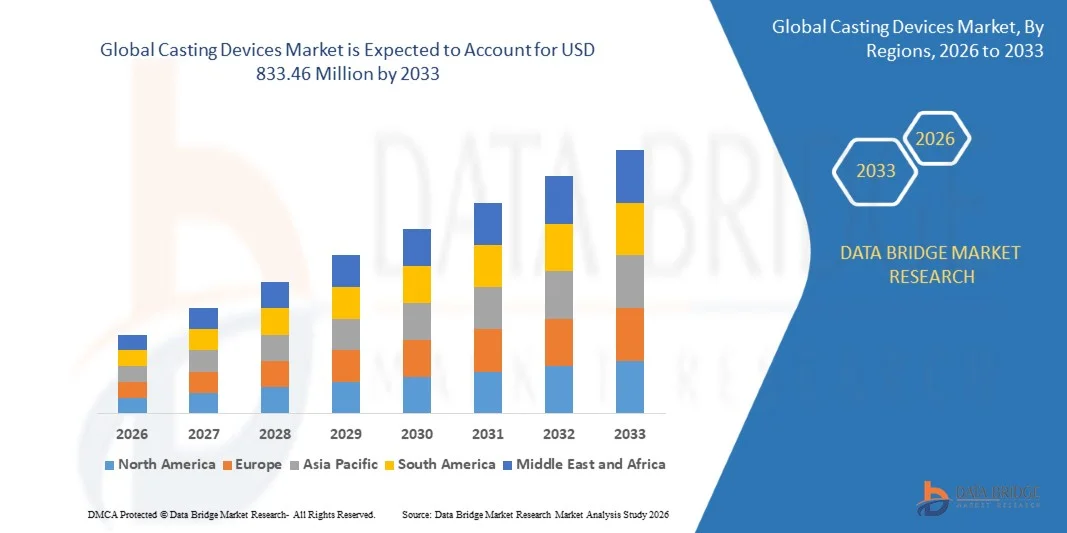
- As per Data Bridge Market Research analysis, the casting devices market was valued at USD 394.52 million in 2025 and is projected to reach USD 833.46 million by 2033, growing at a CAGR of 9.80% from 2026 to 2033.
- The market is experiencing consistent growth driven by rising smart TV penetration, growing consumer preference for OTT streaming over traditional pay-TV, and increasing demand for seamless wireless content sharing across smartphones, tablets, laptops, and larger displays.
- The expanding prevalence of hybrid work and remote collaboration is further increasing demand for wireless screen-mirroring and presentation solutions in corporate and education settings. Continuous technological advancements in Wi-Fi standards, video codecs, and AI-based content recommendation are further accelerating market expansion.
Market Size & Forecast
- Global Market Value (2025): USD 394.52 million
- Expected Market Value (2033): USD 833.46 million
- Forecast CAGR (2026–2033): 9.80%
What are the Major Takeaways of the Casting Devices Market?
- North America dominated the global casting devices market with the largest revenue share of 38.40% in 2025, supported by high smart TV penetration, strong OTT subscription rates, and the presence of leading platform providers such as Google, Amazon, Roku, and Apple.
- Asia-Pacific is expected to be the fastest-growing region at a CAGR of 12.30% from 2026 to 2033, fueled by rising smart TV adoption, expanding middle-class disposable incomes, and growing domestic manufacturing of affordable streaming devices in China and India.
- The media streaming dongles & sticks segment led the market with a 44.20% share in 2025, driven by low cost, plug-and-play simplicity, and widespread consumer familiarity with products such as Fire TV Stick and Roku Streaming Stick.
- Wireless display adapters & receivers are the fastest-growing product type, projected to register a CAGR of 12.60%, reflecting rising enterprise and education-sector demand for wireless presentation solutions.
- The Google Cast segment dominated the technology category with a 36.80% revenue share in 2025, supported by broad cross-platform compatibility and deep integration across Android devices and third-party applications.
- The residential end-user segment accounted for 71.60% of the market share in 2025, driven by rising cord-cutting trends and growing consumer preference for OTT streaming.
- The video conferencing & screen mirroring application is the fastest-growing category, with a CAGR of 13.50%, driven by the continued prevalence of hybrid work models.
Report Scope and Casting Devices Market Segmentation
|
Attributes |
Casting Devices Key Market Insights |
|
Segments Covered |
|
|
Countries Covered |
North America
Europe
Asia-Pacific
Middle East and Africa
South America
|
|
Key Market Players |
|
|
Market Opportunities |
|
|
Value Added Data Infosets |
In addition to the market insights such as market value, growth rate, market segments, geographical coverage, market players, and market scenario, the market report curated by the Data Bridge Market Research team includes in-depth expert analysis, import/export analysis, pricing analysis, production consumption analysis, and pestle analysis. |
What is the Key Trend in the Casting Devices Market?
- The casting devices landscape is undergoing rapid platform consolidation, with manufacturers replacing legacy dongles with more powerful, AI-integrated streaming players offering unified content discovery.
- For instance, in 2025, Google discontinued its original Chromecast dongle lineup and introduced the Google TV Streamer, a USD 99 set-top box powered by Gemini AI that delivers personalized content recommendations across more than 10,000 applications while retaining Chromecast casting compatibility.
- Third-party manufacturers are stepping in to fill gaps left by platform transitions, launching dongle-style devices that replicate the simplicity of earlier casting form factors.
- For instance, in May 2025, French manufacturer Thomson unveiled the Cast 150, a streaming dongle closely resembling the design and functionality of the discontinued Google Chromecast, targeting a European launch at an accessible price point.
- As consumers continue to prioritize simple, affordable access to OTT content, manufacturers are expected to keep balancing AI-enhanced, higher-end streaming boxes with budget-friendly dongles, reinforcing platform diversification as a core market theme.
What are the Key Drivers of the Casting Devices Market?
- Rising global smart TV penetration and continued consumer shift away from traditional pay-TV toward OTT streaming are driving sustained demand for casting-enabled devices.
- For instance, industry estimates indicate that global smart TV shipments surpassed 230 million units in 2024, with smart TVs now dominating new television sales and increasingly shipping with native casting functionality built in.
- Continuous product innovation among leading platform providers, including support for higher resolutions, faster processors, and improved voice assistants, is driving consumer upgrade cycles.
- For instance, newer streaming device models released in 2025 feature enhanced processors, Wi-Fi 6 support, and AV1 hardware decoding, delivering faster app loading and improved 4K HDR playback compared with earlier generations.
- With consumers increasingly relying on multiple streaming subscriptions accessed through a single device, sustained investment in casting hardware and software platforms is expected to remain a key growth driver for the market.
Which Factors are Challenging the Growth of the Casting Devices Market?
- Casting devices are exposed to network security vulnerabilities, including unauthorized access and data interception risks, which raises consumer and enterprise concerns around device and network security.
- Compatibility issues across different operating systems, casting protocols, and display devices can create inconsistent user experiences, particularly when mixing products from different ecosystems.
- The growing built-in casting functionality embedded directly into modern smart TVs is gradually reducing the need for separate external streaming devices among certain consumer segments.
- The combination of security concerns, cross-platform compatibility challenges, and rising built-in smart TV casting functionality continues to create competitive pressure on standalone casting device manufacturers.
How is the Casting Devices Market Segmented?
The casting devices market is segmented on the basis of product type, technology/protocol, connectivity, resolution, end user, price range, distribution channel, application, operating system, and device form factor.
- By Product Type
On the basis of product type, the global casting devices market is segmented into media streaming dongles & sticks, smart TVs with built-in casting, gaming consoles, wireless display adapters & receivers, and set-top boxes. The media streaming dongles & sticks segment dominated the market with a 44.20% share in 2025, owing to their low cost, plug-and-play simplicity, and widespread consumer adoption of products such as Chromecast-compatible dongles, Fire TV Stick, and Roku Streaming Stick.
The wireless display adapters & receivers segment is projected to register the fastest growth at a CAGR of 12.60% from 2026 to 2033, driven by rising enterprise and education-sector demand for wireless presentation and screen-mirroring solutions in meeting rooms and classrooms.
- By Technology/Protocol
On the basis of technology, the global casting devices market is segmented into Google Cast, Apple AirPlay, Miracast, DLNA, and proprietary protocols. The Google Cast segment dominated the market with a 36.80% share in 2025, supported by broad cross-platform compatibility and deep integration across Android devices, Chrome browsers, and a wide range of third-party streaming applications.
The Apple AirPlay segment is expected to witness the fastest CAGR of 11.40% from 2026 to 2033, driven by the growing installed base of Apple devices and rising consumer preference for low-latency, high-fidelity mirroring within the Apple ecosystem.
- By Connectivity
On the basis of connectivity, the global casting devices market is segmented into Wi-Fi network-based, Wi-Fi Direct, Bluetooth-assisted, and HDMI-based wired casting. The Wi-Fi network-based segment dominated the market with a 52.30% share in 2025, owing to its ability to support multi-room streaming, higher bandwidth for 4K content, and simultaneous connection of multiple devices on a shared home network.
The Bluetooth-assisted segment is anticipated to witness the fastest CAGR of 10.90% from 2026 to 2033, driven by rising demand for quick, network-independent pairing in portable and travel-friendly casting devices.
- By Resolution
On the basis of resolution, the global casting devices market is segmented into HD, full HD, 4K/UHD, and 8K. The 4K/UHD segment dominated the market with a 48.70% share in 2025, supported by rising smart TV penetration, wider availability of 4K streaming content, and falling prices of 4K-capable casting hardware.
The 8K segment is expected to witness the fastest CAGR of 14.20% from 2026 to 2033, albeit from a small base, driven by early-stage adoption among premium home entertainment consumers and gradual expansion of 8K-capable displays and content.
- By End User
On the basis of end user, the global casting devices market is segmented into residential, commercial, hospitality, and retail & digital signage. The residential segment dominated the market with a 71.60% share in 2025, driven by rising cord-cutting trends and growing consumer preference for OTT streaming over traditional pay-TV subscriptions.
The commercial (corporate & education) segment is expected to witness the fastest CAGR of 12.10% from 2026 to 2033, supported by rising adoption of wireless presentation systems in hybrid workplaces and smart classrooms.
- By Price Range
On the basis of price range, the global casting devices market is segmented into low/budget, mid-range, and premium. The mid-range segment dominated the market with a 45.30% share in 2025, offering a practical balance of performance, app compatibility, and remote/voice-control features for mainstream consumers.
The premium segment is projected to witness the fastest CAGR of 11.70% from 2026 to 2033, driven by rising consumer willingness to pay for higher processing power, AI-based content recommendations, and support for advanced audio and video formats.
- By Distribution Channel
On the basis of distribution channel, the global casting devices market is segmented into online retail/e-commerce, consumer electronics stores, supermarkets & hypermarkets, and direct/OEM bundled sales. The online retail/e-commerce segment dominated the market with a 41.90% share in 2025, supported by frequent promotional pricing, product bundling, and the convenience of direct-to-door delivery.
The direct/OEM bundled sales segment is expected to witness the fastest CAGR of 10.30% from 2026 to 2033, driven by growing partnerships between casting device makers and smart TV or telecom operators to pre-bundle casting functionality with other services.
- By Application
On the basis of application, the global casting devices market is segmented into video streaming & OTT entertainment, gaming, video conferencing & screen mirroring, and digital signage & presentations. The video streaming & OTT entertainment segment dominated the market with a 58.40% share in 2025, driven by continued global growth in subscription and ad-supported streaming services.
The video conferencing & screen mirroring segment is anticipated to witness the fastest CAGR of 13.50% from 2026 to 2033, driven by the continued prevalence of hybrid work models and rising demand for wireless meeting-room collaboration tools.
- By Operating System
On the basis of operating system, the global casting devices market is segmented into Google TV/Android TV, Apple tvOS, Roku OS, Fire OS, and others. The Google TV/Android TV segment dominated the market with a 33.60% share in 2025, supported by broad OEM adoption across smart TV manufacturers and continuous platform enhancements, including AI-based content recommendations.
The Fire OS segment is expected to witness the fastest CAGR of 10.80% from 2026 to 2033, driven by Amazon's continued investment in Alexa integration, smart home control, and expanding content partnerships bundled with Fire TV devices.
- By Device Form Factor
On the basis of device form factor, the global casting devices market is segmented into HDMI dongles & sticks, set-top box form factor, built-in/embedded, and portable/puck-style. The HDMI dongles & sticks segment dominated the market with a 47.50% share in 2025, owing to their compact size, low cost, and ease of installation directly into a television's HDMI port.
The built-in/embedded segment is projected to witness the fastest CAGR of 11.20% from 2026 to 2033, driven by rising integration of native casting functionality directly into smart TVs, reducing consumer reliance on separate external devices.
Which Region Holds the Largest Share of the Casting Devices Market?
- North America dominated the casting devices market and accounted for the largest revenue share of 38.40% in 2025, supported by high smart TV penetration, strong OTT subscription rates, and the presence of leading platform providers including Google, Amazon, Roku, and Apple.
- The region also benefits from well-developed broadband and Wi-Fi infrastructure, high consumer spending on home entertainment technology, and rapid adoption of new device generations, which continues to reinforce North America's leadership position in the global market.
U.S. Casting Devices Market Insight
The U.S. casting devices market is experiencing steady growth, supported by continued cord-cutting trends and strong consumer adoption of OTT streaming services. The presence of leading platform providers, including Google, Amazon, Roku, and Apple, continues to drive frequent product launches and competitive innovation. Growing consumer interest in AI-enhanced content recommendations and higher-resolution playback is further contributing to market growth in the U.S.
Germany Casting Devices Market Insight
The Germany casting devices market is expanding steadily, supported by rising smart TV adoption and growing consumer preference for streaming over traditional broadcast television. Manufacturers and retailers are increasingly offering competitively priced casting dongles and set-top boxes to meet evolving consumer demand. Continuous product innovation and expanding OTT content availability are further shaping market growth in Germany.
Asia-Pacific Casting Devices Market Insight
The Asia-Pacific casting devices market is expected to witness rapid growth, driven by rising smart TV adoption, expanding middle-class disposable incomes, and growing domestic manufacturing capabilities across China, India, and Japan. Increasing availability of affordable, locally manufactured streaming devices, combined with rapid growth in regional OTT platforms, is supporting strong regional market expansion.
Japan Casting Devices Market Insight
The Japan casting devices market is witnessing consistent growth, supported by high smart TV penetration and strong consumer interest in premium home entertainment technology. Manufacturers continue to introduce casting-enabled devices with advanced audio and video capabilities tailored to Japan's technologically engaged consumer base. Growing integration of casting functionality directly into smart TVs is further contributing to market growth.
China Casting Devices Market Insight
The China casting devices market is growing rapidly, driven by rising domestic manufacturing capacity and strong consumer demand for affordable smart entertainment devices. Leading domestic electronics manufacturers continue to expand their casting-enabled product portfolios across both domestic and export markets. Rising integration of AI-based content recommendation and voice control features is further boosting market demand across China.
Which are the Top Companies in Casting Devices Market?
The casting devices industry is primarily led by well-established companies, including:
- Alphabet Inc. (Google) (U.S.)
- Apple Inc. (U.S.)
- Amazon.com, Inc. (U.S.)
- Roku, Inc. (U.S.)
- Samsung Electronics Co., Ltd. (South Korea)
- Microsoft Corporation (U.S.)
- Sony Corporation (Japan)
- LG Electronics Inc. (South Korea)
- Xiaomi Corporation (China)
- NVIDIA Corporation (U.S.)
- ASUSTeK Computer Inc. (Taiwan)
- Belkin International, Inc. (U.S.)
- NETGEAR, Inc. (U.S.)
- Logitech International S.A. (Switzerland)
- Barco NV (Belgium)
What are Latest Developments in Casting Devices Market?
- In 2025, Google discontinued its original Chromecast dongle and introduced the Google TV Streamer, a USD 99 device powered by Gemini AI and a MediaTek processor, delivering personalized content recommendations across more than 10,000 applications while supporting 4K playback at 60 frames per second.
- In May 2025, French manufacturer Thomson unveiled the Cast 150, a streaming dongle closely resembling the design and functionality of the discontinued Google Chromecast, targeting a European launch priced at approximately EUR 60 to 75.
- In 2025, Roku launched its Roku Ultra 2025 model, featuring improved 4K performance, enhanced voice search, and broader app compatibility aimed at cord-cutting consumers.
- In 2025, Amazon's Fire TV Stick 4K Max continued to gain adoption, offering faster navigation, deeper Alexa smart-home integration, and AV1 hardware decoding for improved streaming efficiency.
- Roku and Amazon both filed new remote control designs with the U.S. Federal Communications Commission ahead of the holiday shopping season, signaling upcoming next-generation streaming device launches from both companies.

- Interactive Data Analysis Dashboard
- Company Analysis Dashboard for high growth potential opportunities
- Research Analyst Access for customization & queries
- Competitor Analysis with Interactive dashboard
- Latest News, Updates & Trend analysis
- Harness the Power of Benchmark Analysis for Comprehensive Competitor Tracking
Data collection and base year analysis are done using data collection modules with large sample sizes. The stage includes obtaining market information or related data through various sources and strategies. It includes examining and planning all the data acquired from the past in advance. It likewise envelops the examination of information inconsistencies seen across different information sources. The market data is analysed and estimated using market statistical and coherent models. Also, market share analysis and key trend analysis are the major success factors in the market report. To know more, please request an analyst call or drop down your inquiry.
The key research methodology used by DBMR research team is data triangulation which involves data mining, analysis of the impact of data variables on the market and primary (industry expert) validation. Data models include Vendor Positioning Grid, Market Time Line Analysis, Market Overview and Guide, Company Positioning Grid, Patent Analysis, Pricing Analysis, Company Market Share Analysis, Standards of Measurement, Global versus Regional and Vendor Share Analysis. To know more about the research methodology, drop in an inquiry to speak to our industry experts.
Data Bridge Market Research is a leader in advanced formative research. We take pride in servicing our existing and new customers with data and analysis that match and suits their goal. The report can be customized to include price trend analysis of target brands understanding the market for additional countries (ask for the list of countries), clinical trial results data, literature review, refurbished market and product base analysis. Market analysis of target competitors can be analyzed from technology-based analysis to market portfolio strategies. We can add as many competitors that you require data about in the format and data style you are looking for. Our team of analysts can also provide you data in crude raw excel files pivot tables (Fact book) or can assist you in creating presentations from the data sets available in the report.













