Catalyst Fertilizers Market Overview
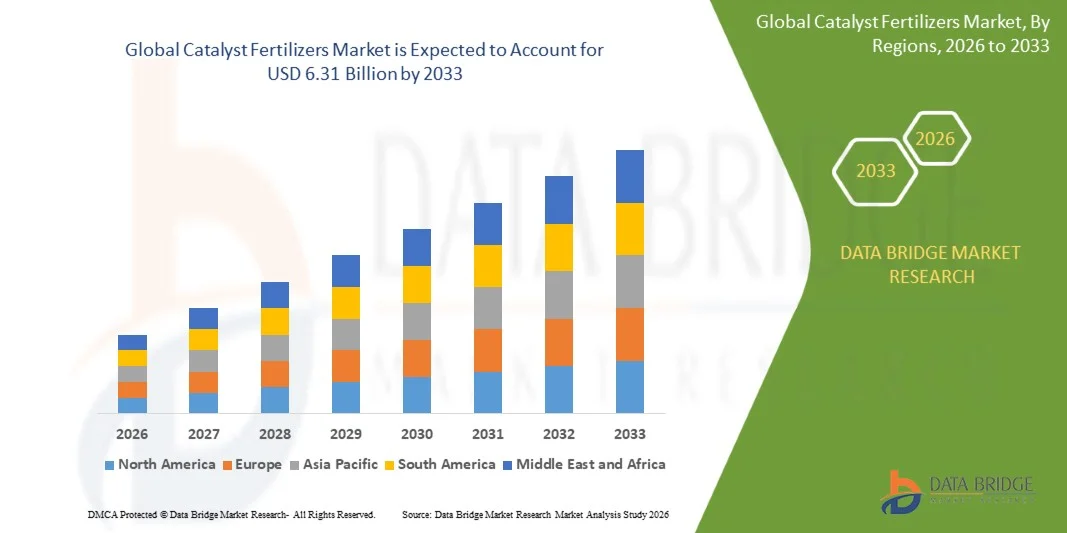
The Catalyst Fertilizers Market was valued at USD 3.80 billion in 2025 and is projected to reach USD 6.31 billion by 2033, growing at a CAGR of 6.55% from 2026 to 2033. The market is experiencing steady growth driven by increasing global demand for higher agricultural productivity, rising pressure to improve fertilizer production efficiency, and growing investments in sustainable ammonia and urea manufacturing technologies.
The expanding need for food security, coupled with stringent environmental regulations on emissions from fertilizer production, is encouraging manufacturers to adopt advanced catalyst solutions that enhance process efficiency, reduce energy consumption, and lower greenhouse gas emissions. Ammonia synthesis, nitric acid, and hydrogen production catalysts are increasingly being utilized across fertilizer manufacturing facilities to improve catalyst lifespan, optimize plant performance, and support the transition toward low-carbon and green ammonia production.
Market Size & Forecast
- Global Market Value (2025): USD 3.80 Billion
- Expected Market Value (2033): USD 6.31 Billion
- Forecast CAGR (2026–2033): 6.55%
- Leading Region in 2025: North America
- Fastest Growing Region: Asia-Pacific
Key Market Trends & Insights
- North America dominated the Catalyst Fertilizers Market with the largest revenue share of 34.26% in 2025, supported by the presence of leading catalyst manufacturers, advanced fertilizer production facilities, and continuous investments in catalyst innovation and sustainable ammonia production.
- The Base Metals segment dominated the market with a 72.08% share in 2025 due to the extensive utilization of iron-, nickel-, and copper-based catalysts across ammonia and fertilizer manufacturing processes.
- Asia-Pacific is expected to be the fastest-growing region at a CAGR of 6.9% from 2026 to 2033, fueled by expanding fertilizer production capacities, increasing agricultural demand, and rising investments in China, India, and Southeast Asia.
- The precious metals segment is the fastest-growing metal group, projected to register a CAGR of 6.6%, reflecting growing demand for high-performance catalysts that improve process efficiency, selectivity, and environmental compliance.
Report Scope and Catalyst Fertilizers Market Segmentation
|
Attributes |
Catalyst Fertilizers Key Market Insights |
|
Segments Covered |
|
|
Countries Covered |
North America · U.S. · Canada · Mexico Europe · Germany · France · U.K. · Netherlands · Switzerland · Belgium · Russia · Italy · Spain · Turkey · Rest of Europe Asia-Pacific · China · Japan · India · South Korea · Singapore · Malaysia · Australia · Thailand · Indonesia · Philippines · Rest of Asia-Pacific Middle East and Africa · Saudi Arabia · U.A.E. · South Africa · Egypt · Israel · Rest of Middle East and Africa South America · Brazil · Argentina · Rest of South America |
|
Key Market Players |
· Topsoe (Denmark) · Johnson Matthey Plc (U.K.) · BASF SE (Germany) · Clariant AG (Switzerland) · Axens (France) · Casale SA (Switzerland) · thyssenkrupp Uhde GmbH (Germany) · KBR, Inc. (U.S.) · Honeywell UOP (U.S.) · Sinopec Catalyst Co., Ltd. (China) · N.E. CHEMCAT Corporation (Japan) · Dorf Ketal Chemicals (India) · Alfa Laval AB (Sweden) · LKAB Minerals AB (Sweden) · Unicat Catalyst Technologies (U.S.) · Heraeus Precious Metals (Germany) · Evonik Industries AG (Germany) · W. R. Grace & Co. (U.S.) · Quality Magnetite (Australia) · QuantumSphere, Inc. (U.S.) · Süd-Chemie India Pvt. Ltd. (India) · Tanaka Holdings Co., Ltd. (Japan) |
|
Market Opportunities |
· Growing Investments in Green Ammonia and Low-Carbon Fertilizer Production · Expansion of Fertilizer Manufacturing Capacity in Emerging Economies · Increasing Adoption of High-Performance and Regenerable Catalysts |
|
Value Added Data Infosets |
In addition to the insights on market scenarios such as market value, growth rate, segmentation, geographical coverage, and major players, the market reports curated by the Data Bridge Market Research also include in-depth expert analysis, geographically represented company-wise production and capacity, network layouts of distributors and partners, detailed and updated price trend analysis and deficit analysis of supply chain and demand. |
Catalyst Fertilizers Market Trends
Trend: Rising Adoption of Low-Carbon and High-Efficiency Catalyst Technologies
Growing pressure to reduce greenhouse gas emissions from fertilizer production is accelerating the adoption of advanced catalyst technologies in ammonia and nitric acid plants. Manufacturers are increasingly deploying high-performance iron-, ruthenium-, platinum-, and rhodium-based catalysts that improve conversion efficiency, reduce energy consumption, and extend catalyst life. In addition, digital catalyst monitoring and predictive maintenance solutions are helping fertilizer producers optimize plant performance while lowering operating costs. For instance, in March 2024, Topsoe introduced its dynamic ammonia synthesis catalyst management solution, enabling producers to improve catalyst utilization and reduce energy intensity, supporting the industry's transition toward low-carbon fertilizer production.
Catalyst Fertilizers Market Dynamics
Key Market Driver: Growing Demand for Ammonia and Nitrogen Fertilizers to Support Global Food Security
The increasing global demand for food, coupled with declining arable land per capita, continues to drive fertilizer consumption and investments in catalyst technologies used in ammonia production. According to the International Fertilizer Association, global fertilizer demand is expected to continue growing over the coming years, with nitrogen fertilizers accounting for the largest share of nutrient consumption. Since ammonia production relies heavily on the Haber-Bosch process, efficient catalysts remain essential for improving production yields, reducing energy consumption, and lowering production costs. Rising investments in new ammonia and urea plants across North America, the Middle East, and Asia further strengthen demand for advanced fertilizer catalysts.
Key Restraint/Challenge: Volatility in Precious Metal Prices and High Catalyst Replacement Costs
A major challenge for the Catalyst Fertilizers Market is the fluctuating prices of precious metals such as platinum, palladium, and rhodium, which are widely used in nitric acid production catalysts. Catalyst replacement represents a significant operational expense, particularly for fertilizer manufacturers operating older production facilities. In addition, stringent operating conditions gradually reduce catalyst activity, requiring periodic regeneration or replacement to maintain production efficiency. For instance, rhodium prices experienced significant volatility during recent years due to supply constraints and geopolitical uncertainties, increasing operating costs for nitric acid producers and affecting investment decisions for catalyst procurement.
Key Market Opportunity: Expansion of Blue and Green Ammonia Projects Worldwide
The rapid development of blue and green ammonia projects presents a significant growth opportunity for catalyst manufacturers. Governments and fertilizer producers are investing heavily in low-carbon ammonia production to support decarbonization goals and clean hydrogen initiatives. Advanced catalysts are critical for improving hydrogen conversion efficiency, reducing energy consumption, and enhancing process reliability in next-generation ammonia plants. For instance, in June 2024, Topsoe announced additional catalyst and technology partnerships supporting large-scale low-carbon ammonia projects, while several new blue and green ammonia facilities under development in North America and the Middle East are expected to create sustained demand for high-performance catalyst solutions throughout the forecast period.
Catalyst Fertilizers Market Scope
The Catalyst Fertilizers Market is segmented on the basis of fertilizer production process, metal group, and fertilizer application.
- By Fertilizer Production Process
On the basis of fertilizer production process, the Catalyst Fertilizers Market is segmented into Haber-Bosch Process, Contact Process, and Other Processes. The Haber-Bosch Process segment dominated the market with a 65.14% share in 2025 due to its indispensable role in ammonia production, which serves as the foundation for nitrogen fertilizer manufacturing worldwide. The process relies heavily on iron-based catalysts that enable efficient nitrogen fixation under high pressure and temperature, making it the most commercially viable technology for large-scale fertilizer production. Continuous technological advancements in catalyst formulations have improved conversion efficiency, extended catalyst lifespan, and reduced energy consumption. The widespread presence of large ammonia production facilities across North America, Europe, China, and the Middle East further strengthens the dominance of this segment. Additionally, increasing investments in low-carbon ammonia plants, modernization of existing production facilities, and growing demand for sustainable agricultural inputs continue to reinforce the leading market position of the Haber-Bosch Process segment.
The Contact Process segment is expected to witness the fastest CAGR of 6.5% from 2026 to 2033, driven by the increasing production of sulfuric acid required for phosphatic fertilizer manufacturing. Rising global demand for phosphate fertilizers, particularly in emerging agricultural economies, is encouraging fertilizer manufacturers to expand sulfuric acid production capacities. Continuous improvements in vanadium-based catalyst technologies are enhancing conversion efficiency while reducing emissions and operating costs. Growing investments in fertilizer manufacturing facilities across Asia-Pacific, the Middle East, and Africa are further supporting market expansion. In addition, stringent environmental regulations are driving the adoption of advanced catalyst systems capable of improving plant efficiency and reducing sulfur dioxide emissions. Increasing focus on energy-efficient industrial processes and sustainable fertilizer production is expected to accelerate the adoption of Contact Process catalysts throughout the forecast period.
- By Metal Group
On the basis of metal group, the Catalyst Fertilizers Market is segmented into Base Metals and Precious Metals. The Base Metals segment dominated the market with a 72.08% share in 2025 due to the extensive utilization of iron-, nickel-, and copper-based catalysts across ammonia and fertilizer manufacturing processes. These catalysts offer superior durability, excellent catalytic performance, and significantly lower costs than precious metal alternatives, making them the preferred choice for large-scale industrial operations. Iron-based catalysts remain the industry standard for Haber-Bosch ammonia synthesis owing to their proven efficiency and long operational life. Growing fertilizer production capacities globally, coupled with rising investments in process optimization, continue to strengthen demand for base metal catalysts. Furthermore, their widespread commercial availability, ease of regeneration, and compatibility with existing fertilizer production infrastructure reinforce their dominant market position.
The Precious Metals segment is projected to register the fastest CAGR of 6.6% from 2026 to 2033, driven by the increasing adoption of platinum-, palladium-, and rhodium-based catalysts in nitric acid production and advanced emission control applications. These catalysts provide higher catalytic efficiency, greater selectivity, and improved resistance under demanding operating conditions. Growing emphasis on reducing greenhouse gas emissions and improving production efficiency is encouraging fertilizer manufacturers to invest in premium catalyst technologies despite their higher costs. Expansion of low-carbon ammonia and sustainable fertilizer production projects is also increasing the demand for high-performance precious metal catalysts. Moreover, continuous research aimed at improving catalyst recovery and recycling technologies is expected to enhance the economic viability of precious metal catalysts during the forecast period.
- By Fertilizer Application
On the basis of fertilizer application, the Catalyst Fertilizers Market is segmented into Nitrogenous Fertilizers and Phosphatic Fertilizers. The Nitrogenous Fertilizers segment dominated the market with a 69.37% share in 2025 due to the widespread global consumption of ammonia- and urea-based fertilizers for improving agricultural productivity. Rising population growth, increasing food demand, and declining arable land availability have significantly increased dependence on nitrogen fertilizers to maximize crop yields. The extensive deployment of Haber-Bosch technology, supported by highly efficient catalysts, continues to drive large-scale ammonia production worldwide. Strong investments in fertilizer manufacturing infrastructure across North America, Asia-Pacific, and the Middle East further reinforce segment growth. Additionally, government initiatives promoting food security and precision agriculture continue to support sustained demand for nitrogen fertilizer catalysts across both developed and emerging economies.
The Phosphatic Fertilizers segment is anticipated to witness the fastest CAGR of 6.3% from 2026 to 2033, driven by the increasing adoption of balanced nutrient management practices and rising cultivation of high-value crops requiring phosphorus-rich fertilizers. Expanding agricultural activities across Asia-Pacific, Latin America, and Africa are encouraging investments in phosphatic fertilizer production facilities, thereby increasing demand for sulfuric acid catalysts used in the Contact Process. Continuous advancements in catalyst technologies are improving process efficiency while reducing emissions and operating costs. Furthermore, growing awareness regarding soil nutrient depletion and sustainable farming practices is accelerating phosphate fertilizer consumption globally. Rising government support for agricultural modernization and fertilizer efficiency programs is expected to further strengthen the growth outlook for this segment during the forecast period.
Catalyst Fertilizers Market Regional Analysis
North America dominated the Catalyst Fertilizers Market and accounted for the largest revenue share of 34.26% in 2025, supported by the presence of leading catalyst manufacturers, well-established fertilizer production facilities, and continuous investments in catalyst innovation. The region benefits from strong demand for high-performance catalysts used in ammonia, hydrogen, and nitric acid production, along with increasing adoption of energy-efficient and low-emission fertilizer manufacturing technologies. Growing investments in sustainable ammonia production and decarbonization initiatives continue to strengthen North America's leadership in the global market.
U.S. Catalyst Fertilizers Market Insight
The U.S. catalyst fertilizers market is witnessing steady growth due to its extensive ammonia production capacity, strong presence of leading catalyst suppliers, and increasing investments in low-carbon fertilizer manufacturing. Fertilizer producers are adopting advanced catalysts to improve plant efficiency, reduce energy consumption, and minimize greenhouse gas emissions. In addition, government support for clean hydrogen and sustainable ammonia projects is creating new growth opportunities for catalyst manufacturers across the country.
Europe Catalyst Fertilizers Market Insight
The Europe catalyst fertilizers market remains a significant contributor to global revenue, driven by stringent environmental regulations, rapid adoption of low-carbon production technologies, and continuous investments in sustainable fertilizer manufacturing. The market is benefiting from increasing deployment of advanced catalysts in ammonia, hydrogen, and nitric acid plants to enhance production efficiency and reduce emissions. Rising focus on green ammonia and circular economy initiatives is further supporting market expansion across the region.
U.K. Catalyst Fertilizers Market Insight
The U.K. catalyst fertilizers market is experiencing stable growth, supported by increasing investments in clean hydrogen, sustainable ammonia production, and industrial decarbonization initiatives. Fertilizer manufacturers are increasingly adopting advanced catalyst technologies to improve process efficiency, lower operating costs, and comply with evolving environmental standards. Collaboration between technology providers and research institutions is also contributing to catalyst innovation in the country.
Germany Catalyst Fertilizers Market Insight
The Germany catalyst fertilizers market is expanding steadily due to the country's strong chemical manufacturing industry, technological leadership in industrial catalysis, and increasing investments in green ammonia production. Fertilizer manufacturers are utilizing high-performance catalysts to improve operational efficiency while reducing carbon emissions and energy consumption. Continuous research and development activities, coupled with government support for sustainable industrial processes, are driving market growth in Germany.
Asia-Pacific Catalyst Fertilizers Market Insight
The Asia-Pacific catalyst fertilizers market is expected to witness the fastest growth, registering a CAGR of 6.9% from 2026 to 2033, fueled by expanding fertilizer production capacities, increasing agricultural demand, and rising investments across China, India, and Southeast Asia. Rapid industrialization, growing food security concerns, and rising consumption of nitrogen-based fertilizers are driving demand for advanced catalyst technologies. Increasing construction of new ammonia and urea plants, along with government initiatives supporting domestic fertilizer production, is further accelerating market growth across the region.
Japan Catalyst Fertilizers Market Insight
The Japan catalyst fertilizers market is witnessing consistent growth due to the country's advanced catalyst technologies, focus on industrial efficiency, and increasing investments in low-carbon hydrogen and ammonia production. Fertilizer manufacturers are adopting high-performance catalysts to enhance production efficiency, extend catalyst life, and reduce emissions. Ongoing research in sustainable catalyst development is further strengthening market prospects.
China Catalyst Fertilizers Market Insight
The China catalyst fertilizers market is growing rapidly, driven by its position as one of the world's largest fertilizer producers and increasing investments in modern ammonia and nitrogen fertilizer manufacturing facilities. Rising demand for high-efficiency catalysts, government initiatives promoting cleaner industrial production, and expanding green ammonia projects are supporting market growth. In addition, continuous capacity expansions and technological upgrades in fertilizer plants are positioning China as one of the fastest-growing markets in the Catalyst Fertilizers Market.
Catalyst Fertilizers Market Share
The catalyst fertilizers industry is primarily led by well-established companies, including:
- Topsoe (Denmark)
- Johnson Matthey Plc (U.K.)
- BASF SE (Germany)
- Clariant AG (Switzerland)
- Axens (France)
- Casale SA (Switzerland)
- thyssenkrupp Uhde GmbH (Germany)
- KBR, Inc. (U.S.)
- Honeywell UOP (U.S.)
- Sinopec Catalyst Co., Ltd. (China)
- N.E. CHEMCAT Corporation (Japan)
- Dorf Ketal Chemicals (India)
- Alfa Laval AB (Sweden)
- LKAB Minerals AB (Sweden)
- Unicat Catalyst Technologies (U.S.)
- Heraeus Precious Metals (Germany)
- Evonik Industries AG (Germany)
- W. R. Grace & Co. (U.S.)
- Quality Magnetite (Australia)
- QuantumSphere, Inc. (U.S.)
- Süd-Chemie India Pvt. Ltd. (India)
- Tanaka Holdings Co., Ltd. (Japan)
Latest Developments in Catalyst Fertilizers Market
- In May 2024, Topsoe announced the commercial launch of its KM 111 advanced ammonia synthesis catalyst, designed to improve ammonia production efficiency while reducing energy consumption and operating costs. The catalyst features an optimized grain structure that delivers higher activity in the lower converter beds, enabling fertilizer producers to increase output, lower loop pressure, and support more sustainable ammonia production.
- In October 2024, First Ammonia signed sales and service agreements with Topsoe for the supply of 100 MW of solid oxide electrolyzers (SOECs) for its green ammonia project in Texas. The project integrates advanced hydrogen production technology with ammonia manufacturing, representing a major step toward low-carbon fertilizer production and creating future demand for advanced catalyst technologies.
- In February 2025, Topsoe published operational results demonstrating the successful industrial deployment of its KM 111 magnetite-based ammonia synthesis catalyst in more than 70 ammonia plants worldwide. The company reported improved catalyst activity, longer operational life, reduced deactivation rates, and enhanced suitability for green ammonia plants operating under fluctuating renewable energy conditions.
- In January 2025, Topsoe highlighted the growing adoption of its low-carbon SynCOR Ammonia technology, which combines advanced catalyst systems with autothermal reforming to enable large-scale ammonia production with lower carbon emissions and improved operational efficiency. The technology supports next-generation blue and green ammonia projects that will supply both fertilizer and clean energy markets

- Interactive Data Analysis Dashboard
- Company Analysis Dashboard for high growth potential opportunities
- Research Analyst Access for customization & queries
- Competitor Analysis with Interactive dashboard
- Latest News, Updates & Trend analysis
- Harness the Power of Benchmark Analysis for Comprehensive Competitor Tracking
Data collection and base year analysis are done using data collection modules with large sample sizes. The stage includes obtaining market information or related data through various sources and strategies. It includes examining and planning all the data acquired from the past in advance. It likewise envelops the examination of information inconsistencies seen across different information sources. The market data is analysed and estimated using market statistical and coherent models. Also, market share analysis and key trend analysis are the major success factors in the market report. To know more, please request an analyst call or drop down your inquiry.
The key research methodology used by DBMR research team is data triangulation which involves data mining, analysis of the impact of data variables on the market and primary (industry expert) validation. Data models include Vendor Positioning Grid, Market Time Line Analysis, Market Overview and Guide, Company Positioning Grid, Patent Analysis, Pricing Analysis, Company Market Share Analysis, Standards of Measurement, Global versus Regional and Vendor Share Analysis. To know more about the research methodology, drop in an inquiry to speak to our industry experts.
Data Bridge Market Research is a leader in advanced formative research. We take pride in servicing our existing and new customers with data and analysis that match and suits their goal. The report can be customized to include price trend analysis of target brands understanding the market for additional countries (ask for the list of countries), clinical trial results data, literature review, refurbished market and product base analysis. Market analysis of target competitors can be analyzed from technology-based analysis to market portfolio strategies. We can add as many competitors that you require data about in the format and data style you are looking for. Our team of analysts can also provide you data in crude raw excel files pivot tables (Fact book) or can assist you in creating presentations from the data sets available in the report.