


What is the Catalytic Converter Size and Growth Rate?
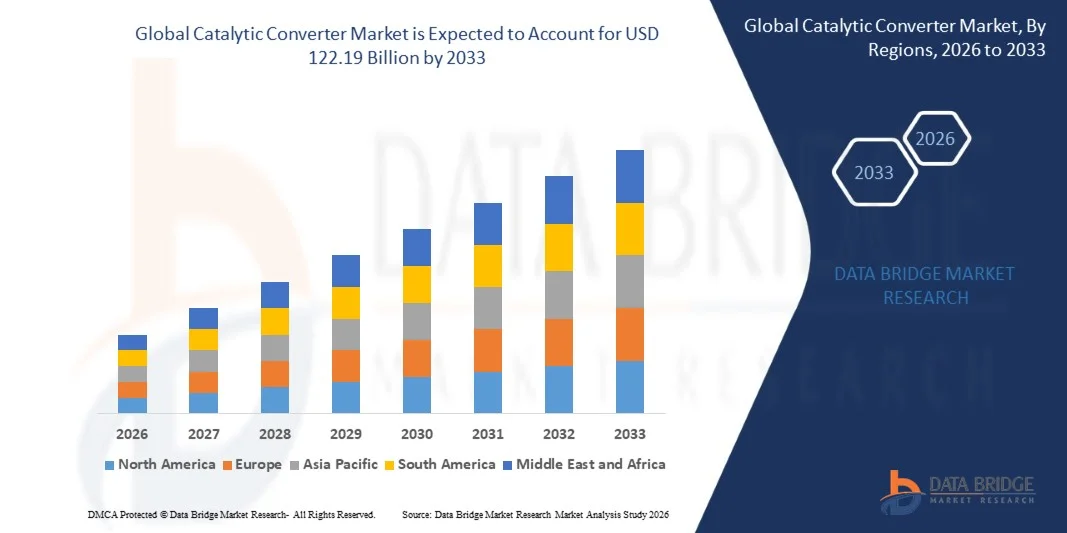
- As per Data Bridge Market Research Analysis the global catalytic converter market size was valued at USD 65.44 billion in 2025and is expected to reach USD 122.19 billion by 2033, at a CAGR of 8.12% during the forecast period
- The market growth is largely fuelled by the increasing implementation of stringent vehicle emission regulations and rising demand for cleaner automotive technologies across developed and emerging economies
- Growing production of passenger and commercial vehicles, along with increasing adoption of advanced exhaust emission control systems, is further accelerating market expansion globally
Market Size & Forecast
- Global Market Value (2025): USD 65.44 billion
- Expected Market Value (2033): USD 122.19 billion
- Forecast CAGR (2026–2033): 8.12%
What are the Major Takeaways of Catalytic Converter?
- The market is witnessing strong growth due to increasing investments in automotive emission reduction technologies and continuous advancements in catalyst materials such as platinum, palladium, and rhodium
- Expanding automotive production, particularly in Asia-Pacific and North America, is significantly supporting demand for catalytic converters across gasoline, diesel, and hybrid vehicles
- North America dominated the catalytic converter market with the largest revenue share in 2025, driven by stringent vehicle emission regulations, strong automotive production capacity, and increasing adoption of advanced exhaust emission control technologies
- Asia-Pacific region is expected to witness the highest growth rate in the global catalytic converter market, driven by expanding automotive manufacturing activities, rapid industrialization, increasing adoption of stringent emission standards, and growing demand for fuel-efficient and low-emission vehicles
- The three-way catalytic converter (TWCC) segment held the largest market revenue share in 2025 driven by its widespread use in gasoline-powered passenger vehicles and its ability to effectively reduce carbon monoxide, hydrocarbons, and nitrogen oxide emissions simultaneously. TWCC systems are extensively adopted due to their high conversion efficiency, regulatory compliance, and compatibility with modern gasoline engines
Report Scope and Catalytic Converter Market Segmentation
|
Attributes |
Catalytic Converter Key Market Insights |
|
Segments Covered |
|
|
Countries Covered |
North America
Europe
Asia-Pacific
Middle East and Africa
South America
|
|
Key Market Players |
|
|
Market Opportunities |
|
|
Value Added Data Infosets |
|
What is the Key Trend in the Catalytic Converter?
“Increasing Adoption Of Advanced Emission Control Technologies”
- The growing emphasis on reducing vehicular emissions and improving air quality is significantly shaping the catalytic converter market, as governments and automotive manufacturers increasingly focus on compliance with stringent emission regulations. Catalytic converters are gaining traction due to their ability to convert harmful pollutants such as carbon monoxide, hydrocarbons, and nitrogen oxides into less harmful gases without compromising engine performance. This trend is strengthening their adoption across passenger cars, commercial vehicles, and hybrid vehicles, encouraging manufacturers to develop advanced catalyst technologies with higher efficiency and durability
- Rising environmental awareness and implementation of stricter emission standards such as Euro 7, Bharat Stage VI, and China VI have accelerated the demand for catalytic converters across global automotive markets. Automotive manufacturers are actively investing in advanced exhaust after-treatment systems and precious metal catalyst technologies to enhance emission reduction performance while meeting evolving regulatory requirements
- Sustainability and emission reduction trends are influencing purchasing decisions, with automakers emphasizing fuel efficiency, lower carbon emissions, and compliance with environmental policies. These factors are helping manufacturers differentiate vehicle offerings in a competitive automotive market while also encouraging investments in catalyst recycling and precious metal recovery technologies
- For instance, in 2024, BASF in Germany and Umicore in Belgium expanded their automotive catalyst production capacities and introduced advanced catalytic converter technologies for hybrid and low-emission vehicles. These developments were launched in response to increasing global demand for cleaner transportation solutions and stricter environmental regulations across Europe and Asia-Pacific markets
- While demand for catalytic converters is growing, sustained market expansion depends on continuous advancements in catalyst materials, cost-efficient manufacturing processes, and stable supply of precious metals such as platinum, palladium, and rhodium. Manufacturers are also focusing on improving recycling efficiency and developing lightweight converter systems to support long-term market growth
Catalytic Converter Market Dynamics
Driver
“Stringent Vehicle Emission Regulations And Growing Demand For Cleaner Transportation”
- Increasing implementation of strict vehicle emission regulations is a major driver for the catalytic converter market. Governments worldwide are mandating lower emission limits for passenger and commercial vehicles, encouraging automakers to integrate advanced catalytic converter systems to comply with environmental standards and improve air quality. This trend is also supporting research into next-generation catalyst technologies with enhanced conversion efficiency
- Expanding automotive production and rising adoption of hybrid and fuel-efficient vehicles are influencing market growth. Catalytic converters help reduce harmful exhaust emissions while maintaining engine efficiency and regulatory compliance, enabling automotive manufacturers to meet sustainability targets and consumer expectations for cleaner mobility solutions
- Automotive manufacturers and catalyst suppliers are actively promoting advanced catalytic converter technologies through product innovation, strategic collaborations, and investments in emission control infrastructure. These efforts are supported by increasing public awareness regarding environmental sustainability and growing demand for low-emission transportation systems globally
- For instance, in 2023, Tenneco in the U.S. and Johnson Matthey in the U.K. reported increased production of advanced catalytic converter systems for gasoline, diesel, and hybrid vehicles. This expansion followed stricter global emission mandates and rising demand for fuel-efficient automotive technologies, driving higher adoption across passenger and commercial vehicle segments
- Although stringent regulations and rising environmental concerns support market growth, wider adoption depends on stable raw material pricing, technological innovation, and development of efficient catalyst recycling systems. Investments in sustainable sourcing and advanced emission control technologies will remain critical for long-term competitiveness
Restraint/Challenge
“High Precious Metal Costs And Growing Shift Toward Electric Vehicles”
- The relatively high cost of catalytic converters due to dependence on precious metals such as platinum, palladium, and rhodium remains a key challenge, limiting profitability for manufacturers and increasing overall vehicle production costs. Fluctuating prices and supply chain uncertainties related to these raw materials can significantly affect market stability and operational efficiency
- The increasing transition toward battery electric vehicles presents another challenge for the catalytic converter market, as fully electric vehicles do not require exhaust emission control systems. Rising government incentives for electric mobility and expanding EV adoption across developed markets may reduce long-term demand for catalytic converters in traditional internal combustion engine vehicles
- Supply chain disruptions and recycling complexities also impact market growth, as catalytic converter manufacturing requires reliable sourcing of rare metals and compliance with stringent environmental standards. Manufacturers must invest in efficient recycling technologies, sustainable sourcing strategies, and advanced processing systems to maintain profitability and supply continuity
- For instance, in 2024, automotive component suppliers in Germany and Japan reported increased operational costs and pricing pressure due to volatility in palladium and rhodium prices, while growing electric vehicle adoption created uncertainties regarding long-term demand for catalytic converter systems in developed automotive markets
- Overcoming these challenges will require technological innovation, efficient catalyst recycling infrastructure, and diversification into advanced emission control solutions for hybrid and alternative fuel vehicles. Collaboration between automakers, catalyst suppliers, and recycling companies will be essential for ensuring sustainable growth and long-term market resilience
How is the Catalytic Converter Segmented?
The market is segmented on the basis of type, material, vehicle type, and off-highway vehicle type.
- By Type
On the basis of type, the catalytic converter market is segmented into three-way catalytic converter (TWCC), four-way catalytic converter (FWCC), diesel oxidation catalyst (DOC), selective catalytic reduction (SCR), and lean NOx trap (LNT). The three-way catalytic converter (TWCC) segment held the largest market revenue share in 2025 driven by its widespread use in gasoline-powered passenger vehicles and its ability to effectively reduce carbon monoxide, hydrocarbons, and nitrogen oxide emissions simultaneously. TWCC systems are extensively adopted due to their high conversion efficiency, regulatory compliance, and compatibility with modern gasoline engines.
The selective catalytic reduction (SCR) segment is expected to witness the fastest growth rate from 2026 to 2033, driven by increasing adoption in diesel-powered commercial vehicles and tightening nitrogen oxide emission regulations globally. SCR systems offer superior NOx reduction efficiency and improved fuel economy, making them highly suitable for heavy-duty transportation and industrial vehicle applications.
- By Material
On the basis of material, the catalytic converter market is segmented into palladium, platinum, rhodium, and others. The palladium segment held the largest market revenue share in 2025 driven by its extensive application in gasoline catalytic converters due to its high oxidation efficiency and relatively lower cost compared to platinum and rhodium. Palladium-based catalysts are widely preferred by automakers to meet stringent emission regulations while maintaining cost efficiency in vehicle production.
The rhodium segment is expected to witness the fastest growth rate from 2026 to 2033, driven by its exceptional capability to reduce nitrogen oxide emissions in advanced catalytic converter systems. Increasing focus on reducing harmful NOx emissions and improving exhaust treatment performance is accelerating demand for rhodium-based catalyst technologies across automotive applications.
- By Vehicle Type
On the basis of vehicle type, the catalytic converter market is segmented into passenger car, light commercial vehicle, and heavy commercial vehicle. The passenger car segment held the largest market revenue share in 2025 driven by high global production volumes, rising consumer demand for personal mobility, and increasing implementation of strict emission regulations for gasoline-powered vehicles. Catalytic converters are extensively integrated into passenger cars to improve exhaust emission control and ensure compliance with environmental standards.
The heavy commercial vehicle segment is expected to witness the fastest growth rate from 2026 to 2033, driven by rising freight transportation activities, increasing industrialization, and stricter emission standards for diesel-powered trucks and buses. Advanced catalytic converter systems such as SCR and DOC are increasingly being adopted in heavy-duty vehicles to improve emission reduction efficiency and fuel performance.
- By Off-Highway Vehicle Type
On the basis of off-highway vehicle type, the catalytic converter market is segmented into agricultural tractors, construction equipment, and mining equipment. The construction equipment segment held the largest market revenue share in 2025 driven by increasing infrastructure development projects, rising urbanization, and growing demand for heavy machinery with advanced emission control systems. Construction equipment manufacturers are increasingly integrating catalytic converters to comply with stringent off-road emission regulations and improve environmental performance.
The mining equipment segment is expected to witness the fastest growth rate from 2026 to 2033, driven by expanding mining activities, rising investments in resource extraction projects, and increasing focus on reducing emissions from heavy-duty off-road vehicles. Advanced catalytic converter technologies are being adopted in mining machinery to improve air quality, enhance operational efficiency, and comply with environmental safety standards.
Which Region Holds the Largest Share of the Catalytic Converter?
- North America dominated the catalytic converter market with the largest revenue share in 2025, driven by stringent vehicle emission regulations, strong automotive production capacity, and increasing adoption of advanced exhaust emission control technologies
- Consumers and automotive manufacturers in the region highly value the efficiency, durability, and environmental benefits offered by catalytic converters in reducing harmful vehicle emissions and improving air quality
- This widespread adoption is further supported by rising investments in automotive innovation, increasing production of passenger and commercial vehicles, and growing focus on sustainable transportation solutions, establishing catalytic converters as essential components across the automotive industry
U.S. Catalytic Converter Market Insight
The U.S. catalytic converter market captured the largest revenue share in 2025 within North America, fueled by strict Environmental Protection Agency (EPA) emission standards and high demand for fuel-efficient and low-emission vehicles. Automotive manufacturers are increasingly integrating advanced catalytic converter systems into gasoline, diesel, and hybrid vehicles to comply with environmental regulations and improve emission reduction performance. The growing focus on automotive catalyst recycling and technological advancements in emission control systems is further contributing to market expansion.
Europe Catalytic Converter Market Insight
The Europe catalytic converter market is expected to witness the fastest growth rate from 2026 to 2033, primarily driven by stringent Euro emission standards and increasing adoption of advanced exhaust after-treatment systems across the automotive sector. Rising environmental awareness and strong government initiatives aimed at reducing vehicular pollution are fostering the demand for catalytic converters in passenger and commercial vehicles. The region is also witnessing increasing investments in hybrid vehicle production and catalyst recycling technologies.
U.K. Catalytic Converter Market Insight
The U.K. catalytic converter market is expected to witness the fastest growth rate from 2026 to 2033, driven by growing emphasis on reducing carbon emissions and increasing adoption of cleaner automotive technologies. Strict emission compliance requirements and rising consumer preference for fuel-efficient vehicles are encouraging automotive manufacturers to deploy advanced catalytic converter systems. The country’s strong automotive aftermarket and recycling infrastructure are also supporting market growth.
Germany Catalytic Converter Market Insight
The Germany catalytic converter market is expected to witness the fastest growth rate from 2026 to 2033, fueled by the country’s strong automotive manufacturing base, technological innovation, and increasing focus on sustainable mobility solutions. Germany’s leading automotive manufacturers are heavily investing in advanced emission control technologies and hybrid vehicle development to comply with evolving environmental regulations. Increasing research activities related to catalyst efficiency and precious metal recovery are further strengthening market growth.
Asia-Pacific Catalytic Converter Market Insight
The Asia-Pacific catalytic converter market is expected to witness the fastest growth rate from 2026 to 2033, driven by rapid industrialization, expanding automotive production, and increasing implementation of stringent emission norms in countries such as China, Japan, and India. Governments across the region are actively promoting cleaner transportation technologies and reducing vehicular pollution through strict regulatory policies. Rising vehicle ownership and expanding automotive manufacturing activities are significantly supporting market growth in the region.
Japan Catalytic Converter Market Insight
The Japan catalytic converter market is expected to witness the fastest growth rate from 2026 to 2033 due to the country’s advanced automotive technologies, strong focus on fuel efficiency, and increasing investments in hybrid vehicle production. Japanese automotive manufacturers are continuously developing high-performance catalytic converter systems to meet global emission standards and improve vehicle sustainability. The integration of lightweight catalyst technologies and advanced precious metal recovery systems is further fueling market expansion.
China Catalytic Converter Market Insight
The China catalytic converter market accounted for the largest market revenue share in Asia Pacific in 2025, attributed to the country’s large-scale automotive production, increasing implementation of China VI emission standards, and growing demand for low-emission vehicles. China remains one of the largest automotive markets globally, with rising adoption of advanced catalytic converter systems across passenger and commercial vehicles. Strong domestic manufacturing capabilities and increasing investments in emission control technologies are key factors propelling the market in China.
Which are the Top Companies in Catalytic Converter?
The Catalytic Converter industry is primarily led by well-established companies, including:
• Cisco Systems, Inc. (U.S.)
• Teledyne FLIR LLC (U.S.)
• Sumitomo Electric Industries, Ltd. (Japan)
• Siemens (Germany)
• SWARCO (Austria)
• LG CNS (South Korea)
• Kapsch TrafficCom AG (Austria)
• Cubic Corporation (U.S.)
• Iteris, Inc. (U.S.)
• JENOPTIK AG (Germany)
• Q-Free ASA (Norway)
• EFKON India Pvt. Ltd. (India)
• HARMAN International (U.S.)
• SNC-Lavalin (Canada)
• Citilog (France)
• Imtac (Canada)
• TransCore (U.S.)
• PTV AG (Germany)
• Global Traffic Technologies (U.S.)
• Faurecia Pvt. Ltd. (France)
• Tenneco LLC (U.S.)
• Johnson Matthey (U.K.)
• Eberspächer Inc. (Germany)
What are Latest Developments in Catalytic Converter?
- In September 2025, Walker Exhaust, a brand under Tenneco, announced the expansion of its catalytic converter portfolio through the addition of 118 new CARB-compliant Walker CalCat converters. This development was aimed at extending vehicle coverage for nearly 9 million additional vehicles in operation while strengthening its presence in the global automotive aftermarket. The expansion supports repair shops with broader product availability and reinforces Walker’s cost-effective premium positioning in the emission control market. The initiative is expected to enhance aftermarket sales opportunities and intensify competition in advanced catalytic converter solutions
- In May 2025, Honeywell announced the acquisition of Johnson Matthey’s Catalyst Technologies business for approximately USD 2.04 billion as part of its strategy to strengthen its Energy and Sustainability Solutions portfolio. The acquisition is intended to expand Honeywell’s catalyst and process technology capabilities across refining and petrochemical applications while improving operational synergies and installed customer base. The development is expected to accelerate innovation in catalyst technologies and enhance Honeywell’s competitive position in the global catalytic converter and emission control market
- In May 2025, Tata AutoComp Systems Ltd. and Katcon Global announced a joint venture in Mexico focused on manufacturing advanced composite materials for passenger vehicles, commercial vehicles, agricultural tractors, and off-road applications. The partnership aims to expand both companies’ global footprint while delivering lightweight and sustainable automotive solutions for the North American market. The initiative is expected to support vehicle weight reduction, improve fuel efficiency, and contribute to the growing demand for advanced emission control and sustainable automotive technologies globally

- Interactive Data Analysis Dashboard
- Company Analysis Dashboard for high growth potential opportunities
- Research Analyst Access for customization & queries
- Competitor Analysis with Interactive dashboard
- Latest News, Updates & Trend analysis
- Harness the Power of Benchmark Analysis for Comprehensive Competitor Tracking
Data collection and base year analysis are done using data collection modules with large sample sizes. The stage includes obtaining market information or related data through various sources and strategies. It includes examining and planning all the data acquired from the past in advance. It likewise envelops the examination of information inconsistencies seen across different information sources. The market data is analysed and estimated using market statistical and coherent models. Also, market share analysis and key trend analysis are the major success factors in the market report. To know more, please request an analyst call or drop down your inquiry.
The key research methodology used by DBMR research team is data triangulation which involves data mining, analysis of the impact of data variables on the market and primary (industry expert) validation. Data models include Vendor Positioning Grid, Market Time Line Analysis, Market Overview and Guide, Company Positioning Grid, Patent Analysis, Pricing Analysis, Company Market Share Analysis, Standards of Measurement, Global versus Regional and Vendor Share Analysis. To know more about the research methodology, drop in an inquiry to speak to our industry experts.
Data Bridge Market Research is a leader in advanced formative research. We take pride in servicing our existing and new customers with data and analysis that match and suits their goal. The report can be customized to include price trend analysis of target brands understanding the market for additional countries (ask for the list of countries), clinical trial results data, literature review, refurbished market and product base analysis. Market analysis of target competitors can be analyzed from technology-based analysis to market portfolio strategies. We can add as many competitors that you require data about in the format and data style you are looking for. Our team of analysts can also provide you data in crude raw excel files pivot tables (Fact book) or can assist you in creating presentations from the data sets available in the report.













