


What is the Catamarans Market Size and Growth Rate?
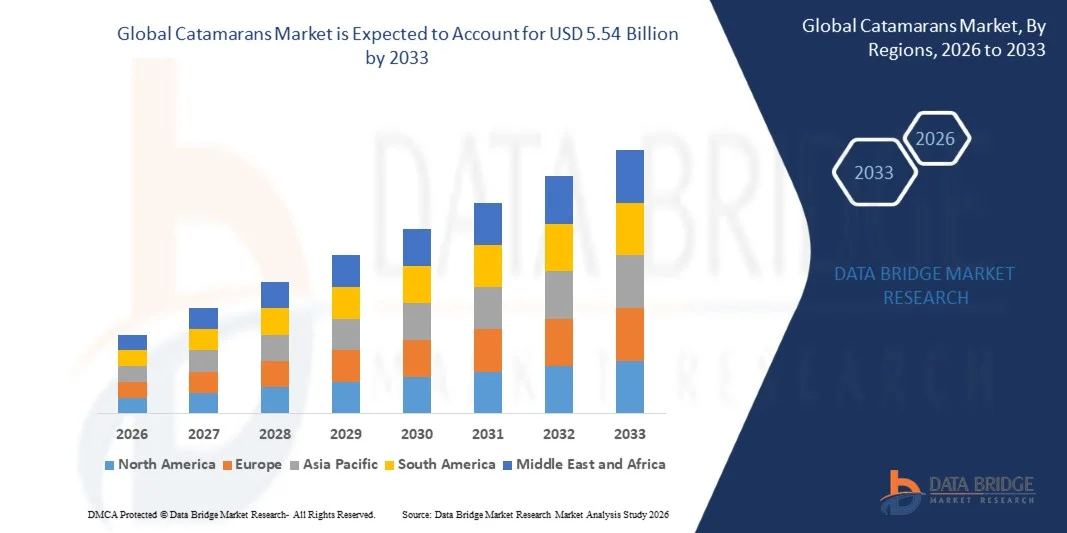
As per Data Bridge Market Research analysis the catamarans market was valued at USD 3.40 billion in 2025 and is projected to reach USD 5.54 billion by 2033, growing at a CAGR of 6.30% from 2026 to 2033. The market is experiencing steady growth driven by increasing demand for recreational boating, rising popularity of marine tourism, growing preference for fuel-efficient and stable vessels, and expanding adoption of catamarans for leisure cruising, sailing, and commercial marine applications.
The growing interest in luxury yacht charters, coastal tourism, and adventure water activities is significantly boosting demand for catamarans due to their superior stability, spacious layouts, and enhanced passenger comfort compared with traditional monohull vessels. The increasing adoption of electric and hybrid propulsion technologies along with advancements in lightweight composite materials and sustainable boat manufacturing is further supporting market expansion. In addition, rising disposable incomes, growth in high-net-worth individual populations, and increasing investments in marine infrastructure are encouraging the development and adoption of advanced catamaran models across global markets.
Market Size & Forecast
- Market Value (2025): USD 3.40 Billion
- Expected Market Value (2033): USD 5.54 Billion
- Forecast CAGR (2026–2033): 6.30%
- Leading Region in 2025: North America
- Fastest Growing Region: Asia-Pacific
Key Market Trends & Insights
- North America accounted for a significant share of 40.5% the global catamarans market in 2025, supported by rising demand for recreational boating, luxury marine tourism, and expanding yacht charter activities.
- Asia-Pacific catamarans market is expected to witness the fastest growth rate from 2026 to 2033, approximately 20.5% of the market share, driven by increasing marine tourism, rising disposable incomes, expanding coastal infrastructure, and growing interest in luxury recreational activities.
- The diesel catamarans segment held the largest market revenue share in 2025, driven by their widespread adoption in recreational boating, yacht charter operations, and commercial marine transportation applications. Diesel-powered catamarans remain preferred due to their long cruising range, established marine infrastructure, high reliability, and suitability for long-distance offshore operations.
- The electric and solar catamarans segment is projected to register the fastest growth during the forecast period from 2026 to 2033, supported by increasing focus marine decarbonization, rising adoption of renewable energy technologies
- and growing demand for sustainable luxury vessels. Advancements in battery technology, solar integration, and low-emission propulsion systems are accelerating the adoption of electric and solar-powered catamarans among environmentally conscious yacht owners and commercial operators.
- The fiberglass catamarans segment accounted for the largest market revenue in 2025, owing to its extensive usage in recreational and charter catamarans. Fiberglass is widely preferred due to its durability, corrosion resistance, lightweight properties, lower manufacturing cost, and ability to provide efficient performance for leisure and commercial marine applications.
- The carbon fiber catamarans segment is anticipated to witness the fastest growth from 2026 to 2033, driven by increasing demand for high-performance luxury vessels, racing catamarans, and lightweight marine structures. The superior strength-to-weight ratio, improved speed capabilities, and enhanced fuel efficiency offered by carbon fiber materials are encouraging manufacturers to adopt advanced composites in premium catamaran models.
Report Scope and Catamarans Market Segmentation
|
Attributes |
Catamarans Key Market Insights |
|
Segments Covered |
|
|
Countries Covered |
North America
Europe
Asia-Pacific
Middle East and Africa
South America
|
|
Key Market Players |
|
|
Market Opportunities |
• Growth In Luxury Marine Tourism And Yacht Charter Services |
|
Value Added Data Infosets |
In addition to the market insights such as market value, growth rate, market segments, geographical coverage, market players, and market scenario, the market report curated by the Data Bridge Market Research team includes in-depth expert analysis, import/export analysis, pricing analysis, production consumption analysis, and pestle analysis. |
What is the Key Trend in the Catamarans Market?
Trend: Rising Adoption Of Sustainable And Luxury Catamaran Solutions
Growing consumer preference for luxury marine experiences, eco-friendly transportation, and advanced recreational vessels is accelerating the adoption of catamarans across global markets. Catamarans are increasingly preferred by yacht owners, charter operators, and marine tourism companies due to their enhanced stability, larger living spaces, improved fuel efficiency, and superior passenger comfort compared with traditional monohull vessels. The rising popularity of luxury yacht tourism, private cruising, and premium sailing experiences is encouraging manufacturers to introduce technologically advanced catamarans equipped with lightweight materials, smart navigation systems, and sustainable propulsion solutions.
The rapid development of electric, hybrid, and solar-powered catamarans is creating new growth opportunities as marine industries focus on reducing emissions and improving energy efficiency. Manufacturers are investing in innovative designs that integrate renewable energy systems, advanced battery technologies, and efficient propulsion systems to meet changing consumer expectations. For instance, in October 2024, Sunreef Yachts announced that its 60 Sunreef Power Eco electric catamaran won the “Best Electric Catamaran” title at the World Yacht Trophies 2024 during the Cannes Yachting Festival. The vessel features high-performance batteries, an advanced solar power system, and energy-efficient technologies designed to support zero-emission and quieter cruising experiences. This development highlights the increasing shift toward sustainable luxury catamarans and strengthens market demand for environmentally responsible marine vessels.
The growing adoption of sustainable technologies, combined with rising demand for premium marine tourism and recreational boating activities, is expected to support long-term growth of the catamarans market by encouraging innovation in vessel design, propulsion systems, and luxury sailing experiences.
Catamarans Market Dynamics
Key Market Driver: Increasing Growth Of Marine Tourism And Recreational Boating Activities
The global recreational boating industry is witnessing increasing demand due to rising disposable incomes, expanding coastal tourism, and growing consumer interest in luxury leisure activities. Catamarans are gaining popularity among private buyers, yacht charter companies, and tourism operators because of their greater stability, spacious interiors, increased passenger capacity, and suitability for long-distance cruising. These advantages are driving adoption across luxury sailing, charter services, passenger transportation, and adventure tourism applications.
The expansion of yacht charter services and increasing investments in marine leisure infrastructure are further supporting market growth. Catamarans provide operational benefits for charter businesses by offering larger accommodation areas, improved onboard comfort, and better stability in different sea conditions. For instance, in 2025, Lagoon Catamarans continued expanding its global product portfolio with new models such as the Lagoon 38, Lagoon 43, and Lagoon 46 Iconic, designed for both private ownership and charter operations. These developments reflect increasing demand from yacht charter operators and leisure travelers seeking spacious and comfortable multihull vessels for recreational sailing experiences.
The growing demand for personalized sailing experiences among high-net-worth individuals and tourists is encouraging fleet operators to invest in modern multihull vessels. As marine tourism continues to expand globally and consumers increasingly seek premium water-based recreational experiences, catamaran manufacturers are expected to benefit from sustained demand driven by luxury travel trends, fleet modernization, and increasing preference for spacious and stable vessels.
Key Restraint/Challenge: High Acquisition Costs And Complex Maintenance Requirements
Catamaran manufacturers face challenges associated with high initial purchase costs due to advanced engineering requirements, larger material usage, and specialized manufacturing processes. Compared with traditional monohull boats, catamarans generally require higher investments because of their dual-hull structure, advanced onboard systems, and premium customization options. These factors can restrict adoption among price-sensitive consumers and smaller commercial operators.
In addition, maintenance costs associated with multiple hull structures, propulsion systems, electrical components, and specialized marine equipment can increase ownership expenses. Fluctuations in prices of composite materials, marine electronics, and other components may further impact production costs and profitability. For instance, in its 2024 Annual Financial Report, Groupe Beneteau highlighted challenging market conditions in the boating industry, including a contraction in demand and the need for continued adaptation across its production and supply chain operations. The company also reported ongoing investments in sustainable boat development, including innovations in electric-hybrid propulsion and recyclable materials, reflecting the increasing complexity and cost requirements of next-generation marine vessels.
The requirement for skilled technicians and specialized maintenance facilities also creates operational challenges for catamaran owners. Despite increasing demand from luxury tourism and recreational boating sectors, high ownership costs, maintenance complexity, and dependence on specialized materials are expected to remain significant restraints, influencing purchasing decisions and limiting adoption in cost-sensitive markets during the forecast period.Key Market Opportunity: Expansion Of Electric And Solar-Powered Catamaran Technologies.
Key Market Opportunity: Expansion Of Electric And Solar-Powered Catamaran Technologies
The increasing focus on marine sustainability and emission reduction is creating significant opportunities for catamaran manufacturers to develop electric, hybrid, and solar-powered vessels. Governments, marine organizations, and consumers are increasingly prioritizing cleaner transportation solutions, encouraging companies to invest in renewable energy integration, advanced batteries, and low-emission propulsion technologies.
Leading manufacturers are introducing innovative sustainable catamaran models to address the growing demand for environmentally responsible luxury vessels. For instance, in September 2024, Silent Yachts announced that its SY62 3-Deck solar-electric catamaran received the “Most Efficient Yacht” award at the Cannes Yachting Festival 2024. The vessel combines solar energy technology, advanced marine engineering, and luxury design features to improve energy efficiency and support sustainable cruising. This development reflects increasing acceptance of solar-electric catamarans among luxury yacht customers and reinforces the transition toward cleaner marine mobility solutions.
As sustainability regulations strengthen and demand for eco-friendly marine transportation increases, the adoption of electric and solar-powered catamarans is expected to create substantial growth opportunities by supporting technological innovation, reducing emissions, and expanding applications across recreational and commercial marine markets.
How is the Catamarans Market Segmented?
The market is segmented on the basis of propulsion type, hull material, size, and application.
- By Propulsion Type
On the basis of propulsion type, the catamarans market is segmented into electric catamarans, hybrid catamarans, solar catamarans, and diesel catamarans. The diesel catamarans segment held the largest market revenue share in 2025, driven by their widespread adoption in recreational boating, yacht charter operations, and commercial marine transportation applications. Diesel-powered catamarans remain preferred due to their long cruising range, established marine infrastructure, high reliability, and suitability for long-distance offshore operations.
The electric and solar catamarans segment is projected to register the fastest growth during the forecast period from 2026 to 2033, supported by increasing focus on marine decarbonization, rising adoption of renewable energy technologies, and growing demand for sustainable luxury vessels. Advancements in battery technology, solar integration, and low-emission propulsion systems are accelerating the adoption of electric and solar-powered catamarans among environmentally conscious yacht owners and commercial operators.
- By Hull Material
On the basis of hull material, the catamarans market is segmented into fiberglass catamarans, carbon fiber catamarans, and aluminum catamarans. The fiberglass catamarans segment accounted for the largest market revenue in 2025, owing to its extensive usage in recreational and charter catamarans. Fiberglass is widely preferred due to its durability, corrosion resistance, lightweight properties, lower manufacturing cost, and ability to provide efficient performance for leisure and commercial marine applications.
The carbon fiber catamarans segment is anticipated to witness the fastest growth from 2026 to 2033, driven by increasing demand for high-performance luxury vessels, racing catamarans, and lightweight marine structures. The superior strength-to-weight ratio, improved speed capabilities, and enhanced fuel efficiency offered by carbon fiber materials are encouraging manufacturers to adopt advanced composites in premium catamaran models.
- By Size
On the basis of size, the catamarans market is segmented into small catamarans (up to 40 feet), midsize catamarans (40 to 60 feet), and large catamarans (over 60 feet). The midsize catamarans (40 to 60 feet) segment dominated the market with an estimated revenue share in 2025, driven by increasing adoption among private owners, yacht charter companies, and marine tourism operators. These vessels provide an optimal balance between affordability, onboard space, cruising capability, and operational efficiency, making them highly suitable for leisure sailing and charter applications.
The large catamarans (over 60 feet) segment is expected to register significant growth during the forecast period due to rising demand for luxury yachts, premium charter experiences, and customized high-end marine vessels. Increasing investments by high-net-worth individuals and luxury tourism companies in spacious catamarans equipped with advanced amenities are supporting segment expansion.
- By Application
On the basis of application, the catamarans market is segmented into recreational catamarans, charter catamarans, and commercial catamarans. The recreational catamarans segment held the largest market revenue share in 2025, driven by increasing consumer interest in leisure boating, private yacht ownership, adventure tourism, and coastal recreational activities. The stability, spacious layouts, and enhanced comfort offered by catamarans are increasing their adoption among individual boat owners globally.
The charter catamarans segment is projected to witness the fastest growth from 2026 to 2033, supported by expanding yacht rental services, increasing marine tourism activities, and rising demand for affordable luxury sailing experiences. Growing investments by charter operators in modern multihull fleets and increasing preference for premium group sailing experiences are expected to further accelerate segment growth. The commercial catamarans segment is also gaining traction due to increasing usage in passenger transportation, fishing, research, and offshore support applications.
Which Region Holds the Largest Share of the Catamarans Market?
North America Catamarans Market Insight
North America accounted for a significant share of 40.5% the global catamarans market in 2025, supported by rising demand for recreational boating, luxury marine tourism, and expanding yacht charter activities. The region benefits from a strong boating culture, high disposable incomes, developed marine infrastructure, and increasing consumer preference for spacious and comfortable vessels. The growing popularity of coastal tourism, private yacht ownership, and premium sailing experiences is encouraging individuals and charter operators to invest in advanced catamaran models. Furthermore, increasing adoption of sustainable marine technologies, including hybrid and electric catamarans, is strengthening market growth across the region.
U.S. Catamarans Market Insight
The U.S. catamarans market held the largest revenue share within North America in 2025, driven by strong recreational boating participation, expanding yacht charter services, and increasing demand for luxury marine experiences. The country has one of the world's largest recreational boating industries, supported by extensive coastlines, inland waterways, and a high number of boat owners. The rising preference for multihull vessels among private owners, charter companies, and tourism operators is accelerating catamaran adoption due to their stability, larger living spaces, and fuel efficiency. In addition, growing interest in eco-friendly boating solutions and solar-electric catamarans is expected to create new growth opportunities in the U.S. market.
Europe Catamarans Market Insight
The Europe catamarans market is expected to witness strong growth from 2026 to 2033, approximately 35.5% of the market share, supported by increasing marine tourism, expanding yacht charter networks, and rising demand for sustainable luxury vessels. European countries such as France, Italy, Greece, Spain, and Croatia have established boating destinations that attract a large number of sailing tourists annually. The presence of leading catamaran manufacturers, advanced shipbuilding capabilities, and growing investments in electric and hybrid marine technologies are further supporting market expansion. In addition, increasing environmental regulations across Europe are encouraging manufacturers and consumers to adopt cleaner and more energy-efficient catamaran solutions.
Germany Catamarans Market Insight
The Germany catamarans market is expected to experience steady growth from 2026 to 2033, supported by increasing interest in sustainable marine transportation, advanced engineering capabilities, and rising demand for premium recreational vessels. German consumers are increasingly adopting technologically advanced boats equipped with efficient propulsion systems, digital navigation solutions, and environmentally friendly features. The country's focus on innovation, sustainability, and high-quality manufacturing is contributing to the development of advanced marine technologies. In addition, growing participation in leisure boating activities and demand for efficient cruising vessels are supporting market expansion.
U.K. Catamarans Market Insight
The U.K. catamarans market is expected to witness steady growth from 2026 to 2033, driven by increasing participation in recreational boating, rising demand for yacht charter services, and growing interest in luxury sailing experiences. The country’s strong maritime heritage, developed coastal tourism industry, and increasing number of sailing enthusiasts are supporting the adoption of catamarans for leisure cruising and charter operations. The U.K. market is also benefiting from growing demand for sustainable marine solutions, with consumers and operators showing increasing interest in electric, hybrid, and fuel-efficient catamaran technologies. Furthermore, expanding marine tourism activities and investments in marina infrastructure are expected to strengthen market growth during the forecast period.
Asia-Pacific Catamarans Market Insight
The Asia-Pacific catamarans market is expected to witness the fastest growth rate from 2026 to 2033, approximately 20.5% of the market share, driven by increasing marine tourism, rising disposable incomes, expanding coastal infrastructure, and growing interest in luxury recreational activities. Countries such as China, Japan, Australia, India, and Southeast Asian nations are witnessing increasing investments in yacht tourism, marina development, and water-based leisure activities. The rising number of high-net-worth individuals and growing preference for premium travel experiences are encouraging adoption of catamarans for private ownership and charter services. Furthermore, increasing awareness of sustainable marine technologies is supporting demand for electric and hybrid catamaran models across the region.
China Catamarans Market Insigh
The China catamarans market is expected to grow significantly from 2026 to 2033, driven by rising disposable incomes, expanding luxury tourism, increasing yacht ownership, and government support for marine leisure development. The country’s growing middle and affluent population is contributing to higher demand for premium recreational activities, including yacht cruising and sailing experiences. Increasing investments in coastal tourism infrastructure, marina development, and water-based entertainment facilities are supporting market growth. Moreover, the presence of domestic boat manufacturers and increasing adoption of advanced marine technologies are improving accessibility and affordability of catamarans across China.
Japan Catamarans Market Insight
The Japan catamarans market is expected to witness significant growth from 2026 to 2033, supported by increasing interest in marine leisure activities, rising demand for luxury tourism, and growing adoption of advanced marine technologies. Japan’s extensive coastline, strong maritime industry, and increasing focus on sustainable transportation solutions are encouraging the adoption of modern catamaran vessels for recreational and commercial applications. The growing popularity of coastal tourism, island exploration, and private sailing experiences is driving demand for stable and comfortable multihull boats. In addition, advancements in electric and hybrid propulsion systems, along with Japan’s emphasis on energy efficiency and innovation, are expected to create new opportunities for catamaran manufacturers in the country.
Catamarans Market Share
The catamarans industry is primarily led by well-established companies, including:
- Lagoon Catamarans (France)
- Fountaine Pajot (France)
- Catana Group (France)
- Nautitech Catamarans (France)
- Sunreef Yachts (Poland)
- Bali Catamarans (France)
- Gemini Catamarans (U.S.)
- Seawind Catamarans (Australia)
- Aventura Catamarans (Tunisia)
- Leopard Catamarans (South Africa)
- Excess Catamarans (France)
- HH Catamarans (U.S.)
- Aquila Power Catamarans (China)
- Robertson & Caine (South Africa)
- McConaghy Boats (Australia)
What are Latest Developments in Catamarans Market?
- In February 2026, Kongsberg Maritime partnered with Austal Limited for the Horizon X project to provide advanced waterjet propulsion systems for a hydrogen-ready high-speed catamaran ferry. The collaboration aims to enhance vessel efficiency, performance, and sustainability while supporting the adoption of cleaner marine propulsion technologies.
- In February 2026, Austal Limited commenced construction of Horizon X, the world’s largest hydrogen-ready high-speed catamaran ferry, to develop a next-generation low-emission passenger vessel. The project highlights growing investment in alternative-fuel technologies and strengthens the shift toward sustainable commercial ferry operations.
- In December 2025, Incat Tasmania achieved a major development milestone by successfully testing the electric motors of Hull 096, the world’s largest battery-electric vessel. The advancement supports the company’s progress toward commercial deployment of zero-emission ferries and accelerates the adoption of large-scale electric marine transportation solutions.
- In February 2025, Austal Limited secured a contract from Gotlandsbolaget to design and construct a 130-meter hydrogen-ready high-speed catamaran ferry. The project is expected to expand the company’s sustainable vessel portfolio and drive market growth by increasing demand for hydrogen-powered maritime transportation solutions.

- Interactive Data Analysis Dashboard
- Company Analysis Dashboard for high growth potential opportunities
- Research Analyst Access for customization & queries
- Competitor Analysis with Interactive dashboard
- Latest News, Updates & Trend analysis
- Harness the Power of Benchmark Analysis for Comprehensive Competitor Tracking
Data collection and base year analysis are done using data collection modules with large sample sizes. The stage includes obtaining market information or related data through various sources and strategies. It includes examining and planning all the data acquired from the past in advance. It likewise envelops the examination of information inconsistencies seen across different information sources. The market data is analysed and estimated using market statistical and coherent models. Also, market share analysis and key trend analysis are the major success factors in the market report. To know more, please request an analyst call or drop down your inquiry.
The key research methodology used by DBMR research team is data triangulation which involves data mining, analysis of the impact of data variables on the market and primary (industry expert) validation. Data models include Vendor Positioning Grid, Market Time Line Analysis, Market Overview and Guide, Company Positioning Grid, Patent Analysis, Pricing Analysis, Company Market Share Analysis, Standards of Measurement, Global versus Regional and Vendor Share Analysis. To know more about the research methodology, drop in an inquiry to speak to our industry experts.
Data Bridge Market Research is a leader in advanced formative research. We take pride in servicing our existing and new customers with data and analysis that match and suits their goal. The report can be customized to include price trend analysis of target brands understanding the market for additional countries (ask for the list of countries), clinical trial results data, literature review, refurbished market and product base analysis. Market analysis of target competitors can be analyzed from technology-based analysis to market portfolio strategies. We can add as many competitors that you require data about in the format and data style you are looking for. Our team of analysts can also provide you data in crude raw excel files pivot tables (Fact book) or can assist you in creating presentations from the data sets available in the report.













