


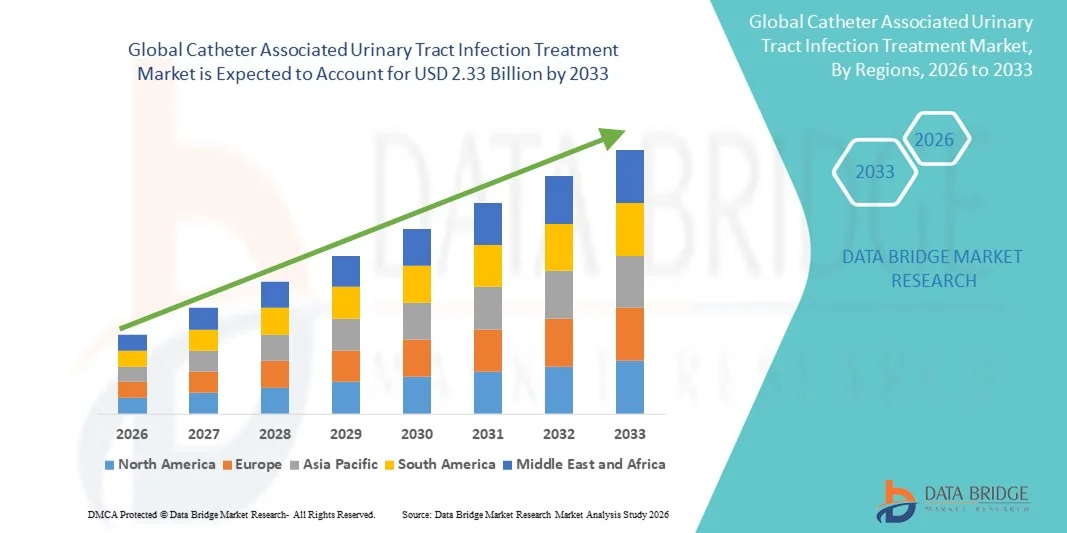
Catheter Associated Urinary Tract Infection Treatment Market Size
- The global catheter associated urinary tract infection treatment market size was valued at USD 1.39 billion in 2025 and is expected to reach USD 2.33 billion by 2033, at a CAGR of 6.7% during the forecast period
- The market growth is largely driven by the increasing prevalence of catheter-associated infections, rising hospitalization rates, and the expanding use of urinary catheters across healthcare settings, coupled with advancements in antimicrobial therapies and infection prevention strategies
- Furthermore, growing awareness among healthcare providers and patients regarding infection control, along with the demand for effective and rapid treatment solutions, is positioning CAUTI management as a critical focus in clinical care. These factors are collectively accelerating the adoption of advanced treatment options, thereby significantly boosting the industry's growth
Catheter Associated Urinary Tract Infection Treatment Market Analysis
- Catheter associated urinary tract infection treatment, including antimicrobial therapies, prophylactic interventions, and advanced catheter care solutions, are increasingly critical components of hospital infection control protocols and patient safety initiatives in both acute and long-term care settings due to their ability to reduce infection rates, hospital stays, and associated healthcare costs
- The escalating demand for catheter associated urinary tract infection treatment is primarily fueled by the rising prevalence of urinary catheter use, increasing hospitalization rates, and growing awareness among healthcare providers regarding infection prevention and management
- North America dominated the catheter associated urinary tract infection treatment market with the largest revenue share of 38.9% in 2025, characterized by stringent infection control regulations, high healthcare expenditure, and a strong presence of key industry players, with the U.S. witnessing substantial adoption of advanced antimicrobial and catheter care solutions driven by innovations from both established pharmaceutical companies and medical device startups
- Asia-Pacific is expected to be the fastest-growing region in the catheter associated urinary tract infection treatment market during the forecast period due to rising hospital infrastructure, increasing catheter utilization, and growing awareness about hospital-acquired infection prevention
- Antibiotics segment dominated the catheter associated urinary tract infection treatment market with a market share of 45.8% in 2025, driven by its proven efficacy, widespread availability, and established clinical protocols for treating catheter-associated urinary tract infections
Report Scope and Catheter Associated Urinary Tract Infection Treatment Market Segmentation
|
Attributes |
Catheter Associated Urinary Tract Infection Treatment Key Market Insights |
|
Segments Covered |
|
|
Countries Covered |
North America
Europe
Asia-Pacific
Middle East and Africa
South America
|
|
Key Market Players |
|
|
Market Opportunities |
|
|
Value Added Data Infosets |
In addition to the insights on market scenarios such as market value, growth rate, segmentation, geographical coverage, and major players, the market reports curated by the Data Bridge Market Research also include in-depth expert analysis, patient epidemiology, pipeline analysis, pricing analysis, and regulatory framework |
Catheter Associated Urinary Tract Infection Treatment Market Trends
Advancements in Antimicrobial and Coated Catheter Technologies
- A significant and accelerating trend in the global catheter associated urinary tract infection treatment market is the development of catheters coated with antimicrobial and antiseptic agents, which help reduce infection rates and improve patient outcomes
- For instance, silver-alloy coated catheters are being widely adopted in hospitals to prevent bacterial colonization and subsequent urinary tract infections in catheterized patients
- Novel materials and coatings are being integrated into catheters to inhibit biofilm formation and bacterial adherence, thereby reducing the incidence of catheter-associated infections over extended periods of use
- Integration of these advanced catheter technologies with hospital monitoring protocols allows healthcare providers to closely track infection prevention metrics and optimize patient care strategies
- This trend toward more effective, preventive catheter solutions is fundamentally reshaping clinical standards and expectations in infection control
- The demand for advanced antimicrobial and coated catheters is growing rapidly across hospitals and long-term care facilities, as healthcare providers increasingly prioritize patient safety and infection prevention. Increased focus on minimally invasive catheterization techniques and single-use catheter designs is gaining traction, reducing infection risks and improving patient comfort
- Digital monitoring and smart catheter systems capable of tracking usage duration and alerting healthcare staff to prolonged catheterization are emerging as innovative solutions to prevent CAUTI
Catheter Associated Urinary Tract Infection Treatment Market Dynamics
Driver
Increasing Prevalence of Catheter Use and Hospital-Acquired Infections
- The rising use of urinary catheters in hospitals and long-term care facilities, coupled with the high incidence of catheter-associated urinary tract infections, is a significant driver for the growth of the market
- For instance, in March 2025, Medtronic launched an advanced antimicrobial catheter solution aimed at reducing hospital-acquired urinary tract infections in intensive care units
- As hospitals face stricter infection control regulations and higher patient safety expectations, catheter associated urinary tract infection treatments provide essential clinical interventions to reduce infection rates
- Furthermore, the growing awareness among healthcare providers regarding the importance of timely infection management is making these treatments a critical component of hospital protocols
- Advancements in drug formulations, catheter materials, and infection monitoring tools are key factors propelling adoption in both acute and long-term care settings
- Expanding geriatric and chronic care patient populations, who require long-term catheterization, are creating sustained demand for CAUTI treatment solutions
- Increased government initiatives and hospital policies promoting infection prevention are incentivizing the adoption of advanced catheter care products
Restraint/Challenge
Antimicrobial Resistance and High Treatment Costs
- The emergence of antimicrobial-resistant pathogens is a major challenge, limiting the effectiveness of standard antibiotic therapies and complicating the treatment of catheter-associated urinary tract infections
- For instance, increasing reports of multidrug-resistant E. coli strains in hospitalized patients have made treatment more complex and prolonged
- High costs associated with advanced antimicrobial catheters and novel treatment regimens can be a barrier, especially for healthcare facilities with budget constraints
- Healthcare providers need to balance the benefits of advanced treatments with the potential financial burden, which may slow widespread adoption in some regions
- Overcoming these challenges requires the development of cost-effective solutions, combined with antimicrobial stewardship programs and continuous monitoring to maintain clinical efficacy and manage resistance
- Limited awareness and training among healthcare staff regarding optimal catheter care and infection prevention protocols can hinder effective CAUTI management
- Inconsistent regulatory standards across regions for antimicrobial catheters and infection treatment products can create adoption challenges for global manufacturers
Catheter Associated Urinary Tract Infection Treatment Market Scope
The market is segmented on the basis of treatment, diagnosis, symptoms, dosage, route of administration, end-users, and distribution channel.
- By Treatment
On the basis of treatment, the market is segmented into antibiotics and others. The antibiotics segment dominated the market with the largest market revenue share of 45.8% in 2025, driven by its proven efficacy and well-established clinical protocols for treating catheter-associated urinary tract infections. Antibiotics provide rapid bacterial reduction, helping prevent infection progression and complications. Hospitals and long-term care facilities heavily rely on antibiotics due to their reliability and broad-spectrum coverage. Ease of administration in multiple forms, including tablets and injections, further strengthens their adoption. Continuous clinical support and guideline-backed usage ensure antibiotics remain the first-line treatment. Resistance monitoring and susceptibility testing enhance targeted treatment, reinforcing dominance.
The others segment, which includes non-antibiotic therapies such as antimicrobial catheter coatings, urinary antiseptics, and probiotic-based treatments, is expected to witness the fastest CAGR from 2026 to 2033. Rising awareness of antimicrobial resistance is pushing adoption of alternative preventive measures. Innovative catheter technologies reduce infection risk without relying solely on drugs. Hospitals are increasingly investing in preventive care solutions. This segment appeals to facilities seeking sustainable and multi-modal infection management strategies. Growing research, clinical trials, and regulatory approvals support market expansion and adoption.
- By Diagnosis
On the basis of diagnosis, the market is segmented into urine tests, ultrasound, CT scan, and others. The urine tests segment dominated the market in 2025 due to its simplicity, low cost, and rapid results for detecting CAUTI. Urine cultures and sensitivity tests guide targeted antibiotic therapy. This method is widely used across hospitals and clinics for quick diagnosis. Urine tests reduce risk of misdiagnosis and enable timely intervention. They are suitable for both inpatient and outpatient settings. Their accessibility, standardization, and clinical reliability support strong adoption globally.
The ultrasound segment is expected to witness the fastest growth during the forecast period. Ultrasound helps identify structural abnormalities and obstructions caused by prolonged catheter use. Non-invasive and radiation-free, it provides real-time visualization for diagnosis and follow-up. Growing awareness of renal complications from CAUTI drives adoption. Hospitals are investing in imaging infrastructure and skilled personnel. Ultrasound supports early intervention, preventive care, and reduction of severe infection outcomes, boosting market growth.
- By Symptoms
On the basis of symptoms, the market is segmented into chills, fever, hematuria, abnormal urine color, flank pain, confusion, abdomen pain, strong urine odor, vomiting, and others. The fever segment dominated the market in 2025 as it is a primary clinical trigger for early CAUTI detection. Fever prompts immediate intervention, making it critical for treatment decisions. Hospitals rely on fever monitoring to reduce complications and optimize protocols. It is a universally recognized symptom across patient populations. Early detection based on fever improves recovery outcomes. Continuous monitoring programs and standardized protocols support widespread adoption.
The flank pain segment is expected to witness the fastest growth from 2026 to 2033. Flank pain indicates potential kidney involvement from catheter-associated infections. Awareness of complications drives demand for targeted diagnostics and treatment. Hospitals prioritize early intervention to prevent renal damage. Imaging and lab tests complement symptom-based detection. Growing geriatric and high-risk populations increase the prevalence of this symptom. Focus on reducing severe CAUTI complications supports segment expansion and innovation.
- By Dosage
On the basis of dosage, the market is segmented into tablet, injection, and others. The tablet segment dominated the market in 2025 due to ease of administration and patient compliance. Tablets are cost-effective and widely available. Suitable for both prophylactic and therapeutic use, they support outpatient and inpatient treatment. Standardized dosing ensures predictable outcomes. Tablets can be combined with other therapies for multi-modal treatment. Their convenience, familiarity among patients, and clinical effectiveness make them the preferred choice in most hospitals.
The injection segment is expected to witness the fastest growth during the forecast period. Injectable therapies offer rapid systemic effects in severe or complicated CAUTI cases. They are preferred in acute care settings and for critically ill patients. IV or intramuscular injections ensure precise dosage control and immediate action. Hospitals adopt injections when oral therapy is not viable or effective. Growing prevalence of severe infections drives adoption in ICUs, surgical wards, and emergency care.
- By Route of Administration
On the basis of route of administration, the market is segmented into oral and intravenous. The oral segment dominated the market in 2025 due to convenience, non-invasiveness, and suitability for mild to moderate infections. Oral administration supports outpatient management and improves adherence. It is cost-effective and widely accessible. Most hospitals and clinics prefer oral drugs for routine treatment. The route allows flexible dosing schedules. Easy administration reduces nursing workload and enhances patient compliance.
The intravenous segment is expected to witness the fastest growth from 2026 to 2033. IV therapy is essential for severe infections requiring rapid drug delivery. Hospitals use IV administration for critically ill patients or those unable to take oral drugs. It ensures 100% bioavailability and faster therapeutic response. Growing ICU admissions support segment growth. Integration with hospital infection protocols boosts adoption. Rising awareness of effective acute care treatment drives demand and innovation.
- By End-Users
On the basis of end-users, the market is segmented into clinics, hospitals, and others. The hospital segment dominated the market in 2025 due to high catheter usage, advanced infrastructure, and infection control protocols. Hospitals serve as primary sites for diagnosis, treatment, and monitoring of CAUTI. They invest in advanced treatment solutions and monitoring systems. Higher patient volumes ensure large-scale adoption. Hospitals follow standardized treatment guidelines for consistency. Availability of skilled personnel strengthens the segment and ensures clinical effectiveness.
The clinic segment is expected to witness the fastest growth during the forecast period. Outpatient clinics are increasingly offering preventive care and early-stage CAUTI management. Telemedicine and home care programs boost clinic-based treatment adoption. Clinics provide convenient access for patients, reducing hospital burden. Awareness campaigns encourage early diagnosis and timely treatment. Rising healthcare infrastructure in emerging regions supports growth. Clinics are becoming key players in preventive CAUTI management.
- By Distribution Channel
On the basis of distribution channel, the market is segmented into hospital pharmacy, retail pharmacy, and online pharmacy. The hospital pharmacy segment dominated the market in 2025 due to direct access to prescribed treatments within hospitals, ensuring timely administration and compliance. Hospitals maintain stock to manage infection control efficiently. On-site pharmacies facilitate immediate treatment for acute cases. They provide standardized dosage and storage conditions. Centralized management reduces errors and enhances adherence. Strong hospital networks and procurement policies support segment dominance.
The online pharmacy segment is expected to witness the fastest growth from 2026 to 2033. Digital healthcare adoption and convenience drive online pharmacy usage. Patients can access medications without visiting hospitals or retail stores. Home delivery ensures treatment continuity and adherence. Growing acceptance of telemedicine supports segment growth. Online platforms expand reach in remote areas. Cost-competitive options, subscription models, and convenience further boost adoption.
Catheter Associated Urinary Tract Infection Treatment Market Regional Analysis
- North America dominated the catheter associated urinary tract infection treatment market with the largest revenue share of 38.9% in 2025, characterized by stringent infection control regulations, high healthcare expenditure, and a strong presence of key industry players
- Healthcare providers in the region place strong emphasis on early diagnosis, advanced treatment options, and evidence-based infection control practices, which increases the adoption of antibiotics, antimicrobial coatings, diagnostic tests, and hospital-grade preventive solutions
- This widespread adoption is further supported by robust healthcare infrastructure, high hospital admission rates, increased awareness of CAUTI complications, and strong government initiatives aimed at reducing hospital-acquired infections, establishing CAUTI treatment as an essential component of patient safety and clinical care management across the region
U.S. Catheter Associated Urinary Tract Infection Treatment Market Insight
The U.S. catheter associated urinary tract infection treatment market captured the largest revenue share of 81% in 2025 within North America, driven by high catheter utilization rates across hospitals, ICUs, and long-term care centers. The strong focus on reducing hospital-acquired infections has accelerated the adoption of advanced diagnostics, targeted antibiotic therapies, and antimicrobial-coated catheters across healthcare systems. Increasing clinician awareness regarding early identification and management of catheter associated urinary tract infection is also boosting market demand. Furthermore, digital infection-monitoring platforms and improved sterilization protocols are increasingly implemented to minimize catheter-related risks. The integration of standardized CAUTI prevention bundles continues to support market expansion across U.S. healthcare facilities.
Europe Catheter Associated Urinary Tract Infection Treatment Market Insight
The Europe catheter associated urinary tract infection treatment market is projected to grow at a substantial CAGR, supported by stringent infection control regulations and strong institutional focus on reducing hospital-acquired infections. The region's aging population and rising rates of catheter usage continue to increase the need for effective CAUTI diagnosis and treatment solutions. Hospitals are adopting enhanced surveillance tools, antimicrobial catheters, and evidence-based clinical strategies to reduce infection incidence. Increasing demand for early detection technologies and standardized care pathways is driving growth across major European healthcare systems. The region is witnessing rising adoption of CAUTI-management solutions across hospitals, long-term care facilities, and outpatient centers.
U.K. Catheter Associated Urinary Tract Infection Treatment Market Insight
The U.K. catheter associated urinary tract infection treatment market is anticipated to register a noteworthy CAGR, driven by national initiatives to minimize hospital-acquired infections and improve patient safety. NHS-led programs encouraging proper catheter care, early removal protocols, and improved infection reporting systems are supporting market growth. Hospitals continue to adopt advanced diagnostic tools, antimicrobial-based therapies, and clinical pathway optimization to reduce catheter associated urinary tract infection rates. The strong uptake of digital surveillance technologies and electronic documentation systems further supports infection prevention. Rising awareness among clinicians and patients about catheter-related risks is also stimulating market expansion across the U.K.
Germany Catheter Associated Urinary Tract Infection Treatment Market Insight
The Germany catheter associated urinary tract infection treatment market is projected to expand at a considerable CAGR, driven by high healthcare standards, strong infection-control frameworks, and rapid adoption of advanced diagnostic technologies. Germany’s hospitals emphasize evidence-based catheter protocols and infection surveillance, contributing to increased use of antimicrobial-coated catheters and targeted treatment options. The country’s commitment to digital health transformation is driving the incorporation of electronic CAUTI monitoring systems across both public and private hospitals. The rising need for efficient catheter-management solutions, particularly in elderly care settings, is further enhancing market demand.
Asia-Pacific Catheter Associated Urinary Tract Infection Treatment Market Insight
The Asia-Pacific catheter associated urinary tract infection treatment market is projected to grow at the fastest CAGR during 2026–2033, supported by expanding healthcare infrastructure, rising hospitalization rates, and greater awareness of catheter-related infection risks. Increasing government focus on improving infection-control practices in countries such as China, India, and Japan is helping accelerate the adoption of advanced diagnostic tests and cost-effective CAUTI therapies. The region’s emergence as a major manufacturing base for medical devices is improving access to affordable antimicrobial catheters and treatment solutions. Rapid digitalization of hospital systems is also enabling better infection tracking and prevention strategies.
Japan Catheter Associated Urinary Tract Infection Treatment Market Insight
The Japan catheter associated urinary tract infection treatment market is witnessing strong growth due to an aging population, high rates of catheter use, and a strong emphasis on hospital infection prevention. Japan’s technologically advanced healthcare system supports rapid adoption of high-precision diagnostics, antimicrobial solutions, and integrated infection-monitoring platforms. Hospitals are increasingly implementing standardized protocols for catheter insertion, maintenance, and removal to minimize CAUTI incidence. The rising adoption of digital health and IoT-enabled infection surveillance systems further contributes to market expansion. Demand for safer and more efficient catheter care solutions continues to rise across hospitals and elderly care institutions in Japan.
India Catheter Associated Urinary Tract Infection Treatment Market Insight
The India catheter associated urinary tract infection treatment market accounted for the largest revenue share in Asia-Pacific in 2025, driven by rising hospitalization rates, increased use of urinary catheters, and growing awareness about hospital-acquired infections. The country is experiencing rising demand for cost-effective diagnostics, effective antibiotics, and infection-prevention training programs across healthcare facilities. Government initiatives promoting improved hygiene and national infection-control standards are boosting adoption of CAUTI-management solutions. India’s fast-growing healthcare sector, combined with strong domestic production of medical devices, is supporting the availability of affordable catheter technologies. Rapid expansion of ICUs and critical care units continues to strengthen the need for efficient CAUTI treatment solutions across the country.
Catheter Associated Urinary Tract Infection Treatment Market Share
The Catheter Associated Urinary Tract Infection Treatment industry is primarily led by well-established companies, including:
- BD (U.S.)
- Cook (U.S.)
- Coloplast Group (Denmark)
- B. Braun SE (Germany)
- Teleflex Incorporated (U.S.)
- Medtronic (Ireland)
- Hollister Incorporated (U.S.)
- ConvaTec Group PLC (U.K.)
- Baxter. (U.S.)
- Boston Scientific Corporation (U.S.)
- 3M (U.S.)
- Cardinal Health (U.S.)
- Pfizer Inc. (U.S.)
- Merck & Co., Inc. (U.S.)
- NIPRO CORPORATION (Japan)
- Merit Medical Systems, Inc. (U.S.)
- Laborie (Canada)
- AngioDynamics, Inc. (U.S.)
- Olympus Corporation (Japan)
What are the Recent Developments in Global Catheter Associated Urinary Tract Infection Treatment Market?
- In November 2025, a study published from King Abdullah Hospital (Bisha, Saudi Arabia) reported CAUTI incidence among 327 ICU patients catheterized with Foley catheters — providing up-to-date data on prevalence, microbial patterns, and risk factors for catheter associated urinary tract infection in critical-care settings. The study highlighted the ongoing challenge of CAUTI in intensive care units, emphasizing the need for stricter catheter-care protocols, antimicrobial stewardship, and regular review of catheter use duration to prevent infections.
- In September 2025, a scientific review article was published analyzing the interplay between bacterial biofilm formation, antimicrobial resistance, and the role of advanced catheter materials/technologies in preventing CAUTI. The review highlights that prolonged catheterization and biofilm formation are core drivers of CAUTI risk and advocates for next-generation solutions including novel catheter coatings, biofilm-resistant materials, and integrated surveillance protocols to reduce infection rates
- In September 2024, a multicenter randomized controlled trial published results showing that a specialized antimicrobial dressing (used in catheter care) significantly inhibited catheter bacterial biofilm formation reducing CAUTI incidence even when used without concurrent antibiotic therapy. This finding is important because biofilm formation on catheters is a major driver of recurrent or hard-to-treat CAUTIs, and biofilm inhibition may lower infection rates without increasing antibiotic use
- In July 2024, a study reported the development of a dual-layer, nano-engineered urinary catheter material that integrates zinc and silver nanoparticles, which together show enhanced resistance against bacterial colonization and biofilm formation. Laboratory tests indicated that this nanoengineered catheter significantly reduces bacterial adhesion a critical early step for CAUTI offering a preventive approach rather than treatment after infection
- In April 2024, researchers published a study demonstrating a novel urinary catheter coated with a piezoelectric zinc-oxide nanoparticles (ZnO-PVDF-HFP) membrane that, when stimulated by ultrasound, activates antimicrobial properties and significantly inhibits bacterial growth and biofilm formation. In in-vitro tests (and animal model experiments), this coated catheter reduced the incidence of CAUTIs compared to conventional silicone catheters under ultrasound stimulation

- Interactive Data Analysis Dashboard
- Company Analysis Dashboard for high growth potential opportunities
- Research Analyst Access for customization & queries
- Competitor Analysis with Interactive dashboard
- Latest News, Updates & Trend analysis
- Harness the Power of Benchmark Analysis for Comprehensive Competitor Tracking
Data collection and base year analysis are done using data collection modules with large sample sizes. The stage includes obtaining market information or related data through various sources and strategies. It includes examining and planning all the data acquired from the past in advance. It likewise envelops the examination of information inconsistencies seen across different information sources. The market data is analysed and estimated using market statistical and coherent models. Also, market share analysis and key trend analysis are the major success factors in the market report. To know more, please request an analyst call or drop down your inquiry.
The key research methodology used by DBMR research team is data triangulation which involves data mining, analysis of the impact of data variables on the market and primary (industry expert) validation. Data models include Vendor Positioning Grid, Market Time Line Analysis, Market Overview and Guide, Company Positioning Grid, Patent Analysis, Pricing Analysis, Company Market Share Analysis, Standards of Measurement, Global versus Regional and Vendor Share Analysis. To know more about the research methodology, drop in an inquiry to speak to our industry experts.
Data Bridge Market Research is a leader in advanced formative research. We take pride in servicing our existing and new customers with data and analysis that match and suits their goal. The report can be customized to include price trend analysis of target brands understanding the market for additional countries (ask for the list of countries), clinical trial results data, literature review, refurbished market and product base analysis. Market analysis of target competitors can be analyzed from technology-based analysis to market portfolio strategies. We can add as many competitors that you require data about in the format and data style you are looking for. Our team of analysts can also provide you data in crude raw excel files pivot tables (Fact book) or can assist you in creating presentations from the data sets available in the report.












