


Catheter Market Overview
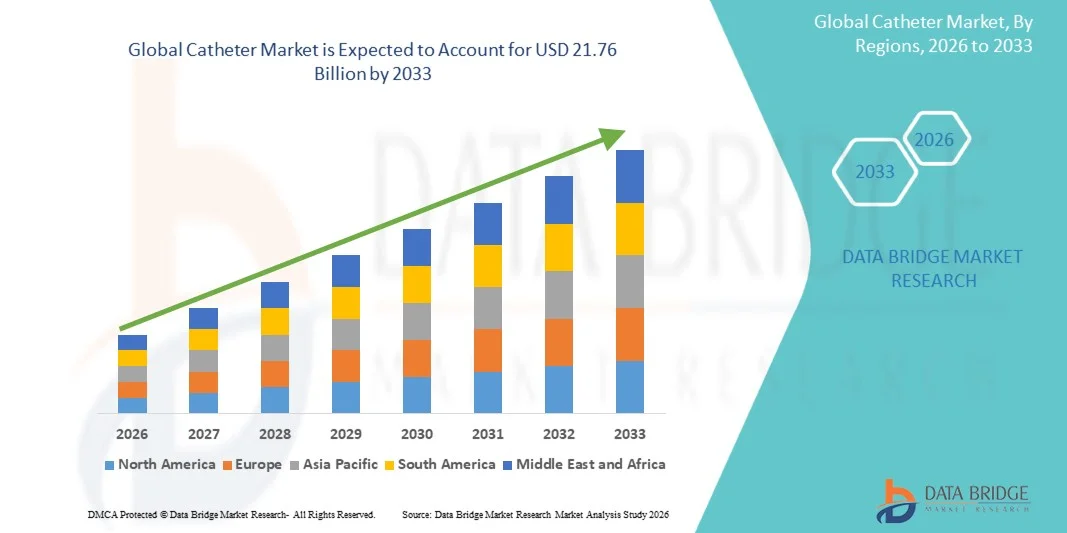
The Catheter Market was valued at USD 12.48 billion in 2025 and is projected to reach USD 21.76 billion by 2033, growing at a CAGR of 7.20% from 2026 to 2033. The market is experiencing steady growth driven by the rising prevalence of cardiovascular, urological, and neurological disorders, increasing demand for minimally invasive procedures, and continuous advancements in catheter design, materials, and coating technologies.
The growing burden of chronic diseases such as heart disease, kidney disorders, and urinary incontinence, along with an aging global population, is significantly increasing the demand for catheter-based diagnostic and therapeutic procedures. In addition, the expansion of hospital infrastructure, rising number of surgical interventions, and growing adoption of advanced, infection-resistant, and sensor-enabled catheters are further accelerating market penetration across hospitals, ambulatory surgical centers, and specialty care settings.
Key Market Trends & Insights
- North America dominated the Catheter Market with the largest revenue share of 38.6% in 2025, supported by advanced healthcare infrastructure, high procedure volumes, and strong adoption of technologically advanced catheter systems.
- The Cardiovascular Catheters segment led the market with a 42.1% share in 2025, driven by the high prevalence of coronary artery disease, increasing number of angioplasty and diagnostic cardiac procedures, and strong adoption of minimally invasive interventional cardiology techniques.
- Asia-Pacific is expected to be the fastest-growing region from 2026 to 2033, with a CAGR of 8.1%, fueled by rising healthcare expenditure, expanding hospital infrastructure, and increasing incidence of chronic diseases in countries such as China and India.
- Neurovascular Catheters are the fastest-growing product type, projected to register a CAGR of 9.2%, reflecting the surge in rising incidence of stroke, aneurysms, and other cerebrovascular disorders.
- The Polyurethane segment dominated the material category with a 36.8% revenue share in 2025, led by its superior biocompatibility, high tensile strength, flexibility, and suitability for long-term and short-term catheterization.
- Cardiovascular Applications accounted for 40.5% of the market, preferred by the rising prevalence of heart diseases, widespread use of angiography and angioplasty procedures, and increasing adoption of minimally invasive cardiac interventions.
- The Neurology Applications segment is the fastest-growing application category, with a CAGR of 9.0%, driven by the increasing incidence of stroke, aneurysms, and neurovascular disorders.
Market Size & Forecast
- Global Market Value (2025): USD 12.48 Billion
- Expected Market Value (2033): USD 21.76 Billion
- Forecast CAGR (2026–2033): 7.20%
- Leading Region in 2025: North America
- Fastest Growing Region: Asia Pacific
Report Scope and Catheter Market Segmentation
|
Attributes |
Catheter Key Market Insights |
|
Segments Covered |
|
|
Countries Covered |
North America · U.S. · Canada · Mexico Europe · Germany · France · U.K. · Netherlands · Switzerland · Belgium · Russia · Italy · Spain · Turkey · Rest of Europe Asia-Pacific · China · Japan · India · South Korea · Singapore · Malaysia · Australia · Thailand · Indonesia · Philippines · Rest of Asia-Pacific Middle East and Africa · Saudi Arabia · U.A.E. · South Africa · Egypt · Israel · Rest of Middle East and Africa South America · Brazil · Argentina · Rest of South America |
|
Key Market Players |
· Medtronic (Ireland) · Boston Scientific Corporation (U.S.) · BD (U.S.) · Teleflex Incorporated (U.S.) · Abbott (U.S.) · Terumo Corporation (Japan) · B. Braun SE (Germany) · Cook (U.S.) · Johnson & Johnson Services, Inc. (U.S.) · Cardinal Health, Inc. (U.S.) · Smiths Medical (U.S.) · Edwards Lifesciences Corporation (U.S.) · Coloplast A/S (Denmark) · Hollister Incorporated (U.S.) · AngioDynamics, Inc. (U.S.) · Merit Medical Systems, Inc. (U.S.) · Integer Holdings Corporation (U.S.) · CONMED Corporation (U.S.) · Lepu Medical Technology Co., Ltd. (China) · Nipro Corporation (Japan) |
|
Market Opportunities |
· Rising adoption of minimally invasive and outpatient procedures · Increasing focus on catheter-associated infection (CAUTI) reduction · Rapid integration of digital health and sensor-enabled catheters |
|
Value Added Data Infosets |
In addition to the insights on market scenarios such as market value, growth rate, segmentation, geographical coverage, and major players, the market reports curated by the Data Bridge Market Research also include in-depth expert analysis, patient epidemiology, pipeline analysis, pricing analysis, and regulatory framework. |
Catheter Market Trends
Trend: Growth in Minimally Invasive and Interventional Procedures
Minimally invasive, catheter-based procedures are increasingly replacing traditional open surgeries across multiple therapeutic areas such as cardiology, neurology, urology, and oncology due to their ability to reduce patient trauma, shorten hospital stays, and improve recovery outcomes. This shift is strongly supported by advancements in imaging technologies, navigation systems, and catheter design, which allow physicians to perform highly precise diagnostic and therapeutic interventions through small vascular or urinary access points. Hospitals and specialty clinics are also expanding interventional departments, further increasing procedure volumes and catheter utilization across acute and chronic care settings. For instance, coronary angiography and neurovascular embolization procedures are now routinely performed using advanced catheter systems in large tertiary care hospitals worldwide.
Catheter Market Dynamics
Key Market Driver: Rising Burden of Chronic and Age-Related Diseases
The growing global burden of chronic diseases such as cardiovascular disorders, chronic kidney disease, diabetes-related complications, and urinary dysfunction is significantly increasing the need for catheter-based diagnosis, monitoring, and treatment procedures. In addition, the rapidly aging population is contributing to higher incidence of conditions requiring long-term catheterization, particularly in urology and critical care management. This trend is further reinforced by the expansion of healthcare infrastructure, increased access to surgical interventions, and growing awareness of early disease diagnosis in both developed and emerging economies. For instance, elderly patients suffering from urinary retention or heart failure often require repeated catheter-based interventions in hospital and home-care settings, driving sustained demand for advanced catheter technologies.
Key Restraint/Challenge: Risk of Catheter-Associated Infections and Complications
Despite technological advancements, catheter-associated infections such as urinary tract infections (CAUTI), bloodstream infections, and local site complications remain a major clinical and economic challenge for healthcare systems globally. Prolonged catheterization, improper handling, and hospital-acquired infections significantly increase patient morbidity, extend hospital stays, and raise treatment costs, making infection control a critical concern for healthcare providers. Even with the introduction of antimicrobial coatings and improved insertion protocols, eliminating infection risks entirely remains difficult, especially in intensive care environments and long-term catheter use cases.
For instance, critically ill patients in intensive care units requiring extended urinary or central venous catheterization are at consistently higher risk of developing secondary infections, necessitating strict monitoring and preventive protocols.
Key Market Opportunity: Advancements in Smart and Infection-Resistant Catheter Technologies
The development of next-generation catheter technologies integrating smart sensors, biocompatible materials, and antimicrobial or anti-biofilm coatings presents a significant growth opportunity in the global market. These innovations are focused on improving patient safety, enabling real-time physiological monitoring, and reducing infection risks associated with long-term catheter use. In addition, the increasing adoption of digital health systems and connected medical devices is accelerating demand for catheters capable of transmitting clinical data such as pressure, flow rate, and blockage detection. For instance, smart central venous catheters with embedded sensors are being developed to continuously monitor hemodynamic status in critically ill patients, supporting early clinical decision-making and improved treatment outcomes.
Catheter Market Scope
The catheter market is segmented on the basis of simulation type, vehicle type, training application, end user.
- By Product Type
On the basis of product type, the Catheter Market is segmented into cardiovascular catheters, urology catheters, intravenous (IV) catheters, neurovascular catheters, dialysis catheters, specialty catheters, and others. The Cardiovascular Catheters segment dominated the market with a 42.1% share in 2025, owing to the high prevalence of coronary artery disease, increasing number of angioplasty and diagnostic cardiac procedures, and strong adoption of minimally invasive interventional cardiology techniques. These catheters are widely used in diagnostic imaging, electrophysiology studies, and interventional procedures, making them essential in modern cardiac care. Continuous advancements in steerability, flexibility, and imaging compatibility are further strengthening their clinical utility. Growing hospital investments in cath labs and hybrid operating rooms are also boosting demand. Increasing aging population and lifestyle-related heart conditions are sustaining long-term market dominance.
The Neurovascular Catheters segment is expected to witness the fastest growth at a CAGR of 9.2% from 2026 to 2033, driven by rising incidence of stroke, aneurysms, and other cerebrovascular disorders. These catheters are increasingly used in minimally invasive brain and spinal interventions where precision and flexibility are critical. Expanding adoption of thrombectomy and embolization procedures is significantly boosting demand. Technological advancements such as ultra-thin microcatheters and improved navigation systems are enhancing procedural success rates. Growing availability of advanced stroke care centers is further supporting segment growth. Increasing awareness of early neurological intervention is also accelerating clinical adoption.
- By Material
On the basis of material, the Catheter Market is segmented into silicone, latex, polyurethane, hydrophilic coated materials, and antimicrobial-coated materials. The Polyurethane segment dominated the market with a 36.8% share in 2025, owing to its superior biocompatibility, high tensile strength, flexibility, and suitability for long-term and short-term catheterization. It is widely used in IV and cardiovascular applications due to its balance between durability and patient comfort. Polyurethane catheters also offer better kink resistance compared to latex, improving procedural reliability. Strong compatibility with coating technologies further enhances its usage in advanced catheter designs. Growing preference for safer and non-allergenic materials is reinforcing its market leadership.
The Antimicrobial-Coated Materials segment is expected to register the fastest growth at a CAGR of 8.7% from 2026 to 2033, driven by increasing focus on reducing catheter-associated infections (CAUTI and CLABSI). These materials are widely used in critical care and long-term catheterization to minimize bacterial colonization and biofilm formation. Rising hospital-acquired infection rates are accelerating adoption of advanced coated devices. Continuous innovation in silver-ion and antibiotic-impregnated coatings is improving clinical effectiveness. Regulatory emphasis on patient safety and infection control is further boosting demand. Increasing adoption in ICU and dialysis settings is significantly supporting growth.
- By Application
On the basis of application, the Catheter Market is segmented into cardiovascular applications, urology applications, neurology applications, gastrointestinal applications, renal care, respiratory & anesthesia, and others. The Cardiovascular Applications segment dominated the market with a 40.5% share in 2025, driven by the rising prevalence of heart diseases, widespread use of angiography and angioplasty procedures, and increasing adoption of minimally invasive cardiac interventions. Catheters are essential in diagnostic and therapeutic cardiovascular procedures, ensuring precise vascular access and treatment delivery. Expanding catheterization laboratory infrastructure is further strengthening demand. Technological advancements in imaging-guided interventions are enhancing procedural accuracy. Growing geriatric population and lifestyle-related risk factors continue to drive sustained utilization.
The Neurology Applications segment is expected to witness the fastest growth at a CAGR of 9.0% from 2026 to 2033, driven by increasing incidence of stroke, aneurysms, and neurovascular disorders. Catheters play a critical role in thrombectomy, embolization, and cerebrospinal fluid management procedures. Rapid expansion of stroke treatment centers and improved emergency response systems are supporting adoption. Advancements in microcatheter technology and neuro-navigation systems are improving treatment outcomes. Rising awareness of early neurological intervention is increasing procedural rates. Growing investment in neurovascular healthcare infrastructure is further accelerating segment growth.
- By End User
On the basis of end user, the Catheter Market is segmented into hospitals, ambulatory surgical centers, specialty clinics, home healthcare, dialysis centers, and long-term care facilities. The Hospitals segment dominated the market with a 54.7% share in 2025, owing to high patient inflow, availability of advanced surgical infrastructure, and widespread use of catheters across emergency, ICU, and surgical departments. Hospitals perform a large volume of cardiovascular, urological, and critical care procedures requiring catheterization. Strong presence of skilled healthcare professionals and advanced infection control systems further supports dominance. Continuous expansion of hospital networks in emerging economies is strengthening demand. High dependency on catheter-based interventions in acute care settings ensures sustained leadership.
The Home Healthcare segment is expected to witness the fastest growth at a CAGR of 8.4% from 2026 to 2033, driven by increasing preference for long-term care outside hospital settings and rising aging population. Patients requiring chronic urological or renal care are increasingly managed at home using intermittent and indwelling catheters. Technological improvements in user-friendly catheter systems are supporting self-care adoption. Growing healthcare cost pressures are encouraging home-based treatment models. Expansion of home nursing services and remote patient monitoring is further boosting uptake. Increasing awareness of patient comfort and quality of life is accelerating this shift.
Catheter Market Regional Analysis
North America dominated the Catheter Market with the largest revenue share of 38.6% in 2025, supported by advanced healthcare infrastructure, high procedure volumes, and strong adoption of technologically advanced catheter systems. The region also benefits from a high prevalence of cardiovascular and urological diseases, well-established hospital networks, and widespread availability of technologically advanced catheter systems. Increasing hospital admissions, strong reimbursement frameworks, and rapid adoption of antimicrobial and sensor-based catheters continue to strengthen North America’s leadership position in the global market.
U.S. Catheter Market Insight
The U.S. catheter market is experiencing robust expansion driven by a high prevalence of chronic diseases, strong healthcare infrastructure, and early adoption of advanced medical technologies. The country has a well-established interventional cardiology and urology ecosystem, with high procedure volumes supporting continuous catheter demand. Increasing investments in smart healthcare solutions, including sensor-based and AI-integrated catheter systems, are further strengthening market growth. In addition, favorable reimbursement policies, strong presence of leading medical device manufacturers, and rapid expansion of outpatient and ambulatory surgical care are significantly boosting adoption across multiple therapeutic areas.
Europe Catheter Market Insight
The Europe catheter market continues to grow steadily, supported by universal healthcare systems, strong regulatory frameworks, and increasing focus on infection prevention and patient safety standards. The region’s rapidly aging population is a major demand driver, particularly for long-term urological and cardiovascular catheterization. Hospitals across Europe are increasingly adopting advanced coated and single-use catheter systems to reduce infection risks and improve procedural efficiency. Furthermore, strong investments in minimally invasive surgery and interventional radiology are expanding catheter usage across both diagnostic and therapeutic applications.
U.K. Catheter Market Insight
The U.K. catheter market is expanding steadily due to increasing hospital admissions, rising geriatric population, and strong reliance on NHS-driven healthcare services. Growing awareness regarding catheter-associated infections is driving demand for antimicrobial and hydrophilic-coated catheter solutions. In addition, the shift toward outpatient care and home-based treatment for chronic conditions is increasing usage of intermittent and long-term catheter systems. Continuous modernization of healthcare infrastructure and adoption of minimally invasive techniques are further supporting sustained market growth across the country.
Germany Catheter Market Insight
The Germany catheter market is witnessing stable growth supported by its advanced medical technology ecosystem, high healthcare spending, and strong emphasis on innovation and precision medicine. German hospitals and specialty centers are increasingly integrating advanced catheter systems in cardiovascular, neurological, and urological procedures. Strong regulatory standards for patient safety and infection control are encouraging the use of high-quality, biocompatible, and antimicrobial-coated catheters. In addition, ongoing research in smart catheter technologies and minimally invasive intervention systems is further strengthening the country’s market position.
Asia-Pacific Catheter Market Insight
The Asia-Pacific catheter market is projected to grow at a rapid pace due to increasing healthcare infrastructure development, rising medical tourism, and growing prevalence of lifestyle-related chronic diseases. Countries such as China, India, and Japan are witnessing strong expansion in hospital capacity and interventional care facilities. Increasing affordability of medical devices and rising adoption of minimally invasive procedures are further boosting catheter demand. In addition, government initiatives to improve access to quality healthcare and strengthen domestic medical device manufacturing are accelerating regional market expansion.
Japan Catheter Market Insight
The Japan catheter market is growing steadily due to its rapidly aging population, high healthcare standards, and strong focus on advanced medical technologies. The country has a high demand for long-term catheterization in elderly care, particularly in urology and home healthcare settings. Japanese healthcare providers are increasingly adopting high-precision, biocompatible, and infection-resistant catheter systems to improve patient outcomes. In addition, continuous innovation in minimally invasive procedures and integration of digital monitoring technologies are further enhancing clinical efficiency and market adoption.
China Catheter Market Insight
The China catheter market is expanding rapidly due to large patient population, rising burden of chronic diseases, and strong government investments in healthcare modernization. The country is witnessing significant growth in hospital infrastructure and interventional procedures, particularly in cardiovascular and renal care segments. Increasing adoption of advanced catheter technologies, combined with rapid growth of domestic medical device manufacturers, is improving product availability and affordability. Furthermore, rising awareness of minimally invasive treatment options and expanding insurance coverage are significantly accelerating market penetration across urban and semi-urban regions.
Catheter Market Share
The catheter industry is primarily led by well-established companies, including:
- Medtronic (Ireland)
- Boston Scientific Corporation (U.S.)
- BD (U.S.)
- Teleflex Incorporated (U.S.)
- Abbott (U.S.)
- Terumo Corporation (Japan)
- Braun SE (Germany)
- Cook (U.S.)
- Johnson & Johnson Services, Inc. (U.S.)
- Cardinal Health, Inc. (U.S.)
- Smiths Medical (U.S.)
- Edwards Lifesciences Corporation (U.S.)
- Coloplast A/S (Denmark)
- Hollister Incorporated (U.S.)
- AngioDynamics, Inc. (U.S.)
- Merit Medical Systems, Inc. (U.S.)
- Integer Holdings Corporation (U.S.)
- CONMED Corporation (U.S.)
- Lepu Medical Technology Co., Ltd. (China)
- Nipro Corporation (Japan)
Latest Developments in Catheter Market
- In December 2024, the FDA classified a recall of Boston Scientific’s POLARx cryoablation balloon catheter system as “most serious” following reports of severe complications, including esophageal injuries, reinforcing the need for enhanced post-market surveillance and safety monitoring in electrophysiology catheter technologies
- In October 2024, Boston Scientific received FDA clearance for an advanced ablation catheter system integrated with enhanced navigation and imaging software, improving procedural accuracy in atrial fibrillation treatment and supporting the growing shift toward AI-assisted and image-guided catheter-based cardiac interventions
- In June 2024, the U.S. FDA issued a Class I recall for Teleflex intra-aortic balloon catheter systems due to a manufacturing defect that could cause balloon twisting and device malfunction, raising serious safety concerns and highlighting the importance of strict quality control in catheter-based cardiac support devices
- In March 2024, Boston Scientific received FDA approval for its AGENT™ drug-coated balloon catheter used in the treatment of coronary in-stent restenosis, enabling targeted delivery of paclitaxel to prevent vessel re-narrowing after stent placement and expanding minimally invasive options in interventional cardiology
- In January 2024, Boston Scientific secured FDA approval for its FARAPULSE™ pulsed field ablation system, a next-generation cardiac catheter technology that uses non-thermal energy to treat atrial fibrillation with improved safety and reduced tissue damage compared to traditional ablation techniques

- Interactive Data Analysis Dashboard
- Company Analysis Dashboard for high growth potential opportunities
- Research Analyst Access for customization & queries
- Competitor Analysis with Interactive dashboard
- Latest News, Updates & Trend analysis
- Harness the Power of Benchmark Analysis for Comprehensive Competitor Tracking
Data collection and base year analysis are done using data collection modules with large sample sizes. The stage includes obtaining market information or related data through various sources and strategies. It includes examining and planning all the data acquired from the past in advance. It likewise envelops the examination of information inconsistencies seen across different information sources. The market data is analysed and estimated using market statistical and coherent models. Also, market share analysis and key trend analysis are the major success factors in the market report. To know more, please request an analyst call or drop down your inquiry.
The key research methodology used by DBMR research team is data triangulation which involves data mining, analysis of the impact of data variables on the market and primary (industry expert) validation. Data models include Vendor Positioning Grid, Market Time Line Analysis, Market Overview and Guide, Company Positioning Grid, Patent Analysis, Pricing Analysis, Company Market Share Analysis, Standards of Measurement, Global versus Regional and Vendor Share Analysis. To know more about the research methodology, drop in an inquiry to speak to our industry experts.
Data Bridge Market Research is a leader in advanced formative research. We take pride in servicing our existing and new customers with data and analysis that match and suits their goal. The report can be customized to include price trend analysis of target brands understanding the market for additional countries (ask for the list of countries), clinical trial results data, literature review, refurbished market and product base analysis. Market analysis of target competitors can be analyzed from technology-based analysis to market portfolio strategies. We can add as many competitors that you require data about in the format and data style you are looking for. Our team of analysts can also provide you data in crude raw excel files pivot tables (Fact book) or can assist you in creating presentations from the data sets available in the report.













