What is the Cationic Starch Market Size and Growth Rate?
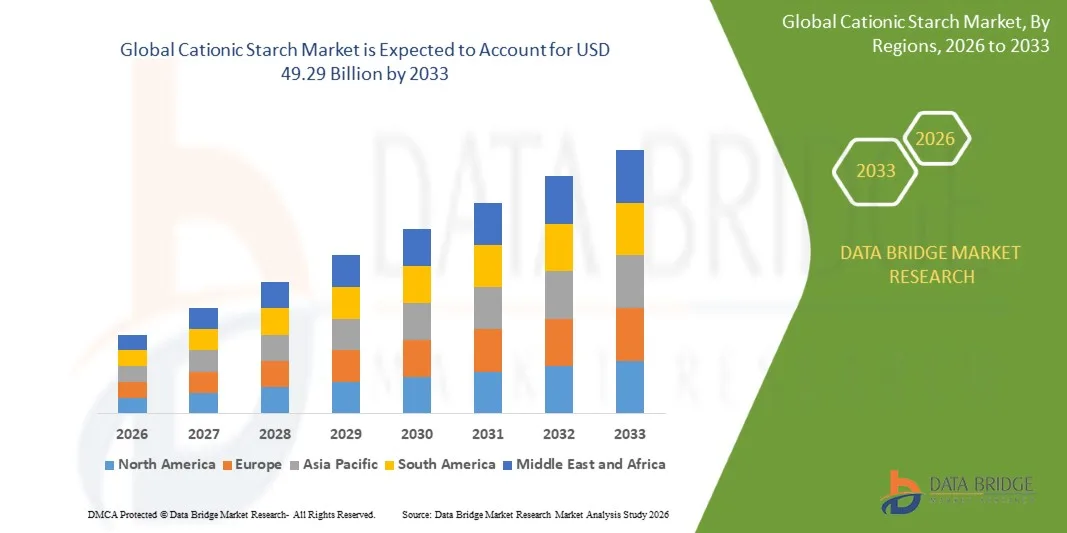
- As per Data Bridge Market Research analysis, the cationic starch market was valued at USD 29.56 billion in 2025 and is projected to reach USD 49.29 billion by 2033, growing at a CAGR of 6.60% from 2026 to 2033.
- The market is experiencing consistent growth driven by rising demand for recyclable paper and packaging, increasing use of bio-based additives, and expanding applications across textiles, water treatment, and food and industrial formulations.
- The increasing shift toward paper-based packaging, renewable raw materials, and cleaner production processes, combined with growing demand for retention, strength, and sizing aids in paper mills, is supporting market adoption. Cationic starch is being applied across paper and board, textiles, wastewater clarification, and selected food-related processes, offering manufacturers greater performance from cationic starch, modified starch, and bio-based paper additives derived from corn, tapioca, and potato.
Market Size & Forecast
- Global Market Value (2025): USD 29.56 Billion
- Expected Market Value (2033): USD 49.29 Billion
- Forecast CAGR (2026–2033): 6.60%
- Leading Region in 2025: Asia-Pacific
- Fastest Growing Region: Asia-Pacific
What are the Major Takeaways of the Cationic Starch Market?
- Asia-Pacific dominated the cationic starch market with the largest revenue share of 42.30% in 2025, supported by large paper and packaging production in China and India, abundant starch crops, and expanding industrial output.
- Asia-Pacific is also expected to be the fastest-growing region at a CAGR of 7.80% from 2026 to 2033, fueled by growing e-commerce packaging, rising paper board capacity, and increasing demand for sustainable additives.
- The corn segment led the market with a 52.40% share in 2025, driven by its large supply, established processing infrastructure, and competitive cost.
- Tapioca is the fastest-growing source, projected to register a CAGR of 7.60%, reflecting rising demand for non-GMO, clean-label, and cost-effective starch in Asia.
- The conventional segment dominated the nature category with an 87.60% revenue share in 2025, led by lower cost and wide use in paper and industrial applications.
- Paper & packaging accounted for 63.80% of the market share in 2025, preferred for improving dry strength, retention, drainage, and sizing performance.
- The food & beverage segment is the fastest-growing application, with a CAGR of 8.30%, driven by clean-label processing aids, food-contact packaging, and specialty uses.
Report Scope and Cationic Starch Market Segmentation
|
Attributes |
Cationic Starch Key Market Insights |
|
Segments Covered |
|
|
Countries Covered |
North America
Europe
Asia-Pacific
Middle East and Africa
South America
|
|
Key Market Players |
|
|
Market Opportunities |
|
|
Value Added Data Infosets |
In addition to the insights on market scenarios such as market value, growth rate, segmentation, geographical coverage, and major players, the market reports curated by the Data Bridge Market Research also include in-depth expert analysis, pricing analysis, brand share analysis, consumer survey, demography analysis, supply chain analysis, value chain analysis, raw material/consumables overview, vendor selection criteria, PESTLE Analysis, Porter Analysis, and regulatory framework. |
What is the Key Trend in the Cationic Starch Market?
- Cationic starch is increasingly evolving from a basic paper-mill additive into a tailored, bio-based performance ingredient, combining improved substitution control, lower environmental impact, and compatibility with recycled fiber.
- For instance, in September 2026, Roquette promoted its STABILYS® BA 25 modified-starch solution for grease-resistant paper and board packaging, offering an alternative to fluorinated chemicals and supporting sustainable packaging development.
- Industry consolidation is accelerating, as large ingredient companies combine starch, texture, and specialty portfolios to broaden formulation capabilities and improve scale and supply security.
- Suppliers are increasingly developing grades for recycled paper and high-speed machines, as mills compare additives on retention, dry strength, charge density, cost in use, and ease of cooking or dispersion.
- For instance, in February 2025, Ingredion announced a US$50 million investment to modernize and expand its Cedar Rapids, Iowa, facility, increasing industrial starch production capacity for the packaging and papermaking industries.
- As paper recycling, packaging regulation, bio-based chemistry, and industry consolidation continue to advance, cationic starch is expected to expand beyond traditional paper sizing into water treatment, food-contact packaging, and specialty industrial uses.
What are the Key Drivers of the Cationic Starch Market?
- The rapid growth of e-commerce packaging and the shift from plastics to paper and board have significantly increased demand for starch-based additives that raise strength and improve machine efficiency.
- For instance, in August 2026, according to the European Commission, the EU Packaging and Packaging Waste Regulation started to apply on 12 August 2026, setting recyclability and chemical safety requirements that favor fiber-based packaging and bio-based additives, supporting demand for paper-based packaging and its supporting chemistries.
- Paper and board mills, textile processors, water treatment operators, and specialty manufacturers are adopting cationic starch to improve retention of fines and fillers, reduce chemical use, and lower overall production costs.
- For instance, in April 2026, Roquette inaugurated a new starch and polyol pilot center in Lianyungang, China, to strengthen research, product testing, and industrial-scale development capabilities for starch-based ingredients.
- With governments pushing recyclable packaging and mills seeking bio-based chemistry, cationic starch can gain wider visibility, qualification, and repeat orders across paper, textile, and water treatment applications.
What Factors are Challenging the Growth of the Cationic Starch Market?
- Cationic starch depends on agricultural raw materials and energy-intensive processing, which exposes manufacturers to crop price swings, weather risks, and production disruptions.
- For instance, in August 2026, according to Ingredion, second-quarter operating income in its Food & Industrial Ingredients—U.S./Canada segment fell to USD 58 million, a USD 28 million decline, reflecting lower production at its Argo facility, softer volumes, and weaker price mix, which also affected volumes available for industrial customers.
- These supply and cost pressures can squeeze margins and delay deliveries, while competition from synthetic polymers, polyacrylamides, and other retention aids may limit pricing power in some paper applications.
- Environmental concerns about chemical modification, regulation of reagents, and variations in starch quality between harvests further restrict growth, requiring producers to invest in cleaner processes, quality control, and application support that may increase operating costs.
- For instance, in August 2026, according to Ingredion, foreign-exchange pressures and a more challenging demand environment in Mexico contributed to a 7% decline in Food & Industrial Ingredients—LATAM operating income to USD 118 million, illustrating regional demand and currency risks for starch suppliers, with weaker volumes and currency effects.
- The combination of raw material volatility, plant disruptions, competition from synthetic additives, and regulatory scrutiny of chemical modification can constrain growth among cost-sensitive buyers and smaller producers.
How is the Cationic Starch Market Segmented?
The cationic starch market is segmented on the basis of source, nature, application, and form.
- By Source
On the basis of source, the cationic starch market is segmented into corn, tapioca, potato, and wheat & others. The corn segment dominated the market with 52.40% share in 2025, supported by large supply, established processing infrastructure, and competitive cost. Corn starch is available in major producing regions and can be modified to give a wide range of charge levels. It is widely used in paper mills, textile plants, and industrial processes. Integrated wet-milling operations by major starch producers also secure consistent quality. Strong customer relationships and long supply history continue to reinforce the segment’s leadership. Producers also offer grades with different degrees of substitution to match fiber type and machine speed.
The tapioca segment is projected to register the fastest growth at a CAGR of 7.60% from 2026 to 2033, driven by rising demand for non-GMO, clean-label, and cost-effective starch in Asia. Tapioca starch has high purity, neutral taste, and good cooking properties. Producers in Thailand, Vietnam, and Indonesia are expanding capacity and export volumes. Papermakers and food processors are testing tapioca-based products for specific performance benefits. Cassava yield and price volatility remain important considerations for long-term growth. Producers are also developing new tapioca-based cationic grades that perform well with recycled fibers.
- By Nature
On the basis of nature, the cationic starch market is segmented into conventional and organic. The conventional segment dominated the market with 87.60% share in 2025, supported by lower cost, wide availability, and established use in paper and industrial applications. Conventional starch can be produced at large scale with consistent quality. Most mills specify performance and price rather than certification. Long-term contracts and standardized grades help buyers manage supply. Continuous process improvements further strengthen the segment’s leadership. Quality consistency and low impurity levels also make conventional grades dependable for continuous production.
The organic segment is projected to register the fastest growth at a CAGR of 8.40% from 2026 to 2033, driven by rising demand for certified, clean-label, and sustainably sourced ingredients. Organic and non-GMO starch is used in food-contact papers, eco-labeled packaging, and natural personal care products. Brands seek lower-impact supply chains and traceable raw materials. Premium pricing is supported by sustainability claims. Limited raw material supply and certification costs remain important considerations. Producers are also working with organic farmers and certified processors to secure traceable supply.
- By Application
On the basis of application, the cationic starch market is segmented into paper & packaging, textile, food & beverage, water & wastewater treatment, and others. The paper & packaging segment dominated the application category with 63.80% share in 2025, supported by its role in improving dry strength, retention, drainage, and sizing performance. Cationic starch binds negatively charged fibers and fillers, which reduces losses and chemical consumption. Growth in corrugated, containerboard, and tissue production increases demand. Established use by large mills continues to reinforce this segment's leadership. Growing use of recycled fiber also increases the need for additives that improve strength and drainage.
The food & beverage segment is projected to register the fastest growth at a CAGR of 8.30% from 2026 to 2033, driven by clean-label processing aids, food-contact packaging, and specialty uses. Cationic and modified starches are used in selected clarification and stabilization processes. Food-grade paper and board packaging requires safe, bio-based additives. Rising consumer interest in natural ingredients supports adoption. Regulatory approvals and strict quality standards remain key considerations. Producers are also developing food-compliant grades with documented safety and traceability to meet customer requirements.
- By Form
On the basis of form, the cationic starch market is segmented into dry powder and liquid. The dry powder segment dominated the market with 71.20% share in 2025, supported by easy storage, long shelf life, and lower transport costs. Mills prepare cooked starch solutions on site using standard equipment. Powders suit large-volume users and long-distance shipping. Established supply chains and familiar handling practices continue to reinforce this segment's leadership. Suppliers also provide technical support for cooking systems, dosing, and quality control at mills.
The liquid segment is projected to register the fastest growth at a CAGR of 7.90% from 2026 to 2033, driven by demand for ready-to-use, easy-to-dose products that reduce cooking time and energy use. Liquid cationic starch simplifies handling and improves consistency. Suppliers are developing stabilized slurries and pre-cooked solutions. Smaller mills value convenience and lower labor needs. Higher transport costs and shelf life remain important considerations. Producers also see liquid forms as helpful for mills that want fewer on-site handling steps and less dust.
Which Region Holds the Largest Share of the Cationic Starch Market?
- Asia-Pacific dominated the cationic starch market with the largest revenue share of 42.30% in 2025, supported by large paper and packaging production in China and India, abundant starch crops, and expanding industrial output.
- The region also benefits from large paper and board manufacturing capacity, strong textile and chemical industries, and a competitive base of local starch producers. Increasing e-commerce and consumption of packaged goods continue to strengthen Asia-Pacific’s position in the global market. Strong investment in packaging production and exports also supports regional demand.
Japan Cationic Starch Market Insight
The Japan cationic starch market is witnessing consistent growth due to a mature paper industry, high quality expectations, and strong domestic starch producers. Paper mills and specialty chemical firms are increasingly adopting customized starch additives. Moreover, strong demand for efficient, stable, and environmentally friendly products is further contributing to market growth in Japan. Close cooperation between suppliers and paper makers also helps improve product performance.
China Cationic Starch Market Insight
The China cationic starch market is growing rapidly, driven by the world’s largest paper and packaging industry, abundant corn and cassava supply, and strong chemical manufacturing. Growing production of containerboard and tissue is significantly boosting market demand. In addition, domestic producers, environmental rules favoring recycling, and large investments in paper capacity are positioning China as a key growth market across Asia-Pacific. Growing recycled paper imports and domestic collection also increase use of strength additives.
Europe Cationic Starch Market Insight
The Europe Cationic Starch Market is experiencing steady growth, driven by rising demand from paper and packaging industries. Cationic starch improves paper strength, retention, drainage, and printability, making it essential for efficient manufacturing. Sustainability initiatives, increased recycled fiber utilization, and the shift toward recyclable packaging further support market expansion. Germany, France, Italy, and Nordic countries represent key markets. However, fluctuating raw material prices, energy costs, and competition from synthetic additives may challenge profitability and growth prospects.
U.K. Cationic Starch Market Insight
The U.K. cationic starch market is experiencing steady growth, supported by a recycled paper and packaging sector, strong sustainability targets, and demand for bio-based chemicals. Paper mills and packaging firms are increasingly adopting starch additives that support recycled fiber use. Furthermore, plastic packaging taxes, extended producer responsibility, and innovation in ingredients are supporting wider adoption of cationic starch in the U.K. Growing interest in circular packaging also helps suppliers position bio-based additives.
Germany Cationic Starch Market Insight
The Germany cationic starch market is expanding steadily due to the country’s strong paper and chemical industries, leading starch producers, and high environmental standards. Mills, textile finishers, and water utilities are increasingly utilizing cationic starch products. Continuous innovation in modification processes, strong circular economy policies, and Germany’s focus on efficiency and quality are further driving market growth in the country. Strong collaboration between research institutes and companies also helps move new products into production.
Which are the Top Companies in Cationic Starch Market?
The cationic starch industry is primarily led by well-established companies, including:
- Ingredion Incorporated (U.S.)
- Cargill, Incorporated (U.S.)
- Archer Daniels Midland Company (U.S.)
- Roquette Frères S.A. (France)
- AGRANA Beteiligungs-AG (Austria)
- Tate & Lyle PLC (U.K.)
- Avebe U.A. (Netherlands)
- Emsland Group (Germany)
- Tereos S.A. (France)
- Western Polymer Corporation (U.S.)
- Galam Ltd. (Israel)
- Santosh Starch Products Limited (India)
- SPAC Starch Products (India) Ltd. (India)
- Sunar Mısır Entegre Tesisleri A.Ş. (Turkey)
- Ruzhou Yintai Starch Co., Ltd. (China)
- KMC Ingredients (Denmark)
- Kemira Oyj (Finland)
- BASF SE (Germany)
- COFCO Corporation (China)
- Nihon Shokuhin Kako Co., Ltd. (Japan)
What are Latest Developments in Cationic Starch Market?
- In October 2026, UPM, Ingredion, and Paramelt announced a collaboration to develop starch-based barrier technologies for recyclable paper food packaging, targeting improved grease resistance and sustainable packaging performance.
- In September 2026, Roquette promoted its STABILYS® BA 25 modified-starch solution for grease-resistant paper and board packaging, offering an alternative to fluorinated chemicals and supporting sustainable packaging development.
- In July 2026, Ingredion announced that Tate & Lyle shareholders had accepted its recommended all-cash offer of 595 pence per share, with closing expected in the second half of 2027, subject to regulatory approvals. The transaction is intended to create a global ingredient solutions leader with stronger innovation and formulation capabilities. The deal also reflects continued consolidation in starch and texture ingredients.
- In April 2026, Roquette inaugurated a new starch and polyol pilot center in Lianyungang, China, to strengthen research, product testing, and industrial-scale development capabilities for starch-based ingredients.
- In August 2026, Ingredion reported second-quarter net sales of USD 1.85 billion, with Texture & Healthful Solutions volume up 7% and the Argo facility returning to normal production rates. The company reaffirmed its full-year outlook and highlighted bio-based adhesive solutions for corrugated packaging manufacturers. The results show continued strength in specialty ingredients alongside operational recovery in industrial starch.
- In August 2026, the EU Packaging and Packaging Waste Regulation started to apply across member states, setting recyclability, chemical safety, and labeling requirements. The rules are expected to support fiber-based packaging and bio-based additives such as starch derivatives. The start of the rules marks a key milestone for packaging suppliers and users.
- In February 2025, the EU Packaging and Packaging Waste Regulation, Regulation (EU) 2025/40, entered into force, replacing the earlier packaging directive with directly applicable rules. The regulation encourages recyclable packaging and recycled content, increasing interest in paper-based solutions and their supporting chemistries. The law also sets a timeline for companies to adjust products and supply chains.
- In October 2023, Ingredion was reported to have launched a new line of sustainable cationic starches aimed at clean-label applications. The launch reflects supplier efforts to broaden the use of cationic starch beyond paper into food-related and consumer applications. The launch was described in market intelligence coverage and should be checked against company announcements.
- Interactive Data Analysis Dashboard
- Company Analysis Dashboard for high growth potential opportunities
- Research Analyst Access for customization & queries
- Competitor Analysis with Interactive dashboard
- Latest News, Updates & Trend analysis
- Harness the Power of Benchmark Analysis for Comprehensive Competitor Tracking
Global Cationic Starch Market, Supply Chain Analysis and Ecosystem Framework
To support market growth and help clients navigate the impact of geopolitical shifts, DBMR has integrated in-depth supply chain analysis into its Global Cationic Starch Market research reports. This addition empowers clients to respond effectively to global changes affecting their industries. The supply chain analysis section includes detailed insights such as Global Cationic Starch Market consumption and production by country, price trend analysis, the impact of tariffs and geopolitical developments, and import and export trends by country and HSN code. It also highlights major suppliers with data on production capacity and company profiles, as well as key importers and exporters. In addition to research, DBMR offers specialized supply chain consulting services backed by over a decade of experience, providing solutions like supplier discovery, supplier risk assessment, price trend analysis, impact evaluation of inflation and trade route changes, and comprehensive market trend analysis.
Data collection and base year analysis are done using data collection modules with large sample sizes. The stage includes obtaining market information or related data through various sources and strategies. It includes examining and planning all the data acquired from the past in advance. It likewise envelops the examination of information inconsistencies seen across different information sources. The market data is analysed and estimated using market statistical and coherent models. Also, market share analysis and key trend analysis are the major success factors in the market report. To know more, please request an analyst call or drop down your inquiry.
The key research methodology used by DBMR research team is data triangulation which involves data mining, analysis of the impact of data variables on the market and primary (industry expert) validation. Data models include Vendor Positioning Grid, Market Time Line Analysis, Market Overview and Guide, Company Positioning Grid, Patent Analysis, Pricing Analysis, Company Market Share Analysis, Standards of Measurement, Global versus Regional and Vendor Share Analysis. To know more about the research methodology, drop in an inquiry to speak to our industry experts.
Data Bridge Market Research is a leader in advanced formative research. We take pride in servicing our existing and new customers with data and analysis that match and suits their goal. The report can be customized to include price trend analysis of target brands understanding the market for additional countries (ask for the list of countries), clinical trial results data, literature review, refurbished market and product base analysis. Market analysis of target competitors can be analyzed from technology-based analysis to market portfolio strategies. We can add as many competitors that you require data about in the format and data style you are looking for. Our team of analysts can also provide you data in crude raw excel files pivot tables (Fact book) or can assist you in creating presentations from the data sets available in the report.