


Cannabidiol (CBD) Infused Edible Market Overview
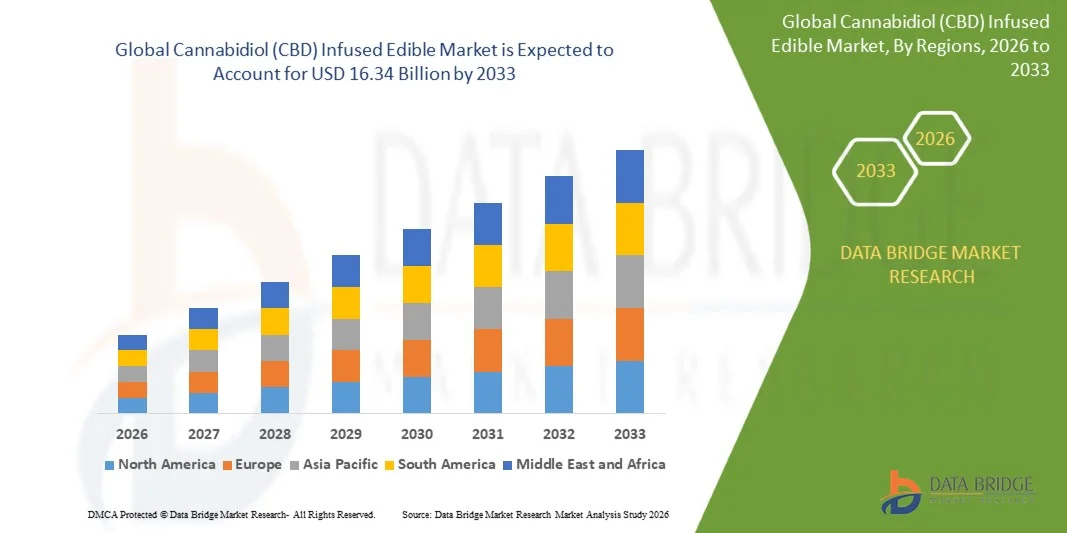
The Cannabidiol (CBD) Infused Edible Market was valued at USD 9.42 billion in 2025 and is projected to reach USD 16.34 billion by 2033, growing at a CAGR of 7.15% from 2026 to 2033. Market growth is supported by increasing consumer acceptance of CBD products, expanding legalization across multiple jurisdictions, rising demand for natural wellness alternatives, and heightened focus on functional food and beverage innovation in consumer markets.
The growing awareness of potential therapeutic benefits associated with cannabidiol, including anxiety relief, pain management, and sleep improvement, is driving demand for CBD-infused edibles across diverse consumer demographics. Technological advancements in CBD extraction and formulation, including nanoemulsion technology, improved bioavailability, and precise dosing capabilities, are enhancing product efficacy and consumer confidence across food and beverage categories. In addition, regulatory developments and quality standardization requirements are prompting manufacturers to invest in third-party testing, compliance frameworks, and transparent labeling practices.
Rising disposable incomes in North America, Europe, and Asia-Pacific are creating new opportunities for market expansion, as consumers seek premium wellness products and innovative edible formats. The shift toward plant-based and organic product preferences and the expansion of e-commerce distribution channels are further diversifying demand across product categories and end-use segments.
Key Market Trends & Insights
- North America dominated the Cannabidiol (CBD) Infused Edible Market with the largest revenue share of 42.8% in 2025, supported by progressive regulatory frameworks, high consumer awareness, established distribution networks, and the presence of leading CBD edible manufacturers.
- Europe is expected to be the fastest-growing region at a CAGR of 8.4% from 2026 to 2033, driven by evolving regulatory clarity, increasing consumer acceptance of CBD products, and expanding retail availability across Western European markets.
- The Hemp segment led the source category with a 68.5% market share in 2025, reflecting regulatory favorability, lower THC content requirements, and broader consumer acceptance of hemp-derived CBD products.
- The Organic segment is anticipated to be the fastest-growing type category, driven by increasing consumer preference for clean-label, pesticide-free, and sustainably sourced CBD ingredients.
- The Chocolates and Bars segment dominated the application category with a 31.2% market share in 2025, supported by consumer preference for familiar delivery formats, ease of dosing, and premium product positioning.
- The Offline Mode segment dominated the distribution channel category with a 56.3% market share in 2025, driven by specialty retail presence, consumer preference for in-store product evaluation, and regulatory requirements for age verification.
- The Online Mode segment is expected to witness the highest CAGR of 9.2% during the forecast period, driven by expanding e-commerce platforms, direct-to-consumer business models, and increased digital marketing capabilities.
Market Size & Forecast
- Global Market Value (2025): USD 9.42 Billion
- Expected Market Value (2033): USD 16.34 Billion
- Forecast CAGR (2026–2033): 7.15%
- Leading Region in 2025: North America
- Fastest Growing Region: Europe
Report Scope and Cannabidiol (CBD) Infused Edible Market Segmentation
|
Attributes |
Cannabidiol (CBD) Infused Edible Key Market Insights |
|
Segments Covered |
|
|
Countries Covered |
North America · U.S. · Canada · Mexico Europe · Germany · France · U.K. · Netherlands · Switzerland · Belgium · Russia · Italy · Spain · Turkey · Rest of Europe Asia-Pacific · China · Japan · India · South Korea · Singapore · Malaysia · Australia · Thailand · Indonesia · Philippines · Rest of Asia-Pacific Middle East and Africa · Saudi Arabia · U.A.E. · South Africa · Egypt · Israel · Rest of Middle East and Africa South America · Brazil · Argentina · Rest of South America |
|
Key Market Players |
· Canopy Growth Corporation (Canada) · Tilray Brands Inc. (U.S.) · Aurora Cannabis Inc. (Canada) · Charlotte's Web Holdings Inc. (U.S.) · CV Sciences Inc. (U.S.) · Elixinol Global Limited (Australia) · Green Roads (U.S.) · Medterra CBD (U.S.) · cbdMD Inc. (U.S.) · Kiva Confections (U.S.) · Plus Products Inc. (U.S.) · Dixie Brands Inc. (U.S.) |
|
Market Opportunities |
· Expansion of regulatory frameworks enabling CBD edible sales in emerging markets with growing health-conscious consumer populations · Development of innovative delivery formats, enhanced bioavailability formulations, and functional ingredient combinations enabling adoption across mainstream food and beverage categories |
|
Value Added Data Infosets |
In addition to the insights on market scenarios such as market value, growth rate, segmentation, geographical coverage, and major players, the market reports curated by the Data Bridge Market Research also include depth expert analysis, patient epidemiology, pipeline analysis, pricing analysis, and regulatory framework. |
Cannabidiol (CBD) Infused Edible Market Trends
Trend: Product Innovation and Enhanced Bioavailability Technologies
CBD edible manufacturers are increasingly investing in advanced formulation technologies to improve product bioavailability, onset time, and consumer experience. Nanoemulsion technology, water-soluble CBD formulations, and microencapsulation techniques are enabling faster absorption rates and more predictable dosing compared to traditional CBD edible formats. The heightened consumer demand for efficacy and consistency has accelerated adoption of these technologies across chocolates, beverages, and gummy product lines.
For instance,
Canopy Growth Corporation's brand, Quatreau, utilizes nanoemulsion technology to deliver water-soluble CBD in sparkling water formats, providing faster onset effects and improved bioavailability compared to oil-based CBD products, addressing consumer expectations for predictable and rapid product effects.
In addition, CBD edible manufacturers are increasingly incorporating functional ingredients such as adaptogens, vitamins, and botanical extracts to create differentiated wellness-focused product offerings. These product innovations are expected to drive continued market expansion and category premiumization through the forecast period, supporting mainstream consumer adoption and retail penetration.
Cannabidiol (CBD) Infused Edible Market Dynamics
Key Market Driver: Increasing Consumer Demand for Natural Wellness Alternatives
The growing consumer preference for natural, plant-based wellness solutions is a primary driver of CBD infused edible market growth. Consumers seeking alternatives to pharmaceutical products for stress management, sleep support, and pain relief are increasingly turning to CBD-infused edibles as convenient and discreet consumption options. The expansion of wellness culture and heightened awareness of holistic health approaches are supporting mainstream consumer adoption of CBD products.
For instance,
According to the Brightfield Group's 2024 Consumer Insights Report, approximately 64% of CBD consumers in North America reported using CBD products for stress and anxiety management, with edible formats representing the preferred consumption method among first-time CBD users due to familiarity and ease of use.
As consumer awareness of CBD's potential benefits continues to grow and stigma diminishes, demand for CBD-infused edibles across diverse demographic segments is expected to increase correspondingly. Rising consumer interest in functional foods and natural wellness alternatives is expected to sustain strong market demand throughout the forecast period, driving innovation and category expansion.
Key Restraint/Challenge: Regulatory Uncertainty and Compliance Complexity
The fragmented and evolving regulatory landscape governing CBD products presents a significant barrier to market growth, particularly for manufacturers seeking to expand across multiple jurisdictions. Inconsistent regulations regarding permissible THC levels, labeling requirements, health claims, and product classifications create compliance complexity and market entry barriers. Regulatory uncertainty can delay product launches, limit distribution channels, and increase operational costs for CBD edible manufacturers.
For instance,
The U.S. Food and Drug Administration (FDA) has not established a comprehensive regulatory framework for CBD in food and beverages, creating uncertainty for manufacturers regarding product legality, permissible marketing claims, and interstate commerce considerations, while individual state regulations vary significantly.
Regulatory inconsistency and compliance complexity may constrain market growth, particularly among risk-averse mainstream food and beverage companies considering CBD product category entry.
Key Market Opportunity: Expansion of E-Commerce and Direct-to-Consumer Channels
The rapid expansion of e-commerce platforms and direct-to-consumer (DTC) business models is creating significant growth opportunities for CBD edible manufacturers to reach consumers beyond traditional retail limitations. Online channels enable brands to educate consumers, build direct relationships, and bypass regulatory constraints that may limit brick-and-mortar retail availability in certain jurisdictions. The development of age-verification technologies and compliance-focused e-commerce platforms is facilitating legitimate online CBD edible sales.
Expansion of digital distribution channels and DTC models represents a significant growth opportunity for CBD edible manufacturers seeking broader market reach and consumer engagement.
Cannabidiol (CBD) Infused Edible Market Scope
The cannabidiol (CBD) infused edible market is segmented on the basis of source, type, form, grade, distribution channel, and application.
By Source
On the basis of source, the Cannabidiol (CBD) Infused Edible Market is segmented into hemp and marijuana. The Hemp segment dominated the market with a 68.5% market share in 2025, reflecting regulatory favorability under the 2018 U.S. Farm Bill and similar international frameworks that permit hemp-derived CBD with THC content below 0.3%. Hemp-derived CBD products benefit from broader legal acceptance, wider retail distribution, and lower regulatory barriers compared to marijuana-derived alternatives. Consumer preference for non-intoxicating CBD products further supports hemp segment leadership.
The Marijuana segment is expected to witness the fastest growth at a CAGR of 8.9% from 2026 to 2033, driven by expanding adult-use cannabis legalization in North America and Europe, development of full-spectrum products with enhanced entourage effects, and increasing consumer interest in higher-potency CBD edibles. Regulatory liberalization in key markets is enabling marijuana-derived CBD edibles to access broader distribution channels and mainstream consumer segments.
By Type
On the basis of type, the Cannabidiol (CBD) Infused Edible Market is segmented into inorganic and organic. The Inorganic segment dominated the market with a 58.2% market share in 2025, supported by lower production costs, broader availability of conventional hemp cultivation, and established supply chain infrastructure. Inorganic CBD products offer competitive pricing and accessibility across mass-market retail channels, driving volume sales among price-conscious consumers.
The Organic segment is expected to witness the fastest growth at a CAGR of 9.6% from 2026 to 2033, driven by increasing consumer preference for clean-label products, pesticide-free cultivation, and sustainably sourced ingredients. Growing awareness of environmental sustainability and health-conscious purchasing behaviors are accelerating organic CBD edible adoption among premium consumer segments. Organic certification is increasingly becoming a competitive differentiator and brand positioning strategy.
By Form
On the basis of form, the Cannabidiol (CBD) Infused Edible Market is segmented into process oil, distillate, and isolate. The Distillate segment dominated the market with a 45.3% market share in 2025, reflecting consumer preference for full-spectrum and broad-spectrum CBD products that preserve beneficial cannabinoids, terpenes, and flavonoids. Distillate formulations offer enhanced entourage effects while maintaining THC compliance, supporting applications across diverse edible formats including chocolates, gummies, and beverages.
The Isolate segment is expected to witness the fastest growth at a CAGR of 8.7% from 2026 to 2033, driven by consumer demand for THC-free CBD products, precise dosing capabilities, and regulatory compliance requirements in restrictive jurisdictions. CBD isolate enables manufacturers to create consistent, predictable formulations without THC content concerns, supporting market expansion in regulated environments and among consumers avoiding any THC exposure.
By Grade
On the basis of grade, the Cannabidiol (CBD) Infused Edible Market is segmented into food and therapeutic. The Food segment dominated the market with a 62.4% market share in 2025, driven by mainstream consumer adoption of CBD edibles as functional foods and wellness supplements. Food-grade CBD products benefit from established retail distribution, familiar consumption formats, and positioning as lifestyle products rather than medical treatments.
The Therapeutic segment is expected to witness the fastest growth at a CAGR of 9.1% from 2026 to 2033, driven by increasing clinical evidence supporting CBD's therapeutic applications, development of pharmaceutical-grade formulations, and expanding acceptance among healthcare professionals. Therapeutic-grade CBD edibles targeting specific health conditions such as epilepsy, chronic pain, and anxiety are gaining regulatory approval and clinical credibility.
By Distribution Channel
On the basis of distribution channel, the Cannabidiol (CBD) Infused Edible Market is segmented into offline mode and online mode. The Offline Mode segment dominated the market with a 56.3% market share in 2025, supported by specialty retail presence in dispensaries, health food stores, and pharmacies, consumer preference for in-store product evaluation, and regulatory requirements for age verification and product education. Physical retail channels enable direct consumer interaction and brand building.
The Online Mode segment is expected to witness the fastest growth at a CAGR of 9.2% from 2026 to 2033, driven by expanding e-commerce platforms, direct-to-consumer business models, subscription services, and increased digital marketing capabilities. Online channels provide market access beyond geographic limitations and enable brands to build direct consumer relationships while providing comprehensive product information and third-party testing documentation.
By Application
On the basis of application, the Cannabidiol (CBD) Infused Edible Market is segmented into baked products, chocolates and bars, drinks, gum and sprays, and sugar candies. The Chocolates and Bars segment dominated the market with a 31.2% market share in 2025, supported by consumer familiarity with confectionery formats, ease of precise dosing, extended shelf life, and premium product positioning. Chocolate's ability to mask CBD's natural flavor profile enhances consumer acceptance.
The Drinks segment is expected to witness the fastest growth at a CAGR of 10.3% from 2026 to 2033, driven by expanding ready-to-drink CBD beverage innovation, improved water-soluble formulation technologies, and consumer preference for functional beverages. CBD-infused sparkling waters, teas, coffees, and wellness shots are gaining mainstream retail placement and attracting consumers seeking convenient, low-calorie CBD consumption options.
Cannabidiol (CBD) Infused Edible Market Regional Analysis
North America dominated the cannabidiol (CBD) infused edible market with a revenue share of 42.8% in 2025, supported by progressive regulatory frameworks following the 2018 Farm Bill, high consumer awareness and acceptance, established distribution networks, and the presence of leading market players including Charlotte's Web Holdings, CV Sciences, and Tilray Brands. Favorable consumer demographics, robust venture capital investment, and extensive retail infrastructure within specialty and mainstream channels contribute to regional market leadership.
U.S. Cannabidiol (CBD) Infused Edible Market Insight
The U.S. CBD infused edible market benefits from the largest addressable consumer base, strong wellness culture, and diverse retail distribution across dispensaries, natural food stores, and mainstream retailers. The U.S. accounted for approximately 36.2% of the global market share in 2025, driven by high consumer penetration, product innovation, and expanding state-level regulatory frameworks. Ongoing FDA regulatory developments and potential federal legislation may further accelerate market maturation and mainstream retail adoption.
Europe Cannabidiol (CBD) Infused Edible Market Insight
The Europe CBD infused edible market remains a major contributor with evolving regulatory clarity following the European Court of Justice's 2020 ruling affirming CBD's legality. Growing adoption across the U.K., Germany, Switzerland, and the Netherlands is improving consumer access and retail availability. Novel food authorization processes and harmonized EU regulations are establishing quality standards and supporting legitimate market growth.
U.K. Cannabidiol (CBD) Infused Edible Market Insight
The U.K. CBD infused edible market is characterized by expanding retail presence following Food Standards Agency novel food authorization requirements. Consumer acceptance of CBD wellness products and established specialty retail channels are supporting market development despite regulatory compliance complexity.
Germany Cannabidiol (CBD) Infused Edible Market Insight
Germany's expanding cannabis regulatory framework and strong pharmaceutical distribution infrastructure support comprehensive CBD edible market development. Consumer preference for quality-certified products and established health food retail networks contribute to market growth and premiumization trends.
Asia-Pacific Cannabidiol (CBD) Infused Edible Market Insight
The Asia-Pacific CBD infused edible market is poised for significant growth with a CAGR of 7.8% during the forecast period, driven by regulatory liberalization in select markets, increasing wellness consciousness, and expanding middle-class consumer populations. Australia, South Korea, and Thailand are leading regional regulatory reform efforts enabling CBD product availability. Japan accounted for approximately 4.6% of the global market share in 2025, reflecting growing consumer interest despite regulatory constraints.
Japan Cannabidiol (CBD) Infused Edible Market Insight
The Japan CBD infused edible market benefits from strong wellness culture and consumer interest in functional foods, despite restrictive regulatory requirements regarding THC content. CBD isolate products and compliant formulations are gaining market traction among health-conscious Japanese consumers seeking natural wellness alternatives.
Australia Cannabidiol (CBD) Infused Edible Market Insight
The Australia CBD infused edible market is experiencing growth following the 2021 rescheduling permitting low-dose CBD sales through pharmacies. Expanding distribution channels and increasing consumer awareness are supporting market development, though regulatory requirements continue to shape product availability and market structure.
Cannabidiol (CBD) Infused Edible Market Share
The cannabidiol (CBD) infused edible industry is primarily led by well-established companies, including:
- Canopy Growth Corporation (Canada)
- Tilray Brands Inc. (U.S.)
- Aurora Cannabis Inc. (Canada)
- Charlotte's Web Holdings Inc. (U.S.)
- CV Sciences Inc. (U.S.)
- Elixinol Global Limited (Australia)
- Green Roads (U.S.)
- Medterra CBD (U.S.)
- cbdMD Inc. (U.S.)
- Kiva Confections (U.S.)
- Plus Products Inc. (U.S.)
- Dixie Brands Inc. (U.S.)
Latest Developments in Cannabidiol (CBD) Infused Edible Market
- In February 2026, Charlotte's Web Holdings Inc. announced the launch of its new line of nano-optimized CBD gummies featuring enhanced bioavailability technology, designed to deliver faster onset effects and improved consumer experience. The launch supports the company's strategy to maintain product innovation leadership in the competitive CBD edible category.
- In November 2025, Tilray Brands Inc. expanded its CBD edible portfolio through the acquisition of a specialty confectionery manufacturer, enabling production scale-up and access to established retail distribution networks across North America and Europe.
- In September 2025, Canopy Growth Corporation introduced its Martha Stewart CBD Wellness Gummies line in new flavor variants and functional formulations targeting sleep and stress relief applications. The expansion leverages the brand's mainstream consumer appeal and premium market positioning.
- In July 2025, CV Sciences Inc. launched its PlusCBD Reserve Collection, featuring premium organic CBD gummies with enhanced terpene profiles and third-party verified potency testing. The collection targets health-conscious consumers seeking premium CBD edible options.
- In May 2025, Kiva Confections announced the expansion of its Camino CBD gummies to new U.S. state markets following regulatory approvals, broadening retail distribution and consumer accessibility for its popular fruit-flavored CBD confectionery products.
- In March 2025, Green Roads expanded its pharmaceutical-grade CBD edible line with the introduction of melatonin-infused CBD sleep gummies, targeting the growing market segment seeking natural sleep support alternatives.
- In January 2025, cbdMD Inc. partnered with major U.S. pharmacy chains to expand retail distribution of its CBD gummy products, increasing mainstream consumer accessibility and brand visibility across conventional retail channels.
- In October 2024, Medterra CBD launched its True Full Spectrum CBD gummies featuring proprietary extraction technology that preserves beneficial cannabinoids and terpenes while maintaining THC compliance for broader market distribution.

- Interactive Data Analysis Dashboard
- Company Analysis Dashboard for high growth potential opportunities
- Research Analyst Access for customization & queries
- Competitor Analysis with Interactive dashboard
- Latest News, Updates & Trend analysis
- Harness the Power of Benchmark Analysis for Comprehensive Competitor Tracking
Global Cbd Infused Edible Market, Supply Chain Analysis and Ecosystem Framework
To support market growth and help clients navigate the impact of geopolitical shifts, DBMR has integrated in-depth supply chain analysis into its Global Cbd Infused Edible Market research reports. This addition empowers clients to respond effectively to global changes affecting their industries. The supply chain analysis section includes detailed insights such as Global Cbd Infused Edible Market consumption and production by country, price trend analysis, the impact of tariffs and geopolitical developments, and import and export trends by country and HSN code. It also highlights major suppliers with data on production capacity and company profiles, as well as key importers and exporters. In addition to research, DBMR offers specialized supply chain consulting services backed by over a decade of experience, providing solutions like supplier discovery, supplier risk assessment, price trend analysis, impact evaluation of inflation and trade route changes, and comprehensive market trend analysis.
Data collection and base year analysis are done using data collection modules with large sample sizes. The stage includes obtaining market information or related data through various sources and strategies. It includes examining and planning all the data acquired from the past in advance. It likewise envelops the examination of information inconsistencies seen across different information sources. The market data is analysed and estimated using market statistical and coherent models. Also, market share analysis and key trend analysis are the major success factors in the market report. To know more, please request an analyst call or drop down your inquiry.
The key research methodology used by DBMR research team is data triangulation which involves data mining, analysis of the impact of data variables on the market and primary (industry expert) validation. Data models include Vendor Positioning Grid, Market Time Line Analysis, Market Overview and Guide, Company Positioning Grid, Patent Analysis, Pricing Analysis, Company Market Share Analysis, Standards of Measurement, Global versus Regional and Vendor Share Analysis. To know more about the research methodology, drop in an inquiry to speak to our industry experts.
Data Bridge Market Research is a leader in advanced formative research. We take pride in servicing our existing and new customers with data and analysis that match and suits their goal. The report can be customized to include price trend analysis of target brands understanding the market for additional countries (ask for the list of countries), clinical trial results data, literature review, refurbished market and product base analysis. Market analysis of target competitors can be analyzed from technology-based analysis to market portfolio strategies. We can add as many competitors that you require data about in the format and data style you are looking for. Our team of analysts can also provide you data in crude raw excel files pivot tables (Fact book) or can assist you in creating presentations from the data sets available in the report.













