


What is CD47-SIRPα Targeting Therapeutics Market Size and Overview ?
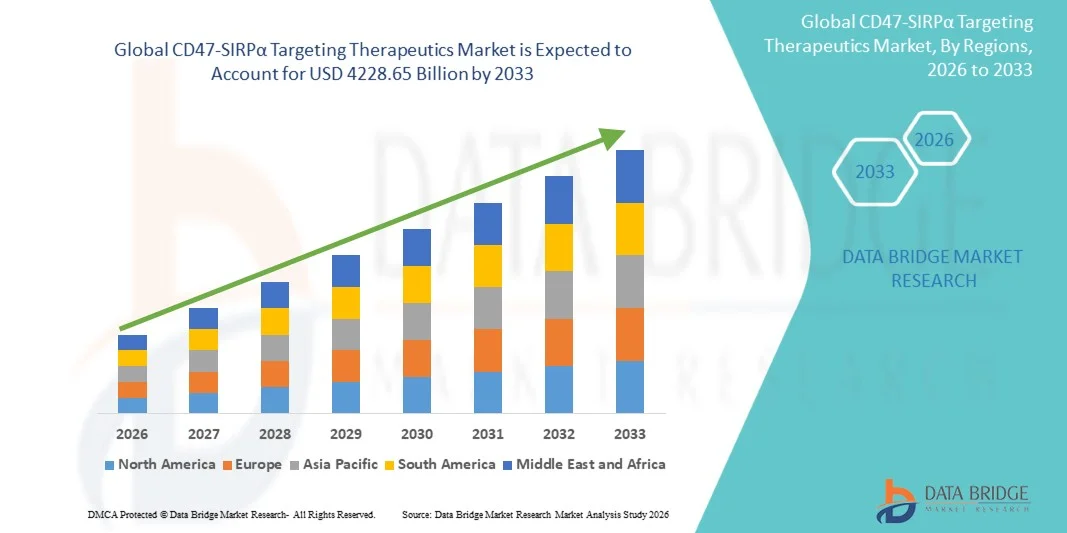
- As per Data Bridge Market Research Analysis the Global CD47-SIRPα Targeting Therapeutics market was valued at USD 964.00 billion in 2025 and is projected to reach USD 4228.65 billion by 2033, growing at a CAGR of 20.30% from 2026 to 2033. The global CD47–SIRPα Targeting Therapeutics market is experiencing strong growth driven by rising prevalence of cancer and increasing focus on next-generation immuno-oncology therapies. The growing demand for innovative treatments that enhance macrophage-mediated tumor clearance is accelerating clinical development of CD47 and SIRPα pathway inhibitors across hematologic malignancies and solid tumors. Rapid advancements in monoclonal antibody engineering, fusion protein design, and combination immunotherapy strategies are further strengthening the therapeutic pipeline.
- The increasing burden of cancers such as leukemia, lymphoma, breast cancer, and lung cancer, along with high unmet clinical needs in refractory and relapsed cases, is compelling pharmaceutical and biotechnology companies to invest heavily in CD47–SIRPα targeting drug development. Expanding clinical trial activity, rising regulatory support for orphan oncology drugs, and growing adoption of precision medicine approaches are further driving market expansion across global healthcare systems.
Market Size & Forecast
- Global Market Value (2025): USD 964.00 Billion
- Expected Market Value (2033): USD 4228.65 Billion
- Forecast CAGR (2026–2033): 20.30%
- Leading Region in 2025: North America
- Fastest Growing Region: Asia-Pacific
Key Market Trends & Insights
- North America dominated the global CD47–SIRPα Targeting Therapeutics market with the largest revenue share of 42.18% in 2025, supported by a strong immuno-oncology R&D ecosystem, high concentration of leading biopharmaceutical companies, and advanced clinical trial infrastructure. The region benefits from early adoption of novel biologics, strong funding for cancer immunotherapy research, and a well-established regulatory framework that accelerates oncology drug approvals. Increasing prevalence of hematologic malignancies and solid tumors, along with expanding pipeline activity for CD47-targeting monoclonal antibodies, is further strengthening regional leadership.
- The Monoclonal Antibodies segment led the market with a 64.73% share in 2025, driven by strong clinical pipeline advancement of anti-CD47 and anti-SIRPα antibodies used in macrophage checkpoint blockade therapies. These therapies are widely adopted in combination with PD-1/PD-L1 inhibitors to enhance anti-tumor immune response. High clinical success in hematologic malignancies such as AML and lymphoma is supporting rapid investment and development. Increasing number of Phase I–III clinical trials and strong participation from major pharmaceutical companies are reinforcing segment dominance.
- Asia-Pacific is expected to be the fastest-growing region at a CAGR of 18.6% from 2026 to 2033, fueled by rising cancer burden, expanding clinical research infrastructure, and increasing investments in immuno-oncology drug development across China, Japan, and India. Growing participation in global clinical trials, supportive government funding for biotech innovation, and rapid expansion of oncology-focused pharmaceutical companies are accelerating market growth. Increasing adoption of precision medicine and biologics manufacturing capabilities is further strengthening regional expansion.
- The Solid Tumors segment is expected to register the fastest CAGR of 19.4% from 2026 to 2033, driven by expanding research into tumor microenvironment modulation and immune evasion pathways. Rising clinical evaluation in breast, lung, colorectal, and ovarian cancers is boosting trial activity for CD47–SIRPα inhibitors. Advances in combination immunotherapy strategies and improved safety profiles of next-generation agents are enhancing therapeutic potential. Increasing focus on overcoming resistance mechanisms in solid tumors is further accelerating segment growth.
- The Monoclonal Antibodies segment dominated the market with a 62.45% revenue share in 2025, driven by strong clinical pipeline activity targeting CD47-mediated “don’t eat me” signaling in cancer cells
Report Scope and Global CD47-SIRPα Targeting Therapeutics Market Segmentation
|
Attributes |
CD47-SIRPα Targeting Therapeutics Key Market Insights |
|
Segments Covered |
|
|
Countries Covered |
North America
Europe
Asia-Pacific
Middle East and Africa
South America
|
|
Key Market Players |
|
|
Market Opportunities |
|
|
Value Added Data Infosets |
In addition to the insights on market scenarios such as market value, growth rate, segmentation, geographical coverage, and major players, the market reports curated by the Data Bridge Market Research also include in-depth expert analysis, geographically represented company-wise production and capacity, network layouts of distributors and partners, detailed and updated price trend analysis and deficit analysis of supply chain and demand. |
What is the Key Trend in Global CD47-SIRPα Targeting Therapeutics Market ?
Trend: Growth in Next-Generation Immuno-Oncology & Combination Therapies
The Global CD47–SIRPα Targeting Therapeutics Market is witnessing strong momentum driven by the rapid expansion of next-generation immuno-oncology therapies and combination treatment strategies. CD47 blockade therapies are increasingly being combined with PD-1/PD-L1 inhibitors and anti-CD20 antibodies to enhance macrophage-mediated phagocytosis of cancer cells. For instance, magrolimab (anti-CD47 antibody developed by Gilead Sciences) has shown encouraging Phase I/II clinical results in acute myeloid leukemia (AML), with early studies reporting objective response rates exceeding 50% in combination regimens. Similarly, evorpacept (ALX Oncology) is being evaluated in multiple solid tumor indications, demonstrating improved tumor immune clearance when used alongside trastuzumab in HER2-positive cancers. Increasing clinical validation across hematologic malignancies and solid tumors is accelerating adoption of CD47–SIRPα targeting approaches globally.
Global CD47-SIRPα Targeting Therapeutics Market Dynamics
Key Market Driver: Rising Cancer Burden and Expansion of Macrophage Checkpoint Therapy
The increasing global incidence of cancer is a major driver for CD47–SIRPα targeting therapeutics. According to GLOBOCAN 2024 estimates, global cancer cases surpassed 20 million annually, with hematologic malignancies accounting for over 1.3 million new cases each year. CD47, known as the “don’t eat me” signal, is overexpressed in many cancers including leukemia, lymphoma, and solid tumors, enabling tumor immune evasion. Therapeutics targeting this pathway enhance macrophage-mediated phagocytosis, making them highly promising in oncology pipelines. Pharmaceutical companies such as Gilead Sciences, ALX Oncology, and Trillium Therapeutics (now part of Pfizer) are investing heavily in clinical development programs. Increasing orphan drug designations and fast-track approvals by regulatory bodies such as the FDA are further accelerating market growth.
Key Restraint/Challenge: Hematologic Toxicity and Clinical Safety Concerns
Despite strong therapeutic potential, the market faces challenges related to on-target anemia and hematologic toxicity caused by CD47 expression on normal red blood cells. Early clinical trials of first-generation CD47 antibodies reported dose-limiting toxicities, requiring modified dosing strategies and priming regimens. This has increased complexity in clinical development and slowed large-scale commercialization. Additionally, high costs of biologic development—often exceeding USD 200–400 million per molecule through late-stage trials—pose financial constraints for smaller biotech firms. Regulatory uncertainty around combination immunotherapies and variability in patient response rates further complicate market adoption. These challenges necessitate advanced antibody engineering and improved safety profiling before widespread clinical use.
Key Market Opportunity: Expansion of Precision Oncology and Solid Tumor Targeting
The growing shift toward precision oncology presents a major opportunity for CD47–SIRPα targeting therapeutics. While early development focused on hematologic cancers, recent advances are expanding applications into solid tumors such as breast, lung, ovarian, and colorectal cancers. For example, ALX Oncology’s evorpacept has demonstrated synergistic tumor reduction when combined with trastuzumab in HER2-positive solid tumor models. Increasing investment in biomarker-driven patient stratification is improving treatment efficacy and reducing adverse effects. The rise of next-generation biologics, including bispecific antibodies and engineered SIRPα-Fc fusion proteins, is further expanding therapeutic pipelines. In addition, growing oncology R&D investments in China, the U.S., and Europe—exceeding USD 50 billion annually—are accelerating innovation and global clinical trial expansion, creating significant long-term growth potential.
Global CD47-SIRPα Targeting Therapeutics Market Scope
The CD47-SIRPα Targeting Therapeutics market is segmented on the basis of drug type and application.
- By Drug Type
On the basis of drug type, the global CD47–SIRPα targeting therapeutics market is segmented into monoclonal antibodies, fusion proteins, and small molecule inhibitors. The Monoclonal Antibodies segment dominated the market with a 62.45% revenue share in 2025, driven by strong clinical pipeline activity targeting CD47-mediated “don’t eat me” signaling in cancer cells. These therapies, including anti-CD47 and anti-SIRPα antibodies, are widely studied in hematologic malignancies such as non-Hodgkin lymphoma, acute myeloid leukemia, and multiple myeloma. High specificity, improved tumor macrophage phagocytosis, and strong response in combination therapies with checkpoint inhibitors are key growth drivers. Increasing number of Phase I and Phase II clinical trials across the U.S. and Europe is further strengthening segment dominance. Strategic collaborations between biotech firms and large pharmaceutical companies are accelerating clinical development and commercialization pathways. Rising investment in immuno-oncology pipelines is supporting sustained demand for monoclonal antibody-based CD47 targeting therapies.
The Fusion Proteins segment is expected to witness the fastest CAGR of 18.6% from 2026 to 2033, driven by their improved safety profile and reduced hematologic toxicity compared to first-generation CD47 antibodies. Growing interest in engineered SIRPα-Fc fusion constructs is enhancing tumor selectivity and minimizing off-target effects. Increasing preclinical success in solid tumor models is accelerating clinical translation. Biopharmaceutical companies are actively investing in next-generation protein engineering platforms to optimize binding affinity and immune activation. Expansion of precision oncology programs is further supporting rapid adoption of fusion-based therapeutics.
- By Application
On the basis of application, the global CD47–SIRPα targeting therapeutics market is segmented into hematologic malignancies, solid tumors, and autoimmune diseases. The Hematologic Malignancies segment dominated the market with a 58.32% revenue share in 2025, driven by strong clinical efficacy of CD47 blockade in blood cancers such as acute myeloid leukemia, myelodysplastic syndromes, and lymphoma. High expression of CD47 on malignant hematopoietic cells makes them prime candidates for macrophage-mediated clearance therapies. Increasing number of late-stage clinical trials and orphan drug designations are accelerating development in this segment. Combination therapies with rituximab and PD-1/PD-L1 inhibitors are further improving clinical outcomes. Strong funding from oncology-focused biotech firms and government research programs is reinforcing market leadership.
The Solid Tumors segment is expected to witness the fastest CAGR of 19.4% from 2026 to 2033, driven by expanding research into tumor microenvironment modulation and immune evasion mechanisms. Rising focus on cancers such as breast, lung, and colorectal cancer is increasing clinical trial activity. Advances in combination immunotherapy approaches are enhancing therapeutic effectiveness in solid tumor settings. Improved antibody engineering and reduced toxicity profiles are supporting broader clinical adoption. Growing investment in next-generation checkpoint therapies is further accelerating segment expansion globally.
Global CD47-SIRPα Targeting Therapeutics Market Regional Analysis
North America dominated the CD47–SIRPα Targeting Therapeutics market and accounted for the largest revenue share of 42.18% in 2025, supported by a strong immuno-oncology R&D ecosystem, high concentration of leading biopharmaceutical companies, and advanced clinical trial infrastructure. The region benefits from early adoption of novel biologics, strong funding for cancer immunotherapy research, and a well-established regulatory framework that accelerates oncology drug approvals. Increasing prevalence of hematologic malignancies and solid tumors, along with expanding pipeline activity for CD47-targeting monoclonal antibodies, is further strengthening regional leadership. In addition, the presence of major pharmaceutical players and extensive collaboration between biotech firms and research institutes continues to drive innovation in macrophage checkpoint therapies across the region.
U.S. CD47-SIRPα Targeting Therapeutics Market Insight
The U.S. CD47–SIRPα Targeting Therapeutics market is witnessing strong growth due to rising investments in advanced immuno-oncology research, increasing clinical trial activity, and strong presence of leading biotechnology and pharmaceutical companies. The country accounts for a major share of global CD47-targeting drug development pipelines, including therapies such as magrolimab and other anti-CD47 antibodies under late-stage evaluation. High cancer burden, particularly in hematologic malignancies and solid tumors, is accelerating demand for novel macrophage checkpoint inhibitors. In addition, strong NIH funding, venture capital investments in biotech startups, and accelerated FDA regulatory pathways such as Breakthrough Therapy Designation are supporting rapid innovation and commercialization. The growing adoption of combination immunotherapy approaches is further strengthening market expansion across oncology centers and research institutions.
Europe CD47-SIRPα Targeting Therapeutics Market Insight
The Europe CD47–SIRPα Targeting Therapeutics market remains a major contributor to global revenue, driven by strong government support for oncology research, advanced clinical trial networks, and increasing adoption of precision medicine approaches. Countries such as Germany, France, and the U.K. play a key role in immuno-oncology development, supported by rising investments in biologics and cancer immunotherapy programs. Expanding participation in multinational clinical trials and strong collaboration between academic research centers and pharmaceutical companies are accelerating pipeline development. In addition, regulatory support for orphan oncology drugs and increasing focus on combination immunotherapy strategies are further strengthening market growth across Europe.
U.K. CD47-SIRPα Targeting Therapeutics Market Insight
The U.K. CD47–SIRPα Targeting Therapeutics market is witnessing steady growth supported by strong academic research infrastructure, increasing participation in global oncology clinical trials, and rising investment in immunotherapy drug development. Leading cancer research institutes are actively engaged in CD47 pathway studies and early-stage clinical evaluations. Government funding initiatives and partnerships with global pharmaceutical companies are further enhancing innovation in macrophage checkpoint therapies. In addition, growing focus on biomarker-driven precision oncology is improving patient stratification and clinical outcomes in the U.K.
Germany CD47-SIRPα Targeting Therapeutics Market Insight
The Germany CD47–SIRPα Targeting Therapeutics market is expanding steadily due to strong biopharmaceutical manufacturing capabilities, advanced oncology research infrastructure, and increasing participation in global immunotherapy clinical trials. The country is a key European hub for hematologic malignancy and solid tumor research, supported by collaboration between universities, biotech companies, and multinational pharmaceutical firms. Government support for translational cancer research and increasing investment in next-generation antibody engineering technologies are further driving market expansion.
Asia-Pacific CD47-SIRPα Targeting Therapeutics Market Insight
The Asia-Pacific CD47–SIRPα Targeting Therapeutics market is expected to witness the fastest growth at a CAGR of 18.6% from 2026 to 2033, driven by rising cancer burden, expanding clinical research infrastructure, and increasing investments in immuno-oncology drug development across China, Japan, and India. The region is emerging as a major hub for cost-efficient clinical trials, attracting global pharmaceutical companies for oncology pipeline expansion. Strong government support for biotechnology innovation, rapid growth of domestic biopharma companies, and increasing adoption of precision medicine are further accelerating regional growth. In addition, improving regulatory frameworks and rising participation in global clinical studies are strengthening long-term market expansion.
Japan CD47-SIRPα Targeting Therapeutics Market Insight
The Japan CD47–SIRPα Targeting Therapeutics market is witnessing consistent growth due to strong pharmaceutical innovation, advanced oncology research infrastructure, and increasing adoption of targeted immunotherapies. Japanese biotech firms and academic institutes are actively engaged in CD47 pathway research and clinical development of next-generation biologics. Rising cancer incidence linked to an aging population is further driving demand for advanced oncology treatments. In addition, government support for precision medicine and regenerative medicine initiatives is accelerating clinical trials and therapeutic adoption.
China CD47-SIRPα Targeting Therapeutics Market Insight
The China CD47–SIRPα Targeting Therapeutics market is growing rapidly, driven by rising cancer prevalence, expanding biopharmaceutical manufacturing capacity, and increasing investments in immuno-oncology research. Domestic biotech companies are actively developing CD47-targeting antibodies and fusion protein therapies, supported by strong government funding and innovation policies. Large patient populations, rapid clinical trial enrollment, and increasing global partnerships are further accelerating drug development. In addition, growing adoption of precision oncology and expansion of cancer research centers are positioning China as one of the fastest-growing markets globally.
Global CD47-SIRPα Targeting Therapeutics Market Share
The CD47-SIRPα Targeting Therapeutics industry is primarily led by well-established companies, including:
- Gilead Sciences Inc. (U.S.)
- Forty Seven Inc. (U.S.)
- Pfizer Inc. (U.S.)
- Bristol Myers Squibb (U.S.)
- AbbVie Inc. (U.S.)
- F. Hoffmann-La Roche Ltd. (Switzerland)
- Novartis AG (Switzerland)
- AstraZeneca plc (U.K.)
- Merck & Co., Inc. (U.S.)
- Amgen Inc. (U.S.)
- Ono Pharmaceutical Co., Ltd. (Japan)
- Innovent Biologics Inc. (China)
- Celgene Corporation (U.S.)
- Trillium Therapeutics Inc. (Canada)
- Arch Oncology Inc. (U.S.)
- ALX Oncology Holdings Inc. (U.S.)
- I-Mab Biopharma Co. Ltd. (China)
- Jiangsu Hengrui Pharmaceuticals Co., Ltd. (China)
- Teneobio Inc. (U.S.)
- Kahr Medical Ltd. (Israel)
- Surface Oncology Inc. (U.S.)
- MacroGenics Inc. (U.S.)
- Sorrento Therapeutics Inc. (U.S.)
- Celldex Therapeutics Inc. (U.S.)
- GSK plc (U.K.)
- BeiGene Ltd. (China)
Latest Developments in Global CD47-SIRPα Targeting Therapeutics Market
- In September 2025, Moog Inc. has unveiled its latest motion systems all electric E60 Series and the electro pneumatic P60 Series, setting a new benchmark for simulation across aviation, land, and maritime training with support for up to 14,000 kg loads and high fidelity motion for Level D flight simulators and other professional uses. The upgraded platforms deliver enhanced reliability, compact design and sustained operational uptime, reflecting modernized electronics and sustainable operation. These new systems strengthen Moog’s market leadership in simulation motion technology by boosting performance, energy efficiency, and usability
- In January 2025, Exail Technologies has acquired Leukos, a French photonics specialist known for pulsed micro lasers, supercontinuum laser sources, ultrafast lasers, and simulation-enabled optical systems, strengthening its technological and industrial capabilities in advanced laser and simulation technologies. The deal integrates Leukos’s expertise with Exail’s photonics, optical, and simulation platforms, broadening product offerings for applications in biophotonics, microelectronics, and high-fidelity training simulations. This strategic acquisition accelerates Exail’s innovation in high-tech technologies, creating synergies that expand its reach in scientific, industrial, and simulation applications while reinforcing its position as a leading advanced-technology provider
- In November 2025, IPG Automotive launched CarMaker 15.0, the latest version of its driving simulation software used for virtual vehicle development. The new release improves simulation accuracy by integrating virtual electronic control units (vECUs), allowing engineers to test software and vehicle systems at earlier development stages. It also includes enhanced sensor models and improved endurance testing capabilities for ADAS and autonomous vehicles. This development strengthens IPG Automotive’s position in the driving simulator market, as CarMaker enables automotive manufacturers to perform complex vehicle tests in a virtual driving environment instead of physical road testing.
- In November 2024, IPG Automotive released CarMaker 14.0, introducing new simulation capabilities including advanced sensor models and more realistic virtual environments. The update allows developers to simulate complex traffic scenarios involving pedestrians, vehicles, and different weather conditions. These features help automotive companies test ADAS and autonomous driving systems more efficiently in driving simulators, reducing development time and cost. The upgrade also expanded simulation capabilities for heavy-duty vehicles using the TruckMaker platform.
- In June 2023, IPG Automotive participated in the UNICARagil research project, collaborating with universities and industry partners to develop automated vehicle architectures. The company contributed its CarMaker driving simulation platform to support simulation and validation of automated driving systems in Software-in-the-Loop (SIL) and Hardware-in-the-Loop (HIL) environments. This collaboration demonstrates the application of CD47-SIRPα Targeting Therapeutics in research and development of autonomous mobility solutions

- Interactive Data Analysis Dashboard
- Company Analysis Dashboard for high growth potential opportunities
- Research Analyst Access for customization & queries
- Competitor Analysis with Interactive dashboard
- Latest News, Updates & Trend analysis
- Harness the Power of Benchmark Analysis for Comprehensive Competitor Tracking
Data collection and base year analysis are done using data collection modules with large sample sizes. The stage includes obtaining market information or related data through various sources and strategies. It includes examining and planning all the data acquired from the past in advance. It likewise envelops the examination of information inconsistencies seen across different information sources. The market data is analysed and estimated using market statistical and coherent models. Also, market share analysis and key trend analysis are the major success factors in the market report. To know more, please request an analyst call or drop down your inquiry.
The key research methodology used by DBMR research team is data triangulation which involves data mining, analysis of the impact of data variables on the market and primary (industry expert) validation. Data models include Vendor Positioning Grid, Market Time Line Analysis, Market Overview and Guide, Company Positioning Grid, Patent Analysis, Pricing Analysis, Company Market Share Analysis, Standards of Measurement, Global versus Regional and Vendor Share Analysis. To know more about the research methodology, drop in an inquiry to speak to our industry experts.
Data Bridge Market Research is a leader in advanced formative research. We take pride in servicing our existing and new customers with data and analysis that match and suits their goal. The report can be customized to include price trend analysis of target brands understanding the market for additional countries (ask for the list of countries), clinical trial results data, literature review, refurbished market and product base analysis. Market analysis of target competitors can be analyzed from technology-based analysis to market portfolio strategies. We can add as many competitors that you require data about in the format and data style you are looking for. Our team of analysts can also provide you data in crude raw excel files pivot tables (Fact book) or can assist you in creating presentations from the data sets available in the report.












