


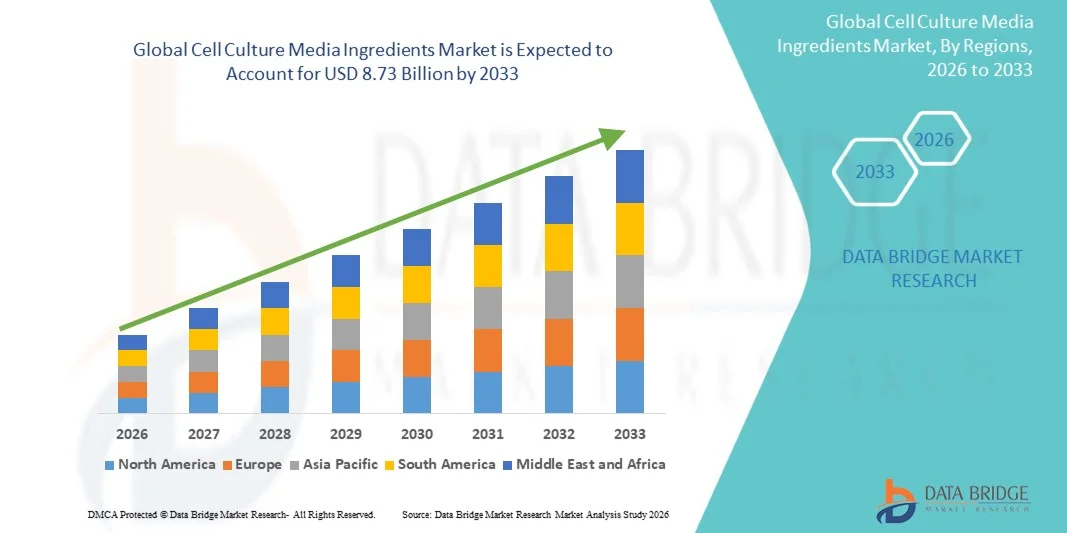
Cell Culture Media Ingredients Market Size
- The global cell culture media ingredients market size was valued at USD 3.76 billion in 2025 and is expected to reach USD 8.73 billion by 2033, at a CAGR of 11.10% during the forecast period
- The market growth is largely fueled by the increasing demand for advanced biopharmaceutical and regenerative medicine applications, leading to higher adoption of optimized cell culture media in both research and commercial production settings
- Furthermore, rising investments in clinical research, expanding stem cell and monoclonal antibody production, and the growing need for high-quality, scalable, and reproducible media formulations are driving the uptake of cell culture media ingredients solutions, thereby significantly boosting the industry's growth
Cell Culture Media Ingredients Market Analysis
- Cell Culture Media Ingredients, encompassing essential nutrients and supplements required for optimal cell growth and maintenance, are increasingly vital components in biopharmaceutical production, research, and regenerative medicine due to their role in ensuring reproducibility, cell viability, and product quality
- The escalating demand for cell culture media ingredients is primarily fueled by the growing biotechnology and pharmaceutical sectors, increasing investment in R&D, and rising adoption of advanced cell-based therapies and regenerative medicine applications
- North America dominated the cell culture media ingredients market with the largest revenue share of 44% in 2025, characterized by well-established biotechnology infrastructure, high R&D expenditure, and the strong presence of key pharmaceutical and biotechnology companies, with the U.S. experiencing substantial growth in clinical research, biopharmaceutical production, and regenerative medicine applications
- Asia-Pacific is expected to be the fastest growing region in the cell culture media ingredients market during the forecast period due to increasing healthcare investments, rising prevalence of chronic and rare diseases, expansion of research institutions, and improving healthcare infrastructure across emerging economies
- The biopharmaceutical production segment held the largest market revenue share of 38.4% in 2025, propelled by the global surge in monoclonal antibody production, recombinant proteins, and vaccines
Report Scope and Cell Culture Media Ingredients Market Segmentation
|
Attributes |
Cell Culture Media Ingredients Key Market Insights |
|
Segments Covered |
|
|
Countries Covered |
North America
Europe
Asia-Pacific
Middle East and Africa
South America
|
|
Key Market Players |
|
|
Market Opportunities |
|
|
Value Added Data Infosets |
In addition to the insights on market scenarios such as market value, growth rate, segmentation, geographical coverage, and major players, the market reports curated by the Data Bridge Market Research also include in-depth expert analysis, patient epidemiology, pipeline analysis, pricing analysis, and regulatory framework. |
Cell Culture Media Ingredients Market Trends
“Expansion of Advanced Cell Culture Media Formulation”
- A significant and accelerating trend in the global cell culture media ingredients market is the increasing development and adoption of advanced media formulations tailored for diverse cell types, including mammalian, microbial, and stem cells. These formulations enhance cell growth, viability, and productivity while reducing contamination risks
- For instance, serum-free and chemically defined media have gained prominence for their reproducibility and regulatory compliance in biopharmaceutical production. Companies are increasingly investing in optimized media to support large-scale production of monoclonal antibodies, vaccines, and recombinant proteins
- Media supplements such as growth factors, vitamins, and amino acids are being integrated into formulations to improve proliferation rates and maintain desired cellular phenotypes. This enables more efficient bioprocessing workflows and accelerates product development timelines
- The trend is further supported by rising demand for tissue engineering, regenerative medicine, and cell therapy applications, where tailored media is critical to achieving high-quality, consistent cell products
- Customization and optimization of cell culture media are increasingly offered as part of contract manufacturing services, enabling end-users to streamline R&D and production
- Regulatory guidance encouraging serum-free and animal-origin-free formulations is pushing companies to innovate safer and more standardized products
- This trend towards precision and reproducibility in cell culture processes is reshaping user expectations for media performance, particularly in high-value applications such as biopharmaceuticals and clinical research
- Consequently, leading players are expanding portfolios to include specialized media for stem cells, CHO cells, and other industrially relevant cell lines
- The demand for high-performance media formulations is growing rapidly across both research and commercial sectors as consumers increasingly prioritize product consistency, scalability, and regulatory compliance
Cell Culture Media Ingredients Market Dynamics
Driver
“Rising Biopharmaceutical Production and Research Activities”
- The increasing prevalence of biopharmaceutical R&D and large-scale cell culture production is a significant driver for the heightened demand for high-quality cell culture media ingredients
- For instance, in March 2024, Thermo Fisher Scientific expanded its cell culture media portfolio with new serum-free and chemically defined media for CHO and HEK cells, aimed at supporting biopharmaceutical production. Such developments by key companies are expected to drive market growth in the forecast period
- Rising investment in vaccine development, gene therapy, and monoclonal antibody production has fueled the need for reproducible, high-performance cell culture media that support robust cell growth and product yield
- Academic research and contract research organizations are increasingly adopting specialized media to accelerate drug discovery, tissue engineering, and regenerative medicine projects
- Furthermore, the convenience of off-the-shelf media formulations reduces experimental variability and shortens R&D timelines, enabling faster translational research and clinical development
- The availability of tailored media for different cell types, coupled with robust quality standards, ensures scalability from bench to bioreactor production, further encouraging adoption
- Strong demand from emerging markets with expanding biotechnology sectors also supports growth, with companies focusing on localized manufacturing and distribution of media products
Restraint/Challenge
“High Costs and Supply Chain Constraints”
- The relatively high cost of advanced cell culture media ingredients compared to standard formulations poses a barrier to adoption, particularly for smaller laboratories and budget-constrained research organizations
- For instance, specialized media for stem cells and serum-free applications can cost several times more than conventional media, impacting procurement decisions in academic and early-stage research settings
- Supply chain limitations, including availability of high-purity raw materials such as amino acids, growth factors, and recombinant proteins, can lead to delays and inconsistency in media production
- Fluctuations in raw material costs and regulatory compliance requirements further complicate production and distribution, affecting market accessibility and pricing stability
- Companies must invest in reliable sourcing, quality control, and logistics infrastructure to ensure uninterrupted supply of critical media components
- While prices are gradually stabilizing due to manufacturing efficiencies and increased competition, high-cost specialized media continues to challenge widespread adoption, especially in emerging economies
- Overcoming these challenges through scalable manufacturing, localized production, and innovative cost-reduction strategies will be crucial for sustained market growth in the global cell culture media ingredients sector
Cell Culture Media Ingredients Market Scope
The market is segmented on the basis of type, application, and end-users.
• By Type
On the basis of type, the Cell Culture Media Ingredients market is segmented into amino acids, vitamins, sugars, salts, buffers, and others. The amino acids segment dominated the largest market revenue share of 32.8% in 2025, owing to their critical role in protein synthesis, cell proliferation, and metabolic regulation. Amino acids are fundamental components in most media formulations used across biopharmaceutical production and research laboratories. Their widespread use in both mammalian and microbial cell culture systems, coupled with the increasing demand for monoclonal antibodies and therapeutic proteins, underpins their dominance. Furthermore, advancements in high-purity amino acid production and the rising adoption in regenerative medicine further support the segment’s strong revenue contribution.
The vitamins segment is expected to witness the fastest CAGR of 20.5% from 2026 to 2033, driven by growing awareness of their essential role in enzymatic reactions, cell growth, and differentiation. Vitamins are increasingly incorporated into advanced culture media designed for stem cell research and regenerative applications. The rising focus on optimizing cell culture conditions, especially for high-value biologics and personalized therapies, has accelerated the adoption of vitamin-enriched media. In addition, innovations in vitamin stability and formulation, along with increasing demand in academic and industrial research, are contributing to robust growth in this segment.
• By Application
On the basis of application, the market is segmented into biopharmaceutical production, research & development, regenerative medicine, and others. The biopharmaceutical production segment held the largest market revenue share of 38.4% in 2025, propelled by the global surge in monoclonal antibody production, recombinant proteins, and vaccines. The pharmaceutical industry's increasing reliance on optimized culture media for higher yield and quality of biologics strengthens this segment. Moreover, strategic expansions by leading biopharmaceutical companies and the growing adoption of high-throughput cell culture systems are fueling consistent demand for media ingredients in production workflows.
The regenerative medicine segment is expected to witness the fastest CAGR of 22.3% from 2026 to 2033, due to increasing investments in stem cell therapies, tissue engineering, and personalized medicine. As regenerative medicine requires highly defined and optimized culture conditions for cell expansion and differentiation, there is a growing need for specialized media formulations enriched with precise amino acids, vitamins, and growth supplements. Collaborative research initiatives and the expansion of regenerative medicine startups are further accelerating growth in this application segment.
• By End-Users
On the basis of end-users, the market is segmented into biotechnology companies, pharmaceutical companies, academic & research institutes, and contract research organizations (CROs). The biotechnology companies segment dominated the largest market revenue share of 35.7% in 2025, driven by the industry’s focus on biopharmaceutical development, cell-based assays, and biologics production. Biotechnology firms increasingly require high-quality, reproducible culture media ingredients for R&D and large-scale production, supporting the segment’s strong market presence.
The academic & research institutes segment is expected to witness the fastest CAGR of 21.8% from 2026 to 2033, owing to the expanding number of research programs in cell biology, molecular biology, and regenerative studies. The rising government funding for life sciences research and the growing demand for advanced culture media to support cutting-edge experiments are key factors driving growth. Universities and research institutes are also collaborating with industrial partners to develop novel media formulations, which further accelerates adoption and drives market expansion in this segment.
Cell Culture Media Ingredients Market Regional Analysis
- North America dominated the cell culture media ingredients market with the largest revenue share of 44% in 2025, characterized by well-established biotechnology infrastructure, high R&D expenditure, and the strong presence of key pharmaceutical and biotechnology companies
- The region benefits from advanced laboratory facilities, skilled workforce, and supportive government policies promoting clinical research and regenerative medicine applications
- Canada contributed to regional growth through increasing research initiatives and expansion of biopharmaceutical manufacturing capabilities, supporting the demand for specialized cell culture media ingredients
U.S. Cell Culture Media Ingredients Market Insight
The U.S. cell culture media ingredients market captured the largest revenue share within North America in 2025, driven by extensive clinical research activities, industrial-scale biopharmaceutical production, and early adoption of advanced cell-based therapies. Growing investments in regenerative medicine, stem cell research, and bioprocessing technologies are significantly supporting market growth. High-quality academic and private research centers, combined with a skilled workforce and advanced laboratory infrastructure, are key factors propelling the U.S. market.
Europe Cell Culture Media Ingredients Market Insight
The Europe cell culture media ingredients market is projected to expand at a substantial CAGR during the forecast period, driven by increasing adoption of advanced bioprocessing technologies and stringent regulatory standards. Countries such as Germany, France, and the U.K. are witnessing significant growth in research facilities and industrial-scale cell therapy production, boosting demand for optimized media formulations. Robust funding for R&D projects and investment in regenerative medicine infrastructure are further accelerating the market.
U.K. Cell Culture Media Ingredients Market Insight
The U.K. cell culture media ingredients market is anticipated to grow at a noteworthy CAGR during the forecast period, fueled by expanding biopharmaceutical research and regenerative medicine initiatives. Government support for biotechnology innovation and increasing clinical trials are driving the adoption of specialized cell culture media ingredients.
Germany Cell Culture Media Ingredients Market Insight
Germany cell culture media ingredients market is expected to expand at a considerable CAGR, supported by a strong biotechnology ecosystem and significant investments in pharmaceutical and regenerative medicine research. Global biopharmaceutical companies and specialized contract research organizations (CROs) in Germany are driving demand for high-quality cell culture media ingredients.
Asia-Pacific Cell Culture Media Ingredients Market Insight
The Asia-Pacific cell culture media ingredients market is poised to grow at the fastest CAGR during the forecast period, driven by increasing healthcare investments, rising prevalence of chronic and rare diseases, and the expansion of research institutions. Countries such as China, India, and Japan are improving healthcare infrastructure and expanding capabilities in biopharmaceutical manufacturing, supporting high demand for specialized media. Focus on stem cell research, monoclonal antibodies, and other advanced therapies is driving adoption of scalable and high-quality cell culture media ingredients.
Japan Cell Culture Media Ingredients Market Insight
Japan cell culture media ingredients market is gaining momentum due to its strong biotechnology research ecosystem, high adoption of regenerative medicine applications, and aging population. Expansion of clinical research and industrial-scale cell production is driving the adoption of specialized media formulations in both research and commercial production.
China Cell Culture Media Ingredients Market Insight
China cell culture media ingredients market accounted for the largest revenue share in Asia-Pacific in 2025, attributed to rapid biopharmaceutical manufacturing expansion, rising research activities, and supportive government policies. The growing middle class, increasing healthcare spending, and establishment of advanced research facilities are key factors propelling the market. Stem cell research, monoclonal antibody production, and other advanced therapy initiatives are significantly driving demand for high-quality cell culture media ingredients.
Cell Culture Media Ingredients Market Share
The Cell Culture Media Ingredients industry is primarily led by well-established companies, including:
- Sigma-Aldrich (U.S.)
- Thermo Fisher Scientific (U.S.)
- Corning Inc. (U.S.)
- Cytiva (U.S.)
- GE Healthcare Life Sciences (U.S.)
- Sartorius AG (Germany)
- Pan Biotech (Germany)
- Dhi Group (Denmark)
- Merck KGaA (Germany)
- Lonza Group (Switzerland)
- Fujifilm Wako (Japan)
- HiMedia Laboratories (India)
- Biowest (France)
- PromoCell GmbH (Germany)
- Takara Bio Inc. (Japan)
- Bio-Rad Laboratories (U.S.)
- Corning Incorporated Life Sciences (U.S.)
- VWR International (U.S.)
- CellGenix GmbH (Germany)
- Stemcell Technologies (Canada)
Latest Developments in Global Cell Culture Media Ingredients Market
- In March 2023, Thermo Fisher Scientific launched a new HyClone serum-free and chemically defined media portfolio for various cell types, enhancing consistency and performance in both research and bioproduction applications
- In 2023, Lonza introduced two new media products: TheraPEAK T‑VIVO (animal-component-free, optimized for CAR‑T cell expansion) and TheraPRO CHO (scalable system for therapeutic monoclonal antibody production)
- In March 2024, Dyadic announced a co‑promotion agreement with Biftek to promote a growth media supplement for cell culture, and also advanced its animal‑free recombinant human and bovine albumin projects for use in cell culture media

- Interactive Data Analysis Dashboard
- Company Analysis Dashboard for high growth potential opportunities
- Research Analyst Access for customization & queries
- Competitor Analysis with Interactive dashboard
- Latest News, Updates & Trend analysis
- Harness the Power of Benchmark Analysis for Comprehensive Competitor Tracking
Data collection and base year analysis are done using data collection modules with large sample sizes. The stage includes obtaining market information or related data through various sources and strategies. It includes examining and planning all the data acquired from the past in advance. It likewise envelops the examination of information inconsistencies seen across different information sources. The market data is analysed and estimated using market statistical and coherent models. Also, market share analysis and key trend analysis are the major success factors in the market report. To know more, please request an analyst call or drop down your inquiry.
The key research methodology used by DBMR research team is data triangulation which involves data mining, analysis of the impact of data variables on the market and primary (industry expert) validation. Data models include Vendor Positioning Grid, Market Time Line Analysis, Market Overview and Guide, Company Positioning Grid, Patent Analysis, Pricing Analysis, Company Market Share Analysis, Standards of Measurement, Global versus Regional and Vendor Share Analysis. To know more about the research methodology, drop in an inquiry to speak to our industry experts.
Data Bridge Market Research is a leader in advanced formative research. We take pride in servicing our existing and new customers with data and analysis that match and suits their goal. The report can be customized to include price trend analysis of target brands understanding the market for additional countries (ask for the list of countries), clinical trial results data, literature review, refurbished market and product base analysis. Market analysis of target competitors can be analyzed from technology-based analysis to market portfolio strategies. We can add as many competitors that you require data about in the format and data style you are looking for. Our team of analysts can also provide you data in crude raw excel files pivot tables (Fact book) or can assist you in creating presentations from the data sets available in the report.













