


Cell-Free Protein Expression Systems Market Size
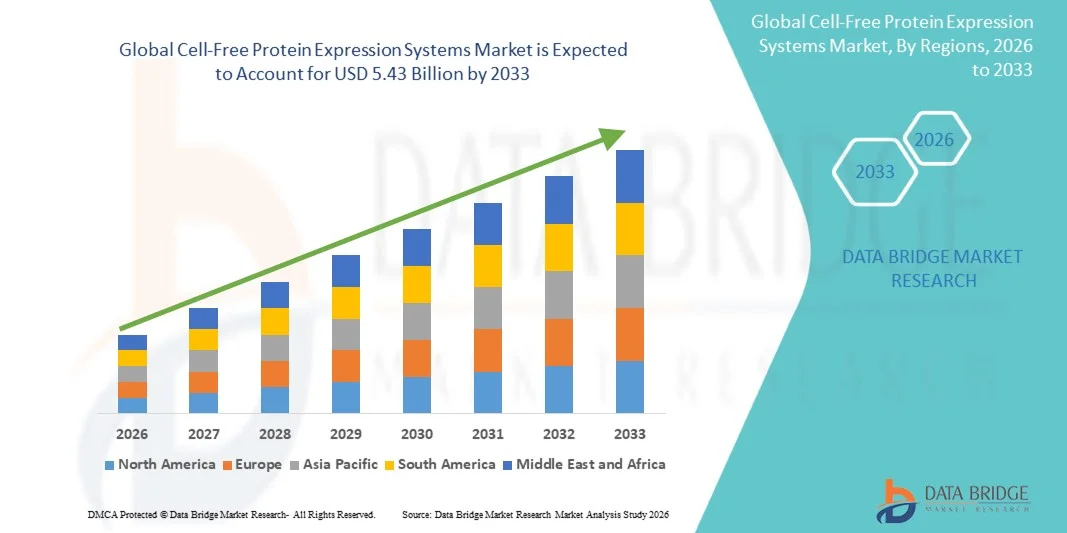
- The global cell-free protein expression systems market size was valued at USD 1.38 billion in 2025 and is expected to reach USD 5.43 billion by 2033, at a CAGR of 18.70% during the forecast period
- The market growth is largely fueled by the increasing demand for rapid protein synthesis and advancements in synthetic biology and protein engineering technologies, leading to accelerated research and development activities in biotechnology and pharmaceutical sectors
- Furthermore, rising focus on personalized medicine, drug discovery, and efficient protein production without the limitations of cell-based systems is establishing cell-free platforms as a preferred solution. These converging factors are accelerating the adoption of cell-free expression systems, thereby significantly boosting the industry's growth
Cell-Free Protein Expression Systems Market Analysis
- Cell-free protein expression systems, enabling in vitro protein synthesis without the use of living cells, are increasingly vital tools in modern biotechnology and pharmaceutical research due to their rapid production capabilities, flexibility, and ability to express complex proteins efficiently
- The escalating demand for cell-free protein expression systems is primarily fueled by the growing focus on drug discovery, synthetic biology advancements, and the need for high-throughput protein production across research and industrial applications
- North America dominated the cell-free protein expression systems market with the largest revenue share of 41.3% in 2025, characterized by strong biotechnology infrastructure, high R&D investments, and the presence of leading industry players, with the U.S. witnessing significant growth in adoption across academic and pharmaceutical research settings
- Asia-Pacific is expected to be the fastest growing region in the cell-free protein expression systems market during the forecast period due to expanding biotechnology capabilities, increasing research funding, and rising collaborations in life sciences
- Transcription & Translation Systems segment dominated the cell-free protein expression systems market with a market share of 42.8% in 2025, driven by its efficiency in simultaneous protein synthesis processes and widespread use in high-throughput and rapid expression applications
Report Scope and Cell-Free Protein Expression Systems Market Segmentation
|
Attributes |
Cell-Free Protein Expression Systems Key Market Insights |
|
Segments Covered |
|
|
Countries Covered |
North America
Europe
Asia-Pacific
Middle East and Africa
South America
|
|
Key Market Players |
|
|
Market Opportunities |
|
|
Value Added Data Infosets |
In addition to the insights on market scenarios such as market value, growth rate, segmentation, geographical coverage, and major players, the market reports curated by the Data Bridge Market Research also include in-depth expert analysis, patient epidemiology, pipeline analysis, pricing analysis, and regulatory framework |
Cell-Free Protein Expression Systems Market Trends
“Rising Adoption of Rapid and Cell-Independent Protein Synthesis Technologies”
- A significant and accelerating trend in the global cell-free protein expression systems market is the increasing adoption of rapid, cell-independent protein synthesis technologies across biotechnology and pharmaceutical research. This advancement is significantly enhancing experimental efficiency and reducing development timelines
- For instance, cell-free platforms such as E. coli-based systems are widely used for rapid protein production, allowing researchers to bypass time-consuming cell culture processes and achieve faster protein expression for screening and analysis purposes. Similarly, wheat germ systems enable efficient synthesis of complex eukaryotic proteins
- Integration with automation and high-throughput screening technologies enables features such as parallel protein synthesis, rapid prototyping, and improved reproducibility of results. For instance, advanced cell-free systems are being utilized in automated workflows to accelerate enzyme engineering and protein interaction studies. Furthermore, these systems offer flexibility in incorporating non-natural amino acids, expanding protein functionality
- The seamless compatibility of cell-free protein expression systems with synthetic biology and molecular engineering platforms facilitates centralized and scalable research workflows. Through integrated systems, researchers can design, produce, and test proteins within a unified environment, improving overall productivity and innovation
- This trend towards more flexible, scalable, and efficient protein synthesis technologies is fundamentally reshaping research methodologies in life sciences. Consequently, companies such as Promega Corporation are developing advanced cell-free systems with enhanced yield, scalability, and compatibility with high-throughput applications
- The demand for cell-free protein expression systems offering rapid, scalable, and flexible protein production is growing rapidly across research and industrial sectors, as organizations increasingly prioritize speed and efficiency in biopharmaceutical development
- Moreover, growing collaborations between academic institutions and biotechnology companies are fostering innovation and accelerating the commercialization of advanced cell-free protein expression technologies
Cell-Free Protein Expression Systems Market Dynamics
Driver
“Growing Demand Driven by Expanding Biopharmaceutical Research and Drug Discovery Activities”
- The increasing focus on biopharmaceutical research and drug discovery, coupled with the need for rapid protein production, is a significant driver for the heightened demand for cell-free protein expression systems
- For instance, in recent years, biotechnology companies have increasingly adopted cell-free platforms to accelerate vaccine development and therapeutic protein screening, enabling faster response to emerging health challenges. Such strategies by key companies are expected to drive the market growth in the forecast period
- As researchers seek faster and more efficient alternatives to traditional cell-based expression systems, cell-free technologies offer advantages such as reduced time, elimination of cell viability constraints, and enhanced control over protein synthesis conditions
- Furthermore, the growing application of these systems in enzyme engineering, protein labeling, and high-throughput screening is making them essential tools in modern laboratories, supporting innovation in both academic and industrial research
- The ability to produce toxic or unstable proteins, along with simplified workflows and scalability, are key factors propelling the adoption of cell-free protein expression systems across pharmaceutical, biotechnology, and research sectors. The increasing availability of user-friendly kits further contributes to market growth
- In addition, rising investments in synthetic biology and proteomics research are further accelerating the demand for efficient and scalable protein expression technologies across global markets
- Moreover, increasing government and private funding for life sciences research is supporting infrastructure development and boosting adoption of advanced cell-free expression platforms
Restraint/Challenge
“High Costs and Technical Limitations in Large-Scale Production”
- Concerns surrounding the relatively high cost of reagents and limited scalability of cell-free systems pose a significant challenge to broader market adoption. As these systems require specialized components and optimization, they can be expensive compared to conventional expression methods
- For instance, the cost of lysates, enzymes, and energy regeneration systems in cell-free platforms can be significantly higher, limiting their use in large-scale commercial protein production. Such factors may restrain market growth in cost-sensitive environments
- Addressing these cost and scalability concerns through technological advancements and process optimization is crucial for wider adoption. Companies are focusing on improving yield efficiency and reducing reagent costs to make systems more economically viable. In addition, variability in protein yield and stability across different systems can impact reproducibility and performance
- While advancements are ongoing, limitations in producing certain complex proteins at industrial scale remain a barrier, particularly for large-volume manufacturing applications. These constraints can restrict adoption beyond research and small-scale production
- Overcoming these challenges through cost reduction strategies, improved system efficiency, and advancements in scalable production technologies will be vital for sustained market growth
- In addition, lack of standardized protocols across different system types can create inconsistencies in results, posing challenges for widespread industrial adoption
- Moreover, limited awareness and technical expertise in emerging markets may hinder adoption, as effective utilization of these systems requires specialized knowledge and training
Cell-Free Protein Expression Systems Market Scope
The market is segmented on the basis of method, application, and end user.
- By Method
On the basis of method, the cell-free protein expression systems market is segmented into transcription & translation systems, translation systems, batch expression, and continuous flow expression. The transcription & translation systems segment dominated the market with the largest revenue share of 42.8% in 2025, driven by its ability to simultaneously perform mRNA synthesis and protein translation in a single reaction. This integrated approach significantly reduces processing time and enhances efficiency, making it highly suitable for high-throughput protein production. Researchers widely prefer these systems for rapid screening and functional analysis of proteins in drug discovery and synthetic biology applications. In addition, their compatibility with automation platforms and reduced complexity compared to separate systems further strengthen their adoption. The increasing demand for fast and reliable protein synthesis workflows continues to support the dominance of this segment.
The continuous flow expression segment is anticipated to witness the fastest growth rate from 2026 to 2033, fueled by its capability to sustain longer protein synthesis reactions and achieve higher yields. Continuous systems allow constant supply of substrates and removal of inhibitory by-products, significantly improving efficiency over batch methods. These systems are gaining traction in advanced research and industrial applications where scalability and productivity are critical. Furthermore, growing interest in large-scale protein production and biomanufacturing is accelerating the adoption of continuous flow technologies. Ongoing innovations aimed at improving system stability and cost-effectiveness are also contributing to the rapid growth of this segment.
- By Application
On the basis of application, the market is segmented into enzyme engineering, high-throughput protein production, protein labeling, protein–protein interaction studies, protein purification, and vaccine & therapeutic development. The high-throughput protein production segment dominated the market with the largest revenue share in 2025, driven by the increasing need for rapid protein synthesis in research and pharmaceutical development. Cell-free systems enable quick generation of multiple protein variants simultaneously, making them ideal for screening and optimization studies. This capability is particularly valuable in drug discovery, where speed and efficiency are critical. In addition, the ability to produce proteins without cell viability constraints enhances flexibility and reliability. The rising adoption of automated workflows in laboratories further supports the dominance of this segment.
The vaccine & therapeutic development segment is expected to witness the fastest growth rate during the forecast period, driven by increasing demand for rapid and flexible production of biologics. Cell-free systems are increasingly being explored for on-demand synthesis of vaccines and therapeutic proteins, especially in response to emerging diseases. Their ability to produce proteins quickly without complex cell culture requirements makes them highly attractive for medical applications. Furthermore, advancements in synthetic biology and personalized medicine are expanding the scope of this segment. Growing investments in healthcare innovation and biopharmaceutical research are also accelerating its growth.
- By End User
On the basis of end user, the market is segmented into pharmaceutical & biotechnology companies, academic & research institutes, contract research organizations (CROs), and others. The pharmaceutical & biotechnology companies segment dominated the market with the largest revenue share in 2025, driven by extensive use of cell-free systems in drug discovery, protein engineering, and biologics development. These companies rely on rapid and scalable protein production technologies to accelerate research timelines and improve efficiency. The growing pipeline of biologics and increasing R&D investments further strengthen the demand for advanced expression systems. In addition, the need for high-quality and reproducible protein synthesis solutions supports widespread adoption in this segment. Strategic collaborations and technological advancements also contribute to its dominance.
The contract research organizations (CROs) segment is anticipated to witness the fastest growth rate from 2026 to 2033, fueled by increasing outsourcing of research and development activities by pharmaceutical and biotech companies. CROs are adopting cell-free protein expression systems to provide efficient and cost-effective research services to their clients. The rising demand for specialized expertise and faster project turnaround times is driving the adoption of advanced protein expression technologies in this segment. Furthermore, expanding global presence of CROs and growing partnerships with industry players are supporting market growth. The flexibility and scalability of cell-free systems make them particularly suitable for diverse research requirements handled by CROs.
Cell-Free Protein Expression Systems Market Regional Analysis
- North America dominated the cell-free protein expression systems market with the largest revenue share of 41.3% in 2025, characterized by strong biotechnology infrastructure, high R&D investments, and the presence of leading industry players
- Researchers and organizations in the region highly value the speed, flexibility, and efficiency offered by cell-free systems for applications such as drug discovery, enzyme engineering, and high-throughput protein production
- This widespread adoption is further supported by robust R&D infrastructure, high funding for life sciences research, and the presence of leading biotechnology companies, establishing cell-free protein expression systems as a preferred solution for both academic and commercial research applications
U.S. Cell-Free Protein Expression Systems Market Insight
The U.S. cell-free protein expression systems market captured the largest revenue share within North America in 2025, fueled by strong investments in biotechnology and the expanding focus on drug discovery and synthetic biology. Research institutions and biopharmaceutical companies are increasingly prioritizing rapid and efficient protein production technologies. The growing preference for high-throughput screening and advanced protein engineering tools further propels the market. Moreover, increasing integration of automation and AI-driven research platforms is significantly contributing to the market's expansion.
Europe Cell-Free Protein Expression Systems Market Insight
The Europe cell-free protein expression systems market is projected to expand at a substantial CAGR throughout the forecast period, primarily driven by increasing research funding and the growing emphasis on advanced biotechnological solutions. The rise in academic and industrial collaborations, coupled with demand for efficient protein synthesis technologies, is fostering adoption. European researchers are also drawn to the flexibility and precision these systems offer. The region is experiencing notable growth across pharmaceutical and academic applications, with cell-free systems being increasingly incorporated into research workflows.
U.K. Cell-Free Protein Expression Systems Market Insight
The U.K. cell-free protein expression systems market is anticipated to grow at a noteworthy CAGR during the forecast period, driven by rising investments in life sciences and a strong focus on innovative research methodologies. In addition, demand for faster and more reliable protein production techniques is encouraging adoption across academic and industrial sectors. The UK’s strong research ecosystem, alongside its advanced laboratory infrastructure, is expected to continue to stimulate market growth.
Germany Cell-Free Protein Expression Systems Market Insight
The Germany cell-free protein expression systems market is expected to expand at a considerable CAGR during the forecast period, fueled by increasing focus on biotechnology innovation and demand for efficient protein synthesis technologies. Germany’s well-developed research infrastructure, combined with its emphasis on precision and quality, promotes adoption, particularly in pharmaceutical and industrial research. The integration of advanced expression systems into research workflows is also becoming increasingly prevalent, aligning with the country’s strong focus on scientific advancement.
Asia-Pacific Cell-Free Protein Expression Systems Market Insight
The Asia-Pacific cell-free protein expression systems market is poised to grow at the fastest CAGR during the forecast period of 2026 to 2033, driven by expanding biotechnology sectors, rising research investments, and increasing adoption of advanced laboratory technologies in countries such as China, Japan, and India. The region's growing focus on biopharmaceutical development, supported by government initiatives, is driving adoption. Furthermore, as APAC emerges as a key hub for research and manufacturing, the accessibility of advanced protein expression technologies is expanding to a broader user base.
Japan Cell-Free Protein Expression Systems Market Insight
The Japan cell-free protein expression systems market is gaining momentum due to the country’s advanced technological capabilities, strong research focus, and increasing demand for efficient protein synthesis. The market places a significant emphasis on precision and innovation, and adoption is driven by growing applications in drug discovery and synthetic biology. The integration of these systems with automation and high-throughput technologies is fueling growth. Moreover, Japan's continuous investments in biotechnology research are likely to spur further demand across academic and industrial sectors.
India Cell-Free Protein Expression Systems Market Insight
The India cell-free protein expression systems market accounted for a significant market share in Asia Pacific in 2025, attributed to the country's expanding biotechnology sector, increasing research activities, and rising adoption of advanced laboratory technologies. India stands as a growing market for life sciences research, and cell-free systems are becoming increasingly popular in academic, pharmaceutical, and research institutions. The push towards innovation in biotechnology and the availability of cost-effective research solutions, alongside increasing government support, are key factors propelling the market in India.
Cell-Free Protein Expression Systems Market Share
The Cell-Free Protein Expression Systems industry is primarily led by well-established companies, including:
- Thermo Fisher Scientific Inc. (U.S.)
- Promega Corporation (U.S.)
- Merck KGaA (Germany)
- Takara Bio Inc. (Japan)
- New England Biolabs, Inc. (U.S.)
- Bio-Rad Laboratories, Inc. (U.S.)
- Jena Bioscience GmbH (Germany)
- GeneCopoeia, Inc. (U.S.)
- CellFree Sciences Co., Ltd. (Japan)
- Bioneer Corporation (South Korea)
- Cube Biotech GmbH (Germany)
- LenioBio GmbH (Germany)
- Arbor Biosciences (U.S.)
- Nuclera Nucleics Ltd. (U.K.)
- Sutro Biopharma, Inc. (U.S.)
- Synthelis (France)
- VectorBuilder Inc. (U.S.)
- Creative Biolabs (U.S.)
- Profacgen (U.S.)
- biotechrabbit GmbH (Germany)
What are the Recent Developments in Global Cell-Free Protein Expression Systems Market?
- June 2024, researchers highlighted the growing role of cell-free protein synthesis platforms in accelerating drug discovery by integrating artificial intelligence and machine learning tools. These platforms enable rapid prototyping and testing of proteins, significantly improving efficiency and reducing development timelines in pharmaceutical research
- In March 2024, Promega Corporation expanded its cell-free protein expression portfolio with advanced TNT® coupled transcription/translation systems, designed for rapid in vitro protein synthesis in a single-tube format. These systems enable researchers to generate functional proteins within hours directly from DNA or RNA templates, significantly reducing experimental timelines and improving efficiency in proteomics and drug discovery workflows
- In September 2023, Promega Corporation introduced enhancements to its TNT® T7 Insect Cell Extract Protein Expression System, offering a streamlined, single-tube coupled transcription and translation process for efficient protein production. The system simplifies workflows by eliminating the need for separate RNA synthesis steps and enables faster protein generation, supporting applications in functional protein analysis and synthetic biology research
- In March 2023, researchers introduced new optimization techniques for amino acid balancing in cell-free protein synthesis systems, improving protein yield prediction and efficiency. This innovation enables better performance evaluation across different systems and supports the development of more efficient and cost-effective protein expression platforms
- In January 2021, scientists demonstrated advancements in compartmentalized cell-free expression systems using phase separation techniques, enabling controlled protein synthesis within microenvironments. This breakthrough supports the development of synthetic biology applications such as artificial cells and advanced biomolecular engineering systems

- Interactive Data Analysis Dashboard
- Company Analysis Dashboard for high growth potential opportunities
- Research Analyst Access for customization & queries
- Competitor Analysis with Interactive dashboard
- Latest News, Updates & Trend analysis
- Harness the Power of Benchmark Analysis for Comprehensive Competitor Tracking
Data collection and base year analysis are done using data collection modules with large sample sizes. The stage includes obtaining market information or related data through various sources and strategies. It includes examining and planning all the data acquired from the past in advance. It likewise envelops the examination of information inconsistencies seen across different information sources. The market data is analysed and estimated using market statistical and coherent models. Also, market share analysis and key trend analysis are the major success factors in the market report. To know more, please request an analyst call or drop down your inquiry.
The key research methodology used by DBMR research team is data triangulation which involves data mining, analysis of the impact of data variables on the market and primary (industry expert) validation. Data models include Vendor Positioning Grid, Market Time Line Analysis, Market Overview and Guide, Company Positioning Grid, Patent Analysis, Pricing Analysis, Company Market Share Analysis, Standards of Measurement, Global versus Regional and Vendor Share Analysis. To know more about the research methodology, drop in an inquiry to speak to our industry experts.
Data Bridge Market Research is a leader in advanced formative research. We take pride in servicing our existing and new customers with data and analysis that match and suits their goal. The report can be customized to include price trend analysis of target brands understanding the market for additional countries (ask for the list of countries), clinical trial results data, literature review, refurbished market and product base analysis. Market analysis of target competitors can be analyzed from technology-based analysis to market portfolio strategies. We can add as many competitors that you require data about in the format and data style you are looking for. Our team of analysts can also provide you data in crude raw excel files pivot tables (Fact book) or can assist you in creating presentations from the data sets available in the report.













