


Cell Line Development Outsourcing Market Overview
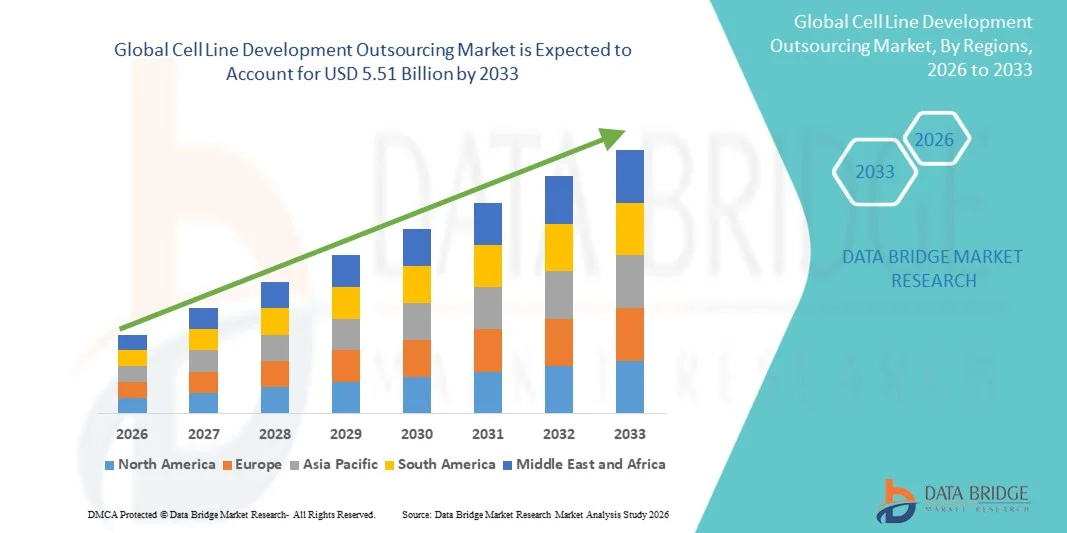
The Cell Line Development Outsourcing Market was valued at USD 1.84 billion in 2025 and is projected to reach USD 5.51 billion by 2033, growing at a CAGR of 14.70% from 2026 to 2033. The market is experiencing consistent growth driven by rising demand for outsourced biopharmaceutical development services, increasing adoption of advanced cell line technologies, and expanding applications across monoclonal antibody production, vaccines, gene therapies, and biologics manufacturing.
The growing complexity of biologic drug development, increasing investments in biotechnology research, and rising need for cost-effective and scalable manufacturing solutions are encouraging pharmaceutical and biotechnology companies to outsource cell line development activities to specialized service providers. Advanced technologies such as CRISPR-based engineering, high-throughput screening, and automated cell line optimization are improving development efficiency and accelerating biologics production timelines. Contract research organizations (CROs) and contract development and manufacturing organizations (CDMOs) are increasingly supporting drug developers by providing expertise in cell line generation, characterization, and validation, enabling faster commercialization of next-generation therapies.
Key Market Trends & Insights
- North America dominated the Cell Line Development Outsourcing Market with the largest revenue share of 36.2% in 2025, supported by the strong presence of pharmaceutical and biotechnology companies, advanced biomanufacturing infrastructure, and increasing outsourcing of complex biologics development activities to specialized service providers. The region benefits from significant investments in biologics, cell-based therapies, and precision medicine research, along with the presence of established CROs and CDMOs offering advanced cell line engineering, characterization, and banking services.
- The mammalian cell lines segment dominated the market with a 68.5% share in 2025, owing to their extensive application in the production of monoclonal antibodies, recombinant proteins, vaccines, and other complex biologics.
- Asia-Pacific is expected to be the fastest-growing region at a CAGR of 10.1% from 2026 to 2033, fueled by increasing investments in biopharmaceutical manufacturing, expansion of CDMO capabilities, rising clinical research activities, and growing adoption of outsourced cell line development services across China, India, South Korea, and Japan. Government initiatives supporting biotechnology innovation and biologics production are further accelerating regional market expansion.
- The cell line development service segment dominated the service type category with a 39.7% revenue share in 2025, owing to rising demand for customized cell line generation, optimization of production platforms, and accelerated biologics development timelines. Pharmaceutical companies are increasingly outsourcing cell line development activities to specialized providers to reduce research costs, improve scalability, and access advanced technologies such as gene editing and high-throughput screening.
Market Size & Forecast
- Global Market Value (2025): USD 1.84 Billion
- Expected Market Value (2033): USD 5.51 Billion
- Forecast CAGR (2026–2033): 14.70%
- Leading Region in 2025: North America
- Fastest Growing Region: Asia-Pacific
Report Scope and Cell Line Development Outsourcing Market Segmentation
|
Attributes |
Cell Line Development Outsourcing Key Market Insights |
|
Segments Covered |
|
|
Countries Covered |
North America · U.S. · Canada · Mexico Europe · Germany · France · U.K. · Netherlands · Switzerland · Belgium · Russia · Italy · Spain · Turkey · Rest of Europe Asia-Pacific · China · Japan · India · South Korea · Singapore · Malaysia · Australia · Thailand · Indonesia · Philippines · Rest of Asia-Pacific Middle East and Africa · Saudi Arabia · U.A.E. · South Africa · Egypt · Israel · Rest of Middle East and Africa South America · Brazil · Argentina · Rest of South America |
|
Key Market Players |
• Thermo Fisher Scientific (U.S.) |
|
Market Opportunities |
· Increasing Adoption of Biologics, Monoclonal Antibodies, and Advanced Therapies · Expansion of Cell and Gene Therapy Manufacturing and Personalized Medicine · Rising Demand for Advanced Automation and High-Throughput Cell Line Development Technologies |
|
Value Added Data Infosets |
In addition to the insights on market scenarios such as market value, growth rate, segmentation, geographical coverage, and major players, the market reports curated by the Data Bridge Market Research also include in-depth expert analysis, geographically represented company-wise production and capacity, network layouts of distributors and partners, detailed and updated price trend analysis and deficit analysis of supply chain and demand. |
Cell Line Development Outsourcing Market Trends
Trend: Growth in Outsourcing of Advanced Biologics and Cell-Based Therapeutic Development
Pharmaceutical and biotechnology companies are increasingly outsourcing high-complexity cell line development activities to specialized service providers to accelerate biologics discovery, improve manufacturing efficiency, and reduce development timelines. The rising demand for monoclonal antibodies, recombinant proteins, vaccines, and gene therapies is driving the adoption of advanced cell line engineering platforms, including mammalian cell systems, gene-edited cell lines, and high-throughput screening technologies. Contract development and manufacturing organizations (CDMOs) and contract research organizations (CROs) are expanding their capabilities in cell line generation, characterization, stability testing, and cell banking to support growing biologics pipelines. For instance, leading providers such as Lonza Group AG, Thermo Fisher Scientific, and Samsung Biologics continue to invest in integrated biologics development and manufacturing platforms, strengthening outsourcing adoption across global pharmaceutical markets.
Cell Line Development Outsourcing Market Dynamics
Key Market Driver: Increasing Demand for Biologics, Monoclonal Antibodies, and Advanced Therapies
The growing global demand for biologic medicines is a major factor driving the expansion of the cell line development outsourcing market. Increasing approvals of monoclonal antibodies, recombinant proteins, vaccines, and cell-based therapies are encouraging pharmaceutical companies to utilize specialized outsourcing partners for efficient and scalable cell line development. Mammalian cell lines, particularly Chinese Hamster Ovary (CHO) cells, remain widely used due to their ability to produce complex therapeutic proteins with appropriate post-translational modifications. According to industry trends, the global biologics pipeline continues to expand, creating increased requirements for optimized production cell lines, regulatory-compliant characterization, and reliable cell banking solutions. In addition, advancements in CRISPR-based gene editing, automation, and high-throughput screening are improving the speed and accuracy of cell line development processes, further supporting market growth.
Key Restraint/Challenge: High Cost and Complexity Associated with Cell Line Development and Regulatory Compliance
A significant challenge in the Cell Line Development Outsourcing Market is the high cost associated with advanced cell engineering, characterization, validation, and regulatory documentation. Developing a stable, high-yield production cell line requires extensive laboratory expertise, specialized analytical platforms, and strict quality control processes. Small and mid-sized biotechnology companies often face challenges related to limited budgets, technology access, and regulatory requirements for biologics manufacturing. In addition, variations in regulatory guidelines across regions increase complexity for companies outsourcing cell line development activities globally. The need for advanced infrastructure, skilled professionals, and continuous investment in next-generation technologies can impact adoption among smaller organizations.
Key Market Opportunity: Expansion of Precision Medicine, Gene Therapy, and Next-Generation Cell Engineering Platforms
The increasing adoption of precision medicine, gene therapies, and engineered cell-based treatments presents significant growth opportunities for the cell line development outsourcing market. Advanced therapies require customized and highly optimized cell systems to support efficient production, scalability, and consistent therapeutic performance. The growing pipeline of viral vectors, recombinant proteins, and personalized medicine approaches is increasing demand for specialized cell line engineering services. For instance, the expansion of gene therapy research and commercial programs has increased the need for optimized producer cell lines, while advancements in artificial intelligence, automation, and digital laboratory platforms are enabling faster cell line screening and development workflows. Furthermore, increasing investments in biopharmaceutical manufacturing capacity across Asia-Pacific, particularly in China, South Korea, and India, are creating new opportunities for global outsourcing providers and CDMOs.
Cell Line Development Outsourcing Market Scope
The cell line development outsourcingmarket is segmented on the basis of cell line type, service type, application, and end user.
- By Cell Line Type
On the basis of cell line type, the Cell Line Development Outsourcing Market is segmented into mammalian cell lines, microbial cell lines, insect cell lines, stem cell lines, and others. The mammalian cell lines segment dominated the market with a 68.5% share in 2025, owing to their extensive application in the production of monoclonal antibodies, recombinant proteins, vaccines, and other complex biologics. Mammalian cell platforms, particularly CHO cell lines, are widely preferred due to their ability to provide efficient protein expression, proper post-translational modifications, and scalability for commercial manufacturing. Increasing demand for biologic drugs, biosimilars, and advanced therapeutic products is encouraging pharmaceutical and biotechnology companies to outsource mammalian cell line development activities. In addition, regulatory acceptance, established manufacturing workflows, and strong adoption across large-scale biologics production facilities are reinforcing the dominance of this segment globally.
The Stem cell lines segment is expected to witness the fastest growth at a CAGR of 12.6% from 2026 to 2033, driven by increasing research activities in regenerative medicine, personalized medicine, and advanced cell-based therapies. The rising development of induced pluripotent stem cells (iPSCs), disease modeling platforms, and regenerative therapeutic solutions is creating significant demand for specialized stem cell development services. Growing investments in gene editing technologies, precision medicine, and next-generation therapeutics are further supporting segment expansion. In addition, pharmaceutical companies and research organizations are increasingly collaborating with outsourcing providers to access advanced stem cell engineering capabilities, accelerating innovation in emerging therapeutic areas.
- By Service Type
On the basis of service type, the Cell Line Development Outsourcing Market is segmented into cell line development, cell line characterization, cell banking, genetic engineering, and other related services. The cell line development segment dominated the market with a 39.7% share in 2025, supported by increasing outsourcing of cell line generation and optimization activities by pharmaceutical and biotechnology companies. The growing demand for high-yield, stable, and regulatory-compliant production cell lines for biologics manufacturing is driving adoption of specialized development services. Outsourcing companies provide advanced platforms for clone selection, expression optimization, and scalability assessment, helping organizations reduce development timelines and operational costs. In addition, the increasing complexity of biologic manufacturing and rising demand for customized cell systems are strengthening the growth of this segment.
The genetic engineering segment is projected to register the fastest growth at a CAGR of 11.3% from 2026 to 2033, driven by increasing adoption of advanced gene editing technologies such as CRISPR, synthetic biology, and engineered cell platforms. The growing need for genetically modified cell lines with improved productivity, enhanced therapeutic protein expression, and optimized manufacturing performance is accelerating demand for genetic engineering services. Pharmaceutical companies are increasingly utilizing engineered cell systems for monoclonal antibodies, gene therapies, and recombinant biologics development. Furthermore, continuous innovation in molecular biology tools and precision engineering approaches is expected to create significant growth opportunities for outsourcing providers.
- By Application
On the basis of application, the Cell Line Development Outsourcing Market is segmented into biopharmaceutical production, vaccine production, monoclonal antibody development, gene therapy, and research & development. The biopharmaceutical production segment dominated the market with a 42.8% share in 2025, due to increasing demand for biologic medicines, including recombinant proteins, therapeutic antibodies, and advanced biologics. The expansion of biologics pipelines and rising approvals of complex therapeutic products are encouraging pharmaceutical companies to outsource cell line development and characterization activities. Cell line outsourcing helps companies improve production efficiency, reduce development risks, and accelerate commercialization timelines. In addition, increasing investments in biologics manufacturing infrastructure and growing demand for scalable production platforms are supporting segment growth.
The gene therapy segment is expected to witness the fastest growth at a CAGR of 12.4% from 2026 to 2033, driven by rising research and development activities in advanced therapies, viral vector manufacturing, and personalized medicine. The increasing number of gene therapy candidates entering clinical development is creating demand for specialized cell line engineering and optimized production systems. Advances in cell engineering, automation, and high-throughput screening technologies are improving the efficiency of gene therapy manufacturing workflows. Furthermore, growing investments from biotechnology companies and research institutions in next-generation therapies are expected to accelerate adoption of outsourced cell line development services.
- By End User
On the basis of end user, the Cell Line Development Outsourcing Market is segmented into pharmaceutical & biotechnology companies, contract research organizations (CROs), Academic & research institutes, and contract development & manufacturing organizations (CDMOs). The pharmaceutical & biotechnology companies segment dominated the market with a 55.6% share in 2025, driven by increasing reliance on outsourcing partners for biologics development, cell line optimization, and manufacturing support. Pharmaceutical companies are increasingly adopting outsourcing models to reduce operational costs, access advanced technologies, and shorten drug development timelines. Growing demand for monoclonal antibodies, vaccines, recombinant proteins, and gene therapies is further increasing the requirement for specialized cell line development services. In addition, partnerships between pharmaceutical companies and outsourcing providers are strengthening market expansion.
The contract development & manufacturing organizations (CDMOs) segment is expected to witness the fastest growth at a CAGR of 11.8% from 2026 to 2033, driven by increasing demand for integrated biologics development and manufacturing solutions. CDMOs are expanding their capabilities across cell line generation, characterization, analytical testing, process optimization, and commercial-scale production support. The growing preference for flexible outsourcing models among emerging biotechnology companies is accelerating CDMO adoption. In addition, increasing investments by CDMOs in advanced biologics facilities, automation technologies, and cell engineering platforms are creating new opportunities for market growth worldwide.
Cell Line Development Outsourcing Market Regional Analysis
North America dominated the cell line development outsourcing market and accounted for the largest revenue share of 36.2% in 2025, supported by the strong presence of pharmaceutical and biotechnology companies, advanced biomanufacturing infrastructure, and increasing outsourcing of complex biologics development activities to specialized service providers. The region benefits from significant investments in biologics, cell-based therapies, precision medicine research, and advanced genetic engineering technologies. The presence of established CROs and CDMOs offering cell line engineering, characterization, optimization, and banking services is further strengthening market growth. Increasing adoption of outsourcing strategies by pharmaceutical companies to reduce development timelines and improve manufacturing efficiency continues to drive demand for cell line development services across North America.
U.S. Cell Line Development Outsourcing Market Insight
The U.S. cell line development outsourcing market is witnessing strong growth due to the presence of leading pharmaceutical and biotechnology companies, advanced research infrastructure, and increasing demand for biologics and next-generation therapies. The country’s strong ecosystem of CROs, CDMOs, and life science companies is supporting the expansion of outsourced cell line development activities, including cell line generation, screening, characterization, and validation. In addition, rising investments in monoclonal antibodies, vaccines, cell and gene therapies, and precision medicine are accelerating demand for advanced cell line development solutions across pharmaceutical and biotechnology sectors.
Europe Cell Line Development Outsourcing Market Insight
The Europe cell line development outsourcing market remains a major contributor to global revenue, driven by strong biotechnology research capabilities, increasing adoption of biologics manufacturing, and growing partnerships between pharmaceutical companies and outsourcing providers. The region benefits from advanced healthcare infrastructure, strong regulatory frameworks, and increasing investments in innovative therapeutic development. Expanding demand for efficient biologics production, along with the presence of specialized CDMOs and research organizations, is supporting the adoption of outsourced cell line development services throughout Europe.
U.K. Cell Line Development Outsourcing Market Insight
The U.K. cell line development outsourcing market is experiencing steady growth, supported by increasing biotechnology research activities, expansion of life science industries, and rising demand for outsourced biologics development services. The country’s strong academic research base and growing collaboration between pharmaceutical companies and biotechnology organizations are driving adoption of advanced cell line engineering and characterization services. Furthermore, increasing focus on personalized medicine, cell-based therapies, and innovative biologic drug development is contributing to market expansion in the U.K.
Germany Cell Line Development Outsourcing Market Insight
The Germany cell line development outsourcing market is expanding steadily due to the country’s strong pharmaceutical manufacturing base, advanced biotechnology ecosystem, and increasing investment in biologics research. Pharmaceutical companies and research organizations are increasingly outsourcing cell line development activities to improve efficiency, reduce development costs, and accelerate commercialization timelines. Continuous advancements in genetic engineering, automation, and bioprocessing technologies, along with strong government support for biotechnology innovation, are further driving market growth in Germany.
Asia-Pacific Cell Line Development Outsourcing Market Insight
The Asia-Pacific cell line development outsourcing market is expected to witness rapid growth at a CAGR of 10.1% from 2026 to 2033, driven by increasing investments in biopharmaceutical manufacturing, expansion of CDMO capabilities, rising clinical research activities, and growing adoption of outsourced cell line development services across countries such as China, India, South Korea, and Japan. The region is benefiting from increasing biotechnology innovation, cost advantages, and improving research infrastructure. In addition, government initiatives supporting biologics production, healthcare modernization, and biotechnology development are accelerating the adoption of cell line development outsourcing solutions across the region.
Japan Cell Line Development Outsourcing Market Insight
The Japan cell line development outsourcing market is witnessing consistent growth due to increasing investments in biotechnology research, advanced pharmaceutical manufacturing, and development of biologic therapies. Pharmaceutical companies and research institutes are increasingly collaborating with specialized outsourcing providers for cell line engineering, optimization, and characterization activities. Moreover, rising adoption of regenerative medicine, precision medicine, and advanced biologics development approaches is further supporting market expansion in Japan.
China Cell Line Development Outsourcing Market Insight
The China cell line development outsourcing market is growing rapidly, driven by expanding biopharmaceutical manufacturing capabilities, increasing investment in biotechnology research, and rising demand for cost-effective biologics development solutions. The country is witnessing strong growth in CDMO services, clinical research activities, and outsourced cell line development projects due to increasing adoption by domestic and international pharmaceutical companies. In addition, government support for biotechnology innovation, growing production of biologics, and increasing focus on advanced therapies are positioning China as one of the fastest-growing markets for Cell Line Development Outsourcing globally.
Cell Line Development Outsourcing Market Share
The cell line development outsourcing industry is primarily led by well-established companies, including:
- Thermo Fisher Scientific (U.S.)
- Lonza Group (Switzerland)
- Merck KGaA (Germany)
- Sartorius AG (Germany)
- Charles River Laboratories (U.S.)
- Samsung Biologics (South Korea)
- WuXi AppTec (China)
- WuXi Biologics (China)
- Catalent (U.S.)
- Eurofins Scientific (Luxembourg)
- GenScript Biotech (China)
- AGC Biologics (U.S.)
- Fujifilm Diosynth Biotechnologies (Japan)
- Boehringer Ingelheim (Germany)
- Recipharm (Sweden)
- Bio-Techne (U.S.)
- Creative Biolabs (U.S.)
- Abzena (U.K.)
- KBI Biopharma (U.S.)
- Syngene International (India)
- Vibalogics (Germany)
- Evotec (Germany)
- Genovis (Sweden)
- Biovian (Finland)
- ProteoGenix (France)
- ProBioGen AG (Germany)
- MabPlex (China)
- Rentschler Biopharma (Germany)
- Biosynth (Switzerland)
- Selexis (Switzerland)
- Sphere Fluidics (U.K.)
- ValitaCell (Ireland)
- Nitto Denko Avecia Pharma Services (U.S.)
Latest Developments in Cell Line Development Outsourcing Market
- In January 2021, Lonza announced the expansion of its biopharmaceutical development and manufacturing capabilities through investments in advanced cell line development and biologics production technologies. The expansion supported increasing demand from pharmaceutical and biotechnology companies for outsourced services, including mammalian cell line development, process optimization, and manufacturing support for complex biologics. This development strengthened Lonza’s position as a key CDMO provider supporting faster development and commercialization of next-generation therapies
- In March 2022, Thermo Fisher Scientific announced the expansion of its bioproduction capabilities with enhanced cell line development and biologics manufacturing solutions through its Gibco portfolio. The company introduced advanced tools and services designed to improve cell line engineering, productivity, and scalability for biopharmaceutical developers. This expansion supported growing demand for outsourced development solutions in monoclonal antibodies, vaccines, and other biologic therapies
- In September 2022, WuXi Biologics announced the expansion of its global biologics development and manufacturing network with additional capabilities supporting cell line development, process development, and commercial manufacturing. The expansion aimed to meet increasing demand from biotechnology companies seeking integrated outsourcing solutions for biologics development. This initiative strengthened WuXi Biologics’ ability to provide end-to-end services from early-stage research to large-scale production
- In April 2023, Samsung Biologics announced the expansion of its biologics development and manufacturing capabilities with additional investment in its global CDMO infrastructure. The expansion included strengthening support for cell line development, process development, and advanced biologics manufacturing services. This development highlighted the increasing role of CDMOs in supporting pharmaceutical companies seeking flexible outsourcing models for biologic drug development
- In June 2023, Sartorius announced advancements in its bioprocessing technologies and expanded solutions supporting cell line development and biologics manufacturing workflows. The company focused on improving automation, process monitoring, and laboratory efficiency to support pharmaceutical and biotechnology companies developing complex biologics. These advancements supported the growing adoption of integrated and technology-driven outsourcing solutions in biopharmaceutical research
- In February 2024, Charles River Laboratories announced the expansion of its biologics testing and development service capabilities to support increasing demand for outsourced pharmaceutical research solutions. The company enhanced its support for biologics developers through integrated services including cell line characterization, safety testing, and regulatory support. This development reflected the growing demand for specialized outsourcing partners in biologics and advanced therapy development
- In May 2024, Fujifilm Diosynth Biotechnologies announced investments to expand its global biopharmaceutical manufacturing and development capabilities, including support for cell line development and process development activities. The expansion aimed to support increasing demand for biologics, vaccines, and advanced therapies by providing scalable outsourcing solutions. This investment reinforced the company’s focus on strengthening its CDMO capabilities for next-generation therapeutics
- In October 2024, Merck KGaA announced enhancements to its life science business capabilities through expanded bioprocessing solutions supporting biologics development and manufacturing. The company continued development of advanced technologies for cell culture, process optimization, and laboratory workflows to support pharmaceutical customers. These initiatives contributed to improving efficiency and scalability in outsourced cell line development and biologics production
- In January 2025, WuXi AppTec continued expanding its integrated pharmaceutical R&D and manufacturing service capabilities, including support for biologics development and cell-based research activities. The company strengthened its outsourcing platform to support biotechnology companies with advanced research, development, and manufacturing solutions. This development reflects the increasing demand for comprehensive outsourcing partners in the global biopharmaceutical industry
- In March 2025, AGC Biologics announced continued expansion of its global CDMO capabilities to support increasing demand for biologics and advanced therapeutic development. The company focused on enhancing its expertise in mammalian cell line development, process development, and manufacturing services. This expansion supported pharmaceutical and biotechnology companies seeking reliable outsourcing partners for complex biologic products

- Interactive Data Analysis Dashboard
- Company Analysis Dashboard for high growth potential opportunities
- Research Analyst Access for customization & queries
- Competitor Analysis with Interactive dashboard
- Latest News, Updates & Trend analysis
- Harness the Power of Benchmark Analysis for Comprehensive Competitor Tracking
Data collection and base year analysis are done using data collection modules with large sample sizes. The stage includes obtaining market information or related data through various sources and strategies. It includes examining and planning all the data acquired from the past in advance. It likewise envelops the examination of information inconsistencies seen across different information sources. The market data is analysed and estimated using market statistical and coherent models. Also, market share analysis and key trend analysis are the major success factors in the market report. To know more, please request an analyst call or drop down your inquiry.
The key research methodology used by DBMR research team is data triangulation which involves data mining, analysis of the impact of data variables on the market and primary (industry expert) validation. Data models include Vendor Positioning Grid, Market Time Line Analysis, Market Overview and Guide, Company Positioning Grid, Patent Analysis, Pricing Analysis, Company Market Share Analysis, Standards of Measurement, Global versus Regional and Vendor Share Analysis. To know more about the research methodology, drop in an inquiry to speak to our industry experts.
Data Bridge Market Research is a leader in advanced formative research. We take pride in servicing our existing and new customers with data and analysis that match and suits their goal. The report can be customized to include price trend analysis of target brands understanding the market for additional countries (ask for the list of countries), clinical trial results data, literature review, refurbished market and product base analysis. Market analysis of target competitors can be analyzed from technology-based analysis to market portfolio strategies. We can add as many competitors that you require data about in the format and data style you are looking for. Our team of analysts can also provide you data in crude raw excel files pivot tables (Fact book) or can assist you in creating presentations from the data sets available in the report.













