


What is the Cell Programming and Reprogramming Technologies Market Size and Overview?
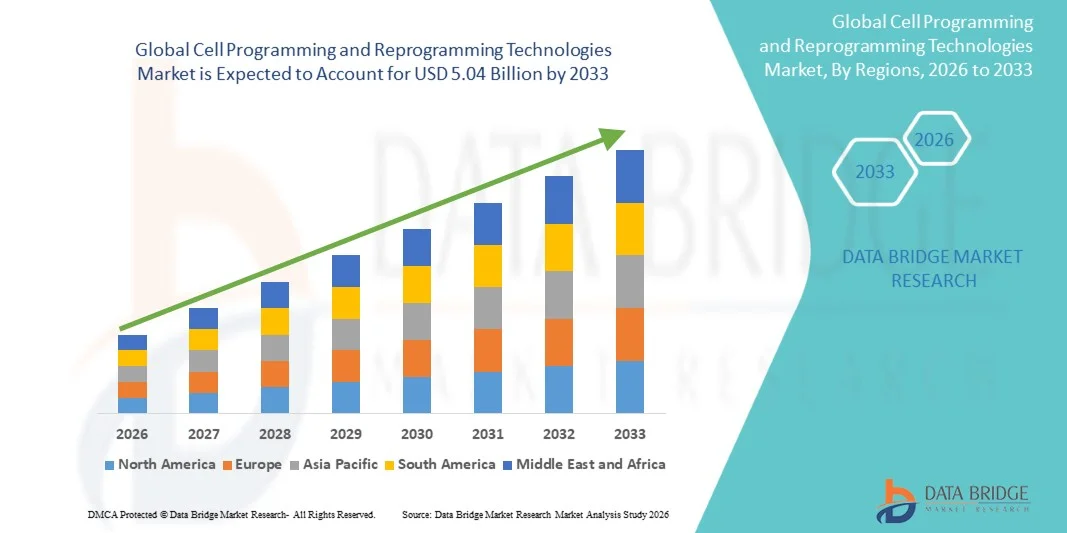
- As per Data Bridge Market Research Analysis The global Cell Programming & Reprogramming Technologies market size was valued at USD 1.28 billion in 2025 and is expected to reach USD 5.04 billion by 2033, at a CAGR of 18.70% during the forecast period
- The market growth is largely fueled by the increasing advancements in stem cell research, rising adoption of regenerative medicine, and growing focus on personalized therapies, leading to enhanced innovation in biomedical and clinical applications
- Furthermore, rising demand for effective disease modeling, drug discovery, and gene editing solutions is establishing cell programming and reprogramming technologies as critical tools in modern life sciences. These converging factors are accelerating the uptake of Cell Programming & Reprogramming Technologies solutions, thereby significantly boosting the industry's growth
Market Size & Forecast
- Global Market Value (2025): USD 1.28 billion
- Expected Market Value (2033): USD 5.04 billion
- Forecast CAGR (2026–2033):18.70%
What are the Major Takeaways of Cell Programming & Reprogramming Technologies Market?
- Cell programming and reprogramming technologies, enabling precise manipulation of cellular states for therapeutic, research, and drug discovery purposes, are increasingly vital components of modern life sciences and regenerative medicine due to their enhanced efficiency, reproducibility, and integration with advanced laboratory workflows
- The escalating demand for these technologies is primarily fueled by the growing focus on personalized medicine, rising stem cell research initiatives, and increasing adoption in pharmaceutical and biotechnology applications
- North America dominated the cell programming & reprogramming technologies market with the largest revenue share of approximately 38.7% in 2025, supported by advanced research infrastructure, high adoption of stem cell and regenerative medicine technologies, and the strong presence of leading industry players. The U.S. is experiencing substantial growth in cell programming and reprogramming solutions across research laboratories, hospitals, and biopharma centers, driven by innovations in CRISPR, induced pluripotent stem cell (iPSC) technologies, and automation platforms
- Asia-Pacific is expected to be the fastest-growing region in the cell programming & reprogramming technologies market during the forecast period, registering a CAGR of approximately 9.5%, driven by increasing investments in life sciences research, growing adoption of advanced therapeutic platforms in countries such as China, Japan, and India, and expanding infrastructure for biotechnology and pharmaceutical applications
- The regenerative medicine segment accounted for the largest market revenue share of 48.3% in 2025, driven by the increasing need for cell-based therapies and organ repair
Report Scope and Cell Programming & Reprogramming Technologies Market Segmentation
Attributes |
Cell Programming & Reprogramming Technologies Key Market Insights |
|
Segments Covered |
|
|
Countries Covered |
North America
Europe
Asia-Pacific
Middle East and Africa
South America
|
|
Key Market Players |
• Thermo Fisher Scientific (U.S.) |
|
Market Opportunities |
|
|
Value Added Data Infosets |
In addition to the insights on market scenarios such as market value, growth rate, segmentation, geographical coverage, and major players, the market reports curated by the Data Bridge Market Research also include in-depth expert analysis, patient epidemiology, pipeline analysis, pricing analysis, and regulatory framework. |
What is the Key Trend in the Cell Programming & Reprogramming Technologies Market?
“Advancements in Cell Reprogramming and Integration into Therapeutic Applications”
- A key trend in the global cell programming & reprogramming technologies market is the continuous development of innovative platforms that enhance cellular reprogramming efficiency, precision, and reproducibility. This includes platforms that allow high-throughput screening, automated cell culture, and integration with bioinformatics for predictive modeling
- For instance, in 2024, Cellaria Therapeutics launched its automated iPSC reprogramming platform, which reduces manual handling errors and improves yield consistency across multiple cell lines, enabling researchers to accelerate drug discovery and regenerative medicine studies
- Technologies enabling direct reprogramming, induced pluripotent stem cell (iPSC) generation, and lineage-specific differentiation are being increasingly adopted to support regenerative medicine, disease modeling, and drug discovery
- There is also a trend toward combining cell programming technologies with genome editing, organoid formation, and single-cell sequencing to optimize therapeutic outcomes and enable more precise modeling of patient-specific diseases
- Efforts are underway to standardize protocols across laboratories, ensuring reproducibility and regulatory compliance, which supports broader adoption in clinical research and translational applications
Cell Programming & Reprogramming Technologies Market Dynamics
Driver
“Increasing Demand for Regenerative Medicine and Personalized Therapeutics”
- The growing prevalence of chronic diseases, organ failures, and age-related degenerative conditions is driving the demand for advanced cell programming and reprogramming solutions in regenerative medicine and tissue engineering
- For instance, in 2023, Fate Therapeutics reported the successful use of reprogrammed iPSC-derived natural killer (NK) cells in preclinical cancer immunotherapy studies, highlighting the potential of these technologies to deliver personalized treatments and improve patient outcome
- Rising investments by biotechnology and pharmaceutical companies in stem cell therapies and personalized medicine are boosting adoption of these technologies
- Advancements in cell programming are enabling cost-effective production of functional cells for transplantation, organ repair, and tissue regeneration, which is expanding applications across clinical, research, and pharmaceutical sectors
- Increasing awareness among healthcare providers and patients regarding the potential of regenerative therapies is also encouraging adoption, particularly in specialized hospitals, transplant centers, and research institutes
Restraint/Challenge
“High Costs and Technical Complexity Limit Widespread Adoption”
- The relatively high cost of advanced cell programming and reprogramming technologies, including reagents, automated culture systems, and genome editing tools, remains a significant barrier, particularly for smaller laboratories, academic institutions, and facilities in emerging regions
- For instance, many research hospitals in India and Brazil have delayed adoption of advanced iPSC platforms due to the initial capital investment required for automated systems and skilled personnel training
- Technical challenges such as low reprogramming efficiency, variability between cell lines, and the requirement for highly skilled personnel restrict large-scale implementation
- Regulatory hurdles, complex quality control requirements, and the need for validation in clinical applications also pose challenges to adoption and scale-up
- Overcoming these limitations requires the development of more robust, reproducible, and cost-effective solutions, alongside enhanced training programs, collaborative research initiatives, and technology transfer partnerships to expand accessibility and optimize clinical outcomes globally
How is the Cell Programming & Reprogramming Technologies Market Segmented?
The market is segmented on the basis of technology and application.
• By Technology
On the basis of technology, the Cell Programming & Reprogramming Technologies market is segmented into induced pluripotent stem cells (iPSCs), direct reprogramming, gene editing technologies (CRISPR/Cas9, TALENs, ZFNs), and others. The iPSCs segment dominated the largest market revenue share of 45.1% in 2025, driven by their extensive applications in regenerative medicine, disease modeling, and drug screening. iPSCs allow generation of patient-specific cells, reducing immune rejection risks and improving personalized therapies. Growing adoption in pharmaceutical R&D and academic research accelerates demand. Technological advancements in reprogramming efficiency enhance usability. Increased funding for stem cell research globally supports segment growth. Clinical trials using iPSCs for organ repair and regenerative therapies are on the rise. High compatibility with gene editing technologies strengthens market dominance. Continuous innovation in iPSC culture systems improves scalability and reproducibility. Adoption in toxicology testing and modeling rare diseases contributes significantly. Expansion of regenerative medicine programs across North America and Europe boosts growth.
The direct reprogramming segment is expected to witness the fastest CAGR of 13.2% from 2026 to 2033, fueled by its ability to convert somatic cells directly into target cell types without passing through a pluripotent state. This approach reduces time and cost for generating functional cells for therapeutic and research purposes. Increasing adoption in disease modeling and cell therapy accelerates growth. Technological improvements in transcription factor delivery enhance efficiency. Rising demand for personalized medicine and patient-specific therapies supports market expansion. Growing interest from biotech and pharmaceutical companies further contributes to adoption. Integration with automated cell culture platforms improves scalability. Emerging applications in regenerative medicine and neurodegenerative disease research drive growth. Expansion in Asia-Pacific and North America supports rapid adoption. Continuous innovation in cell reprogramming techniques strengthens competitive positioning.
• By Application
On the basis of application, the Cell Programming & Reprogramming Technologies market is segmented into regenerative medicine, drug discovery & development, disease modeling, and toxicology testing. The regenerative medicine segment accounted for the largest market revenue share of 48.3% in 2025, driven by the increasing need for cell-based therapies and organ repair. iPSC-derived cells are widely used for tissue engineering and organ regeneration applications. Rising prevalence of chronic diseases and organ failures further supports growth. Government and private funding for regenerative medicine programs accelerates adoption. Clinical trials and translational research in stem cell therapies boost market demand. Technological advancements in cell differentiation improve therapeutic outcomes. Hospitals, research institutes, and biotech companies are major adopters. Expansion of personalized medicine programs enhances market penetration. Increasing awareness about regenerative treatments among clinicians and patients contributes to growth.
The drug discovery & development segment is expected to witness the fastest CAGR of 12.9% from 2026 to 2033, fueled by the growing demand for high-throughput screening and patient-specific drug testing platforms. Microenvironment-specific reprogrammed cells help predict drug efficacy and toxicity more accurately. Integration with CRISPR/Cas9 and other gene editing technologies improves precision and reliability. Pharmaceutical companies are increasingly adopting cell programming platforms for preclinical testing. Rising R&D investments in novel therapeutics support market expansion. Adoption in disease modeling and safety testing accelerates growth. Automation and AI integration further enhance productivity. Regulatory support for innovative drug development methods contributes positively. Expansion of contract research organizations (CROs) globally strengthens adoption. Continuous innovation in drug screening platforms maintains high growth momentum.
Cell Programming & Reprogramming Technologies Market Regional Analysis
- North America dominated the cell programming & reprogramming technologies market with the largest revenue share of approximately 38.7% in 2025, supported by advanced research infrastructure, high adoption of stem cell and regenerative medicine technologies, and the strong presence of leading industry players
- The region is witnessing substantial growth in cell programming and reprogramming solutions across research laboratories, hospitals, and biopharma centers, driven by innovations in CRISPR, induced pluripotent stem cell (iPSC) technologies, and automation platforms that increase efficiency, reproducibility, and scalability of cell-based applications
- For instance, in 2024, Fate Therapeutics expanded its iPSC-derived natural killer (NK) cell manufacturing platform, enabling faster preclinical studies and clinical trials. Advanced infrastructure, robust funding for biomedical research, and collaborations between academic and commercial institutions further support adoption in North America
U.S. Cell Programming & Reprogramming Technologies Market Insight
The U.S. cell programming & reprogramming technologies is the largest contributor to the North American market, capturing a significant revenue share in 2025. The country is experiencing substantial growth in cell programming and reprogramming solutions across research laboratories, hospitals, and biopharma centers, driven by continuous technological advancements and the increasing demand for rapid, accurate, and scalable solutions. For instance, in 2023, Sartorius introduced automated iPSC reprogramming platforms in multiple U.S. research centers, accelerating regenerative medicine studies and preclinical testing. Strong investments in stem cell research, biopharmaceutical development, and automation technologies continue to drive the adoption of advanced cell programming platforms across the country.
Europe Cell Programming & Reprogramming Technologies Market Insight
The Europe cell programming & reprogramming technologies is projected to expand at a substantial CAGR during the forecast period, driven by strong research initiatives, supportive regulatory frameworks, and increasing investment in regenerative medicine and personalized therapeutics. For instance, in 2023, Miltenyi Biotec launched a standardized automated reprogramming system in Germany, enhancing efficiency and reproducibility in stem cell research across European laboratories. Growing collaborations between research institutes, hospitals, and biotech companies are facilitating the adoption of automated platforms, high-throughput screening tools, and gene-editing technologies to develop advanced cell therapies and disease models.
U.K. Cell Programming & Reprogramming Technologies Market Insight
The U.K. cell programming & reprogramming technologies is anticipated to grow at a noteworthy CAGR during the forecast period, supported by strong life sciences research initiatives, government funding for regenerative medicine, and increasing adoption of advanced therapeutic platforms. In 2022, Cell Guidance Systems collaborated with NHS research centers to implement automated iPSC reprogramming technologies, accelerating preclinical studies and cell therapy development. Rising demand for regenerative therapies, coupled with growing expertise in translational research, is driving adoption across academic, hospital, and biotech sectors.
Germany Cell Programming & Reprogramming Technologies Market Insight
Germany’s cell programming & reprogramming technologies is expected to expand at a considerable CAGR, fueled by a well-established research ecosystem, strong focus on innovation, and expanding infrastructure for stem cell and regenerative medicine applications. In 2023, Evotec AG implemented automated cellular reprogramming systems for high-throughput drug screening, improving reproducibility and reducing experimental variability. Increasing investments in biotechnology, coupled with collaborations between universities, research institutes, and pharma companies, are promoting adoption of advanced cell programming and reprogramming platforms for both research and clinical applications.
Asia-Pacific Cell Programming & Reprogramming Technologies Market Insight
The Asia-Pacific cell programming & reprogramming technologies is expected to be the fastest-growing region in the Cell Programming & Reprogramming Technologies market during the forecast period, registering a CAGR of approximately 9.5%, driven by increasing investments in life sciences research, growing adoption of advanced therapeutic platforms, and expanding infrastructure for biotechnology and pharmaceutical applications. In 2024, Cellular Dynamics International (CDI) China partnered with hospitals in Shanghai to implement automated iPSC-derived cardiomyocyte production for regenerative medicine studies. Countries such as China, India, and Japan are witnessing rapid growth in stem cell and regenerative medicine applications, driven by increasing clinical trials, expanding research funding, and technological innovations in cell programming, gene editing, and high-throughput automation.
Japan Cell Programming & Reprogramming Technologies Market Insight
The Japanese cell programming & reprogramming technologies is gaining momentum due to strong government support for regenerative medicine, high technological adoption, and increasing focus on translational research. In 2023, ReproCELL launched an automated iPSC-derived neuronal cell platform for disease modeling and drug discovery applications. Japan’s growing investment in infrastructure for biotechnology, stem cell research, and personalized therapeutics is driving adoption of cell programming and reprogramming technologies across research and clinical sectors.
China Cell Programming & Reprogramming Technologies Market Insight
China cell programming & reprogramming technologies accounted for the largest market revenue share in Asia-Pacific in 2025, driven by rising investments in life sciences research, expanding biotechnology infrastructure, and rapid adoption of advanced cell therapy platforms. In 2024, Beike Biotechnology implemented high-throughput iPSC reprogramming systems for clinical-grade cell production, supporting regenerative medicine and tissue engineering applications. The country’s focus on expanding stem cell research, growing awareness of regenerative therapies, and strong government support for biotechnology are key factors propelling adoption across hospitals, research labs, and biopharma centers.
Cell Programming & Reprogramming Technologies Market Share
The Cell Programming & Reprogramming Technologies industry is primarily led by well-established companies, including:
• Thermo Fisher Scientific (U.S.)
• Lonza Group (Switzerland)
• Merck KGaA (Germany)
• STEMCELL Technologies (Canada)
• GE Healthcare Life Sciences (U.K.)
• Cellular Dynamics International (U.S.)
• ReproCELL (Japan)
• Cytiva (U.S.)
• Sartorius AG (Germany)
• Takara Bio Inc. (Japan)
• Miltenyi Biotec (Germany)
• Beijing Beike Biotechnology (China)
• Fujifilm Cellular Dynamics (Japan)
• BioTime Inc. (U.S.)
• Pluristem Therapeutics (Israel)
• Nexcelom Bioscience (U.S.)
• Roche Holding AG (Switzerland)
• Cyagen Biosciences (China)
• ReNeuron (U.K.)
• Genea Biocells (Australia)
Latest Developments in Global Cell Programming & Reprogramming Technologies Market
- In November 2024, Continuity Biosciences LLC officially launched operations as a new biotechnology company focused on cell reprogramming, immune modulation, and advanced delivery technologies aimed at enhancing emerging cell‑based therapies. This entry into the market is expected to accelerate innovation in scalable cell programming solutions, particularly those supporting cell therapy platforms
- In September 2025, researchers at Stanford University developed AI‑assisted CRISPR experimental design tools that significantly accelerate gene editing workflows, enabling scientists to more rapidly configure and execute CRISPR experiments, which underpins improvements in precision reprogramming techniques and the design of complex cellular engineering strategies
- In March 2024, several clinical updates reported expansion of advanced CRISPR‑based and genome editing technologies in regenerative medicine and cell therapy research, highlighting increasing use of base editors and prime editors to refine reprogramming outcomes and broaden therapeutic targets. These advancements are foundational to next‑generation cell programming and reprogramming platforms
- In June 2025, a new low‑cost automated production facility for patient‑derived iPS cells was launched in Osaka, Japan, aiming to reduce production time and costs for autologous iPSCs from around six months to approximately three weeks. This facility supports broader clinical translation of reprogrammed cell therapies by enabling more efficient generation of patient‑specific pluripotent cells
- In January 2025, automated iPSC production using advanced culture systems was initiated at Kyoto University’s facility, with operations beginning to produce clinical‑grade reprogrammed cells from patient tissue for downstream differentiation studies in heart and nerve cells, marking progress toward scalable manufacturing of reprogrammed cells for therapeutic research
- In April 2025, REPROCELL Inc. introduced a new range of immune‑modulated induced pluripotent stem cell (iPSC) products designed for research applications. These products were developed using advanced StemEdit gene editing technology to improve the utility of iPSCs in disease modeling and therapeutic discovery workflows, boosting capabilities in cell reprogramming platforms used across biotech and pharmaceutical R&D

- Interactive Data Analysis Dashboard
- Company Analysis Dashboard for high growth potential opportunities
- Research Analyst Access for customization & queries
- Competitor Analysis with Interactive dashboard
- Latest News, Updates & Trend analysis
- Harness the Power of Benchmark Analysis for Comprehensive Competitor Tracking
Data collection and base year analysis are done using data collection modules with large sample sizes. The stage includes obtaining market information or related data through various sources and strategies. It includes examining and planning all the data acquired from the past in advance. It likewise envelops the examination of information inconsistencies seen across different information sources. The market data is analysed and estimated using market statistical and coherent models. Also, market share analysis and key trend analysis are the major success factors in the market report. To know more, please request an analyst call or drop down your inquiry.
The key research methodology used by DBMR research team is data triangulation which involves data mining, analysis of the impact of data variables on the market and primary (industry expert) validation. Data models include Vendor Positioning Grid, Market Time Line Analysis, Market Overview and Guide, Company Positioning Grid, Patent Analysis, Pricing Analysis, Company Market Share Analysis, Standards of Measurement, Global versus Regional and Vendor Share Analysis. To know more about the research methodology, drop in an inquiry to speak to our industry experts.
Data Bridge Market Research is a leader in advanced formative research. We take pride in servicing our existing and new customers with data and analysis that match and suits their goal. The report can be customized to include price trend analysis of target brands understanding the market for additional countries (ask for the list of countries), clinical trial results data, literature review, refurbished market and product base analysis. Market analysis of target competitors can be analyzed from technology-based analysis to market portfolio strategies. We can add as many competitors that you require data about in the format and data style you are looking for. Our team of analysts can also provide you data in crude raw excel files pivot tables (Fact book) or can assist you in creating presentations from the data sets available in the report.













