




Global Cell Signaling Market
Market Size in USD Billion
CAGR :
% 
 USD
7.06 Billion
USD
12.49 Billion
2025
2033
USD
7.06 Billion
USD
12.49 Billion
2025
2033
 Forecast Period Forecast Period |
2026 –2033 |
 Market Size (Base Year) Market Size (Base Year) |
USD 7.06 Billion |
 Market Size (Forecast Year) Market Size (Forecast Year) |
USD 12.49 Billion |
 CAGR CAGR |
% |
| Major Markets Players |
|
Cell Signaling Market Size
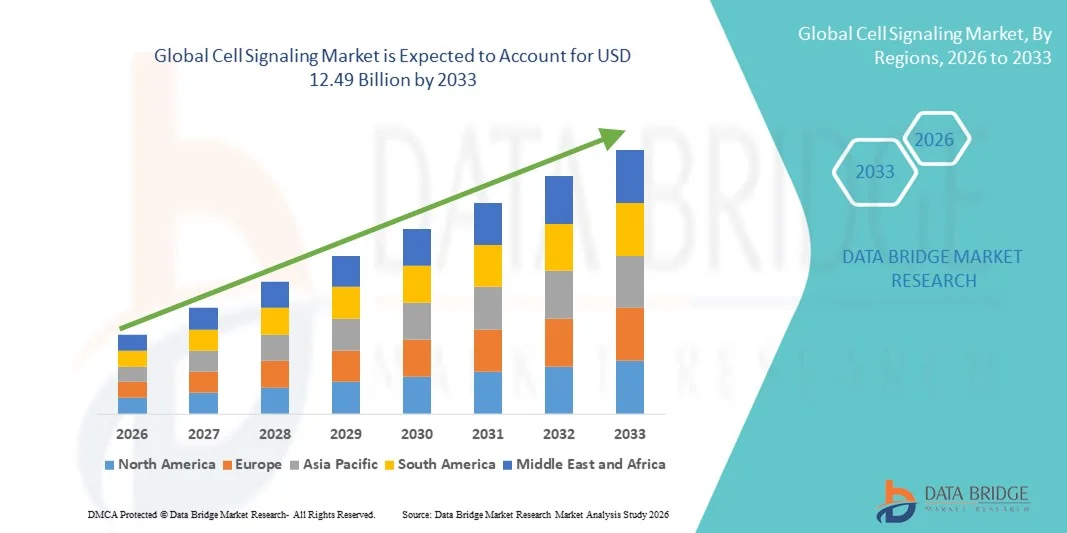
- The global cell signaling market size was valued at USD 7.06 billion in 2025 and is expected to reach USD 12.49 billion by 2033, at a CAGR of 7.40% during the forecast period
- The market growth is primarily driven by increasing research and development activities in biotechnology and pharmaceutical sectors, alongside advances in molecular biology and proteomics technologies, enhancing the understanding of cellular mechanisms
- In addition, rising prevalence of chronic diseases, demand for targeted therapeutics, and the adoption of precision medicine approaches are propelling the need for cell signaling analysis, positioning it as a crucial component in drug discovery and disease research. These factors collectively are accelerating the adoption of cell signaling solutions, thereby substantially contributing to market expansion
Cell Signaling Market Analysis
- Cell signaling, encompassing the study and manipulation of biochemical pathways that govern cellular communication and function, is increasingly critical in modern biomedical research, drug discovery, and precision medicine applications due to its role in understanding disease mechanisms and developing targeted therapies
- The growing demand for cell signaling solutions is primarily driven by advances in molecular biology, proteomics, and genomics technologies, increased focus on targeted therapeutics, and rising investments in biotechnology and pharmaceutical research
- North America dominated the cell signaling market with the largest revenue share of 42.7% in 2025, attributed to a strong biotechnology and pharmaceutical industry, high research funding, and a concentration of key industry players, with the U.S. leading in adoption of advanced signaling assays, high-throughput screening, and innovative molecular tools for cancer and chronic disease research
- Asia-Pacific is expected to be the fastest growing region in the cell signaling market during the forecast period due to expanding biomedical research infrastructure, increasing R&D investments, and rising prevalence of chronic and lifestyle-related diseases
- Consumables segment dominated the cell signaling market with a market share of 44.2% in 2025, driven by their frequent use in signaling assays, high demand in research laboratories, and the need for reliable reagents and kits to support reproducible experimental results
Report Scope and Cell Signaling Market Segmentation
|
Attributes |
Cell Signaling Key Market Insights |
|
Segments Covered |
|
|
Countries Covered |
North America
Europe
Asia-Pacific
Middle East and Africa
South America
|
|
Key Market Players |
|
|
Market Opportunities |
|
|
Value Added Data Infosets |
In addition to the insights on market scenarios such as market value, growth rate, segmentation, geographical coverage, and major players, the market reports curated by the Data Bridge Market Research also include in-depth expert analysis, patient epidemiology, pipeline analysis, pricing analysis, and regulatory framework |
Cell Signaling Market Trends
Advancements in High-Throughput and Multiplexed Assays
- A significant and accelerating trend in the global cell signaling market is the increasing adoption of high-throughput and multiplexed signaling assays, enabling simultaneous analysis of multiple pathways and biomarkers, thereby enhancing experimental efficiency and data depth
- For instance, platforms such as the Luminex xMAP technology allow researchers to analyze dozens of signaling proteins in a single sample, providing comprehensive insights into cellular responses and pathway interactions
- Integration of automated workflows and bioinformatics with these assays is enabling faster interpretation of complex signaling networks, helping researchers identify novel therapeutic targets and disease mechanisms
- These advancements allow centralized and streamlined analysis of signaling pathways, reducing sample consumption, and improving reproducibility across diverse research applications
- The trend towards more automated, multiplexed, and high-throughput signaling solutions is shaping expectations in biomedical research, encouraging companies such as Bio-Rad Laboratories to develop kits and instruments capable of simultaneous pathway detection and quantitative analysis
- Demand for high-throughput, multiplexed, and automated signaling assays is growing rapidly across pharmaceutical, biotechnology, and academic research sectors as the need for comprehensive cellular analysis continues to rise
- Rising collaborations between academic institutions, biotech firms, and pharmaceutical companies are driving innovation in signaling assay development, expanding access to cutting-edge tools globally
Cell Signaling Market Dynamics
Driver
Rising R&D Investments and Focus on Targeted Therapeutics
- The increasing investment in biotechnology and pharmaceutical research, coupled with growing emphasis on targeted therapies, is a key driver for the expanding adoption of cell signaling solutions
- For instance, in March 2025, Thermo Fisher Scientific announced enhanced cell signaling reagent portfolios to support high-throughput drug discovery and precision medicine research
- As researchers aim to understand disease-specific signaling pathways, cell signaling assays provide critical data for identifying drug targets and validating therapeutic strategies
- Rising prevalence of chronic diseases and demand for precision medicine approaches are driving the utilization of pathway-specific signaling analysis in both preclinical and clinical research
- Companies are expanding their offerings of reagents, kits, and instruments to cater to these growing needs, making cell signaling assays integral to modern biomedical R&D pipelines
- Government and private funding initiatives supporting molecular and cellular research are accelerating the adoption of advanced signaling technologies
- Growing demand for translational research bridging lab discoveries to clinical applications is encouraging the development of specialized signaling assays and kits for therapeutic validation
Restraint/Challenge
High Costs and Complexity of Signaling Technologies
- The relatively high cost of advanced cell signaling instruments and consumables, combined with the technical complexity of experimental protocols, poses a significant challenge to broader market adoption
- For instance, sophisticated mass spectrometry and flow cytometry-based signaling assays require expensive equipment and trained personnel, limiting access for smaller research labs
- Technical challenges such as pathway cross-talk, variability in cellular responses, and reproducibility issues can complicate experimental design and data interpretation
- While some platforms offer simplified workflows and pre-validated kits, the perceived complexity and high initial investment can hinder adoption, especially in emerging markets or smaller academic settings
- Overcoming these challenges through cost-effective instruments, user-friendly kits, and targeted training programs will be essential for driving sustained growth in the cell signaling market
- Regulatory hurdles and stringent validation requirements for signaling-based diagnostic or therapeutic applications can slow commercialization and adoption
- Limited standardization across signaling assay protocols may lead to inconsistent data, reducing confidence among researchers and delaying wider market penetration
Cell Signaling Market Scope
The market is segmented on the basis of product, type, pathway, technology, and application
- By Product
On the basis of product, the cell signaling market is segmented into consumables and instruments. The consumables segment dominated the market with the largest revenue share of 44.2% in 2025, driven by their frequent use in signaling assays, high demand in research laboratories, and the need for reliable reagents and kits to support reproducible experimental results. Consumables such as antibodies, kits, and chemical reagents are essential for almost all cell signaling experiments, making them a recurring purchase for laboratories globally. In addition, consumables are often designed for specific pathways and technologies, increasing their demand among pharmaceutical, biotechnology, and academic researchers. Established manufacturers focus on developing high-quality consumables with batch-to-batch consistency, further strengthening this segment’s dominance.
The instruments segment is anticipated to witness the fastest growth rate during 2026–2033, fueled by increasing adoption of advanced technologies such as flow cytometry, mass spectrometry, and high-content microscopy. Instruments enable detailed, high-resolution analysis of cellular pathways and provide scalability for high-throughput screening in drug discovery. The rising demand for automated and multiplexed assays is encouraging laboratories to invest in cutting-edge instruments that enhance data accuracy and efficiency. Moreover, collaborations between instrument manufacturers and biotech companies are facilitating the introduction of integrated systems that simplify complex signaling analyses.
- By Type
On the basis of type, the market is segmented into endocrine signaling, paracrine signaling, autocrine signaling, juxtacrine signaling, and other signaling types. The endocrine signaling segment dominated the market in 2025, attributed to its critical role in regulating systemic physiological processes and the extensive research focus on hormone-driven diseases. Researchers rely heavily on endocrine signaling studies to understand mechanisms in diabetes, thyroid disorders, and reproductive health, driving consistent demand for pathway-specific reagents and assays. The established knowledge base, coupled with well-characterized biomarkers, makes endocrine signaling assays widely adopted in both research and clinical laboratories. Pharmaceutical companies also focus on endocrine pathways to develop targeted therapeutics, further supporting the segment’s market leadership.
The autocrine signaling segment is expected to witness the fastest growth during the forecast period due to its growing relevance in cancer research and immunotherapy. Autocrine signaling plays a critical role in tumor cell proliferation and immune cell regulation, prompting increased demand for specialized assays and detection technologies. Advances in multiplexed and high-throughput platforms are enabling more precise autocrine signaling analysis, accelerating research and drug discovery. The segment benefits from rising investment in oncology and immunology research globally.
- By Pathway
On the basis of pathway, the market is segmented into Akt, AMPK, ErbB/HER, Hedgehog (Hh), JAK/STAT, NF-κB, Notch, and other signaling pathways. The NF-κB pathway dominated the market in 2025 due to its central role in inflammation, immune response, and cancer progression, making it a critical target for drug discovery and therapeutic research. Researchers rely on NF-κB assays for studying disease mechanisms and evaluating potential inhibitors, driving strong demand for reagents and detection kits. Pharmaceutical and biotechnology companies prioritize NF-κB signaling in preclinical studies, ensuring continuous growth of this segment.
The JAK/STAT pathway is expected to witness the fastest growth during 2026–2033, driven by its increasing relevance in autoimmune disorders, cancer immunotherapy, and cytokine signaling research. Growing interest in targeted therapies and precision medicine is boosting demand for pathway-specific assays and instruments. Innovations in high-throughput screening and multiplexed technologies are further accelerating research on JAK/STAT signaling, making it a rapidly expanding subsegment.
- By Technology
On the basis of technology, the market is segmented into microscopy, western blotting, flow cytometry, immunohistochemistry, ELISA, mass spectrometry, and other technologies. ELISA dominated the market with the largest share in 2025, owing to its simplicity, sensitivity, and widespread adoption in both academic and industrial research laboratories for quantitative analysis of signaling proteins. ELISA kits are cost-effective, easily reproducible, and compatible with high-throughput workflows, ensuring sustained demand. The availability of pathway-specific ELISA kits further strengthens the segment’s market position.
Flow cytometry is expected to witness the fastest growth from 2026 to 2033, driven by its ability to provide the single-cell analysis, multiplexing capabilities, and rapid detection of multiple signaling markers. The flow cytometry is increasingly adopted in immunology, cancer research, and drug discovery, where detailed cellular profiling is required. The introduction of automated and high-throughput flow cytometers is further accelerating the growth in this segment.
- By Application
On the basis of application, the market is segmented into research applications and medical applications. The research applications segment dominated the market in 2025, attributed to the rising demand from academic institutions, biotechnology firms, and pharmaceutical companies for understanding cellular mechanisms and discovering novel therapeutic targets. Research applications cover pathway analysis, biomarker discovery, and preclinical drug testing, driving consistent demand for signaling assays and instruments.
Medical applications are expected to witness the fastest growth during 2026–2033 due to increasing adoption of cell signaling-based diagnostics and personalized medicine approaches. Pathway-specific analysis is becoming essential for patient stratification, disease prognosis, and therapy monitoring, creating new opportunities for assay developers and diagnostic instrument manufacturers. The growing integration of cell signaling data into clinical decision-making is further supporting the expansion of this segment.
Cell Signaling Market Regional Analysis
- North America dominated the cell signaling market with the largest revenue share of 42.7% in 2025, attributed to a strong biotechnology and pharmaceutical industry, high research funding, and a concentration of key industry players
- Researchers and institutions in the region prioritize advanced cell signaling solutions due to their critical role in drug discovery, disease mechanism studies, and precision medicine development
- This widespread adoption is further supported by well-established R&D infrastructure, access to cutting-edge technologies, and collaborations between academic and industrial research organizations, making North America a key hub for both research and commercialization of cell signaling products
U.S. Cell Signaling Market Insight
The U.S. cell signaling market captured the largest revenue share of 42% in 2025, driven by extensive investment in biotechnology and pharmaceutical research, coupled with the widespread adoption of advanced signaling technologies. Researchers increasingly prioritize pathway-specific assays and high-throughput platforms to support drug discovery and precision medicine. The growing focus on chronic diseases, cancer, and immunotherapy is further boosting demand for cell signaling products. Moreover, collaborations between academic institutions, biotech firms, and pharmaceutical companies are accelerating innovation in signaling reagents and instruments, strengthening market growth.
Europe Cell Signaling Market Insight
The Europe cell signaling market is projected to expand at a substantial CAGR throughout the forecast period, primarily driven by increasing research funding, stringent regulatory standards for drug development, and a strong focus on translational and clinical studies. Rising investments in molecular biology and proteomics research, along with increasing adoption of high-throughput and multiplexed signaling technologies, are fostering market growth. European laboratories are also emphasizing reproducibility, accuracy, and advanced analytics, driving demand for reliable signaling assays and instruments across pharmaceutical, academic, and diagnostic applications.
U.K. Cell Signaling Market Insight
The U.K. cell signaling market is anticipated to grow at a noteworthy CAGR during the forecast period, fueled by government-backed research initiatives, a robust life sciences ecosystem, and high adoption of advanced laboratory technologies. Academic and commercial research centers increasingly utilize cell signaling assays to understand disease mechanisms and develop targeted therapeutics. In addition, the country’s strong biotechnology and pharmaceutical sectors, alongside investments in personalized medicine, are supporting adoption. The U.K.’s emphasis on innovation and translational research is expected to continue propelling market growth in both preclinical and clinical applications.
Germany Cell Signaling Market Insight
The Germany cell signaling market is expected to expand at a considerable CAGR during the forecast period, driven by strong R&D infrastructure, technological innovation, and a focus on precision medicine. Increasing demand for pathway-specific analysis, coupled with rising investment in oncology, immunology, and neurodegenerative disease research, is supporting growth. Germany’s emphasis on sustainable and reproducible laboratory practices further promotes the adoption of high-quality signaling assays and instruments. Moreover, integration of automated and high-throughput technologies is enhancing efficiency and enabling large-scale signaling studies across research institutions and pharmaceutical companies.
Asia-Pacific Cell Signaling Market Insight
The Asia-Pacific cell signaling market is poised to grow at the fastest CAGR of 25% during 2026–2033, driven by expanding biotechnology and pharmaceutical research, growing government support for life sciences, and increasing establishment of high-tech laboratories in countries such as China, Japan, and India. Rising prevalence of chronic diseases, growing adoption of precision medicine, and the expanding academic research base are accelerating demand for cell signaling solutions. Furthermore, the region is witnessing growth in domestic manufacturing of reagents and instruments, improving accessibility and affordability of signaling products for both research and medical applications.
Japan Cell Signaling Market Insight
The Japan cell signaling market is gaining momentum due to the country’s advanced biotechnology infrastructure, high research spending, and focus on innovative drug discovery. Japanese researchers are adopting automated and multiplexed signaling platforms to study complex pathways and cellular interactions, particularly in oncology and neurodegenerative diseases. The integration of advanced analytical instruments and bioinformatics tools is enabling more precise and efficient research outcomes. Moreover, the country’s emphasis on translational medicine and personalized therapies is driving demand for pathway-specific assays and instruments in both academic and industrial laboratories.
India Cell Signaling Market Insight
The India cell signaling market accounted for the largest market revenue share in Asia-Pacific in 2025, attributed to the country’s growing life sciences research ecosystem, expanding biotechnology sector, and increasing government funding for R&D. Rising adoption of high-throughput and multiplexed signaling assays in academic and pharmaceutical laboratories is driving growth. The expansion of research infrastructure, combined with the availability of cost-effective reagents and instruments from domestic manufacturers, is making advanced signaling technologies more accessible. In addition, the rising focus on cancer, immunology, and chronic disease research is further propelling the demand for cell signaling solutions across India.
Cell Signaling Market Share
The Cell Signaling industry is primarily led by well-established companies, including:
- Thermo Fisher Scientific Inc. (U.S.)
- Cell Signaling Technology, Inc. (U.S.)
- Abcam plc (U.K.)
- Bio‑Rad Laboratories, Inc. (U.S.)
- Bio‑Techne Corporation (U.S.)
- PerkinElmer Inc. (U.S.)
- BD (U.S.)
- QIAGEN (Netherlands)
- Promega Corporation (U.S.)
- Danaher (U.S.)
- Merck KGaA (Germany)
- Miltenyi Biotec B.V. & Co. KG (Germany)
- Agilent Technologies, Inc. (U.S.)
- Lonza Group Ltd. (Switzerland)
- Enzo Life Sciences, Inc. (U.S.)
- Cell Biolabs, Inc. (U.S.)
- BPS Bioscience, Inc. (U.S.)
- Rockland Immunochemicals, Inc. (U.S.)
- Santa Cruz Biotechnology, Inc. (U.S.)
- RayBiotech Life, Inc. (U.S.)
What are the Recent Developments in Global Cell Signaling Market?
- In October 2025, Cell Signaling Technology (CST) released a new portfolio of antibodies validated for spatial biology applications, designed specifically for advanced tissue imaging platforms to support complex cell signaling studies in the tumor microenvironment and improve mapping of protein interactions in situ
- In April 2025, Cell Signaling Technology (CST) announced a strategic partnership with Visiopharm to advance spatial biology research by combining CST’s SignalStar® multiplex immunohistochemistry (IHC) technology with Visiopharm’s AI‑driven image analysis software, enabling more robust and efficient interrogation of cellular interactions in tumor microenvironments
- In January 2025, BD (Becton, Dickinson and Company) and Biosero announced a collaboration to integrate robotic arms with BD’s flow cytometry systems—enhancing automation for high‑throughput drug discovery and development workflows that rely on cell signaling and immunophenotyping assays
- In November 2024, Leica Biosystems and Cell Signaling Technology (CST) joined forces to integrate the SignalStar™ Multiplex IHC assays with the BOND RX automated stainer, enabling fast, fully automated high‑plex imaging in under two days a significant step forward for high‑throughput cell signaling research
- In February 2023, Bio‑Techne Corporation and Cell Signaling Technology (CST) formed a partnership to validate CST antibodies on the ProteinSimple “Simple Western™” platform, enabling researchers to run robust, automated western blot analyses for molecular signaling pathways with improved efficiency and data reliability
SKU-
Get online access to the report on the World's First Market Intelligence Cloud

- Interactive Data Analysis Dashboard
- Company Analysis Dashboard for high growth potential opportunities
- Research Analyst Access for customization & queries
- Competitor Analysis with Interactive dashboard
- Latest News, Updates & Trend analysis
- Harness the Power of Benchmark Analysis for Comprehensive Competitor Tracking
Research Methodology
Data collection and base year analysis are done using data collection modules with large sample sizes. The stage includes obtaining market information or related data through various sources and strategies. It includes examining and planning all the data acquired from the past in advance. It likewise envelops the examination of information inconsistencies seen across different information sources. The market data is analysed and estimated using market statistical and coherent models. Also, market share analysis and key trend analysis are the major success factors in the market report. To know more, please request an analyst call or drop down your inquiry.
The key research methodology used by DBMR research team is data triangulation which involves data mining, analysis of the impact of data variables on the market and primary (industry expert) validation. Data models include Vendor Positioning Grid, Market Time Line Analysis, Market Overview and Guide, Company Positioning Grid, Patent Analysis, Pricing Analysis, Company Market Share Analysis, Standards of Measurement, Global versus Regional and Vendor Share Analysis. To know more about the research methodology, drop in an inquiry to speak to our industry experts.
Customization Available
Data Bridge Market Research is a leader in advanced formative research. We take pride in servicing our existing and new customers with data and analysis that match and suits their goal. The report can be customized to include price trend analysis of target brands understanding the market for additional countries (ask for the list of countries), clinical trial results data, literature review, refurbished market and product base analysis. Market analysis of target competitors can be analyzed from technology-based analysis to market portfolio strategies. We can add as many competitors that you require data about in the format and data style you are looking for. Our team of analysts can also provide you data in crude raw excel files pivot tables (Fact book) or can assist you in creating presentations from the data sets available in the report.












