


Cell Therapy Quality Control Testing Market Overview
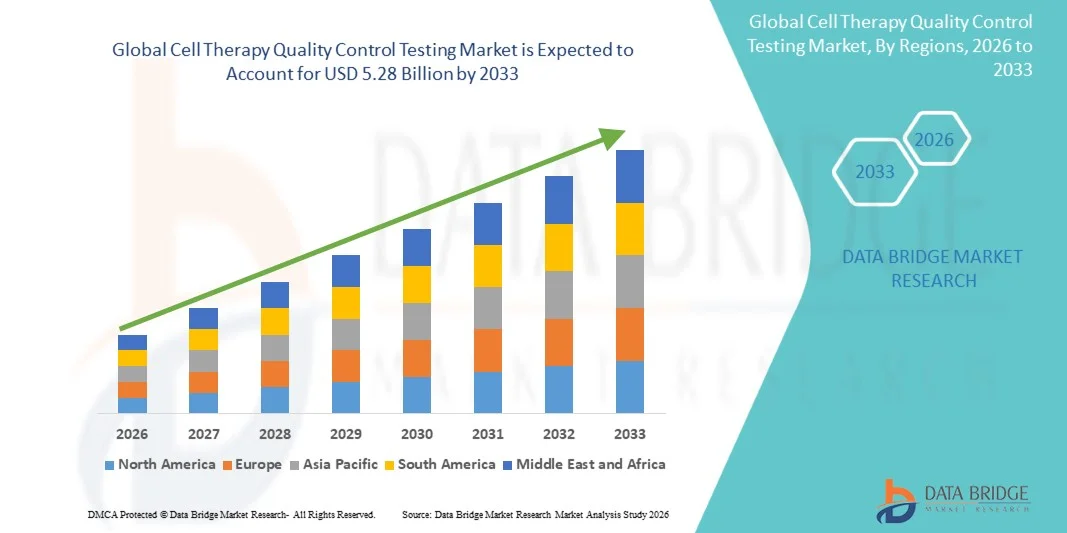
As per Data Bridge Market Research analysis The Cell Therapy Quality Control Testing Market was valued at USD 1.74 billion in 2025 and is projected to reach USD 5.28 billion by 2033, growing at a CAGR of 14.90% from 2026 to 2033. The market is experiencing strong growth driven by the increasing number of cell therapy clinical trials, rising commercialization of advanced cell-based therapies, and stringent regulatory requirements for product safety, potency, and consistency.
The growing adoption of autologous and allogeneic cell therapies, coupled with the expansion of manufacturing capacities and the need for comprehensive quality assurance throughout the production process, is accelerating demand for advanced quality control testing solutions. Sterility, mycoplasma, endotoxin, identity, and potency testing have become critical components of cell therapy development and commercialization, while innovations in rapid microbiological methods, molecular testing technologies, and automated analytical platforms are enabling faster batch release and improved compliance with global regulatory standards.
Key Market Trends & Insights
- North America dominated the Cell Therapy Quality Control Testing Market with the largest revenue share of 38.12% in 2025, supported by strong cell therapy pipelines, advanced manufacturing capabilities, and stringent regulatory oversight.
- The Sterility Testing segment led the market with a 29.84% share in 2025, driven by its critical role in ensuring the safety of cell therapy products before clinical use and commercialization.
- Asia-Pacific is expected to be the fastest-growing region at a CAGR of 14.2% from 2026 to 2033, fueled by expanding biopharmaceutical investments, rising clinical trial activity, and growing cell therapy manufacturing infrastructure.
- Potency Testing are the fastest-growing test type, projected to register a CAGR of 15.2%, reflecting the surge in regulatory emphasis on demonstrating therapeutic effectiveness and product consistency.
- The Allogeneic Cell Therapy segment dominated the cell therapy type category with a 57.43% revenue share in 2025, led by its scalability, batch manufacturing capabilities, and increasing commercial development activities
- PCR-Based Testing accounted for 31.67% of the market, preferred by its high sensitivity, specificity, and widespread application in contamination detection and product characterization.
- The Rapid Microbial Methods segment is the fastest-growing technology category, with a CAGR of 15.6%, driven by increasing demand for faster batch release and reduced manufacturing delays.
Market Size & Forecast
- Global Market Value (2025): USD 1.74 Billion
- Expected Market Value (2033): USD 5.28 Billion
- Forecast CAGR (2026–2033): 14.90%
- Leading Region in 2025: North America
- Fastest Growing Region: Asia Pacific
Report Scope and Cell Therapy Quality Control Testing Market Segmentation
|
Attributes |
Cell Therapy Quality Control Testing Key Market Insights |
|
Segments Covered |
|
|
Countries Covered |
North America · U.S. · Canada · Mexico Europe · Germany · France · U.K. · Netherlands · Switzerland · Belgium · Russia · Italy · Spain · Turkey · Rest of Europe Asia-Pacific · China · Japan · India · South Korea · Singapore · Malaysia · Australia · Thailand · Indonesia · Philippines · Rest of Asia-Pacific Middle East and Africa · Saudi Arabia · U.A.E. · South Africa · Egypt · Israel · Rest of Middle East and Africa South America · Brazil · Argentina · Rest of South America |
|
Key Market Players |
· Thermo Fisher Scientific Inc. (U.S.) · Merck KGaA (Germany) · Sartorius AG (Germany) · Bio-Techne (U.S.) · Charles River Laboratories (U.S.) · Eurofins Scientific SE (Luxembourg) · SGS Société Générale de Surveillance SA (Switzerland) · Lonza (Switzerland) · WuXi AppTec (China) · STEMCELL Technologies Canada Inc. (Canada) · Miltenyi Biotec B.V. & Co. KG (Germany) · REPROCELL Inc. (Japan) · Minaris Advanced Therapies (U.S.) · Nelson Laboratories, LLC (U.S.) · Cell Therapies Pty Ltd (Australia) · ENCELL Co., Ltd. (South Korea) · PathoQuest SAS (France) · PromoCell GmbH (Germany) · Creative Bioarray (U.S.) · FUJIFILM Cellular Dynamics, Inc. (U.S.) |
|
Market Opportunities |
· Expansion of automated and AI-enabled quality control platforms · Growing commercialization of allogeneic cell therapies · Increasing adoption of rapid microbial and real-time release testing technologies |
|
Value Added Data Infosets |
In addition to the insights on market scenarios such as market value, growth rate, segmentation, geographical coverage, and major players, the market reports curated by the Data Bridge Market Research also include in-depth expert analysis, patient epidemiology, pipeline analysis, pricing analysis, and regulatory framework. |
Cell Therapy Quality Control Testing Market Trends
Trend: Adoption of Rapid Microbial and Automated Testing Technologies
Cell therapy manufacturers are increasingly adopting rapid microbial detection and automated quality control platforms to accelerate product release timelines, improve testing accuracy, and reduce manual intervention across manufacturing workflows. The integration of molecular diagnostics, automation software, and real-time analytics enables faster identification of contaminants and product attributes while maintaining compliance with stringent regulatory requirements. Biopharmaceutical companies and contract manufacturers are similarly leveraging advanced testing technologies to support growing production volumes, while digital quality management systems create streamlined environments that closely align with modern cell therapy manufacturing needs. For instance, leading manufacturers are implementing automated rapid sterility testing systems to reduce batch release delays and improve operational efficiency.
Cell Therapy Quality Control Testing Market Dynamics
Key Market Driver: Growing Commercialization of Cell Therapies and Regulatory Compliance Requirements
The rapid commercialization of cell therapies and increasing regulatory scrutiny have created substantial demand for advanced quality control testing solutions that can verify product safety, potency, identity, and purity throughout development and manufacturing. Biopharmaceutical companies, contract development organizations, and cell therapy manufacturers are deploying comprehensive testing platforms as a core component of their production strategy, reducing compliance risks, accelerating approval pathways, and improving product consistency. For instance, commercial CAR-T therapy manufacturers routinely conduct extensive sterility, potency, and identity testing before product release to meet regulatory standards.
Key Restraint/Challenge: High Complexity and Cost of Quality Control Testing Processes
A significant restraint in the Cell Therapy Quality Control Testing Market is the high complexity and cost associated with advanced analytical testing procedures. Modern quality control programs integrate specialized assays, molecular testing platforms, cell characterization technologies, and regulatory documentation systems, requiring substantial investment in equipment, skilled personnel, and ongoing validation activities. The total operational burden extends to method development, compliance management, and quality assurance requirements, making implementation challenging for smaller biotechnology firms, research institutions, and early-stage therapy developers. For instance, establishing validated potency testing workflows often requires significant financial and technical resources before commercial manufacturing can begin.
The March 2025 expansion of advanced cell therapy testing capabilities by major contract testing organizations highlights the level of investment required for sophisticated analytical infrastructure, reflecting the broader challenge of quality control implementation beyond large and well-funded manufacturers.
Key Market Opportunity: Expansion of Automated and Real-Time Release Testing Platforms
The integration of automation and real-time release testing technologies in cell therapy manufacturing presents a significant market opportunity. Automated platforms can deliver faster analytical results, support continuous process monitoring, and provide enhanced data integrity for regulatory submissions. The development of high-throughput testing solutions and digital quality management ecosystems is further improving operational efficiency, opening growth opportunities across commercial manufacturing facilities, contract testing organizations, and emerging cell therapy markets worldwide. For instance, manufacturers are increasingly evaluating rapid release testing platforms to shorten product delivery timelines for time-sensitive cell therapies.
Cell Therapy Quality Control Testing Market Scope
The cell therapy quality control testing market is segmented on the basis of test type, cell therapy type, technology, and end user.
- By Test Type
On the basis of test type, the Cell Therapy Quality Control Testing Market is segmented into sterility testing, endotoxin testing, mycoplasma testing, adventitious agent testing, identity testing, purity testing, potency testing, and other tests. The Sterility Testing segment dominated the market with a 29.84% share in 2025, owing to its critical role in ensuring the safety of cell therapy products before clinical use and commercialization. Regulatory agencies require comprehensive sterility testing as a mandatory component of product release, making it an essential quality control step across all manufacturing stages. The increasing number of cell therapy approvals and commercial launches is driving demand for reliable sterility testing solutions. Advanced rapid sterility testing technologies are improving turnaround times while maintaining compliance standards. The segment also benefits from growing investments in GMP-compliant manufacturing facilities worldwide. Its indispensable role in patient safety continues to support its market leadership.
The Potency Testing segment is projected to register the fastest growth at a CAGR of 15.2% from 2026 to 2033, driven by increasing regulatory emphasis on demonstrating therapeutic effectiveness and product consistency. Potency assays are becoming increasingly important as more advanced cell therapies progress toward commercialization. These tests help manufacturers verify the biological activity and functional performance of cell-based products. Continuous advancements in analytical technologies are improving assay sensitivity and reproducibility. Growing complexity of cell therapy products is further increasing demand for sophisticated potency testing platforms. Rising focus on product characterization and regulatory compliance is expected to accelerate segment growth significantly.
- By Cell Therapy Type
On the basis of cell therapy type, the Cell Therapy Quality Control Testing Market is segmented into autologous cell therapy and allogeneic cell therapy. The Allogeneic Cell Therapy segment dominated the market with a 57.43% share in 2025, driven by its scalability, batch manufacturing capabilities, and increasing commercial development activities. Unlike patient-specific autologous therapies, allogeneic therapies can be manufactured in larger quantities, creating substantial demand for standardized quality control testing. The growing number of pipeline candidates and clinical trials is supporting market expansion. Manufacturers require extensive testing protocols to ensure consistency across production batches. Rising investments from biotechnology companies and pharmaceutical organizations are further strengthening the segment. The ability to support large patient populations continues to drive adoption globally.
The Allogeneic Cell Therapy segment is also expected to witness the fastest growth at a CAGR of 14.8% from 2026 to 2033, supported by increasing commercialization efforts and advancements in large-scale manufacturing technologies. Growing interest in off-the-shelf therapeutic products is accelerating research and development activities. These therapies require robust quality control frameworks to meet stringent regulatory requirements. Expanding manufacturing infrastructure across North America, Europe, and Asia-Pacific is creating additional demand for testing services. Continuous innovation in cell engineering technologies is also contributing to segment growth. The increasing focus on cost-effective treatment production is expected to sustain strong market momentum.
- By Technology
On the basis of technology, the Cell Therapy Quality Control Testing Market is segmented into PCR-based testing, flow cytometry, next-generation sequencing (NGS), ELISA, chromatography, mass spectrometry, rapid microbial methods, and other technologies. The PCR-Based Testing segment dominated the market with a 31.67% share in 2025, owing to its high sensitivity, specificity, and widespread application in contamination detection and product characterization. PCR technologies are extensively used for mycoplasma testing, viral detection, and genetic analysis in cell therapy manufacturing. The method provides rapid and accurate results, supporting efficient quality control workflows. Increasing regulatory expectations for molecular-level testing are driving broader adoption. Technological advancements are improving automation and throughput capabilities. Its versatility across multiple testing applications continues to reinforce market dominance.
The Rapid Microbial Methods segment is projected to register the fastest growth at a CAGR of 15.6% from 2026 to 2033, driven by increasing demand for faster batch release and reduced manufacturing delays. These technologies significantly shorten testing timelines compared to conventional microbial detection methods. Manufacturers are adopting rapid methods to improve operational efficiency and accelerate product availability. Growing commercialization of time-sensitive cell therapies is further supporting demand. Regulatory agencies are increasingly recognizing validated rapid testing approaches. Continuous advancements in automation and real-time monitoring technologies are expected to drive widespread implementation across manufacturing facilities.
- By End User
On the basis of end user, the Cell Therapy Quality Control Testing Market is segmented into biopharmaceutical & biotechnology companies, CDMOs & CROs, academic & research institutes, and clinical laboratories. The Biopharmaceutical & Biotechnology Companies segment dominated the market with a 48.92% share in 2025, driven by increasing investments in cell therapy development, manufacturing expansion, and commercialization activities. These organizations conduct extensive quality control testing throughout the product lifecycle to ensure regulatory compliance and product safety. Growing numbers of clinical trials and approved therapies are generating strong demand for testing solutions. Many companies are establishing in-house quality control capabilities to maintain operational control and data integrity. Continuous innovation in cell therapy pipelines is further supporting segment growth. Their central role in product development positions them as the largest end-user group.
The CDMOs & CROs segment is expected to witness the fastest growth at a CAGR of 15.1% from 2026 to 2033, driven by increasing outsourcing of quality control testing activities by biotechnology and pharmaceutical companies. These service providers offer specialized expertise, advanced analytical infrastructure, and regulatory support capabilities. Outsourcing helps manufacturers reduce capital expenditure and accelerate development timelines. Growing complexity of testing requirements is encouraging companies to partner with experienced external organizations. Expansion of global cell therapy manufacturing capacity is also contributing to demand. The increasing preference for flexible and cost-efficient testing solutions is expected to fuel rapid segment growth.
Cell Therapy Quality Control Testing Market Regional Analysis
North America dominated the Cell Therapy Quality Control Testing Market with the largest revenue share of 38.12% in 2025, supported by strong cell therapy pipelines, advanced manufacturing capabilities, and stringent regulatory oversight. The region also benefits from stringent regulatory requirements, high adoption of advanced analytical technologies, and growing demand for quality assurance across clinical and commercial cell therapy production. Increasing numbers of cell therapy approvals, expanding manufacturing capacity, and continuous innovation in testing methodologies continue to strengthen North America’s leadership position in the global market.
U.S. Cell Therapy Quality Control Testing Market Insight
The U.S. cell therapy quality control testing market is witnessing strong growth due to rising investments in cell therapy development programs, regulatory compliance requirements, and advanced biopharmaceutical manufacturing technologies. The country’s mature biotechnology ecosystem, along with increasing adoption of automated testing platforms, molecular diagnostics, and rapid microbial methods, is driving demand across clinical and commercial applications. In addition, growing emphasis on product safety, manufacturing consistency, and accelerated regulatory approvals is accelerating quality control testing adoption across biotechnology companies and contract service providers.
Europe Cell Therapy Quality Control Testing Market Insight
The Europe cell therapy quality control testing market remains a major contributor to global revenue, driven by strong regulatory frameworks, technological innovation, and high demand for advanced analytical testing solutions. The widespread use of quality control testing in cell therapy development, manufacturing, and commercialization programs is supporting market expansion across the region. Increasing investments in advanced testing technologies, coupled with strict quality standards and a highly skilled workforce, continue to enhance the adoption of cell therapy quality control testing throughout Europe.
U.K. Cell Therapy Quality Control Testing Market Insight
The U.K. cell therapy quality control testing market is experiencing steady growth, supported by rising adoption of advanced testing technologies in cell therapy development, manufacturing, and commercialization activities. Increasing investments in quality control infrastructure and growing demand for reliable, compliant testing solutions are contributing to market growth. Furthermore, integration of automation, molecular diagnostics, and digital quality management technologies is improving testing efficiency and regulatory compliance, positioning the U.K. as a key innovation hub in the cell therapy quality control testing industry.
Germany Cell Therapy Quality Control Testing Market Insight
The Germany cell therapy quality control testing market is expanding steadily due to the country’s strong biopharmaceutical manufacturing base, advanced research capabilities, and increasing adoption of next-generation analytical technologies. Biotechnology companies, testing laboratories, and research institutes are increasingly utilizing quality control solutions for product characterization, contamination detection, and regulatory compliance activities. Continuous advancements in molecular testing, automation, and rapid microbial technologies, along with strong government support for life sciences innovation, are further driving market growth in Germany.
Asia-Pacific Cell Therapy Quality Control Testing Market Insight
The Asia-Pacific cell therapy quality control testing market is expected to witness rapid growth, driven by increasing biotechnology investments, expanding cell therapy manufacturing activities, and rising research infrastructure across countries such as China, India, and Japan. Growing awareness regarding product quality requirements, rising adoption of advanced analytical technologies, and increasing demand for scalable and cost-effective testing solutions are supporting regional market expansion. In addition, the growing presence of biopharmaceutical manufacturing facilities and clinical research activities is accelerating quality control testing adoption across commercial and academic sectors.
Japan Cell Therapy Quality Control Testing Market Insight
The Japan cell therapy quality control testing market is witnessing consistent growth due to rising investments in regenerative medicine technologies, biopharmaceutical innovation, and regulatory quality assurance initiatives. Biotechnology companies, research institutes, and testing laboratories are increasingly adopting advanced analytical platforms for product validation, safety assessment, and manufacturing support purposes. Moreover, increasing integration of automation technologies and the country’s focus on safe and effective cell-based therapies are further contributing to market growth.
China Cell Therapy Quality Control Testing Market Insight
The China cell therapy quality control testing market is growing rapidly, driven by increasing biotechnology investments, expanding manufacturing infrastructure, and rising government focus on regenerative medicine development and product quality standards. Growing adoption of molecular testing and automated analytical platforms across biotechnology, research, and contract testing sectors is significantly boosting market demand. In addition, rising investments in cell therapy commercialization, increasing awareness regarding regulatory compliance, and rapid technological advancements are positioning China as one of the fastest-growing markets for cell therapy quality control testing globally.
Cell Therapy Quality Control Testing Market Share
The cell therapy quality control testing industry is primarily led by well-established companies, including:
- Thermo Fisher Scientific Inc. (U.S.)
- Merck KGaA (Germany)
- Sartorius AG (Germany)
- Bio-Techne (U.S.)
- Charles River Laboratories (U.S.)
- Eurofins Scientific SE (Luxembourg)
- SGS Société Générale de Surveillance SA (Switzerland)
- Lonza (Switzerland)
- WuXi AppTec (China)
- STEMCELL Technologies Canada Inc. (Canada)
- Miltenyi Biotec B.V. & Co. KG (Germany)
- REPROCELL Inc. (Japan)
- Minaris Advanced Therapies (U.S.)
- Nelson Laboratories, LLC (U.S.)
- Cell Therapies Pty Ltd (Australia)
- ENCELL Co., Ltd. (South Korea)
- PathoQuest SAS (France)
- PromoCell GmbH (Germany)
- Creative Bioarray (U.S.)
- FUJIFILM Cellular Dynamics, Inc. (U.S.)
Latest Developments in Cell Therapy Quality Control Testing Market
- In March 2025, Nelson Labs, a global provider of microbiological and analytical testing services, announced the launch of its Rapid Sterility Testing solution designed to significantly reduce sterility testing timelines for pharmaceutical and advanced therapy products, including cell therapies. The new rapid microbiological method delivers results in as little as six days while complying with USP <71> and USP <1223> requirements, enabling faster product release and improved manufacturing efficiency. This launch highlights the industry's growing focus on accelerating quality control without compromising regulatory compliance
- In May 2025, the UNITC Consortium Bioproduction Working Group published a harmonized quality control framework for academic CAR-T cell manufacturing in Bone Marrow Transplantation. The publication established standardized recommendations for mycoplasma detection, endotoxin testing, vector copy number analysis, and potency assays to improve consistency, safety, and regulatory compliance across academic cell therapy production facilities. This development supports greater standardization of quality control practices for advanced cell therapies
- In July 2024, Reuters reported that leading cell therapy manufacturers, including Gilead Sciences and Novartis, were implementing manufacturing innovations and streamlined quality control processes to reduce CAR-T production timelines. The initiatives focused on improving analytical testing efficiency and accelerating batch release while maintaining stringent quality standards for commercial cell therapy manufacturing. This reflects the industry's increasing investment in optimized quality control workflows
- In May 2024, bioMérieux highlighted its advanced quality testing solutions for cell and gene therapy manufacturing, emphasizing rapid sterility testing, mycoplasma detection, and contamination monitoring technologies. The company showcased how these solutions help manufacturers accelerate batch release while maintaining product safety and regulatory compliance for short shelf-life cell therapies. This development reflects the growing adoption of rapid quality control technologies across the advanced therapy sector
- In May 2024, Rapid Microbiology published a special industry focus on the growing adoption of Rapid Microbial Methods (RMMs) for quality control in cell and gene therapies. The publication highlighted how rapid sterility, endotoxin, and mycoplasma testing technologies are helping manufacturers replace conventional culture-based methods to support faster release of time-sensitive cell therapy products while ensuring regulatory compliance and patient safety. This reflects the industry's shift toward rapid analytical testing platforms

- Interactive Data Analysis Dashboard
- Company Analysis Dashboard for high growth potential opportunities
- Research Analyst Access for customization & queries
- Competitor Analysis with Interactive dashboard
- Latest News, Updates & Trend analysis
- Harness the Power of Benchmark Analysis for Comprehensive Competitor Tracking
Data collection and base year analysis are done using data collection modules with large sample sizes. The stage includes obtaining market information or related data through various sources and strategies. It includes examining and planning all the data acquired from the past in advance. It likewise envelops the examination of information inconsistencies seen across different information sources. The market data is analysed and estimated using market statistical and coherent models. Also, market share analysis and key trend analysis are the major success factors in the market report. To know more, please request an analyst call or drop down your inquiry.
The key research methodology used by DBMR research team is data triangulation which involves data mining, analysis of the impact of data variables on the market and primary (industry expert) validation. Data models include Vendor Positioning Grid, Market Time Line Analysis, Market Overview and Guide, Company Positioning Grid, Patent Analysis, Pricing Analysis, Company Market Share Analysis, Standards of Measurement, Global versus Regional and Vendor Share Analysis. To know more about the research methodology, drop in an inquiry to speak to our industry experts.
Data Bridge Market Research is a leader in advanced formative research. We take pride in servicing our existing and new customers with data and analysis that match and suits their goal. The report can be customized to include price trend analysis of target brands understanding the market for additional countries (ask for the list of countries), clinical trial results data, literature review, refurbished market and product base analysis. Market analysis of target competitors can be analyzed from technology-based analysis to market portfolio strategies. We can add as many competitors that you require data about in the format and data style you are looking for. Our team of analysts can also provide you data in crude raw excel files pivot tables (Fact book) or can assist you in creating presentations from the data sets available in the report.












