


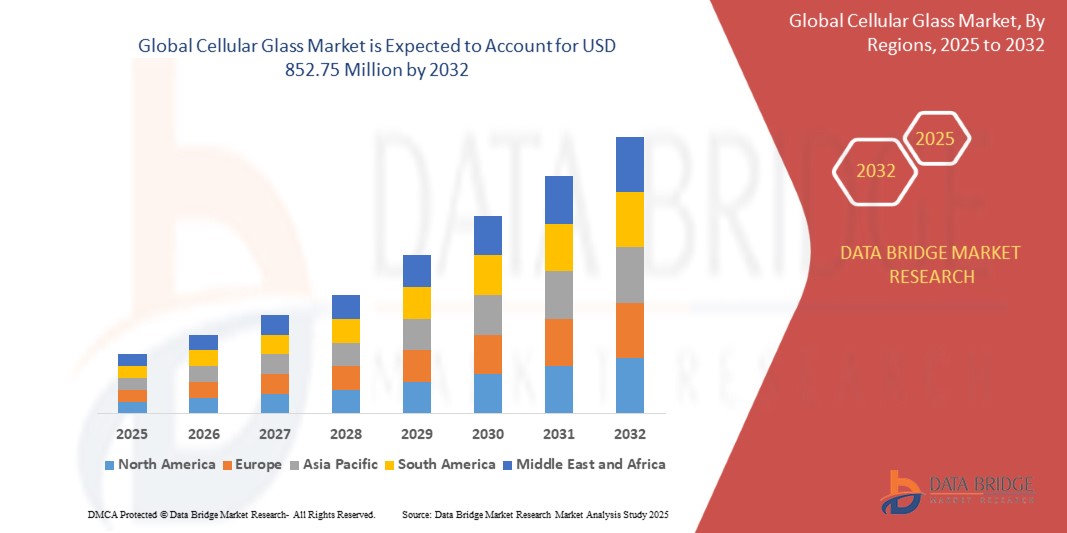
Global Cellular Glass Market Size
- The global cellular glass market was valued at USD 647.59 million in 2024 and is expected to reach USD 852.75 million by 2032
- During the forecast period of 2025 to 2032 the market is such as to grow at a CAGR of 3.50%, primarily driven by energy efficiency and sustainable demand
- This growth is driven by factors such as thermal and acoustic insulation
Global Cellular Glass Market Analysis
- Cellular glass is a versatile material widely used for insulation in various industries, including construction, industrial applications, and energy systems. Known for its excellent thermal and acoustic insulation properties and fire resistance, cellular glass is essential for creating energy-efficient and sustainable buildings and industrial systems. It is crucial for applications such as thermal insulation in buildings, fireproofing, and cryogenic storage systems
- The demand for cellular glass is significantly driven by the growing need for energy-efficient, sustainable, and fire-resistant materials. Much global demand comes from the construction industry, where cellular glass is used for insulation in commercial, residential, and industrial buildings. The increasing focus on reducing carbon footprints and adhering to stringent building codes further accelerates its adoption. In addition, the rising prevalence of energy-efficient building certifications, such as LEED, plays a vital role in driving the demand
- The Asia Pacific region stands out as one of the dominant markets for cellular glass, driven by rapid urbanization, industrialization, and infrastructure development. Countries such as China and India are witnessing significant growth in construction activities, and the demand for energy-efficient materials, including cellular glass, is rising. In addition, the adoption of energy-efficient building practices is leading to increased utilization of advanced insulation materials such as cellular glass in both commercial and residential projects
- For instance, large-scale infrastructure projects and the increasing demand for energy-efficient buildings in major urban centers in the Asia Pacific region are driving the market for cellular glass. Moreover, the adoption of advanced insulation materials is expected to grow, given the region's focus on sustainability and reducing energy consumption
- Globally, cellular glass is becoming an increasingly essential material in the insulation and fireproofing sectors, playing a pivotal role in ensuring energy efficiency, sustainability, and safety in construction and industrial operations. It ranks highly among the materials used in energy-efficient and fire-resistant applications, contributing to its widespread use across a variety of industries worldwide
Report Scope and Global and Cellular Glass Market Segmentation
|
Attributes |
Global and Cellular Glass Market Insights |
|
Segments Covered |
|
|
Countries Covered |
North America
Europe
Asia-Pacific
Middle East and Africa
South America
|
|
Key Market Players |
|
|
Market Opportunities |
|
|
Value Added Data Infosets |
In addition to the insights on market scenarios such as market value, growth rate, segmentation, geographical coverage, and major players, the market reports curated by the Data Bridge Market Research also include import export analysis, production capacity overview, production consumption analysis, price trend analysis, climate change scenario, supply chain analysis, value chain analysis, raw material/consumables overview, vendor selection criteria, PESTLE Analysis, Porter Analysis, and regulatory framework |
Global Cellular Glass Market Trends
“Increasing Demand for Sustainable and Energy Efficient Insulation Materials”
- One prominent trend in the global cellular glass market is the increasing demand for sustainable and energy-efficient insulation materials.
- As the construction industry focuses more on reducing carbon footprints and enhancing energy efficiency, cellular glass has gained popularity due to its excellent thermal and acoustic insulation properties, as well as its fire resistance
- For instance, cellular glass is increasingly being used in green building projects to meet strict energy standards, such as LEED certifications, due to its ability to significantly improve energy efficiency and reduce heating and cooling cost
- In addition, the growing global emphasis on sustainability and reducing environmental impact has led to an increase in demand for eco-friendly building materials such as cellular glass, which is made from recycled materials and has a long lifecycle
- This trend is transforming the construction industry, making cellular glass a preferred choice for builders and developers looking to comply with green building initiatives, improving energy efficiency, and contributing to environmental sustainability
Global Cellular Glass Market Dynamics
Driver
“Growing Demand for Energy-Efficient and Sustainable Building Materials”
- The increasing global focus on sustainability and energy efficiency is significantly driving the demand for cellular glass, which is known for its excellent thermal insulation properties and eco-friendly production process
- As governments and organizations push for green building practices and stricter energy efficiency regulations, cellular glass offers a compelling solution for thermal insulation in both residential and commercial construction
- The global move toward reducing carbon footprints and lowering energy consumption in buildings, especially in regions such as North America, Europe, and Asia Pacific, is propelling the demand for materials such as cellular glass that enhance energy efficiency
- The building and construction industry's shift toward using sustainable materials, particularly for insulation and fireproofing, has further highlighted the advantages of cellular glass, including its long lifespan and resistance to environmental factors
- As construction and renovation projects continue to increase globally, especially with the rise of energy-efficient and green buildings, cellular glass has become a preferred choice for developers looking to meet energy-saving standards and environmental certifications
For instance,
- In January 2023, a report from the International Energy Agency (IEA) emphasized the need for improved energy performance in buildings worldwide, highlighting the role of advanced insulation materials such as cellular glass in reducing heating and cooling demands, thus supporting the drive for energy-efficient buildings
- In December 2022, the European Union’s "Green Deal" and energy efficiency targets highlighted the increasing importance of sustainable materials, boosting the adoption of insulation materials such as cellular glass in construction projects across Europe
- The growing demand for energy-efficient and sustainable building materials, driven by global sustainability initiatives and stricter energy regulations, is making cellular glass a preferred choice for thermal insulation in construction
Opportunity
“Adoption of Cellular Glass in Industrial and High-Temperature Applications”
- The ability of cellular glass to withstand high temperatures and its resistance to chemicals make it an ideal material for industrial applications, such as in the oil and gas, chemical processing, and power generation sectors
- As industries strive for better insulation solutions to improve energy efficiency and reduce operational costs, cellular glass is gaining traction in applications such as high-temperature piping insulation, cryogenic systems, and heat transfer fluid systems
- The growing need for energy-efficient systems in industrial operations, combined with the increasing focus on safety, is driving the demand for advanced insulation materials such as cellular glass
For instance,
- In March 2024, a report from the American Institute of Chemical Engineers (AIChE) noted that high-performance insulation materials, such as cellular glass, are essential for improving energy efficiency in chemical plants, where temperature control is critical for both safety and process optimization
- In September 2023, the global oil and gas industry witnessed a rise in demand for more energy-efficient and sustainable insulation materials, with cellular glass being highlighted as a preferred choice for its thermal performance and ability to withstand harsh industrial environments
- The adoption of cellular glass in industrial and high-temperature applications is driven by its superior thermal performance, chemical resistance, and ability to enhance energy efficiency and safety in critical sectors
Restraint/Challenge
“High Production and Material Cost”
- The production of cellular glass involves specialized manufacturing processes that contribute to its relatively high cost, making it a more expensive alternative than traditional insulation materials
- The price of cellular glass can present a challenge for its adoption, especially in price-sensitive markets or smaller construction projects with limited budgets
- While cellular glass offers long-term energy savings and durability, the upfront costs associated with its procurement and installation can deter its use, particularly in developing regions where cheaper alternatives are more widely available
For instance,
- In October 2023, a Global Construction Market Outlook report noted that while cellular glass offers superior insulation performance, its high production cost remains a barrier for broader adoption in emerging markets, where cost-effective solutions are often prioritized for large-scale infrastructure projects
- In June 2024, an article by the International Building Materials Association (IBMA) highlighted the high costs of raw materials and the energy-intensive manufacturing process of cellular glass, noting that this could limit its penetration in regions with cost-sensitive markets and low-budget building projects
- The high production and material costs of cellular glass, driven by specialized manufacturing processes, pose a significant barrier to its widespread adoption, particularly in cost-sensitive markets and smaller projects
Global Cellular Glass Market Scope
The market is segmented on the basis of type, product, process, application, end use industry, and distribution channel.
|
Segmentation |
Sub-Segmentation |
|
By Type |
|
|
By Product |
|
|
By Process |
|
|
By Application |
|
|
By End Use Industry |
|
Global Cellular Glass Market Regional Analysis
“North America is the Dominant Region in the Global Cellular Glass Market”
- North America holds a significant share of the global cellular glass market, driven by its advanced industrial infrastructure, high demand for energy-efficient materials, and strong presence of key market players
- The United States, in particular, is leading the market due to a growing focus on sustainable building materials, increasing demand for thermal insulation, and the rising adoption of cellular glass in construction and industrial applications
- The availability of established policies promoting energy-efficient and environmentally friendly materials, along with continuous investments in infrastructure, further strengthens the market.
- In addition, the increasing number of construction projects, coupled with stringent regulations regarding energy conservation and thermal insulation standards, is fueling the demand for cellular glass in the region
“Asia-Pacific is Projected to Register the Highest Growth Rate”
- Asia-Pacific is expected to witness the highest growth rate in the global cellular glass market, driven by rapid industrialization, expansion of the construction sector, and increasing awareness of energy-efficient insulation materials
- Countries such as China, India, and Japan are emerging as key markets due to their large construction industries, which are increasingly adopting cellular glass for thermal and acoustic insulation, as well as fireproofing applications
- Japan, with its technological advancements and commitment to sustainability, is a crucial market for cellular glass, with growing applications in industrial insulation and advanced building materials
- India, with its rapid urbanization and large-scale infrastructure projects, are witnessing an increase in the use of cellular glass for both residential and commercial construction. Government investments in energy-efficient building materials and the expanding presence of global manufacturers further contribute to the market’s growth in the country
Cellular Glass Market Share
The market competitive landscape provides details by competitor. Details included are company overview, company financials, revenue generated, market potential, investment in research and development, new market initiatives, global presence, production sites and facilities, production capacities, company strengths and weaknesses, product launch, product width and breadth, application dominance. The above data points provided are only related to the companies' focus related to market.
The Major Market Leaders Operating in the Market Are:
- Owens Corning (U.S.)
- Misapor (Switzerland)
- POLYDROS, S.A. (Spain)
- REFAGLASS (Czech Republic)
- An Hui Chuang Yan New Materials Co., Ltd. (China)
- Cellglas Group AB (Sweden)
- HK Group (India)
- ZHEJIANG ZHENSHEN INSULATION TECHNOLOGY CORP.LTD. (China)
- Schlüsselbauer Geomaterials GmbH (Austria)
- PINOSKLO cellular glass (Ukraine)
- Ningbo Yoyo Foam Glass Co., Ltd. (China)
- Stikloporas.com (Lithuania)
- AeroAggregates of North America, LLC (U.S.)
- GLAVEL (U.S.)
- Jahan Ayegh Pars Company (Iran)
- Knauf Insulation (U.S.)
Latest Developments in Global Cellular Glass Market
- In January 2025, Owens Corning, announced the expansion of its cellular glass offerings in the North American and European markets. The new line of cellular glass products, engineered for superior thermal insulation and fire-resistant properties, will meet growing demands in the construction, industrial, and chemical sectors. Owens Corning’s cellular glass is designed to enhance energy efficiency and sustainability, aligning with the global push for more eco-friendly building materials
- In December 2024, Misapor AG showcased its latest advancements at the International Building and Construction Expo in Germany. The company introduced its innovative foam glass blocks, which offer high thermal insulation and are fully recyclable, making them ideal for the growing trend of sustainable construction. Misapor AG is also focusing on expanding its market presence in Asia-Pacific, with new partnerships aimed at driving the adoption of cellular glass in countries such as China and India
- In November 2024, GEOCELL Schaumglas GmbH launched a new range of cellular glass solutions optimized for cryogenic systems and chemical processing industries. The new products offer enhanced performance under extreme temperatures and aggressive chemical environments, addressing the specific needs of industries such as oil and gas, chemicals, and refrigeration. GEOCELL Schaumglas GmbH continues to invest in research and development to innovate in high-performance insulation materials for both the building and industrial markets
- In October 2024, AeroAggregates of North America, LLC introduced a new line of lightweight cellular glass aggregates for use in commercial and residential construction projects. These aggregates provide excellent thermal insulation, reducing energy costs and improving sustainability in building design. The company’s commitment to environmentally friendly products is reflected in their increased use of recycled materials in manufacturing, positioning them as a key player in the green building movement across North America and Europe
- In September 2024, Ningbo Yoyo Foam Glass Co., Ltd. expanded its production capacity for cellular glass gravel, meeting growing demand in the Asia-Pacific region. The company’s product range, which includes cellular glass for industrial insulation and construction, is set to penetrate new markets as the region continues to urbanize. With the growing emphasis on sustainability, Ningbo Yoyo Foam Glass Co., Ltd. is capitalizing on the need for energy-efficient building materials in both residential and industrial projects

- Interactive Data Analysis Dashboard
- Company Analysis Dashboard for high growth potential opportunities
- Research Analyst Access for customization & queries
- Competitor Analysis with Interactive dashboard
- Latest News, Updates & Trend analysis
- Harness the Power of Benchmark Analysis for Comprehensive Competitor Tracking
Global Cellular Glass Market, Supply Chain Analysis and Ecosystem Framework
To support market growth and help clients navigate the impact of geopolitical shifts, DBMR has integrated in-depth supply chain analysis into its Global Cellular Glass Market research reports. This addition empowers clients to respond effectively to global changes affecting their industries. The supply chain analysis section includes detailed insights such as Global Cellular Glass Market consumption and production by country, price trend analysis, the impact of tariffs and geopolitical developments, and import and export trends by country and HSN code. It also highlights major suppliers with data on production capacity and company profiles, as well as key importers and exporters. In addition to research, DBMR offers specialized supply chain consulting services backed by over a decade of experience, providing solutions like supplier discovery, supplier risk assessment, price trend analysis, impact evaluation of inflation and trade route changes, and comprehensive market trend analysis.
Data collection and base year analysis are done using data collection modules with large sample sizes. The stage includes obtaining market information or related data through various sources and strategies. It includes examining and planning all the data acquired from the past in advance. It likewise envelops the examination of information inconsistencies seen across different information sources. The market data is analysed and estimated using market statistical and coherent models. Also, market share analysis and key trend analysis are the major success factors in the market report. To know more, please request an analyst call or drop down your inquiry.
The key research methodology used by DBMR research team is data triangulation which involves data mining, analysis of the impact of data variables on the market and primary (industry expert) validation. Data models include Vendor Positioning Grid, Market Time Line Analysis, Market Overview and Guide, Company Positioning Grid, Patent Analysis, Pricing Analysis, Company Market Share Analysis, Standards of Measurement, Global versus Regional and Vendor Share Analysis. To know more about the research methodology, drop in an inquiry to speak to our industry experts.
Data Bridge Market Research is a leader in advanced formative research. We take pride in servicing our existing and new customers with data and analysis that match and suits their goal. The report can be customized to include price trend analysis of target brands understanding the market for additional countries (ask for the list of countries), clinical trial results data, literature review, refurbished market and product base analysis. Market analysis of target competitors can be analyzed from technology-based analysis to market portfolio strategies. We can add as many competitors that you require data about in the format and data style you are looking for. Our team of analysts can also provide you data in crude raw excel files pivot tables (Fact book) or can assist you in creating presentations from the data sets available in the report.













