


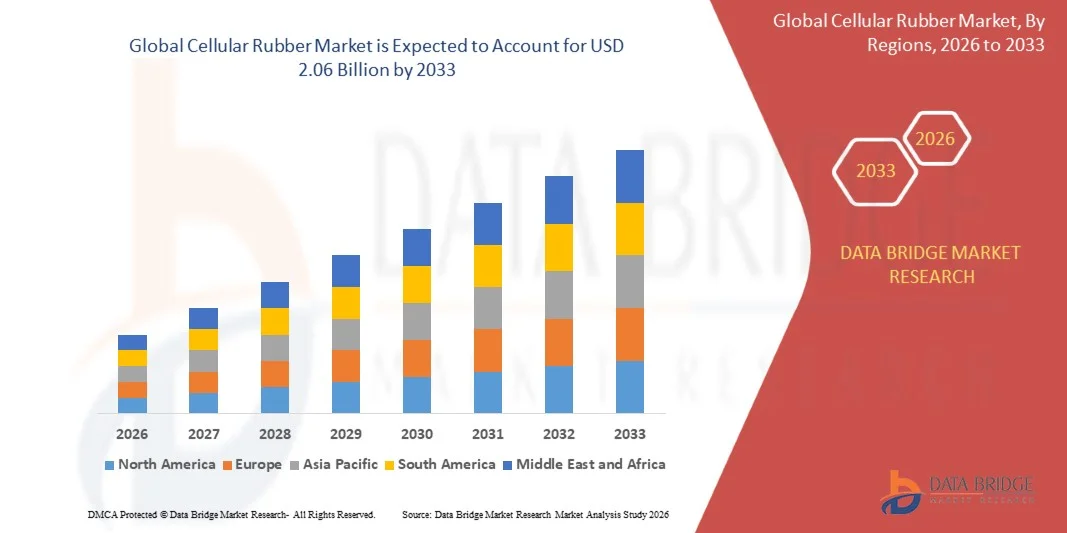
Cellular Rubber Market Size
- The global cellular rubber market size was valued at USD 1.85 billion in 2025 and is expected to reach USD 2.06 billion by 2033, at a CAGR of 4.50% during the forecast period
- The market growth is largely fuelled by the rising demand for lightweight, high-performance sealing and insulation materials across automotive, aerospace, and industrial applications
- Increasing adoption of cellular rubber in noise reduction, vibration control, and thermal management solutions is further enhancing market expansion
Cellular Rubber Market Analysis
- The market is witnessing strong demand due to the versatile properties of cellular rubber, such as flexibility, compressibility, and resistance to moisture, chemicals, and heat
- Technological advancements in foam manufacturing processes and the development of high-quality EPDM, neoprene, and silicone-based cellular rubber products are improving performance and broadening usage across industries
- North America dominated the cellular rubber market with the largest revenue share in 2025, driven by rising demand for high-performance sealing, insulation, and vibration-control materials across automotive, construction, and electronics sectors
- Asia-Pacific region is expected to witness the highest growth rate in the global cellular rubber market, driven by expanding manufacturing activities and increasing consumption of rubber-based components across key industries
- The Sheets segment held the largest market revenue share in 2025 driven by its widespread use across automotive, construction, and industrial applications for sealing, cushioning, and insulation purposes. Sheets are preferred for their ease of fabrication, uniform density, and suitability for high-performance gaskets and thermal insulation solutions
Report Scope and Cellular Rubber Market Segmentation
|
Attributes |
Cellular Rubber Key Market Insights |
|
Segments Covered |
|
|
Countries Covered |
North America
Europe
Asia-Pacific
Middle East and Africa
South America
|
|
Key Market Players |
|
|
Market Opportunities |
|
|
Value Added Data Infosets |
In addition to the insights on market scenarios such as market value, growth rate, segmentation, geographical coverage, and major players, the market reports curated by the Data Bridge Market Research also include import export analysis, production capacity overview, production consumption analysis, price trend analysis, climate change scenario, supply chain analysis, value chain analysis, raw material/consumables overview, vendor selection criteria, PESTLE Analysis, Porter Analysis, and regulatory framework. |
Cellular Rubber Market Trends
“Increasing Use of Cellular Rubber in High-Performance Sealing Applications”
• The rising demand for durable, lightweight, and flexible sealing materials is transforming the cellular rubber market as industries such as automotive, aerospace, and electronics increasingly adopt foam-based rubber for vibration control, insulation, and gasketing. This shift is driven by the need for materials that withstand extreme temperatures and harsh environmental conditions, ensuring long-term performance. Growing industrial modernization further amplifies the requirement for reliable and energy-efficient sealing solutions
• The growing focus on energy efficiency and noise reduction in vehicles and industrial machinery is accelerating the adoption of cellular rubber components. Manufacturers are utilizing EPDM, neoprene, and silicone-based cellular rubber for superior sealing and acoustic insulation, supporting enhanced safety and comfort standards. This trend is strengthened by regulatory pressures that promote low-noise, low-emission, and high-efficiency mechanical systems
• The expansion of advanced manufacturing facilities and automation technologies is promoting the use of cellular rubber across applications such as HVAC systems, electronic enclosures, and industrial equipment. Its resistance to chemicals, ozone, and UV exposure further strengthens its usage in both indoor and outdoor environments. The demand for long-lasting protective components in high-stress industrial setups is also driving continuous material innovation
• For instance, in 2023, several automotive OEMs in Europe reported increased usage of closed-cell EPDM rubber for thermal insulation and sealing in electric vehicle battery packs, improving efficiency and extending component lifespan. This adoption aligns with the industry-wide push for enhancing EV safety, thermal regulation, and sustainability. The growing EV production pipeline is expected to further expand the application scope of advanced cellular rubber materials
• While cellular rubber is gaining traction in high-performance applications, future growth relies on continuous material innovation, cost optimization, and improved adaptability to evolving regulatory and sustainability requirements. Manufacturers are increasingly focusing on eco-friendly formulations and recyclable rubber technologies to meet global green standards. Strategic collaborations and R&D advancements remain essential for maintaining competitive advantage
Cellular Rubber Market Dynamics
Driver
“Rising Adoption Across Automotive, Construction, and Electronics Industries”
• The expanding automotive sector is significantly increasing demand for cellular rubber due to its essential role in sealing, gasketing, noise reduction, and vibration control. As vehicle electrification accelerates, the need for lightweight and heat-resistant materials is driving substantial consumption of cellular rubber components. The shift toward enhanced safety and comfort features in modern vehicles further strengthens adoption across OEMs and tier suppliers
• The construction industry is increasingly relying on cellular rubber for insulation, cushioning, and weatherproofing applications. Rising infrastructure development and renovation activities are strengthening the demand for high-performance sealing materials that ensure durability and energy efficiency. The emphasis on sustainable and energy-efficient buildings is also encouraging the use of advanced rubber-based insulation technologies
• The electronics industry is adopting cellular rubber for device protection, thermal management, and shock absorption. Miniaturization trends and growing production of consumer electronics have further boosted market demand. As electronic devices become more compact and thermally sensitive, manufacturers are integrating cellular rubber to enhance reliability, prevent damage, and improve operational stability
• For instance, in 2022, several Asia-Pacific electronics manufacturers integrated silicone-based cellular rubber into sensitive device components to improve heat dissipation and protect against mechanical stress. This shift reflects the rising need for durable, lightweight, and thermally efficient components in high-performance electronics. Increasing automation and semiconductor production are further accelerating this demand across the region
• While cross-industry adoption continues to rise, ensuring consistent quality, maintaining cost efficiency, and addressing supply chain dependencies are essential for long-term market stability. Manufacturers must balance innovation with affordability to meet the varying needs of end-use industries. Strengthening global supply chains and enhancing material availability will be critical for supporting sustained market expansion
Restraint/Challenge
“Fluctuating Raw Material Prices and Manufacturing Complexity”
• Volatile prices of raw materials such as natural rubber, petrochemical derivatives, and specialized polymers pose significant challenges for manufacturers. These unpredictable cost variations strain budgeting and long-term planning for producers across major regions. As a result, companies often struggle to maintain competitive pricing without compromising product quality
• The manufacturing of high-quality cellular rubber requires precision, advanced equipment, and strict quality control. Many regions face a shortage of skilled labor and technical expertise, affecting production efficiency and scalability. This lack of specialized knowledge also limits manufacturers’ ability to diversify product portfolios for evolving end-use sectors
• Supply chain constraints and limited availability of specialized grades of rubber in developing regions hinder market penetration and delay production timelines. Industries such as automotive and electronics require consistent and timely sourcing, magnifying the impact of material delays. This creates bottlenecks for OEMs seeking high-performance sealing and insulation solutions
• For instance, in 2023, several North American manufacturers reported production delays due to shortages of key rubber compounds, affecting their supply commitments to the automotive and industrial sectors. These shortages disrupted project schedules and increased operational costs. Consequently, many companies were forced to seek alternative material suppliers or adjust their procurement strategies
• While innovation in material science is improving performance and sustainability, overcoming cost volatility, scaling production capabilities, and enhancing supply chain efficiency remain crucial to unlocking the market’s full growth potential. Companies are increasingly investing in formulation optimization and recycling processes to reduce dependency on volatile raw materials. Strengthening global supplier networks and adopting automation are also emerging as key strategies for long-term stability
Cellular Rubber Market Scope
The market is segmented on the basis of product type, material type, and end user.
• By Product Type
On the basis of product type, the cellular rubber market is segmented into Sheets, Rolls, and Others. The Sheets segment held the largest market revenue share in 2025 driven by its widespread use across automotive, construction, and industrial applications for sealing, cushioning, and insulation purposes. Sheets are preferred for their ease of fabrication, uniform density, and suitability for high-performance gaskets and thermal insulation solutions.
The Rolls segment is expected to witness the fastest growth rate from 2026 to 2033, driven by rising adoption in large-scale manufacturing facilities and continuous sealing applications. Rolls are increasingly used in HVAC systems, electronics enclosures, and industrial equipment due to their flexibility, long-length availability, and cost-efficiency for bulk processing.
• By Material Type
On the basis of material type, the cellular rubber market is segmented into Cellular Nitrile Butadiene Rubber (NBR), Neoprene, Ethylene Propylene Diene Monomer (EPDM), Cellular Silicone Rubber, and Others. The EPDM segment held the largest market revenue share in 2025 due to its superior resistance to weathering, ozone, heat, and chemicals, making it a preferred choice for automotive sealing, construction insulation, and outdoor applications. Its long service life and excellent performance in harsh environments contribute to its extensive adoption.
The Cellular Silicone Rubber segment is expected to witness the fastest growth rate from 2026 to 2033, driven by its exceptional thermal stability and compatibility with demanding applications in electronics, aerospace, and high-temperature environments. Its lightweight structure, low toxicity, and consistent compression characteristics further support its rising demand in precision sealing applications.
• By End User
On the basis of end user, the cellular rubber market is segmented into Automotive, Electronics, Aerospace, and Others. The Automotive segment held the largest market revenue share in 2025, supported by the increasing use of cellular rubber for sealing, gasketing, vibration damping, and noise control components. The transition toward electric vehicles has further strengthened demand for lightweight, heat-resistant, and energy-efficient materials.
The Electronics segment is expected to witness the fastest growth rate from 2026 to 2033, driven by the rising production of consumer electronics and increasing need for thermal insulation, shock absorption, and device protection solutions. Cellular rubber is becoming essential for safeguarding compact electronic components, supporting long-term reliability and performance in miniaturized devices.
Cellular Rubber Market Regional Analysis
• North America dominated the cellular rubber market with the largest revenue share in 2025, driven by rising demand for high-performance sealing, insulation, and vibration-control materials across automotive, construction, and electronics sectors
• Industries in the region increasingly prefer lightweight, durable, and temperature-resistant cellular rubber components, which support compliance with energy efficiency standards and enhance product performance in demanding environments
• This widespread adoption is further supported by advanced manufacturing capabilities, strong R&D investments, and the growing emphasis on noise reduction, weatherproofing, and material longevity across various industrial applications
U.S. Cellular Rubber Market Insight
The U.S. cellular rubber market captured the largest revenue share in 2025 within North America, fuelled by extensive use of EPDM, neoprene, and nitrile-based cellular rubber across automotive, aerospace, HVAC, and electronic enclosure applications. Industries are increasingly prioritizing materials that offer superior sealing, thermal resistance, and compression recovery, supporting the expansion of closed-cell and open-cell rubber products. In addition, growing investment in electric vehicles, renewable energy infrastructure, and building insulation is further driving consumption of high-performance cellular rubber materials.
Europe Cellular Rubber Market Insight
The Europe cellular rubber market is expected to witness the fastest growth rate from 2026 to 2033, driven by strict environmental regulations, expanding automotive production, and rising demand for sustainable, weather-resistant sealing materials. The region’s focus on energy-efficient construction and advanced manufacturing technologies is accelerating the adoption of EPDM, silicone, and neoprene cellular rubber products. Growing applications in industrial machinery, electronics, and transportation are further supporting market growth across both established and emerging industries.
U.K. Cellular Rubber Market Insight
The U.K. cellular rubber market is expected to witness the fastest growth rate from 2026 to 2033, supported by increasing demand for high-quality insulation, acoustic damping, and sealing solutions in residential, commercial, and industrial construction. The country’s growing shift toward sustainable building materials and enhanced regulatory standards is stimulating adoption across HVAC, electrical enclosures, and transportation sectors. In addition, rising use of lightweight cellular rubber components in electric vehicle assemblies is further contributing to market expansion.
Germany Cellular Rubber Market Insight
The Germany cellular rubber market is expected to witness the fastest growth rate from 2026 to 2033, driven by the nation’s strong automotive and engineering industries, which rely heavily on advanced sealing, gasketing, and vibration-control solutions. Germany’s emphasis on high-precision manufacturing, material innovation, and sustainability is promoting rapid adoption of cellular rubber materials across EV battery systems, insulation components, and industrial equipment. Increasing integration of flame-resistant and high-performance cellular rubber is also aligning with strict safety and quality requirements.
Asia-Pacific Cellular Rubber Market Insight
The Asia-Pacific cellular rubber market is expected to witness the fastest growth rate from 2026 to 2033, fuelled by rapid industrialization, growing manufacturing output, and rising demand for insulation and sealing materials in automotive, construction, and electronics sectors. Expanding infrastructure projects, increasing disposable incomes, and supportive government policies promoting industrial development are strengthening market growth. In addition, APAC’s position as a major manufacturing hub for automotive components and electronic devices boosts the consumption of cellular rubber across multiple applications.
Japan Cellular Rubber Market Insight
The Japan cellular rubber market is expected to witness the fastest growth rate from 2026 to 2033 due to the country’s advanced manufacturing ecosystem, strong focus on precision engineering, and rising adoption of high-performance sealing materials. Japan’s electronics and automotive sectors are increasingly using cellular rubber for thermal insulation, vibration damping, and device protection in compact and high-tech applications. Moreover, the country’s emphasis on energy-efficient buildings and stringent safety standards is driving the use of specialized cellular rubber materials across commercial and industrial projects.
China Cellular Rubber Market Insight
The China cellular rubber market accounted for the largest market revenue share in Asia-Pacific in 2025, supported by the country’s strong automotive production, expanding electronics manufacturing, and rapid growth in industrial infrastructure. China is one of the largest consumers of EPDM, NBR, and silicone-based cellular rubber, with widespread applications in construction, transportation, and industrial equipment. The nation’s focus on smart manufacturing, large-scale construction activities, and continuous expansion of EV and electronics industries is significantly contributing to market growth.
Cellular Rubber Market Share
The Cellular Rubber industry is primarily led by well-established companies, including:
- Rogers Corporation (U.S.)
- Armacell (Germany)
- Saint-Gobain (France)
- Klinger (Austria)
- FoamTech (U.S.)
- Griffon Corporation (U.S.)
- Trelleborg AB (Sweden)
- Rubbermill (U.S.)
- American Foam Products (U.S.)
- Stockwell Elastomerics (U.S.

- Interactive Data Analysis Dashboard
- Company Analysis Dashboard for high growth potential opportunities
- Research Analyst Access for customization & queries
- Competitor Analysis with Interactive dashboard
- Latest News, Updates & Trend analysis
- Harness the Power of Benchmark Analysis for Comprehensive Competitor Tracking
Global Cellular Rubber Market, Supply Chain Analysis and Ecosystem Framework
To support market growth and help clients navigate the impact of geopolitical shifts, DBMR has integrated in-depth supply chain analysis into its Global Cellular Rubber Market research reports. This addition empowers clients to respond effectively to global changes affecting their industries. The supply chain analysis section includes detailed insights such as Global Cellular Rubber Market consumption and production by country, price trend analysis, the impact of tariffs and geopolitical developments, and import and export trends by country and HSN code. It also highlights major suppliers with data on production capacity and company profiles, as well as key importers and exporters. In addition to research, DBMR offers specialized supply chain consulting services backed by over a decade of experience, providing solutions like supplier discovery, supplier risk assessment, price trend analysis, impact evaluation of inflation and trade route changes, and comprehensive market trend analysis.
Data collection and base year analysis are done using data collection modules with large sample sizes. The stage includes obtaining market information or related data through various sources and strategies. It includes examining and planning all the data acquired from the past in advance. It likewise envelops the examination of information inconsistencies seen across different information sources. The market data is analysed and estimated using market statistical and coherent models. Also, market share analysis and key trend analysis are the major success factors in the market report. To know more, please request an analyst call or drop down your inquiry.
The key research methodology used by DBMR research team is data triangulation which involves data mining, analysis of the impact of data variables on the market and primary (industry expert) validation. Data models include Vendor Positioning Grid, Market Time Line Analysis, Market Overview and Guide, Company Positioning Grid, Patent Analysis, Pricing Analysis, Company Market Share Analysis, Standards of Measurement, Global versus Regional and Vendor Share Analysis. To know more about the research methodology, drop in an inquiry to speak to our industry experts.
Data Bridge Market Research is a leader in advanced formative research. We take pride in servicing our existing and new customers with data and analysis that match and suits their goal. The report can be customized to include price trend analysis of target brands understanding the market for additional countries (ask for the list of countries), clinical trial results data, literature review, refurbished market and product base analysis. Market analysis of target competitors can be analyzed from technology-based analysis to market portfolio strategies. We can add as many competitors that you require data about in the format and data style you are looking for. Our team of analysts can also provide you data in crude raw excel files pivot tables (Fact book) or can assist you in creating presentations from the data sets available in the report.













