


What is the Cement Packaging Market Size and Overview?
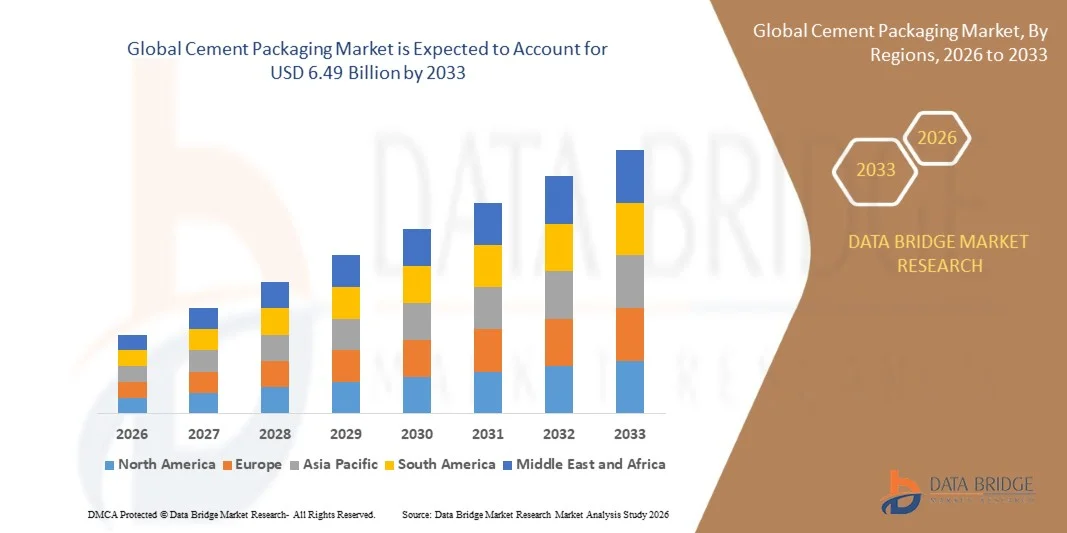
As per Data Bridge Market Research analysis, the Cement Packaging Market was valued at USD 4.78 billion in 2025 and is projected to reach USD 6.49 billion by 2033, growing at a CAGR of 3.9% from 2026 to 2033. The market is witnessing steady expansion driven by rising global cement consumption, rapid urbanization, and increasing infrastructure development across emerging economies.
The growing demand for durable, moisture-resistant, and cost-efficient packaging solutions, particularly cement paper bags and woven polypropylene sacks, is supporting market growth. In addition, expansion of construction activities, large-scale housing projects, and industrial development are encouraging cement manufacturers to adopt high-strength, eco-friendly, and recyclable packaging formats that ensure safe transportation and storage under varying environmental conditions.
Market Size & Forecast
- Global Market Value (2025): USD 4.78 Billion
- Expected Market Value (2033): USD 6.49 Billion
- Forecast CAGR (2026–2033): 3.9%
- Leading Region in 2025: North America
- Fastest Growing Region: Asia Pacific
Key Market Trends & Insights
- North America dominated the Cement Packaging Market with the largest revenue share of 34.18% in 2025, supported by strong construction activity, high cement consumption, and well-established packaging manufacturing infrastructure in the U.S. and Canada.
- The Paper segment led the market with a 46.12% share in 2025, driven by its strong recyclability, cost-effectiveness, and widespread acceptance across domestic and export cement distribution channels.
- Asia-Pacific is expected to be the fastest-growing region at a CAGR of 5.1% from 2026 to 2033, fueled by rapid urbanization, massive infrastructure development, and increasing cement production capacity in countries such as China, India, and Southeast Asia.
- Polypropylene (PP) are the fastest-growing material type, projected to register a CAGR of 4.3%, reflecting the surge in superior strength, reusability, and resistance to tearing under heavy loads.
- The Valve Sacks segment dominated the product type category with a 42.35% revenue share in 2025, led by their high efficiency in automated filling systems and minimal spillage during high-speed cement packaging operations.
- 15–30 kg accounted for 51.28% of the market, preferred by the standard packaging size used in most residential, commercial, and infrastructure construction activities.
- The 30 kg and Above segment is the fastest-growing capacity category, with a CAGR of 4.5%, driven by rising demand for bulk cement packaging in large-scale infrastructure and industrial construction projects.
Report Scope and Cement Packaging Market Segmentation
|
Attributes |
Cement Packaging Key Market Insights |
|
Segments Covered |
|
|
Countries Covered |
North America
Europe
Asia-Pacific
Middle East and Africa
South America
|
|
Key Market Players |
|
|
Market Opportunities |
|
|
Value Added Data Infosets |
In addition to the insights on market scenarios such as market value, growth rate, segmentation, geographical coverage, and major players, the market reports curated by the Data Bridge Market Research also include import export analysis, production capacity overview, production consumption analysis, price trend analysis, climate change scenario, supply chain analysis, value chain analysis, raw material/consumables overview, vendor selection criteria, PESTLE Analysis, Porter Analysis, and regulatory framework. |
What is the Key Trend in the Cement Packaging Market?
Trend: Shift Toward Sustainable and High-Strength Packaging Solutions
The cement packaging industry is witnessing a strong transition toward environmentally responsible and mechanically robust packaging formats as sustainability regulations and construction efficiency demands intensify globally. Manufacturers are increasingly replacing conventional plastic-heavy cement sacks with recyclable kraft paper bags and woven polypropylene (PP) sacks that offer higher tensile strength, improved stacking stability, and better resistance to moisture exposure during long-distance transportation. At the same time, innovations such as multi-layer barrier coatings, anti-slip surfaces, and reinforced stitching are improving product safety across storage, handling, and export logistics. This shift is also being supported by circular economy initiatives, where packaging waste reduction and recyclability targets are becoming mandatory in several regions.
For instance, cement producers in Germany and India are progressively adopting fully recyclable paper-based cement bags in compliance with stricter environmental norms and sustainable construction certification requirements.
Cement Packaging Market Dynamics
Key Market Driver: Rising Global Cement Demand from Infrastructure Expansion
The growth of the cement packaging market is closely tied to the accelerating pace of urbanization and infrastructure development worldwide, particularly in emerging economies where large-scale construction activities are reshaping industrial and residential landscapes. Increasing investments in highways, metro systems, airports, smart cities, and affordable housing projects are driving consistent cement production, which in turn fuels demand for reliable packaging solutions capable of handling high-volume distribution. Cement packaging plays a critical role in ensuring product integrity during transportation from manufacturing plants to construction sites, especially in regions with long supply chains and challenging climatic conditions. In addition, the expansion of export-oriented cement trade is further increasing the need for durable, standardized packaging formats that comply with international logistics requirements.
For instance, India’s infrastructure-led growth programs and China’s continued urban development initiatives are significantly boosting cement consumption and strengthening demand for industrial-scale cement bagging systems.
Key Restraint/Challenge: Volatility in Raw Material Prices and Supply Chain Disruptions
A major challenge impacting the cement packaging industry is the high dependency on raw materials such as kraft paper, polypropylene resin, and chemical adhesives, all of which are subject to significant price fluctuations driven by global energy costs, crude oil volatility, and supply-demand imbalances. These fluctuations directly affect production costs for cement bag manufacturers, making long-term pricing contracts with cement producers more difficult to sustain. In addition, disruptions in global logistics networks, container shortages, and geopolitical uncertainties can delay raw material procurement and finished goods delivery, resulting in operational inefficiencies and inventory management challenges. Smaller and mid-sized packaging manufacturers are particularly vulnerable, as they often lack the financial buffer to absorb sudden cost escalations.
For instance, during recent global supply chain disruptions, polypropylene prices surged sharply, increasing the cost of woven cement sacks and forcing packaging suppliers in multiple regions to renegotiate contracts with cement producers.
Key Market Opportunity: Development of Smart and Automated Cement Packaging Systems
The increasing adoption of automation and digitalization in cement manufacturing facilities is creating strong opportunities for advanced packaging technologies that enhance speed, precision, and operational efficiency. Modern cement plants are integrating automated rotary packers, robotic palletizing systems, and IoT-enabled monitoring solutions that allow real-time tracking of bag filling accuracy, sealing quality, and production throughput. These systems significantly reduce manual intervention, minimize material wastage, and improve consistency in packaging output, making them highly attractive for large-scale cement producers. In addition, the integration of data analytics and predictive maintenance capabilities is helping manufacturers optimize equipment performance and reduce downtime. Cloud-based monitoring platforms are also enabling centralized control across multiple packaging lines, improving scalability for multinational cement companies.
For instance, advanced automated cement bagging and palletizing systems have been deployed in several large cement production facilities in the Middle East, where high-capacity operations require continuous, efficient, and precision-driven packaging processes.
How is the Cement Packaging Market Segmented?
The cement packaging market is segmented on the basis of material type, product type, and capacity.
- By Material Type
On the basis of material type, the Cement Packaging Market is segmented into paper, plastic, high-density polyethylene (HDPE), and polypropylene (PP). The Paper segment dominated the market with a 46.12% share in 2025, owing to its strong recyclability, cost-effectiveness, and widespread acceptance across domestic and export cement distribution channels. Paper-based cement bags, especially multi-layer kraft paper variants, provide excellent moisture resistance and structural strength, making them suitable for bulk handling and long-distance transportation. Their lightweight nature also reduces logistics costs while supporting sustainability goals in the construction industry. Increasing regulatory pressure on plastic usage is further strengthening demand for paper-based packaging solutions. Cement manufacturers prefer paper sacks due to their ease of branding and compatibility with high-speed filling machines. Continuous innovation in barrier coatings is enhancing durability and performance, reinforcing their market dominance.
The Polypropylene (PP) segment is expected to be the fastest growing at a CAGR of 4.3% from 2026 to 2033, driven by its superior strength, reusability, and resistance to tearing under heavy loads. PP woven sacks are increasingly used in large-scale industrial cement distribution and export shipments due to their high durability and load-bearing capacity. These bags offer better protection in humid and challenging environmental conditions compared to traditional packaging materials. Rising demand from infrastructure megaprojects and cross-border cement trade is boosting adoption. Technological improvements in weaving and lamination are enhancing performance efficiency. Cost advantages over multi-layer paper packaging in certain regions are also accelerating market penetration.
- By Product Type
On the basis of product type, the market is segmented into sewn open mouth, pinched bottom open mouth, valve sacks, and open mouth sacks. The Valve Sacks segment dominated the market with a 42.35% share in 2025, due to their high efficiency in automated filling systems and minimal spillage during high-speed cement packaging operations. These bags are widely used in modern cement plants where precision filling and dust control are critical operational requirements. Their design enables faster packaging cycles, improving overall plant productivity and reducing labor dependency. Valve sacks also enhance product safety by minimizing leakage during transportation and storage. Increasing adoption of fully automated rotary packing machines is further supporting demand for this segment. Their compatibility with bulk cement handling systems makes them the preferred choice for large manufacturers. Continuous improvements in valve technology are improving sealing efficiency and performance reliability.
The Pinched Bottom Open Mouth segment is expected to be the fastest growing at a CAGR of 4.1% from 2026 to 2033, driven by increasing demand for secure sealing and improved product protection during transportation. These sacks offer strong closure mechanisms that reduce the risk of leakage and contamination, making them suitable for long-distance logistics. They are increasingly adopted in regions with high humidity and challenging storage conditions. Growing focus on packaging integrity and reduced wastage is supporting their adoption. Cement exporters prefer this format due to its improved stacking stability and handling efficiency. Advancements in automated stitching and sealing technologies are further accelerating growth.
- By Capacity
On the basis of capacity, the market is segmented into up to 5 kg, 5–15 kg, 15–30 kg, and 30 kg and above. The 15–30 kg segment dominated the market with a 51.28% share in 2025, as it represents the standard packaging size used in most residential, commercial, and infrastructure construction activities. This capacity range offers an optimal balance between handling convenience and material efficiency, making it widely preferred across retail and wholesale cement distribution channels. It is also highly compatible with manual handling systems and small-scale construction applications. Cement manufacturers favor this segment due to its strong market acceptance and logistical efficiency. Standardization across global construction markets further reinforces its dominance. High demand from urban housing and infrastructure projects continues to sustain growth in this category.
The 30 kg and Above segment is expected to be the fastest growing at a CAGR of 4.5% from 2026 to 2033, driven by rising demand for bulk cement packaging in large-scale infrastructure and industrial construction projects. This segment is increasingly used in high-volume applications where efficiency in loading, transportation, and storage is critical. It reduces packaging frequency and handling costs, making it attractive for large contractors and industrial buyers. Expansion of mega construction projects and industrial zones is boosting demand for high-capacity cement sacks. Technological improvements in material strength are enabling safer handling of heavier loads. Growing preference for bulk logistics solutions is further accelerating adoption in emerging economies.
Which Region Holds the Largest Share of the Cement Packaging Market?
North America dominated the Cement Packaging Market with the largest revenue share of 34.18% in 2025, supported by strong construction activity, high cement consumption, and well-established packaging manufacturing infrastructure in the U.S. and Canada. The region also benefits from advanced industrial packaging technologies, large-scale infrastructure redevelopment projects, and strong presence of integrated cement manufacturers with long-term packaging contracts. Increasing demand for sustainable packaging materials such as recyclable paper bags and PP woven sacks is further strengthening market growth. Rising investments in residential, commercial, and transportation infrastructure continue to support consistent cement packaging demand. High adoption of automated bagging systems and efficient logistics networks also enhances operational efficiency across the region. Strong regulatory focus on sustainable construction practices further reinforces North America’s leadership position in the global market.
U.S. Cement Packaging Market Insight
The U.S. cement packaging market is experiencing robust growth driven by large-scale infrastructure upgrades, residential construction expansion, and strong demand for durable packaging solutions in cement distribution. The country benefits from advanced manufacturing capabilities, high automation in cement bagging operations, and widespread use of paper-based and PP woven cement sacks. Increasing investments in sustainable construction practices and green building standards are further encouraging the adoption of recyclable packaging materials. Strong presence of leading cement producers and packaging suppliers supports stable supply chain integration. Growth in public infrastructure projects such as highways, bridges, and smart city developments continues to boost cement consumption. Technological advancements in packaging machinery and logistics optimization are further enhancing market efficiency and competitiveness.
Europe Cement Packaging Market Insight
The Europe cement packaging market remains a key contributor globally, driven by strict environmental regulations, advanced packaging technologies, and strong demand for sustainable construction materials. The region has high adoption of recyclable paper-based cement bags and eco-friendly packaging solutions due to stringent EU sustainability mandates. Increasing use of automated cement packing systems and smart logistics solutions is improving operational efficiency across manufacturing plants. Strong presence of established cement producers and packaging manufacturers supports steady market development. Growth in renovation projects, infrastructure modernization, and green building initiatives continues to drive cement demand. Focus on circular economy practices and packaging waste reduction further strengthens Europe’s market position.
U.K. Cement Packaging Market Insight
The U.K. cement packaging market is experiencing steady growth, supported by rising infrastructure development, residential construction activities, and modernization of aging buildings. Increasing adoption of sustainable packaging materials such as recyclable paper sacks is driven by environmental regulations and corporate sustainability goals. The market is also benefiting from automation in cement packaging plants, improving efficiency and reducing operational costs. Strong demand from urban housing projects and commercial construction is supporting consistent cement consumption. Integration of advanced logistics and supply chain systems is enhancing packaging distribution efficiency. In addition, innovation in lightweight and durable packaging formats is strengthening market competitiveness in the region.
Germany Cement Packaging Market Insight
The Germany cement packaging market is expanding steadily due to strong industrial infrastructure, advanced manufacturing capabilities, and strict environmental compliance standards. High adoption of eco-friendly cement packaging materials such as recyclable kraft paper bags is driven by sustainability regulations and green construction initiatives. The country’s focus on automation and Industry 4.0 technologies is improving efficiency in cement packaging operations. Strong demand from residential, commercial, and infrastructure renovation projects supports stable market growth. Advanced packaging machinery and precision filling systems are widely used across cement plants. Continuous innovation in material strength and recyclability is further enhancing Germany’s market development.
Asia-Pacific Cement Packaging Market Insight
The Asia-Pacific cement packaging market is expected to witness rapid growth, driven by massive urbanization, infrastructure expansion, and increasing cement production across developing economies. Rising construction activities in countries such as China, India, and Southeast Asia are significantly boosting demand for efficient cement packaging solutions. Growing adoption of cost-effective materials such as paper sacks and PP woven bags supports large-scale distribution requirements. Expansion of smart cities, transportation networks, and housing projects continues to accelerate market growth. Increasing investment in automated cement packaging systems is improving production efficiency. Strong industrial development and export-oriented cement trade further strengthen regional demand.
Japan Cement Packaging Market Insight
The Japan cement packaging market is witnessing steady growth due to ongoing infrastructure maintenance, disaster-resilient construction, and advanced manufacturing practices. High demand for precision-engineered and high-quality packaging solutions supports adoption of durable paper and PP-based cement bags. The country’s focus on automation and robotics in packaging systems is improving efficiency and consistency in cement distribution. Sustainability initiatives are encouraging the use of recyclable and low-waste packaging materials. Stable construction activity in urban redevelopment and transportation infrastructure supports consistent cement demand. Technological innovation in packaging machinery continues to enhance operational efficiency across the sector.
China Cement Packaging Market Insight
The China cement packaging market is growing rapidly, driven by large-scale infrastructure development, urbanization, and high cement production capacity. Strong demand from residential, commercial, and mega infrastructure projects significantly boosts packaging requirements across the country. Increasing adoption of automated cement bagging systems and high-speed production lines is improving efficiency in cement plants. Expansion of eco-friendly packaging materials, including recyclable paper bags, is supported by environmental regulations. The country’s strong export-oriented cement industry further increases demand for durable packaging solutions. Continuous technological advancements and industrial expansion position China as a dominant market in the region.
Which are the Top Companies in Cement Packaging Market?
The cement packaging industry is primarily led by well-established companies, including:
- Mondi Group (U.K.)
- Smurfit WestRock (Ireland)
- Billerud AB (Sweden)
- LC Packaging International BV (Netherlands)
- Fischbein LLC (U.S.)
- Haver & Boecker OHG (Germany)
- FLSmidth A/S (Denmark)
- BEUMER Group GmbH & Co. KG (Germany)
- AUMUND Group (Germany)
- ANDRITZ AG (Austria)
- GEA Group AG (Germany)
- Valmet Oyj (Finland)
- Sonoco Products Company (U.S.)
- International Paper Company (U.S.)
- Packaging Corporation of America (U.S.)
- Glatfelter Corporation (U.S.)
- ProAmpac LLC (U.S.)
- Glatz Klimatechnik (Germany)
- Shandong Xinfa Packaging Co., Ltd. (China)
- Shandong Sunshine Packaging Co., Ltd. (China)
What are Latest Developments in Cement Packaging Market?
- In June 2024, Mondi, a global leader in sustainable packaging solutions, launched its SolmixBag water-soluble cement packaging technology in collaboration with CEMEX to reduce construction waste and improve on-site efficiency. The innovative kraft paper-based cement bag is designed to dissolve during the mixing process, eliminating the need for manual emptying and significantly reducing dust emissions and packaging waste. This solution enhances safety, improves operational efficiency, and supports circular economy goals in the construction industry. It is also compatible with existing cement filling systems, enabling easy adoption across large-scale cement manufacturing operations
- In January 2024, Heidelberg Materials North America introduced redesigned cement packaging aligned with its updated brand identity and sustainability strategy. The new packaging enhances product visibility and differentiation across its cement product portfolio while maintaining high durability standards for industrial handling and logistics. It also reflects the company’s focus on reducing environmental impact through improved material efficiency and optimized packaging design. The rollout across North America supports stronger market positioning and streamlined distribution networks
- In June 2023, Mondi further strengthened its sustainable cement packaging portfolio by partnering with Baumit to introduce water-soluble paper bags for dry-mix mortar applications. This development focuses on eliminating packaging waste at construction sites by allowing the entire bag to dissolve during mixing, improving efficiency and reducing material handling. The solution also enhances worker safety by minimizing dust exposure and supports high-speed industrial filling processes used in cement packaging plants. It reflects the growing demand for environmentally friendly and efficient packaging formats in the global cement industry
- In April 2022, Mondi expanded its cement packaging production capabilities in Egypt through strategic asset integration from Lafarge Cement Egypt, strengthening its presence in the Middle East and Africa region. This expansion increased the supply of high-strength kraft paper cement bags, which are widely used in automated filling systems and large-scale cement distribution networks. The development supports rising construction demand across emerging markets and improves regional supply chain efficiency for cement manufacturers. It also reflects the growing shift toward recyclable and sustainable paper-based cement packaging solutions
- In April 2022, Mondi further strengthened its industrial packaging footprint by expanding cement bag production capacity in Egypt, supporting increasing demand from regional cement manufacturers. This development enhanced the availability of durable paper-based cement sacks designed for high-speed filling and long-distance transportation. It also improved supply reliability in a rapidly growing construction market across the Middle East and Africa. The initiative highlights ongoing industrial consolidation and the increasing importance of sustainable cement packaging solutions in global supply chains

- Interactive Data Analysis Dashboard
- Company Analysis Dashboard for high growth potential opportunities
- Research Analyst Access for customization & queries
- Competitor Analysis with Interactive dashboard
- Latest News, Updates & Trend analysis
- Harness the Power of Benchmark Analysis for Comprehensive Competitor Tracking
Global Cement Packaging Market, Supply Chain Analysis and Ecosystem Framework
To support market growth and help clients navigate the impact of geopolitical shifts, DBMR has integrated in-depth supply chain analysis into its Global Cement Packaging Market research reports. This addition empowers clients to respond effectively to global changes affecting their industries. The supply chain analysis section includes detailed insights such as Global Cement Packaging Market consumption and production by country, price trend analysis, the impact of tariffs and geopolitical developments, and import and export trends by country and HSN code. It also highlights major suppliers with data on production capacity and company profiles, as well as key importers and exporters. In addition to research, DBMR offers specialized supply chain consulting services backed by over a decade of experience, providing solutions like supplier discovery, supplier risk assessment, price trend analysis, impact evaluation of inflation and trade route changes, and comprehensive market trend analysis.
Data collection and base year analysis are done using data collection modules with large sample sizes. The stage includes obtaining market information or related data through various sources and strategies. It includes examining and planning all the data acquired from the past in advance. It likewise envelops the examination of information inconsistencies seen across different information sources. The market data is analysed and estimated using market statistical and coherent models. Also, market share analysis and key trend analysis are the major success factors in the market report. To know more, please request an analyst call or drop down your inquiry.
The key research methodology used by DBMR research team is data triangulation which involves data mining, analysis of the impact of data variables on the market and primary (industry expert) validation. Data models include Vendor Positioning Grid, Market Time Line Analysis, Market Overview and Guide, Company Positioning Grid, Patent Analysis, Pricing Analysis, Company Market Share Analysis, Standards of Measurement, Global versus Regional and Vendor Share Analysis. To know more about the research methodology, drop in an inquiry to speak to our industry experts.
Data Bridge Market Research is a leader in advanced formative research. We take pride in servicing our existing and new customers with data and analysis that match and suits their goal. The report can be customized to include price trend analysis of target brands understanding the market for additional countries (ask for the list of countries), clinical trial results data, literature review, refurbished market and product base analysis. Market analysis of target competitors can be analyzed from technology-based analysis to market portfolio strategies. We can add as many competitors that you require data about in the format and data style you are looking for. Our team of analysts can also provide you data in crude raw excel files pivot tables (Fact book) or can assist you in creating presentations from the data sets available in the report.













