


Cement Sacks Market Overview
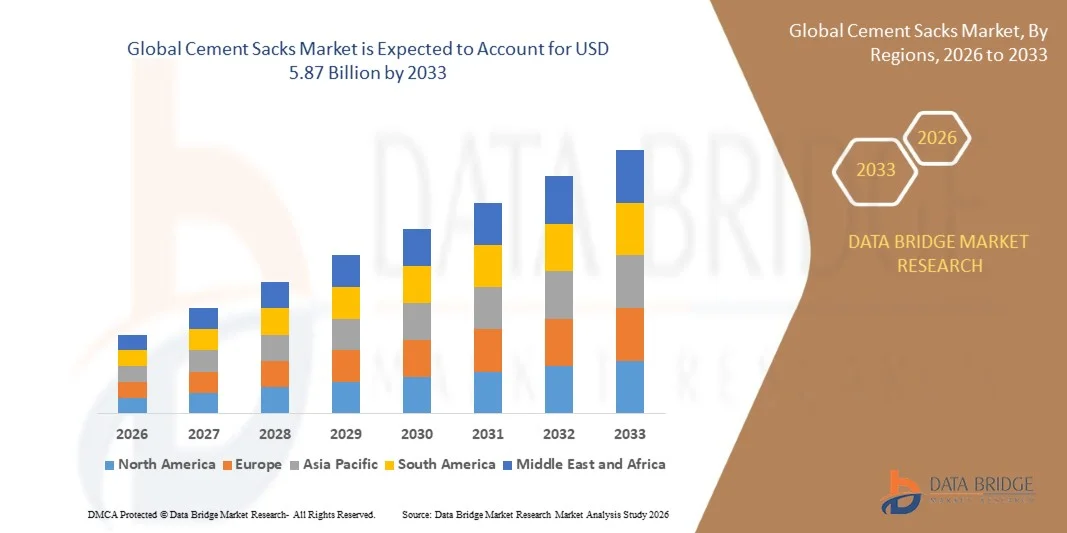
The Cement Sacks Market was valued at USD 4.30 Billion in 2025 and is projected to reach USD 5.87 Billion by 2033, growing at a CAGR of 3.97% from 2026 to 2033. The market is experiencing consistent growth driven by increasing cement production, rapid urbanization, and rising investments in residential, commercial, and infrastructure construction projects worldwide. Growing demand for efficient bulk material handling and transportation solutions, along with advancements in durable and sustainable packaging materials, is further supporting market expansion across developed and emerging economies.
The continuous growth of the global construction industry, combined with increasing infrastructure development activities, is significantly driving demand for high-performance cement packaging solutions. Cement sacks play a critical role in protecting products from moisture, contamination, and material loss during storage and transportation while improving handling efficiency throughout the supply chain. In addition, rising adoption of recyclable paper sacks, advanced valve bag technologies, and automated cement filling systems is encouraging manufacturers to invest in innovative packaging formats that enhance operational efficiency and sustainability.
Key Market Trends & Insights
- Asia-Pacific dominated the Cement Sacks Market with the largest revenue share of 40% in 2025, supported by strong cement production capacity, rapid urbanization, and large-scale infrastructure development across major economies
- The Polypropylene (PP) segment led the market with a 52.0% share in 2025, driven by its high tensile strength, cost efficiency, and strong resistance to moisture during bulk cement transportation
- North America is expected to be the fastest-growing region at a CAGR of 3.8% from 2026 to 2033, fueled by increasing infrastructure investment, industrial construction activity, and modernization of cement packaging operations
- Valve sacks are the fastest-growing product type, projected to register a CAGR of 9.0% from 2026 to 2033, supported by increasing automation in cement packaging plants and demand for dust-free filling systems
- The sewn open mouth segment dominated the product type category with a 46.0% revenue share in 2025, led by its widespread use in traditional cement filling operations and compatibility with high-speed filling lines
- 31 kg - 40 kg accounted for 44.0% of the market in 2025, preferred by its standardization across bulk cement distribution in construction and infrastructure projects
- The Linear Low Density Polyethylene (LLDPE) segment is the fastest-growing category, with a CAGR of 8.5% from 2026 to 2033, driven by increasing demand for flexible, puncture-resistant, and lightweight cement packaging solutions
Market Size & Forecast
- Global Market Value (2025): USD 4.30 Billion
- Expected Market Value (2033): USD 5.87 Billion
- Forecast CAGR (2026–2033): 3.97%
- Leading Region in 2025: Asia-Pacific
- Fastest Growing Region: North America
Report Scope and Cement Sacks Market Segmentation
|
Attributes |
Cement Sacks Key Market Insights |
|
Segments Covered |
|
|
Countries Covered |
North America · U.S. · Canada · Mexico Europe · Germany · France · U.K. · Netherlands · Switzerland · Belgium · Russia · Italy · Spain · Turkey · Rest of Europe Asia-Pacific · China · Japan · India · South Korea · Singapore · Malaysia · Australia · Thailand · Indonesia · Philippines · Rest of Asia-Pacific Middle East and Africa · Saudi Arabia · U.A.E. · South Africa · Egypt · Israel · Rest of Middle East and Africa South America · Brazil · Argentina · Rest of South America |
|
Key Market Players |
· Mondi plc (U.K.) · Klabin S.A. (Brazil) · Billerud AB (Sweden) · Smurfit Westrock plc (Ireland) · Conitex Sonoco (U.S.) · Segezha Group PJSC (Russia) · LC Packaging International BV (Netherlands) · Gascogne Sacs SAS (France) · Rengo Co., Ltd. (Japan) · Industrial Development Company SAL (Lebanon) · Hood Packaging Corporation (U.S.) · Novolex Holdings, LLC (U.S.) · United Bags, Inc. (U.S.) · Yorkshire Packaging Systems Ltd. (U.K.) · Bischof + Klein SE & Co. KG (Germany) · NNZ Group B.V. (Netherlands) · UFlex Limited (India) · Berry Global Group, Inc. (U.S.) |
|
Market Opportunities |
· Expansion of Valve Sack Usage in Automated Cement Packaging Facilities · Increasing Demand for High-Strength Lightweight Cement Packaging Solutions · Growing Adoption of Eco-Friendly Paper-Based Cement Sacks in Emerging Markets |
|
Value Added Data Infosets |
In addition to the insights on market scenarios such as market value, growth rate, segmentation, geographical coverage, and major players, the market reports curated by the Data Bridge Market Research also include import export analysis, production capacity overview, production consumption analysis, price trend analysis, climate change scenario, supply chain analysis, value chain analysis, raw material/consumables overview, vendor selection criteria, PESTLE Analysis, Porter Analysis, and regulatory framework. |
Cement Sacks Market Trends
Trend: Growing Adoption of Sustainable and Recyclable Cement Sack Packaging
Cement manufacturers are increasingly adopting sustainable and recyclable packaging solutions to reduce environmental impact and comply with evolving packaging regulations. Paper-based cement sacks, lightweight packaging structures, and recyclable valve sacks are gaining popularity as construction material producers seek to improve sustainability across supply chains. Growing investments in circular economy initiatives and waste reduction programs are further accelerating the transition from conventional packaging formats toward environmentally friendly alternatives. The trend is particularly prominent in Europe and North America, where construction companies are placing greater emphasis on sustainable procurement practices.
Companies such as Mondi and Cemex have collaborated to commercialize the SolmixBag, a water-soluble paper-based cement sack that eliminates packaging waste during the mixing process while reducing dust emissions at construction sites. Such innovations are accelerating the adoption of sustainable cement packaging technologies across global markets.
Cement Sacks Market Dynamics
Key Market Driver: Rising Infrastructure Development and Cement Consumption Worldwide
The increasing pace of infrastructure development and urban construction activities is significantly driving demand for cement sacks globally. Governments across Asia-Pacific, the Middle East, and Africa are investing heavily in transportation networks, residential housing, industrial facilities, and commercial developments, resulting in growing cement consumption. Efficient packaging solutions are essential for protecting cement during storage, transportation, and distribution while minimizing material losses. The expansion of cement manufacturing capacity in emerging economies is further strengthening demand for durable and high-performance cement sacks.
According to the International Energy Agency (IEA), global floor area is expected to continue expanding substantially through 2030, while major economies including India are investing billions of dollars in infrastructure projects. Companies such as UltraTech Cement and Holcim continue to expand cement production and distribution operations, supporting sustained demand for industrial cement packaging solutions.
Key Restraint/Challenge: Volatility in Raw Material Prices for Paper and Plastic Packaging
A major challenge in the Cement Sacks market is the fluctuation in prices of key raw materials including kraft paper, polypropylene, polyethylene, and other packaging inputs. Variations in crude oil prices, energy costs, transportation expenses, and pulp supply dynamics directly affect manufacturing costs for cement sack producers. These cost fluctuations can reduce profit margins and create pricing pressures throughout the packaging supply chain. In addition, uncertainty in global commodity markets makes long-term procurement and production planning increasingly difficult for packaging manufacturers.
For instance, paper and packaging manufacturers across Europe experienced significant cost pressures during recent years due to higher energy and pulp prices, prompting companies such as Smurfit Westrock and Mondi to implement pricing adjustments across industrial packaging portfolios. Such volatility continues to challenge profitability and cost management within the cement sacks industry.
Key Market Opportunity: Expansion of Valve Sack Usage in Automated Cement Packaging Facilities
The growing adoption of automated cement filling and packaging systems is creating substantial opportunities for valve sack manufacturers worldwide. Valve sacks enable high-speed filling operations, improved sealing performance, lower dust generation, and reduced material wastage compared to conventional packaging formats. As cement producers modernize production facilities and invest in automation technologies, demand for advanced valve sack solutions is increasing significantly. The technology also supports improved logistics efficiency and workplace safety, making it highly attractive for large-scale cement manufacturing operations.
Companies such as Haver & Boecker and BEUMER Group are expanding automated packaging and filling technologies that are designed to work efficiently with valve sack systems. Increasing deployment of automated cement plants across Asia-Pacific, the Middle East, and Latin America is expected to accelerate adoption of valve sacks and create significant growth opportunities for packaging manufacturers over the coming years.
Cement Sacks Market Scope
The cement sacks market is segmented on the basis of material type, product type, and capacity.
- By Material Type
On the basis of material type, the Cement Sacks Market is segmented into plastic, high density polyethylene (HDPE), low density polyethylene (LDPE), linear low density polyethylene (LLDPE), polypropylene (PP), polystyrene (PS), polyvinyl chloride (PVC), plastic paper, bleached paper, unbleached paper, and jute. The Polypropylene (PP) segment dominated the market with the largest share of 52.0% in 2025, driven by its high tensile strength, cost efficiency, and strong resistance to moisture during bulk cement transportation. PP woven sacks are widely used in large-scale cement packaging due to their durability under heavy loading conditions. Expanding construction activity and infrastructure development further strengthen demand across emerging economies. Established recycling compatibility and easy manufacturing scalability also support its leading position.
The Linear Low Density Polyethylene (LLDPE) segment is projected to register the fastest growth at a CAGR of 8.5% from 2026 to 2033, driven by increasing demand for flexible, puncture-resistant, and lightweight cement packaging solutions. LLDPE-based sacks offer improved sealing performance, reducing leakage risks during long-distance transportation and storage. Rising adoption of advanced multi-layer packaging structures in modern cement logistics is further accelerating usage. Growth in export-oriented cement trade and humid-region applications is reinforcing material preference. Continuous innovation in polymer blending technologies is expected to sustain segment expansion.
- By Product Type
On the basis of product type, the Cement Sacks Market is segmented into sewn open mouth, pinched bottom open mouth, valve sacks, and open mouth sacks. The Sewn Open Mouth segment dominated the market with a share of 46.0% in 2025, supported by its widespread use in traditional cement filling operations and compatibility with high-speed filling lines. These sacks provide reliable closure strength, ensuring safe handling during bulk transportation and storage. Their low production cost and ease of availability make them highly preferred across small and medium cement manufacturers. Strong demand from domestic construction supply chains further reinforces segment dominance. Operational simplicity and high filling efficiency continue to sustain their market leadership.
The Valve Sacks segment is projected to register the fastest growth at a CAGR of 9.0% from 2026 to 2033, driven by increasing automation in cement packaging plants and demand for dust-free filling systems. Valve sacks enable faster filling with minimal spillage, improving operational efficiency and reducing material loss. Adoption is rising in large-scale cement manufacturing facilities focused on productivity enhancement and environmental compliance. Growing emphasis on clean packaging standards in export markets is further supporting demand. Continuous upgrades in high-speed valve packaging machinery are accelerating segment expansion.
- By Capacity
On the basis of capacity, the Cement Sacks Market is segmented into less than 10 kg, 11 kg–30 kg, 31 kg–40 kg, and above 40 kg. The 31 kg–40 kg segment dominated the market with the largest share of 44.0% in 2025, driven by its standardization across bulk cement distribution in construction and infrastructure projects. This capacity range offers an optimal balance between handling efficiency and transportation economics. It is widely adopted in both residential and commercial construction supply chains due to its compatibility with industry norms. Strong demand from large-scale infrastructure development projects further supports its dominance. Established packaging line configurations across cement plants reinforce sustained usage.
The Above 40 kg segment is projected to register the fastest growth at a CAGR of 7.8% from 2026 to 2033, driven by increasing demand for high-volume cement transportation in industrial and infrastructure megaprojects. These sacks reduce handling cycles and improve logistics efficiency in large-scale construction operations. Rising adoption in bulk cement trade and export shipments is further accelerating segment expansion. Growing investments in smart logistics and warehouse optimization are supporting higher capacity packaging solutions. Continuous improvements in sack strength and load-bearing materials are enabling broader adoption.
Cement Sacks Market Regional Analysis
Asia-Pacific dominated the cement sacks market and accounted for the largest revenue share of 40% in 2025, supported by strong cement production capacity, rapid urbanization, and large-scale infrastructure development across major economies. The region benefits from extensive construction activity, cost-effective manufacturing of woven sacks and paper-based packaging, and well-established cement distribution networks. Rising investments in residential, commercial, industrial, and transportation infrastructure are accelerating demand for durable bulk cement packaging solutions. In addition, expansion of export-oriented cement production and modernization of packaging operations are reinforcing regional market leadership.
China Cement Sacks Market Insight
China held the largest share in the Asia-Pacific Cement Sacks market in 2025, supported by its dominant cement manufacturing industry and extensive packaging production ecosystem. The country has a large installed base of automated cement filling lines that heavily utilize polypropylene and valve sack packaging formats. Strong domestic demand from infrastructure, real estate, and industrial construction projects continues to sustain high packaging consumption. In addition, China's significant role in regional cement trade and bulk material logistics reinforces its leadership position in cement sack production and utilization.
India Cement Sacks Market Insight
India is witnessing the fastest growth in the Asia-Pacific region, driven by expanding cement capacity, rising infrastructure spending, and increasing demand from housing and urban development programs. Growing adoption of automated packaging systems is accelerating the shift toward high-performance valve sacks and advanced woven sack formats. The country is also benefiting from rapid growth in cement distribution networks across Tier 2 and Tier 3 cities. In addition, rising investments in highways, railways, industrial corridors, and commercial construction projects are supporting sustained long-term market expansion.
Europe Cement Sacks Market Insight
The Europe Cement Sacks market is expanding steadily, supported by modernization of cement packaging facilities, growing focus on operational efficiency, and increasing adoption of sustainable packaging solutions. Cement producers across the region are investing in dust-reducing valve sack systems and recyclable paper-based sack formats to meet environmental and workplace safety requirements. Strong demand from infrastructure renovation, energy transition projects, and commercial construction activity is further supporting packaging consumption. In addition, emphasis on circular economy initiatives and packaging waste reduction is encouraging innovation in lightweight and recyclable cement sacks.
Germany Cement Sacks Market Insight
Germany accounted for the largest share in the Europe Cement Sacks market in 2025, driven by its advanced cement manufacturing infrastructure and widespread adoption of automated filling technologies. The country has a strong industrial base that requires high-volume cement packaging for construction, infrastructure, and industrial applications. Demand for premium valve sacks with improved filling efficiency and dust control is particularly strong among large cement producers. In addition, Germany's established logistics networks and focus on sustainable packaging practices reinforce its leading market position in Europe.
U.K. Cement Sacks Market Insight
The U.K. market is supported by infrastructure upgrades, commercial redevelopment projects, and increasing demand for efficient cement distribution systems. Cement manufacturers and construction suppliers are progressively adopting advanced sack formats that improve handling efficiency and reduce material loss during transport and storage. Growing attention to environmental compliance and packaging recyclability is also influencing material selection across the supply chain. In addition, expansion of warehousing, logistics modernization, and e-commerce-enabled construction material distribution is supporting steady market growth.
North America Cement Sacks Market Insight
North America is projected to grow at the fastest CAGR of 3.8% from 2026 to 2033, driven by increasing infrastructure investment, industrial construction activity, and modernization of cement packaging operations. Rising demand for high-speed automated filling systems is accelerating adoption of valve sacks and performance-oriented woven packaging solutions. Strong focus on workplace safety, dust reduction, and supply-chain efficiency is further supporting upgrades in cement packaging technology. In addition, growing renovation activity, energy infrastructure projects, and logistics optimization initiatives are contributing to sustained regional market expansion.
U.S. Cement Sacks Market Insight
The U.S. accounted for the largest share in the North America Cement Sacks market in 2025, supported by strong cement consumption from residential, commercial, infrastructure, and industrial construction sectors. The country benefits from extensive utilization of automated packaging lines that require high-quality valve sacks and durable woven sack formats. Increasing investment in highways, bridges, data centers, manufacturing facilities, and energy projects is further strengthening packaging demand. In addition, emphasis on supply-chain reliability, material handling efficiency, and sustainable packaging solutions is reinforcing the U.S. leadership position in the regional market.
Cement Sacks Market Share
The cement sacks industry is primarily led by well-established companies, including:
- Mondi plc (U.K.)
- Klabin S.A. (Brazil)
- Billerud AB (Sweden)
- Smurfit Westrock plc (Ireland)
- Conitex Sonoco (U.S.)
- Segezha Group PJSC (Russia)
- LC Packaging International BV (Netherlands)
- Gascogne Sacs SAS (France)
- Rengo Co., Ltd. (Japan)
- Industrial Development Company SAL (Lebanon)
- Hood Packaging Corporation (U.S.)
- Novolex Holdings, LLC (U.S.)
- United Bags, Inc. (U.S.)
- Yorkshire Packaging Systems Ltd. (U.K.)
- Bischof + Klein SE & Co. KG (Germany)
- NNZ Group B.V. (Netherlands)
- UFlex Limited (India)
- Berry Global Group, Inc. (U.S.)
Latest Developments in Cement Sacks Market
- In April 2025, Mondi Group partnered with Evonik Industries to develop a recyclable paper valve bag designed for industrial powder applications, replacing conventional plastic-coated packaging formats. This development strengthened the shift toward sustainable heavy-duty sack solutions by reducing packaging weight and improving recyclability, encouraging broader adoption of eco-friendly packaging technologies across cement sacks and other construction material packaging markets
- In June 2024, Mondi Group and Cemex expanded the commercialization of the SolmixBag water-soluble cement sack for selected cement products in Europe. The initiative enhanced sustainability within the cement sacks market by eliminating packaging waste during the mixing process, reducing dust emissions on construction sites, and promoting the adoption of innovative paper-based packaging alternatives among cement manufacturers
- In June 2024, Mondi Group and Cemex introduced the SolmixBag water-soluble cement bag in Spain’s Balearic Islands, marking a significant advancement in sustainable cement packaging. The launch accelerated market interest in environmentally responsible cement sacks by improving construction-site efficiency, reducing waste disposal requirements, and supporting circular economy objectives within the building materials sector
- In March 2024, ProAmpac completed the acquisition of Gelpac, a manufacturer of multiwall paper sacks and poly-woven industrial packaging products. The acquisition expanded ProAmpac’s presence in the heavy-duty industrial packaging segment, strengthened supply capabilities for cement sack applications, and increased competitive investment in advanced packaging solutions for construction material transportation and storage
- In June 2023, Mondi Group partnered with Baumit to launch the SolmixBag water-soluble packaging solution for dry mix mortar and cement-based products. The development advanced innovation in the cement sacks market by reducing paper consumption, minimizing packaging waste, and improving handling efficiency, while encouraging cement and construction material producers to adopt more sustainable packaging formats

- Interactive Data Analysis Dashboard
- Company Analysis Dashboard for high growth potential opportunities
- Research Analyst Access for customization & queries
- Competitor Analysis with Interactive dashboard
- Latest News, Updates & Trend analysis
- Harness the Power of Benchmark Analysis for Comprehensive Competitor Tracking
Global Cement Sacks Market, Supply Chain Analysis and Ecosystem Framework
To support market growth and help clients navigate the impact of geopolitical shifts, DBMR has integrated in-depth supply chain analysis into its Global Cement Sacks Market research reports. This addition empowers clients to respond effectively to global changes affecting their industries. The supply chain analysis section includes detailed insights such as Global Cement Sacks Market consumption and production by country, price trend analysis, the impact of tariffs and geopolitical developments, and import and export trends by country and HSN code. It also highlights major suppliers with data on production capacity and company profiles, as well as key importers and exporters. In addition to research, DBMR offers specialized supply chain consulting services backed by over a decade of experience, providing solutions like supplier discovery, supplier risk assessment, price trend analysis, impact evaluation of inflation and trade route changes, and comprehensive market trend analysis.
Data collection and base year analysis are done using data collection modules with large sample sizes. The stage includes obtaining market information or related data through various sources and strategies. It includes examining and planning all the data acquired from the past in advance. It likewise envelops the examination of information inconsistencies seen across different information sources. The market data is analysed and estimated using market statistical and coherent models. Also, market share analysis and key trend analysis are the major success factors in the market report. To know more, please request an analyst call or drop down your inquiry.
The key research methodology used by DBMR research team is data triangulation which involves data mining, analysis of the impact of data variables on the market and primary (industry expert) validation. Data models include Vendor Positioning Grid, Market Time Line Analysis, Market Overview and Guide, Company Positioning Grid, Patent Analysis, Pricing Analysis, Company Market Share Analysis, Standards of Measurement, Global versus Regional and Vendor Share Analysis. To know more about the research methodology, drop in an inquiry to speak to our industry experts.
Data Bridge Market Research is a leader in advanced formative research. We take pride in servicing our existing and new customers with data and analysis that match and suits their goal. The report can be customized to include price trend analysis of target brands understanding the market for additional countries (ask for the list of countries), clinical trial results data, literature review, refurbished market and product base analysis. Market analysis of target competitors can be analyzed from technology-based analysis to market portfolio strategies. We can add as many competitors that you require data about in the format and data style you are looking for. Our team of analysts can also provide you data in crude raw excel files pivot tables (Fact book) or can assist you in creating presentations from the data sets available in the report.













