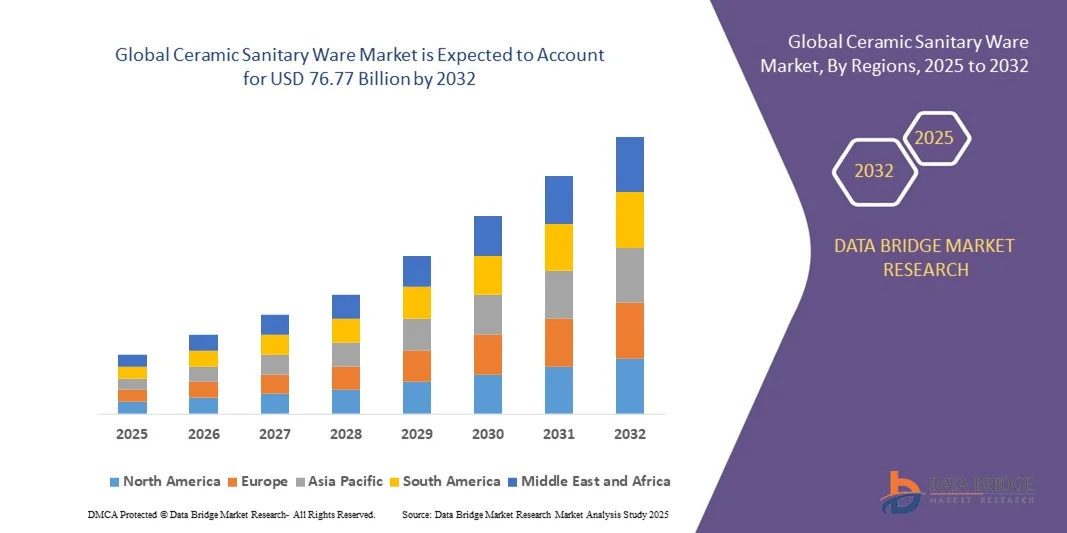
Ceramic Sanitary Ware Market Size
- The global ceramic sanitary ware market size was valued at USD 47.09 billion in 2024 and is expected to reach USD 76.77 billion by 2032, at a CAGR of 6.3% during the forecast period
- The market growth is largely fueled by the rapid expansion of the construction and real estate sectors, coupled with increasing urbanization and rising consumer expenditure on modern bathroom aesthetics. Growing demand for durable, water-efficient, and eco-friendly sanitary ware products is further propelling market development, as consumers prioritize hygiene and design sophistication in both residential and commercial spaces
- Furthermore, the rising trend of home renovation and modernization, along with the introduction of advanced manufacturing technologies and innovative product designs, is driving strong demand for ceramic sanitary ware. These factors collectively enhance the appeal of high-quality, sustainable bathroom solutions, significantly boosting the market’s growth trajectory
Ceramic Sanitary Ware Market Analysis
- Ceramic sanitary ware, encompassing products such as toilets, washbasins, and urinals, is increasingly gaining traction in both residential and commercial construction due to its durability, aesthetic versatility, and ease of maintenance. The industry benefits from growing awareness of hygiene standards, eco-friendly production practices, and continuous innovation in design and material efficiency
- The escalating demand for ceramic sanitary ware is primarily driven by rising urban housing development, improved living standards, and government initiatives promoting sanitation infrastructure. In addition, the shift toward sustainable and water-saving sanitary solutions is positioning ceramic products as the preferred choice for modern and eco-conscious consumers
- Asia-Pacific dominated ceramic sanitary ware market with a share of 40.9% in 2024, due to rapid urbanization, increasing disposable incomes, and expanding construction activities across residential and commercial sectors
- North America is expected to be the fastest growing region in the ceramic sanitary ware market during the forecast period due to modernization of residential spaces, increasing bathroom remodeling activities, and growing demand for sustainable building materials
- Toilet sinks/water closets segment dominated the market with a market share of 43.5% in 2024, due to their essential role in both residential and commercial sanitation infrastructure. The demand is largely driven by rising urbanization, increasing construction of residential complexes, and government initiatives for improving sanitation facilities. In addition, advancements in water-efficient flush technologies and the availability of aesthetically designed models have strengthened their adoption among consumers focused on hygiene and sustainability. The growing preference for smart toilets integrated with automatic flushing and self-cleaning systems further enhances this segment’s market dominance
Report Scope and Ceramic Sanitary Ware Market Segmentation
|
Attributes |
Ceramic Sanitary Ware Key Market Insights |
|
Segments Covered |
|
|
Countries Covered |
North America
Europe
Asia-Pacific
Middle East and Africa
South America
|
|
Key Market Players |
|
|
Market Opportunities |
|
|
Value Added Data Infosets |
In addition to the insights on market scenarios such as market value, growth rate, segmentation, geographical coverage, and major players, the market reports curated by the Data Bridge Market Research also include in-depth expert analysis, pricing analysis, brand share analysis, consumer survey, demography analysis, supply chain analysis, value chain analysis, raw material/consumables overview, vendor selection criteria, PESTLE Analysis, Porter Analysis, and regulatory framework. |
Ceramic Sanitary Ware Market Trends
Growing Adoption of Sustainable and Water-Efficient Sanitary Ware
- The ceramic sanitary ware market is witnessing a significant transformation driven by the increasing focus on sustainability and water-efficient product designs. Consumers and builders are prioritizing eco-friendly bathroom solutions that combine aesthetics, durability, and resource conservation, aligning with global initiatives for green building and sustainable living practices
- For instance, Kohler Co. and Roca Group have introduced water-saving toilets and faucets featuring smart flushing systems that reduce water usage by up to 50 percent compared to conventional models. These innovations reflect the broader industry shift toward environmentally responsible manufacturing and eco-efficient product development
- Water-efficient ceramic fixtures, including dual-flush toilets, low-flow washbasins, and sensor-based urinals, are becoming standard features in both residential and commercial buildings. Their growing adoption is being supported by government regulations promoting water conservation through programs such as the U.S. Environmental Protection Agency’s WaterSense certification initiative
- Manufacturers are investing in material engineering and production technologies to develop high-performance ceramics that reduce water absorption, extend lifespan, and withstand heavy usage. This ensures sustained value for consumers while minimizing replacement frequency, further contributing to sustainability goals
- Increasing consumer awareness of environmental impact and the expansion of green-certified construction projects are motivating brands to adopt recyclable raw materials and cleaner manufacturing processes. For instance, TOTO Ltd. has advanced its eco-friendly sanitary ware ranges with products built using energy-efficient firing techniques and environmentally safe glazes
- The move toward sustainable and water-efficient sanitary ware signifies a major advancement in the evolution of bathroom infrastructure. As environmental consciousness and regulatory standards continue to rise globally, the demand for eco-optimized ceramic sanitary solutions will remain a key trend shaping the market’s long-term growth trajectory
Ceramic Sanitary Ware Market Dynamics
Driver
Rising Urbanization and Expansion of Residential Construction
- Rapid urbanization and continuous expansion in residential construction activities are primary drivers accelerating the growth of the ceramic sanitary ware market. Urban population growth has increased demand for modern housing facilities featuring advanced, hygienic, and aesthetically pleasing bathroom fixtures
- For instance, in 2024, LIXIL Corporation recorded a notable increase in sanitary ware sales across Asia-Pacific, supported by infrastructure investments and rising residential real estate projects in countries such as India and Vietnam. Such developments underline the link between housing expansion and increased consumption of ceramic sanitary products including toilets, basins, and bidets
- The surge in smart city and affordable housing projects is fueling installation of efficient and durable sanitary solutions in both new and renovated buildings. Ceramic sanitary ware products are favored for their long lifespan, easy maintenance, and compatibility with modern plumbing systems, making them ideal for large-scale residential adoption
- The shifting consumer preference toward modern bathroom aesthetics and modular interior design is amplifying demand for premium sanitary ware collections with customized finishes and innovative textures. The combination of functionality and design appeal continues to drive replacement demand across developed as well as emerging markets
- As global urbanization accelerates and construction projects multiply, the market will continue benefiting from infrastructure investment and evolving lifestyle trends. The integration of advanced designs and smart product features will further reinforce the expansion of ceramic sanitary ware adoption globally
Restraint/Challenge
Fluctuating Raw Material Prices
- Volatility in raw material prices, particularly those of clay, silica, feldspar, and glazing compounds, poses a major restraint to the ceramic sanitary ware market. These key inputs are heavily influenced by mining costs, energy prices, and transportation logistics, which together contribute to frequent production cost fluctuations
- For instance, ceramic manufacturers across Europe and Asia experienced notable cost escalations in 2023–2024 due to rising energy prices and supply chain disruptions, which directly impacted the affordability of ceramic sanitary ware. Major producers such as Villeroy & Boch and RAK Ceramics faced margin pressures stemming from increased raw material and fuel costs
- High dependence on imported raw materials and energy-intensive manufacturing processes add further challenges to cost stability. The unpredictability of global commodity markets can disrupt production schedules and affect supply commitments for large-scale construction contracts
- Fluctuations in material pricing also restrict manufacturers’ ability to maintain consistent product pricing, impacting competitiveness in price-sensitive markets. Smaller companies and regional producers, in particular, face substantial difficulties in absorbing sudden cost hikes without passing them to end users
- To mitigate these challenges, the industry is focusing on supply chain optimization, alternative material sourcing, and energy-efficient production technologies. The development of localized raw material networks and circular production models will be essential to ensuring long-term cost control and stability in the ceramic sanitary ware market
Ceramic Sanitary Ware Market Scope
The market is segmented on the basis of product, technology, and application.
- By Product
On the basis of product, the ceramic sanitary ware market is segmented into toilet sinks/water closets, washbasins, urinals, and others. The toilet sinks/water closets segment dominated the market with the largest revenue share of 43.5% in 2024 due to their essential role in both residential and commercial sanitation infrastructure. The demand is largely driven by rising urbanization, increasing construction of residential complexes, and government initiatives for improving sanitation facilities. In addition, advancements in water-efficient flush technologies and the availability of aesthetically designed models have strengthened their adoption among consumers focused on hygiene and sustainability. The growing preference for smart toilets integrated with automatic flushing and self-cleaning systems further enhances this segment’s market dominance.
The washbasins segment is anticipated to witness the fastest growth rate from 2025 to 2032, attributed to the increasing emphasis on modern bathroom aesthetics and hygiene-conscious consumer behavior. The expansion of premium housing and hospitality sectors is also propelling the demand for designer and space-efficient washbasins. Manufacturers are increasingly offering innovative materials and finishes, such as anti-bacterial coatings and compact designs suited for smaller living spaces. Moreover, rising consumer expenditure on home renovation and remodeling projects continues to boost the demand for high-quality ceramic washbasins in both residential and commercial buildings.
- By Technology
On the basis of technology, the ceramic sanitary ware market is segmented into slip casting, pressure casting, tape casting, and isostatic casting. The slip casting segment dominated the market with the largest revenue share in 2024 owing to its cost efficiency, simplicity of production, and suitability for manufacturing intricate shapes and designs. The method’s adaptability to both mass and customized production makes it highly preferred by sanitary ware manufacturers globally. In addition, the wide use of slip casting for producing toilets, washbasins, and urinals enhances its market share, especially in developing regions where traditional manufacturing methods remain prevalent. Continuous improvements in mold technology and slurry composition also contribute to maintaining its competitive edge.
The pressure casting segment is projected to record the fastest growth rate from 2025 to 2032, driven by its superior production speed, precision, and reduced drying time compared to conventional methods. This technology enables consistent product quality and high output, making it ideal for large-scale manufacturing. Its growing adoption by leading sanitary ware producers stems from its ability to minimize defects and ensure dimensional accuracy. The trend toward automation in sanitary ware manufacturing is further accelerating the use of pressure casting, supporting higher productivity and material efficiency while reducing labor dependence.
- By Application
On the basis of application, the ceramic sanitary ware market is segmented into commercial and residential. The residential segment dominated the market with the largest revenue share in 2024, supported by rapid urbanization, rising disposable income, and increased spending on modern home interiors. Expanding housing projects, coupled with consumer inclination toward elegant and hygienic bathroom fittings, are major contributors to the segment’s growth. Furthermore, technological innovations in residential sanitary products such as touchless flushing, anti-stain glazing, and eco-friendly materials are enhancing their adoption in both new constructions and home renovations.
The commercial segment is expected to witness the fastest CAGR from 2025 to 2032, fueled by the expansion of commercial infrastructure including hotels, malls, airports, and office buildings. The rising focus on sustainability and hygiene standards in public facilities is boosting the demand for durable, easy-to-clean ceramic sanitary ware. In addition, the growth of the tourism and hospitality industry is driving large-scale installation of premium sanitary fittings in hotels and resorts. Manufacturers are developing products with advanced features and customized designs to cater to the specific needs of high-traffic commercial environments, supporting the segment’s strong future potential.
Ceramic Sanitary Ware Market Regional Analysis
- Asia-Pacific dominated the ceramic sanitary ware market with the largest revenue share of 40.9% in 2024, driven by rapid urbanization, increasing disposable incomes, and expanding construction activities across residential and commercial sectors
- The region’s large population base, ongoing infrastructure development, and growing emphasis on improved sanitation facilities are accelerating market growth
- Government initiatives promoting affordable housing and hygiene improvement programs are also playing a major role. Moreover, the availability of low-cost raw materials, skilled labor, and large-scale manufacturing capabilities is strengthening Asia-Pacific’s leadership in the global ceramic sanitary ware market
China Ceramic Sanitary Ware Market Insight
China held the largest share in the Asia-Pacific ceramic sanitary ware market in 2024, supported by its robust construction industry, rising urban population, and strong manufacturing capacity. The country’s focus on modern housing projects, sanitary infrastructure, and urban redevelopment is driving product demand. China’s extensive domestic production base enables competitive pricing and high export volumes, making it a leading global supplier. The growing preference for aesthetic, durable, and water-efficient sanitary products further contributes to market expansion within the country.
India Ceramic Sanitary Ware Market Insight
India is witnessing the fastest growth in the Asia-Pacific region, fueled by government-led sanitation programs such as “Swachh Bharat Abhiyan,” rapid urban housing expansion, and the growing middle-class population. Increasing awareness about hygiene, coupled with rising disposable income and infrastructure investments, is strengthening market growth. The “Make in India” initiative and expanding real estate sector are further driving domestic manufacturing. Demand for affordable, innovative, and space-efficient bathroom solutions continues to rise in both urban and semi-urban areas.
Europe Ceramic Sanitary Ware Market Insight
The Europe ceramic sanitary ware market is expanding steadily, supported by growing demand for sustainable and energy-efficient bathroom fixtures. Stringent environmental standards promoting water-saving and eco-friendly designs are driving innovation among manufacturers. The market is benefiting from the rising trend of home renovation, modernization of commercial spaces, and increasing focus on hygienic sanitary environments. Europe’s strong emphasis on premium aesthetics and advanced design integration continues to foster consistent growth in the region.
Germany Ceramic Sanitary Ware Market Insight
Germany’s ceramic sanitary ware market is driven by its strong industrial base, advanced production technology, and emphasis on sustainable design. The country’s focus on energy efficiency and water conservation is encouraging the adoption of eco-friendly sanitary solutions. High demand from modern residential and commercial construction projects, along with consumer preference for high-quality, durable products, continues to strengthen market growth. Germany’s leadership in innovation and design excellence reinforces its dominant position within Europe.
U.K. Ceramic Sanitary Ware Market Insight
The U.K. market is supported by rising residential renovation activities, infrastructure development, and growing consumer focus on bathroom aesthetics and hygiene. Increasing adoption of smart sanitary ware products and compact designs suitable for urban homes is driving demand. Post-Brexit efforts to strengthen domestic manufacturing and supply chains are further supporting market expansion. The U.K.’s robust retail and e-commerce networks continue to play a vital role in the distribution of premium ceramic sanitary ware products.
North America Ceramic Sanitary Ware Market Insight
North America is projected to grow at the fastest CAGR from 2025 to 2032, driven by modernization of residential spaces, increasing bathroom remodeling activities, and growing demand for sustainable building materials. The region’s emphasis on water-efficient and eco-friendly sanitary products aligns with evolving consumer preferences and regulatory standards. In addition, technological innovation, luxury housing trends, and rising disposable incomes are fueling adoption across the region.
U.S. Ceramic Sanitary Ware Market Insight
The U.S. accounted for the largest share in the North America market in 2024, supported by strong construction and renovation activity, particularly in residential and hospitality sectors. The growing preference for modern, smart, and aesthetically appealing sanitary products is shaping market demand. Sustainability initiatives, coupled with advanced distribution channels and presence of leading manufacturers, are strengthening market expansion. The U.S. continues to lead in product innovation and consumer adoption of eco-conscious sanitary ware solutions.
Ceramic Sanitary Ware Market Share
The ceramic sanitary ware industry is primarily led by well-established companies, including:
- Geberit AG (Switzerland)
- LIXIL Corporation (Japan)
- Villeroy & Boch (Germany)
- RAK Ceramics (U.A.E.)
- TOTO Ltd. (Japan)
- Kohler Co. (U.S.)
- Duravit AG (Germany)
- Duratex (Brazil)
- Roca Sanitario, S.A. (Spain)
- Lecico (Egypt)
- Eczacibasi (Turkey)
- Sanita (Lebanon)
- Catalano (Italy)
- Noken (Spain)
- Jaquar (India)
- Saudi Ceramics (Saudi Arabia)
- Shanghai Aquacubic Sanitaryware Co., Ltd. (China)
- CERA Sanitaryware Limited (India)
- Eagle Ceramics (China)
- Coto Bathware (India)
- Sanso Sanitary (China)
- Sanyo Ceramic (Japan)
- Devon & Devon (Italy)
Latest Developments in Global Ceramic Sanitary Ware Market
- In September 2024, Asian Granito India Ltd. strengthened its presence in the ceramic sanitary ware market by inaugurating a 10,000 sq. ft. display center in Kochi, Kerala. The center showcases over 1,400 products, including grestek, anti-bacterial, special effect tiles, quartz, faucets, and smart sanitary solutions. This strategic expansion enhances the company’s brand visibility and customer engagement while reflecting its technological advancement and design innovation. The move is expected to drive regional market growth by catering to evolving consumer preferences for modern, high-quality sanitary ware and bath fittings
- In April 2024, Roca Group expanded its footprint in the bathroom furnishings market through the acquisition of Nosag and IneoCare, both specializing in the production and commercialization of bathroom and toilet assist devices. This acquisition strengthens Roca’s position in the global sanitary ware sector by broadening its product portfolio in accessibility solutions. It also aligns with the company’s strategy to address growing demand for ergonomic and inclusive bathroom designs, enhancing its competitiveness across residential and healthcare segments
- In December 2023, Utopia Bathrooms introduced the Corr collection, a space-saving range featuring washbasins and water closets with rimless designs aimed at optimizing water usage and flushing efficiency. This launch supports the company’s focus on compact, sustainable, and design-driven bathroom solutions for urban households. By catering to modern lifestyle needs and environmental concerns, Utopia Bathrooms reinforces its market position in the premium sanitary ware segment and strengthens its appeal to eco-conscious consumers
- In August 2023, Star Pipes entered the Kerala market under its new brand, Star Sanitary Ware, unveiling a premium range of bathroom products such as one-piece toilets, wall-hung models, and washbasins inspired by French and Italian aesthetics. This launch marked a significant diversification of the company’s product portfolio, enhancing its competitiveness in the luxury sanitary ware category. By offering contemporary designs and high-quality finishes, Star Pipes aims to capture the growing demand for stylish and durable sanitary ware solutions in the Indian market
- In December 2022, Kohler revolutionized the bathroom experience with the launch of a new smart toilet equipped with built-in speakers, mood lighting, and Alexa integration. The innovation reflects Kohler’s commitment to merging technology with comfort and elevating user experience in modern bathrooms. The introduction of voice-controlled features positions the company at the forefront of smart sanitary ware innovation, driving consumer interest in connected bathroom solutions and reinforcing its dominance in the premium smart toilet segment

- Interactive Data Analysis Dashboard
- Company Analysis Dashboard for high growth potential opportunities
- Research Analyst Access for customization & queries
- Competitor Analysis with Interactive dashboard
- Latest News, Updates & Trend analysis
- Harness the Power of Benchmark Analysis for Comprehensive Competitor Tracking
Data collection and base year analysis are done using data collection modules with large sample sizes. The stage includes obtaining market information or related data through various sources and strategies. It includes examining and planning all the data acquired from the past in advance. It likewise envelops the examination of information inconsistencies seen across different information sources. The market data is analysed and estimated using market statistical and coherent models. Also, market share analysis and key trend analysis are the major success factors in the market report. To know more, please request an analyst call or drop down your inquiry.
The key research methodology used by DBMR research team is data triangulation which involves data mining, analysis of the impact of data variables on the market and primary (industry expert) validation. Data models include Vendor Positioning Grid, Market Time Line Analysis, Market Overview and Guide, Company Positioning Grid, Patent Analysis, Pricing Analysis, Company Market Share Analysis, Standards of Measurement, Global versus Regional and Vendor Share Analysis. To know more about the research methodology, drop in an inquiry to speak to our industry experts.
Data Bridge Market Research is a leader in advanced formative research. We take pride in servicing our existing and new customers with data and analysis that match and suits their goal. The report can be customized to include price trend analysis of target brands understanding the market for additional countries (ask for the list of countries), clinical trial results data, literature review, refurbished market and product base analysis. Market analysis of target competitors can be analyzed from technology-based analysis to market portfolio strategies. We can add as many competitors that you require data about in the format and data style you are looking for. Our team of analysts can also provide you data in crude raw excel files pivot tables (Fact book) or can assist you in creating presentations from the data sets available in the report.