


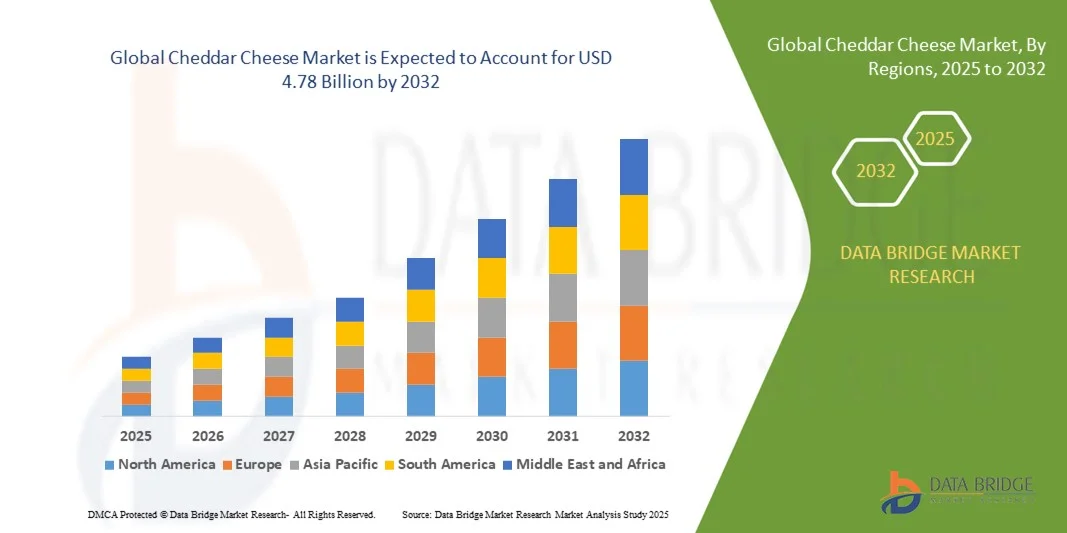
Cheddar Cheese Market Size
- The global cheddar cheese market size was valued at USD 3.50 billion in 2024 and is expected to reach USD 4.78 billion by 2032, at a CAGR of 4.0% during the forecast period
- The market growth is largely fueled by rising global consumption of dairy products, increasing adoption of Western diets, and growing demand for convenience and processed food products, which are incorporating Cheddar cheese as a key ingredient
- Furthermore, evolving consumer preferences for ready-to-eat meals, protein-enriched foods, and premium or specialty cheese varieties are driving innovation and product diversification in the Cheddar cheese industry. These factors are collectively boosting market expansion and encouraging manufacturers to develop new formats, flavors, and packaging options
Cheddar Cheese Market Analysis
- Cheddar cheese is a versatile dairy product consumed in multiple forms such as blocks, slices, cubes, spreads, and spray. It is widely used across households, foodservice, and industrial applications for its flavor, meltability, and nutritional value
- The increasing demand is primarily driven by urbanization, rising disposable incomes, and expanding retail and e-commerce channels. In addition, the growing interest in health-conscious, fortified, and protein-rich cheese products, along with the popularity of processed and ready-to-eat meals, is supporting sustained market growth
- North America dominated the cheddar cheese market with a share of 47.9% in 2024, due to high consumption of dairy products and growing preference for cheese in processed and ready-to-eat foods
- Asia-Pacific is expected to be the fastest growing region in the cheddar cheese market during the forecast period due to increasing urbanization, rising disposable incomes, and growing westernization of diets in countries such as China, Japan, and India
- Blocks cheddar segment dominated the market with a market share of 43.7% in 2024, due to its traditional use in both retail and commercial kitchens. Blocks are preferred for their long shelf life, ease of portioning, and versatility in culinary applications such as grating, melting, or cooking. In addition, blocks are compatible with both household and foodservice requirements, making them a staple choice for chefs and home cooks alike. Consumer familiarity and perception of quality associated with block Cheddar further strengthen its market position. Its ability to retain flavor and texture over time also drives consistent demand across multiple regions
Report Scope and Cheddar Cheese Market Segmentation
|
Attributes |
Cheddar Cheese Key Market Insights |
|
Segments Covered |
|
|
Countries Covered |
North America
Europe
Asia-Pacific
Middle East and Africa
South America
|
|
Key Market Players |
|
|
Market Opportunities |
|
|
Value Added Data Infosets |
In addition to the insights on market scenarios such as market value, growth rate, segmentation, geographical coverage, and major players, the market reports curated by the Data Bridge Market Research also include in-depth expert analysis, pricing analysis, brand share analysis, consumer survey, demography analysis, supply chain analysis, value chain analysis, raw material/consumables overview, vendor selection criteria, PESTLE Analysis, Porter Analysis, and regulatory framework. |
Cheddar Cheese Market Trends
Rising Demand for Premium and Specialty Cheddar Varieties
- The cheddar cheese market is witnessing significant growth in demand for premium and specialty varieties as consumers increasingly seek diverse flavors, textures, and high-quality cheese experiences. Rising interest in artisanal and aged cheddar is reshaping market offerings, with producers focusing on distinctive taste profiles and differentiated branding
- For instance, Arla Foods has expanded its range of premium cheddar offerings with aged and specialty formulations, while Lactalis Group has invested in developing cheddar products with unique flavor notes tailored for gourmet consumption. These product developments highlight the rising value consumers place on premium cheese experiences
- Specialty cheddars such as vintage, smoked, and flavored varieties are becoming popular in both retail and foodservice channels. Their versatility in pairing with premium wines, craft beers, and specialty foods is expanding cheddar’s role in upscale dining and at-home culinary experiences
- In addition, consumer demand for authenticity and product origin transparency is fueling the growth of region-specific cheddar varieties. Protected Designation of Origin products such as West Country Farmhouse Cheddar in the UK are gaining traction in premium markets where provenance adds value to the brand story
- The rise of health-conscious segments is further driving demand for natural, organic, and hormone-free cheddar varieties. Premium positioning around quality sourcing and minimal processing is creating clear differentiation for producers targeting this consumer base
- The rising demand for premium and specialty cheddar varieties is redefining market dynamics by shifting focus away from commodity products to value-driven differentiation. This long-term trend highlights cheddar’s role in premiumization strategies across global dairy markets
Cheddar Cheese Market Dynamics
Driver
Growing Consumption of Processed and Convenience Foods
- The increasing consumption of processed and convenience foods is a significant driver fueling cheddar cheese market growth. Its versatility and ability to deliver flavor, texture, and functionality make it a staple ingredient in ready-to-eat and processed food categories
- For instance, Kraft Heinz utilizes cheddar extensively in packaged products such as macaroni and cheese, while Mondelez incorporates cheddar into processed snacks under its global cheese brands. These strategies demonstrate how leading companies leverage cheddar to enhance convenience-oriented offerings
- Cheddar is widely used in processed foods such as frozen meals, burgers, pizzas, and sandwiches because it provides consistent melting, flavor enhancement, and longer shelf life. This makes it indispensable for quick-service restaurants and frozen food manufacturers meeting rising demand for convenience
- In addition, rapid urbanization and busy lifestyles are increasing dependence on ready-to-cook and ready-to-eat meals, where cheddar cheese ensures both taste and nutritional value. It also plays a role in snack innovation, where portion-controlled formats appeal to health-conscious but time-sensitive consumers
- The growing demand for processed and convenience foods ensures cheddar maintains its position as a versatile and essential dairy product. Its adaptability across foodservice and retail channels continues to strengthen market expansion in line with global changes in dietary patterns
Restraint/Challenge
Fluctuating Milk Prices Impacting Production Costs
- The volatility of milk prices is a major challenge affecting cheddar cheese production, as milk constitutes the primary raw material cost in cheese making. Price fluctuations, influenced by factors such as feed costs, climate variability, and global dairy trade policies, place significant pressure on producer margins
- For instance, major dairy processors such as Saputo and FrieslandCampina have reported cost challenges due to rising milk prices, which directly impact the profitability of cheese production and final product pricing. These fluctuations create instability in supply chains and affect overall market dynamics
- Cheddar cheese manufacturers face difficulty in stabilizing final prices for consumers when raw milk costs vary dramatically. This creates affordability concerns in emerging markets and limits the competitive positioning of cheddar against other cheese varieties
- In addition, global market exposure to trade disputes, shifting export policies, and regional supply constraints exacerbate variability in milk availability and cost. These factors add uncertainty for producers trying to balance manufacturing efficiency with price competitiveness
- Mitigating the challenge of fluctuating milk prices requires diversification of sourcing strategies, adoption of cost-optimized processing methods, and value addition through premium positioning. Ensuring resilience against raw material price volatility will be essential for sustaining long-term growth in the cheddar cheese market
Cheddar Cheese Market Scope
The market is segmented on the basis of product form, sales channel, application, source, and flavor and texture.
- By Product Form
On the basis of product form, the Cheddar cheese market is segmented into blocks, cubes, slices, spreads, and sprays. The blocks Cheddar segment dominated the market in 2024, accounting for the largest revenue share of 43.7%, due to its traditional use in both retail and commercial kitchens. Blocks are preferred for their long shelf life, ease of portioning, and versatility in culinary applications such as grating, melting, or cooking. In addition, blocks are compatible with both household and foodservice requirements, making them a staple choice for chefs and home cooks alike. Consumer familiarity and perception of quality associated with block Cheddar further strengthen its market position. Its ability to retain flavor and texture over time also drives consistent demand across multiple regions.
The slices Cheddar segment is expected to witness the fastest growth from 2025 to 2032, propelled by rising demand for convenience foods and ready-to-eat options. Sliced Cheddar is widely used in sandwiches, burgers, and snacks, making it popular among working professionals and families seeking quick meal solutions. Its portion-controlled packaging and ease of use in retail-ready formats appeal to supermarkets and fast-food chains. The trend toward single-serve and pre-packaged food products also accelerates adoption, particularly in urban centers with high-paced lifestyles.
- By Sales Channel
On the basis of sales channel, the Cheddar cheese market is segmented into wholesale/distributor/direct, supermarket/hypermarket, convenience store, online retail, and others. The supermarket/hypermarket segment dominated the market in 2024, owing to its extensive product variety, competitive pricing, and strong promotional campaigns. Consumers prefer purchasing Cheddar from supermarkets due to the availability of multiple brands, packaging options, and fresh stock. Retailers in this segment often provide bulk packs and value-added deals, which attract both individual buyers and small businesses. The organized retail infrastructure and widespread network of stores contribute to high visibility and accessibility, reinforcing its market dominance.
The online retail segment is expected to witness the fastest CAGR from 2025 to 2032, driven by growing e-commerce adoption and increasing consumer preference for doorstep delivery. Online platforms offer convenience, product variety, and subscription options for regular cheese deliveries. In addition, rising awareness of premium and specialty Cheddar through online channels is boosting demand. Urban consumers, in particular, leverage digital platforms for timely access to fresh and specialty cheeses, further fueling market growth in this channel.
- By Application
On the basis of application, the Cheddar cheese market is segmented into food and beverage processing, HoReCa, and household. The food and beverage processing segment dominated the market in 2024, driven by extensive use in ready-to-eat meals, sauces, bakery products, and snacks. Cheddar cheese is valued for its meltability, flavor enhancement, and consistency, making it a preferred ingredient for industrial food production. Manufacturers prioritize bulk procurement of high-quality Cheddar to maintain product standards and operational efficiency. Increasing demand for processed foods across global markets further consolidates its dominant position.
The HoReCa segment is projected to witness the fastest growth from 2025 to 2032, fueled by the expansion of restaurants, cafes, hotels, and catering services globally. Rising consumer preference for gourmet dishes, pizzas, sandwiches, and cheese-based delicacies is creating high demand in this sector. Chefs favor Cheddar for its rich flavor, texture, and versatility in hot and cold dishes. The growth of tourism and foodservice outlets also supports the rising adoption of premium and specialty Cheddar variants.
- By Source
On the basis of source, the Cheddar cheese market is segmented into cattle milk, goat milk, and sheep milk. The cattle milk segment dominated the market in 2024, reflecting the widespread availability of cow’s milk and its suitability for mass Cheddar production. Cattle milk-based Cheddar is preferred for its consistent taste, texture, and higher yield, which ensures cost-effective large-scale manufacturing. It also aligns with consumer expectations for traditional flavor profiles, making it the most commonly consumed variant across households and foodservice sectors.
The goat milk segment is expected to witness the fastest CAGR from 2025 to 2032, driven by increasing consumer inclination toward specialty and health-oriented dairy products. Goat milk Cheddar is recognized for its digestibility, unique flavor, and nutritional benefits, including lower cholesterol and higher mineral content. Rising awareness of lactose intolerance and the health benefits of goat milk products is supporting growth. Gourmet food trends and niche markets are also boosting demand for goat milk-based Cheddar in premium segments.
- By Flavor and Texture
On the basis of flavor and texture, the Cheddar cheese market is segmented into mild, sharp, extra sharp, and premium Cheddar. The mild Cheddar segment dominated the market in 2024, due to its broad consumer appeal and suitability for everyday culinary applications. Mild Cheddar offers a balanced flavor, easy meltability, and versatility, making it preferred in households, restaurants, and processed foods. Its approachable taste profile ensures high acceptance among children and adults alike, reinforcing consistent demand.
The extra sharp Cheddar segment is expected to witness the fastest growth from 2025 to 2032, driven by increasing consumer interest in bold and aged cheese flavors. Extra sharp Cheddar is favored in gourmet cooking, artisanal dishes, and premium snack products. The rising trend of cheese-tasting events, specialty cheese subscriptions, and culinary experimentation in urban areas contributes to market expansion. Consumers seeking richer, more intense flavors are propelling the adoption of extra sharp variants across both retail and HoReCa channels.
Cheddar Cheese Market Regional Analysis
- North America dominated the cheddar cheese market with the largest revenue share of 47.9% in 2024, driven by high consumption of dairy products and growing preference for cheese in processed and ready-to-eat foods
- Consumers in the region favor cheddar for its taste, versatility, and nutritional value, which supports strong demand across households and the foodservice industry
- The market is further strengthened by well-established dairy processing infrastructure, high disposable incomes, and widespread availability of both premium and mass-market cheddar products
U.S. Cheddar cheese Market Insight
The U.S. cheddar cheese market captured the largest revenue share in 2024 within North America, fueled by increasing cheese consumption in snacks, sandwiches, fast food, and prepared meals. Rising demand for convenient, pre-packaged, and sliced cheddar cheese products is supporting market growth. The trend toward healthier and fortified dairy products, combined with a strong foodservice sector and expanding e-commerce channels, further propels the market. Premium and specialty cheddar cheese varieties are also witnessing strong adoption, catering to urban consumers seeking distinctive flavors.
Europe Cheddar cheese Market Insight
The Europe cheddar cheese market is projected to expand at a substantial CAGR throughout the forecast period, primarily driven by the region’s preference for high-quality dairy products and rising demand in both HoReCa and household segments. The presence of established dairy producers and traditional cheese consumption cultures supports strong market adoption. European consumers are also drawn to convenience formats such as slices and cubes. Increasing urbanization and the growth of processed food applications are further promoting cheddar cheese consumption across the region.
U.K. Cheddar cheese Market Insight
The U.K. cheddar cheese market is anticipated to grow at a noteworthy CAGR during the forecast period, driven by the country’s strong tradition of cheese consumption and rising preference for convenience-oriented and value-added products. The demand for premium, aged, and specialty cheddar cheese is also increasing among consumers seeking unique flavors. Robust retail infrastructure, combined with expanding online grocery channels, supports market growth. In addition, foodservice adoption in restaurants, cafes, and catering services is driving further demand.
Germany Cheddar cheese Market Insight
The Germany cheddar cheese market is expected to expand at a considerable CAGR during the forecast period, fueled by increasing consumer interest in imported and specialty cheeses. Growing awareness of nutritional benefits, rising consumption of sandwiches, snacks, and ready-to-eat meals, and a developed HoReCa sector are supporting market growth. Germany’s focus on high-quality dairy standards and innovation in cheese processing enhances the adoption of premium cheddar cheese variants. Convenience and pre-packaged formats are particularly driving sales in urban centers.
Asia-Pacific Cheddar cheese Market Insight
The Asia-Pacific cheddar cheese market is poised to grow at the fastest CAGR during the forecast period of 2025 to 2032, driven by increasing urbanization, rising disposable incomes, and growing westernization of diets in countries such as China, Japan, and India. The expanding foodservice sector, rising pizza and sandwich consumption, and growing awareness of cheese-based snacks are fueling demand. Moreover, improving cold-chain infrastructure and the emergence of domestic and international dairy players are increasing availability and affordability of cheddar cheese products in the region.
Japan Cheddar cheese Market Insight
The Japan cheddar cheese market is gaining momentum due to the growing popularity of Western cuisine, rising processed food consumption, and increasing incorporation of cheese in bakery and convenience foods. Consumers are seeking both mild and aged cheddar cheese for everyday cooking and gourmet applications. The growth of supermarkets, convenience stores, and online channels further supports accessibility and adoption. In addition, the trend of healthy snacking and fortified dairy products is stimulating the market.
China Cheddar cheese Market Insight
The China cheddar cheese market accounted for the largest market revenue share in Asia-Pacific in 2024, attributed to rapid urbanization, rising disposable incomes, and a growing middle class embracing Western diets. Increasing adoption of cheese in fast food, ready-to-eat meals, and casual dining establishments is driving consumption. Government initiatives supporting dairy production, expanding cold-chain infrastructure, and the presence of local and international cheese manufacturers are further bolstering market growth.
Cheddar Cheese Market Share
The cheddar cheese industry is primarily led by well-established companies, including:
- Associated Milk Producers Inc. (U.S.)
- Arla Foods amba (Denmark)
- Chr. Hansen Holding A/S (Denmark)
- Dairygold Co-Operative Society Ltd (Ireland)
- Dana Dairy (U.A.E.)
- Cabot Creamery (U.S.)
- Glanbia plc (Ireland)
- Grafton Village Cheese (U.S.)
- Mooivallei Suiwel (Pty) Ltd (South Africa)
- Crowley Cheese, LLC (U.S.)
- Pacific Cheese, Co. (U.S.)
- Northwoods Cheese Co. (U.S.)
- Somerdale International Ltd (U.K.)
- GCMMF (India)
- The Kraft Heinz Company (U.S.)
- SARGENTO FOODS INCORPORATED (U.S.)
- Parag Milk Foods (India)
- Tetra Pak International S.A. (Switzerland)
- DAIRY FARMERS OF WISCONSIN (U.S.)
- Land O’Lakes, Inc. (U.S.)
Latest Developments in Global Cheddar Cheese Market
- In September 2025, Middlefield Original Cheese Co-Op issued a recall of over 5,400 pounds of various cheeses, including white cheddar, due to potential Listeria monocytogenes contamination. The affected products were sold under multiple labels and distributed between July 14 and August 7, 2025. While no illnesses were reported, Listeria poses serious health risks, particularly to vulnerable populations. The recall underscores the importance of stringent food safety measures in dairy production and may influence consumer confidence and purchasing decisions in the cheddar cheese market
- In May 2025, Bega Cheese announced the closure of its Strathmerton processing facility in Victoria, resulting in the loss of around 300 jobs. The company plans to consolidate production at its Bega facility in New South Wales, aiming for approximately $30 million in annual cost savings. This strategic consolidation is expected to streamline operations, enhance efficiency, and reduce overhead costs, allowing Bega Cheese to remain competitive amid rising operational expenses and increasing pressure from imported dairy products. The move is likely to improve profitability while enabling the company to focus on higher-margin products and optimized supply chain management
- In February 2025, Kraft introduced a range of innovative products, including taste-elevated offerings such as Lunchables Spicy Nachos and value-sized mac & cheese packs. These product launches are designed to meet evolving consumer demands for convenient, flavorful, and portion-controlled meal options. By expanding its portfolio with these new platforms, Kraft is reinforcing its market presence in both the ready-to-eat and processed cheese segments. The innovation strategy is expected to drive increased consumer engagement, boost sales, and strengthen brand loyalty in a highly competitive dairy and snack market
- In March 2024, Nandini, under the Karnataka Milk Federation, launched “Nandini Splash,” a whey-based flavored energy drink available in mango, orange, lychee, and lemon flavors. This initiative marks the brand’s entry into the functional and protein-enriched beverage segment, targeting health-conscious consumers seeking nutritious and convenient options. By diversifying its product portfolio beyond traditional dairy offerings, Nandini aims to capture emerging consumer trends and expand its market presence. The launch also positions the company to benefit from growing demand for innovative, value-added dairy and beverage products in both urban and semi-urban markets
- In September 2024, Nandini announced plans to sponsor the Indian Super League (ISL) football tournament and expand its international footprint. The sponsorship is intended to enhance brand visibility and connect with a younger, sports-oriented audience, while the international expansion demonstrates the company’s ambition to establish a global presence. This strategy is expected to increase brand recognition, drive cross-border sales, and position Nandini as a competitive player in the global dairy and functional beverage markets. By combining marketing initiatives with product innovation, Nandini is working to strengthen its influence in both domestic and international markets

- Interactive Data Analysis Dashboard
- Company Analysis Dashboard for high growth potential opportunities
- Research Analyst Access for customization & queries
- Competitor Analysis with Interactive dashboard
- Latest News, Updates & Trend analysis
- Harness the Power of Benchmark Analysis for Comprehensive Competitor Tracking
Table of Content
1 INTRODUCTION
1.1 OBJECTIVES OF THE STUDY
1.2 MARKET DEFINITION
1.3 OVERVIEW OF GLOBAL CHEDDAR CHEESE MARKET
1.4 CURRENCY AND PRICING
1.5 LIMITATION
1.6 MARKETS COVERED
2 MARKET SEGMENTATION
2.1 MARKETS COVERED
2.2 ARRIVING AT THE GLOBAL CHEDDAR CHEESE MARKET
2.3 VENDOR POSITIONING GRID
2.4 TECHNOLOGY LIFE LINE CURVE
2.5 MARKET GUIDE
2.6 COMPANY POSITIONING GRID
2.6.1 MARKET VENDORS
2.6.2 PROSPECT LEADERS
2.6.3 MARKET DISRUPTORS
2.6.4 NICHE PLAYERS
2.7 COMAPANY MARKET SHARE ANALYSIS
2.8 MULTIVARIATE MODELLING
2.9 DEMAND AND SUPPLY-SIDE VARIABLES
2.1 CONSUMPTION TREND OF END PRODUCTS
2.11 TOP TO BOTTOM ANALYSIS
2.12 STANDARDS OF MEASUREMENT
2.13 VENDOR SHARE ANALYSIS
2.14 DATA POINTS FROM KEY PRIMARY INTERVIEWS
2.15 DATA POINTS FROM KEY SECONDARY DATABASES
2.16 GLOBAL CHEDDAR CHEESE MARKET: RESEARCH SNAPSHOT
2.17 ASSUMPTIONS
3 MARKET OVERVIEW
3.1 DRIVERS
3.2 RESTRAINTS
3.3 OPPORTUNITIES
3.4 CHALLENGES
4 EXECUTIVE SUMMARY
5 PREMIUM INSIGHTS
5.1 SUPPLY CHAIN ANALYSIS
5.2 VALUE CHAIN ANALYSIS
5.3 IMPORT EXPPORT ANALYSIS
5.4 FACTORS INFLUENCING PURCHASING DECISION OF END USER
5.5 GROWTH STRATEGIES ADOPTED BY KEY PLAYERS
5.6 INDUSTRY TREND AND FUTURE PERSPECTIVES
5.7 CHEDDAR CHEESE MANUFACTURING PROCESS
5.8 PRIVATE LABEL VS BRAND ANALYSIS
5.9 PROMOTIONAL ACTIVITIES
5.1 NEW PRODUCT LAUNCH STRATEGY
5.10.1 NUMBER OF NEW PRODUCT LAUNCH
5.10.1.1. LINE EXTENSION
5.10.1.2. NEW PACKAGING
5.10.1.3. RE-LAUNCHED
5.10.1.4. NEW FORMULATION
5.11 CONSUMER LEVEL TREND
5.12 MEETING CONSUMER REQUIREMENTS
5.13 BRAND COMPARITIVE ANALYSIS
6 REGULATORY FRAMEWORK AND GUIDELINES AND LABELLING CLAIMS
7 GLOBAL CHEDDAR CHEESE MARKET, BY SOURCE
7.1 OVERVIEW
7.2 DAIRY BASED SOURCE
7.2.1 DAIRY BASED SOURCE, BY TYPE
7.2.1.1. COW MILK
7.2.1.2. BUFFALO MILK
7.2.1.3. GOAT MILK
7.3 PLANT BASED SOURCE
7.3.1 PLANT BASED SOURCE, BY TYPE
7.3.1.1. SOY
7.3.1.2. ALMOND
7.3.1.3. CASHEW
7.3.1.4. COCONUT
7.3.1.5. OTHERS
8 GLOBAL CHEDDAR CHEESE MARKET, BY FORM
8.1 OVERVIEW
8.2 SHERD
8.3 BLOCK
8.4 SLICES
8.5 SPREAD
8.6 WHEELS
8.7 CUBES
8.8 OTHERS
9 GLOBAL CHEDDAR CHEESE MARKET, BY TEXTURE
9.1 OVERVIEW
9.2 SHARP CHEDDAR
9.3 MILD CHEDDAR
9.4 EXTRA SHARP CHEDDAR
10 GLOBAL CHEDDAR CHEESE MARKET, BY END USER
10.1 OVERVIEW
10.2 HOUSEHOLD/RETAIL
10.2.1 HOUSEHOLD/RETAIL, BY CHEDDAR CHEESE FORM
10.2.1.1. SHERD
10.2.1.2. BLOCK
10.2.1.3. SLICES
10.2.1.4. SPREAD
10.2.1.5. WHEELS
10.2.1.6. CUBES
10.2.1.7. OTHERS
10.2.2 HOUSEHOLD/RETAIL, BY TEXTURE
10.2.2.1. SHARP CHEDDAR
10.2.2.2. MILD CHEDDAR
10.2.2.3. EXTRA SHARP CHEDDAR
10.3 HORECA
10.3.1 HORECA, BY TYPE
10.3.1.1. HOTEL
10.3.1.2. RESTAURANTS
10.3.1.3. CAFES
10.3.2 HORECA, BY CHEDDAR CHEESE FORM
10.3.2.1. SHERD
10.3.2.2. BLOCK
10.3.2.3. SLICES
10.3.2.4. SPREAD
10.3.2.5. WHEELS
10.3.2.6. CUBES
10.3.2.7. OTHERS
10.3.3 HORECA, BY TEXTURE
10.3.3.1. SHARP CHEDDAR
10.3.3.2. MILD CHEDDAR
10.3.3.3. EXTRA SHARP CHEDDAR
10.4 FOOD PROCESSING
10.4.1 FOOD PROCESSING, BY APPLICATIONS
10.4.1.1. CHEESE SAUCES
10.4.1.2. CHEESE DRESSINGS & DIPS
10.4.1.3. CHEESE BASED SNACKS
10.4.1.4. SPRAY CHEESE
10.4.1.5. CHEESE DESSERTS
10.4.1.6. CHEDAAR CHEESE SOUPS
10.4.1.7. READY TO EAT (RTE) CONVENIENCE FOODS
10.4.1.7.1. READY TO EAT (RTE) CONVENIENCE FOODS, BY TYPE
10.4.1.7.1.1 PIZZA
10.4.1.7.1.2 PASTA
10.4.1.7.1.3 MACRONI
10.4.1.7.1.4 OTHERS
10.4.1.8. OTHERS
10.4.2 FOOD PROCESSING, BY CHEDDAR CHEESE FORM
10.4.2.1. SHERD
10.4.2.2. BLOCK
10.4.2.3. SLICES
10.4.2.4. SPREAD
10.4.2.5. WHEELS
10.4.2.6. CUBES
10.4.2.7. OTHERS
10.4.3 FOOD PROCESSING, BY TEXTURE
10.4.3.1. SHARP CHEDDAR
10.4.3.2. MILD CHEDDAR
10.4.3.3. EXTRA SHARP CHEDDAR
11 GLOBAL CHEDDAR CHEESE MARKET, BY FLAVORS
11.1 OVERVIEW
11.2 REGULAR
11.3 FLAVORED
11.3.1 CHIVE
11.3.2 ONION
11.3.3 GARLIC
11.3.4 TOMATO&BASIL
11.3.5 HOT PAPER
11.3.6 GARLIC
11.3.7 JALPENO
11.3.8 MIX HERB
11.3.9 EARTHY
11.3.10 TANGY & TART
11.3.11 OTHERS
12 GLOBAL CHEDDAR CHEESE MARKET, BY CATEGORY
12.1 OVERVIEW
12.2 REGULAR CHEDDAR CHEESE
12.3 PREMIUM CHEDDAR CHEESE
13 GLOBAL CHEDDAR CHEESE MARKET, BY CLAIM
13.1 OVERVIEW
13.2 DAIRY FREE
13.3 GLUTEN FREE
13.4 ARTIFICIAL PRESERVATIVES FREE
13.5 ARTIFICIAL FLAVOR FREE
13.6 SOY FREE
13.7 OTHERS
14 GLOBAL CHEDDAR CHEESE MARKET, BY AGEING
14.1 OVERVIEW
14.2 FRESH
14.3 AGED
14.3.1 AGED, BY DURATION
14.3.1.1. 4 WEEKS
14.3.1.2. 6 WEEKS
14.3.1.3. 16 WEEKS
14.3.1.4. 24 WEEKS
14.3.1.5. UPTO 1 YEAR
14.3.1.6. MORE THAN 1 YEAR
15 GLOBAL CHEDDAR CHEESE MARKET, BY BRAND
15.1 OVERVIEW
15.2 BRANDED
15.3 PRIVATE LABEL
16 GLOBAL CHEDDAR CHEESE MARKET, BY DISTRIBUTION CHANNEL
16.1 OVERVIEW
16.2 DIRECT
16.3 INDIRECT
16.3.1 INDIRECT, BY TYPE
16.3.1.1. STORE-BASED RETAILING
16.3.1.1.1. STORE-BASED RETAILING, BY TYPE
16.3.1.1.1.1 CONVENIENCE STORES
16.3.1.1.1.2 SUPERMARKETS/HYPERMARKETS
16.3.1.1.1.3 SPECIALTY STORES
16.3.1.1.1.4 GROCERY STORES
16.3.1.1.1.5 WHOLESALERS
16.3.1.1.1.6 DISTRIBUTORS
16.3.1.1.1.7 OTHERS
16.3.1.2. NON-STORE RETAILING (ONLINE)
17 GLOBAL CHEDDAR CHEESE MARKET, BY GEOGRAPHY
17.1 GLOBAL CHEDDAR CHEESE MARKET, (ALL SEGMENTATION PROVIDED ABOVE IS REPRESENTED IN THIS CHAPTER BY COUNTRY)
17.2 NORTH AMERICA
17.2.1 U.S.
17.2.2 CANADA
17.2.3 MEXICO
17.3 EUROPE
17.3.1 GERMANY
17.3.2 U.K.
17.3.3 ITALY
17.3.4 FRANCE
17.3.5 SPAIN
17.3.6 SWITZERLAND
17.3.7 NETHERLANDS
17.3.8 BELGIUM
17.3.9 RUSSIA
17.3.10 SWEDEN
17.3.11 TURKEY
17.3.12 REST OF EUROPE
17.4 ASIA-PACIFIC
17.4.1 JAPAN
17.4.2 CHINA
17.4.3 SOUTH KOREA
17.4.4 INDIA
17.4.5 AUSTRALIA
17.4.6 SINGAPORE
17.4.7 MALAYSIA
17.4.8 THAILAND
17.4.9 INDONESIA
17.4.10 PHILIPPINES
17.4.11 VIETNAM
17.4.12 REST OF ASIA-PACIFIC
17.5 SOUTH AMERICA
17.5.1 BRAZIL
17.5.2 ARGENTINA
17.5.3 REST OF SOUTH AMERICA
17.6 MIDDLE EAST AND AFRICA
17.6.1 SOUTH AFRICA
17.6.2 NIGERIA
17.6.3 EGYPT
17.6.4 UAE
17.6.5 SAUDI ARABIA
17.6.6 ISRAEL
17.6.7 KUWAIT
17.6.8 QATAR
17.6.9 OMAN
17.6.10 REST OF MIDDLE EAST AND AFRICA
18 GLOBAL CHEDDAR CHEESE MARKET, COMPANY LANDSCAPE
18.1 COMPANY SHARE ANALYSIS: GLOBAL
18.2 COMPANY SHARE ANALYSIS: NORTH AMERICA
18.3 COMPANY SHARE ANALYSIS: EUROPE
18.4 COMPANY SHARE ANALYSIS: ASIA-PACIFIC
18.5 MERGERS & ACQUISITIONS
18.6 NEW PRODUCT DEVELOPMENT & APPROVALS
18.7 EXPANSIONS & PARTNERSHIP
18.8 REGULATORY CHANGES
19 GLOBAL CHEDDAR CHEESE MARKET, SWOT AND DBMR ANALYSIS
20 GLOBAL CHEDDAR CHEESE MARKET, COMPANY PROFILE
20.1 ARLA FOODS
20.1.1 COMPANY OVERVIEW
20.1.2 REVENUE ANALYSIS
20.1.3 PRODUCT PORTFOLIO
20.1.4 GEOGRAPHIC PRESENCE
20.1.5 RECENT DEVELOPMENTS
20.2 DAIRY GOLD CO-OPERATIVE SOCIETY LTD
20.2.1 COMPANY OVERVIEW
20.2.2 REVENUE ANALYSIS
20.2.3 PRODUCT PORTFOLIO
20.2.4 GEOGRAPHIC PRESENCE
20.2.5 RECENT DEVELOPMENTS
20.3 DANA DAIRY GROUP
20.3.1 COMPANY OVERVIEW
20.3.2 REVENUE ANALYSIS
20.3.3 PRODUCT PORTFOLIO
20.3.4 GEOGRAPHIC PRESENCE
20.3.5 RECENT DEVELOPMENTS
20.4 ASSOCIATED MILK PRODUCERS INC.
20.4.1 COMPANY OVERVIEW
20.4.2 REVENUE ANALYSIS
20.4.3 PRODUCT PORTFOLIO
20.4.4 GEOGRAPHIC PRESENCE
20.4.5 RECENT DEVELOPMENTS
20.5 CABOT CREAMERY
20.5.1 COMPANY OVERVIEW
20.5.2 REVENUE ANALYSIS
20.5.3 PRODUCT PORTFOLIO
20.5.4 GEOGRAPHIC PRESENCE
20.5.5 RECENT DEVELOPMENTS
20.6 GRAFTON VILLAGE CHEESE
20.6.1 COMPANY OVERVIEW
20.6.2 REVENUE ANALYSIS
20.6.3 PRODUCT PORTFOLIO
20.6.4 GEOGRAPHIC PRESENCE
20.6.5 RECENT DEVELOPMENTS
20.7 GLANBIA PLC
20.7.1 COMPANY OVERVIEW
20.7.2 REVENUE ANALYSIS
20.7.3 PRODUCT PORTFOLIO
20.7.4 GEOGRAPHIC PRESENCE
20.7.5 RECENT DEVELOPMENTS
20.8 MOOIVALLEI
20.8.1 COMPANY OVERVIEW
20.8.2 REVENUE ANALYSIS
20.8.3 PRODUCT PORTFOLIO
20.8.4 GEOGRAPHIC PRESENCE
20.8.5 RECENT DEVELOPMENTS
20.9 CROWLEY CHEESE, LLC
20.9.1 COMPANY OVERVIEW
20.9.2 REVENUE ANALYSIS
20.9.3 PRODUCT PORTFOLIO
20.9.4 GEOGRAPHIC PRESENCE
20.9.5 RECENT DEVELOPMENTS
20.1 PACIFIC CHEESE, CO.
20.10.1 COMPANY OVERVIEW
20.10.2 REVENUE ANALYSIS
20.10.3 PRODUCT PORTFOLIO
20.10.4 GEOGRAPHIC PRESENCE
20.10.5 RECENT DEVELOPMENTS
20.11 NORTHWOODS CHEESE CO.
20.11.1 COMPANY OVERVIEW
20.11.2 REVENUE ANALYSIS
20.11.3 PRODUCT PORTFOLIO
20.11.4 GEOGRAPHIC PRESENCE
20.11.5 RECENT DEVELOPMENTS
20.12 GCMMF
20.12.1 COMPANY OVERVIEW
20.12.2 REVENUE ANALYSIS
20.12.3 PRODUCT PORTFOLIO
20.12.4 GEOGRAPHIC PRESENCE
20.12.5 RECENT DEVELOPMENTS
20.13 SARGENTO FOODS INCORPORATED
20.13.1 COMPANY OVERVIEW
20.13.2 REVENUE ANALYSIS
20.13.3 PRODUCT PORTFOLIO
20.13.4 GEOGRAPHIC PRESENCE
20.13.5 RECENT DEVELOPMENTS
20.14 PARAG MILK FOODS
20.14.1 COMPANY OVERVIEW
20.14.2 REVENUE ANALYSIS
20.14.3 PRODUCT PORTFOLIO
20.14.4 GEOGRAPHIC PRESENCE
20.14.5 RECENT DEVELOPMENTS
20.15 HILMAR CHEESE COMPANY, INC.
20.15.1 COMPANY OVERVIEW
20.15.2 REVENUE ANALYSIS
20.15.3 PRODUCT PORTFOLIO
20.15.4 GEOGRAPHIC PRESENCE
20.15.5 RECENT DEVELOPMENTS
20.16 DALE FARM LTD
20.16.1 COMPANY OVERVIEW
20.16.2 REVENUE ANALYSIS
20.16.3 PRODUCT PORTFOLIO
20.16.4 GEOGRAPHIC PRESENCE
20.16.5 RECENT DEVELOPMENTS
20.17 SAPUTO INC.
20.17.1 COMPANY OVERVIEW
20.17.2 REVENUE ANALYSIS
20.17.3 PRODUCT PORTFOLIO
20.17.4 GEOGRAPHIC PRESENCE
20.17.5 RECENT DEVELOPMENTS
20.18 BEGA CHEESE
20.18.1 COMPANY OVERVIEW
20.18.2 REVENUE ANALYSIS
20.18.3 PRODUCT PORTFOLIO
20.18.4 GEOGRAPHIC PRESENCE
20.18.5 RECENT DEVELOPMENTS
20.19 NANDINI CHEESE
20.19.1 COMPANY OVERVIEW
20.19.2 REVENUE ANALYSIS
20.19.3 PRODUCT PORTFOLIO
20.19.4 GEOGRAPHIC PRESENCE
20.19.5 RECENT DEVELOPMENTS
20.2 BURNETT DAIRY
20.20.1 COMPANY OVERVIEW
20.20.2 REVENUE ANALYSIS
20.20.3 PRODUCT PORTFOLIO
20.20.4 GEOGRAPHIC PRESENCE
20.20.5 RECENT DEVELOPMENTS
20.21 BONGARDS
20.21.1 COMPANY OVERVIEW
20.21.2 REVENUE ANALYSIS
20.21.3 PRODUCT PORTFOLIO
20.21.4 GEOGRAPHIC PRESENCE
20.21.5 RECENT DEVELOPMENTS
20.22 AMUL
20.22.1 COMPANY OVERVIEW
20.22.2 REVENUE ANALYSIS
20.22.3 PRODUCT PORTFOLIO
20.22.4 GEOGRAPHIC PRESENCE
20.22.5 RECENT DEVELOPMENTS
20.23 BRITANNIA INDUSTRIES LTD.
20.23.1 COMPANY OVERVIEW
20.23.2 REVENUE ANALYSIS
20.23.3 PRODUCT PORTFOLIO
20.23.4 GEOGRAPHIC PRESENCE
20.23.5 RECENT DEVELOPMENTS
20.24 SARGENTO FOOD INC.
20.24.1 COMPANY OVERVIEW
20.24.2 REVENUE ANALYSIS
20.24.3 PRODUCT PORTFOLIO
20.24.4 GEOGRAPHIC PRESENCE
20.24.5 RECENT DEVELOPMENTS
20.25 ALMARAI
20.25.1 COMPANY OVERVIEW
20.25.2 REVENUE ANALYSIS
20.25.3 PRODUCT PORTFOLIO
20.25.4 GEOGRAPHIC PRESENCE
20.25.5 RECENT DEVELOPMENTS
20.26 ALMARAI
20.26.1 COMPANY OVERVIEW
20.26.2 REVENUE ANALYSIS
20.26.3 PRODUCT PORTFOLIO
20.26.4 GEOGRAPHIC PRESENCE
20.26.5 RECENT DEVELOPMENTS
20.27 GUJARAT COOPERATIVE MILK MARKETING FEDERATION LTD.
20.27.1 COMPANY OVERVIEW
20.27.2 REVENUE ANALYSIS
20.27.3 PRODUCT PORTFOLIO
20.27.4 GEOGRAPHIC PRESENCE
20.27.5 RECENT DEVELOPMENTS
20.28 BUTE ISLAND FOODS LTD.
20.28.1 COMPANY OVERVIEW
20.28.2 REVENUE ANALYSIS
20.28.3 PRODUCT PORTFOLIO
20.28.4 GEOGRAPHIC PRESENCE
20.28.5 RECENT DEVELOPMENTS
20.29 VIOLIFE FOODS
20.29.1 COMPANY OVERVIEW
20.29.2 REVENUE ANALYSIS
20.29.3 PRODUCT PORTFOLIO
20.29.4 GEOGRAPHIC PRESENCE
20.29.5 RECENT DEVELOPMENTS
20.3 FIELD ROAST
20.30.1 COMPANY OVERVIEW
20.30.2 REVENUE ANALYSIS
20.30.3 PRODUCT PORTFOLIO
20.30.4 GEOGRAPHIC PRESENCE
20.30.5 RECENT DEVELOPMENTS
20.31 MIYOKO’S CREAMERY.
20.31.1 COMPANY OVERVIEW
20.31.2 REVENUE ANALYSIS
20.31.3 PRODUCT PORTFOLIO
20.31.4 GEOGRAPHIC PRESENCE
20.31.5 RECENT DEVELOPMENTS
20.32 WAYFARRE FOODS
20.32.1 COMPANY OVERVIEW
20.32.2 REVENUE ANALYSIS
20.32.3 PRODUCT PORTFOLIO
20.32.4 GEOGRAPHIC PRESENCE
20.32.5 RECENT DEVELOPMENTS
*NOTE: THE COMPANIES PROFILED IS NOT EXHAUSTIVE LIST AND IS AS PER OUR PREVIOUS CLIENT REQUIREMENT. WE PROFILE MORE THAN 100 COMPANIES IN OUR STUDY AND HENCE THE LIST OF COMPANIES CAN BE MODIFIED OR REPLACED ON REQUEST
21 CONCLUSION
22 QUESTIONNAIRE
23 RELATED REPORTS

Global Cheddar Cheese Market, Supply Chain Analysis and Ecosystem Framework
To support market growth and help clients navigate the impact of geopolitical shifts, DBMR has integrated in-depth supply chain analysis into its Global Cheddar Cheese Market research reports. This addition empowers clients to respond effectively to global changes affecting their industries. The supply chain analysis section includes detailed insights such as Global Cheddar Cheese Market consumption and production by country, price trend analysis, the impact of tariffs and geopolitical developments, and import and export trends by country and HSN code. It also highlights major suppliers with data on production capacity and company profiles, as well as key importers and exporters. In addition to research, DBMR offers specialized supply chain consulting services backed by over a decade of experience, providing solutions like supplier discovery, supplier risk assessment, price trend analysis, impact evaluation of inflation and trade route changes, and comprehensive market trend analysis.
Data collection and base year analysis are done using data collection modules with large sample sizes. The stage includes obtaining market information or related data through various sources and strategies. It includes examining and planning all the data acquired from the past in advance. It likewise envelops the examination of information inconsistencies seen across different information sources. The market data is analysed and estimated using market statistical and coherent models. Also, market share analysis and key trend analysis are the major success factors in the market report. To know more, please request an analyst call or drop down your inquiry.
The key research methodology used by DBMR research team is data triangulation which involves data mining, analysis of the impact of data variables on the market and primary (industry expert) validation. Data models include Vendor Positioning Grid, Market Time Line Analysis, Market Overview and Guide, Company Positioning Grid, Patent Analysis, Pricing Analysis, Company Market Share Analysis, Standards of Measurement, Global versus Regional and Vendor Share Analysis. To know more about the research methodology, drop in an inquiry to speak to our industry experts.
Data Bridge Market Research is a leader in advanced formative research. We take pride in servicing our existing and new customers with data and analysis that match and suits their goal. The report can be customized to include price trend analysis of target brands understanding the market for additional countries (ask for the list of countries), clinical trial results data, literature review, refurbished market and product base analysis. Market analysis of target competitors can be analyzed from technology-based analysis to market portfolio strategies. We can add as many competitors that you require data about in the format and data style you are looking for. Our team of analysts can also provide you data in crude raw excel files pivot tables (Fact book) or can assist you in creating presentations from the data sets available in the report.













