


What is the Global Cheese Substitute Market Size and Growth Rate?
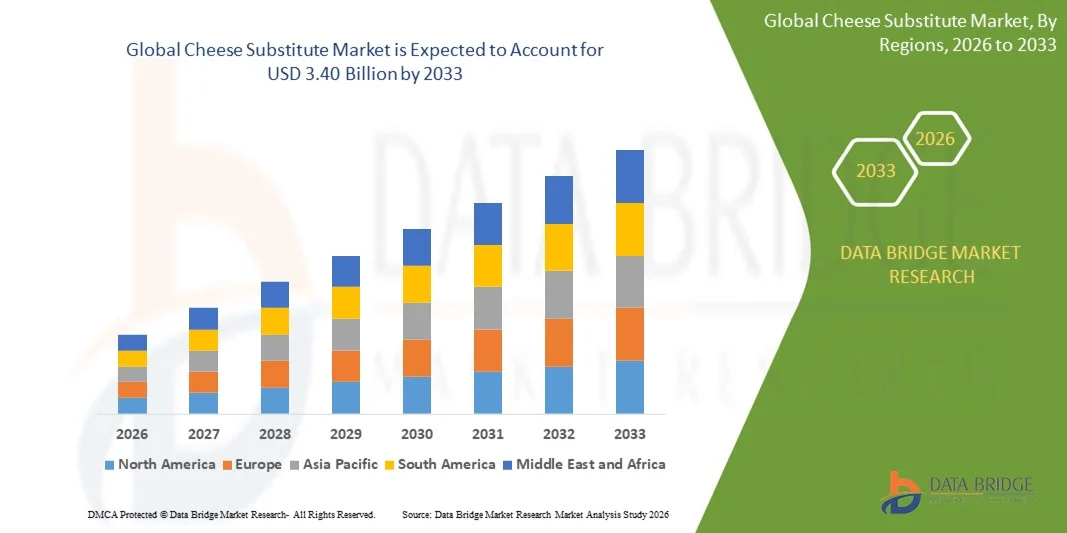
- As per Data Bridge Market Research Analysis the global Cheese Substitute Market size was valued at USD 1.88 billion in 2025 and is expected to reach USD 3.40 billion by 2033, at a CAGR of 7.70% during the forecast period.
- The market growth is primarily driven by increasing consumer preference for plant-based and lactose-free alternatives, along with rising awareness of health and environmental benefits associated with dairy-free diets.
- Additionally, innovations in taste, texture, and nutritional profiles, coupled with expanding distribution channels in both retail and online platforms, are making cheese substitutes more accessible and appealing to a broader audience. These combined factors are accelerating market adoption, thereby significantly boosting the industry's growth.
Market Size & Forecast
- Global Market Value (2025): USD 1.88 billion
- Expected Market Value (2033): USD 3.40 billion
- Forecast CAGR (2026–2033): 7.70%
Global Cheese Substitute Market Analysis
- Cheese substitutes, including plant-based and lactose-free alternatives, are increasingly essential components of modern diets in both residential and commercial settings due to their health benefits, environmental sustainability, and versatility in culinary applications.
- The escalating demand for cheese substitutes is primarily fueled by growing consumer awareness of lactose intolerance and dairy allergies, rising preference for plant-based diets, and increasing focus on sustainable and ethical food choices.
- North America dominated the Global Cheese Substitute Market with the largest revenue share of 32.3% in 2025, characterized by high health consciousness, strong adoption of plant-based diets, and a well-established retail infrastructure, with the U.S. experiencing substantial growth in vegan and lactose-free cheese consumption, driven by innovations from both established food brands and startups focusing on taste, texture, and nutritional enhancement.
- Asia-Pacific is expected to be the fastest-growing region in the Global Cheese Substitute Market during the forecast period due to increasing urbanization, rising disposable incomes, and greater exposure to Western dietary trends.
- The Mozzarella segment dominated the market with the largest revenue share of 32.5% in 2025, driven by its high usage in pizzas, pastas, and bakery applications, and the growing consumer preference for plant-based alternatives in mainstream recipes.
Report Scope and Global Cheese Substitute Market Segmentation
|
Attributes |
Cheese Substitute Key Market Insights |
|
Segments Covered |
|
|
Countries Covered |
North America
Europe
Asia-Pacific
Middle East and Africa
South America
|
|
Key Market Players |
|
|
Market Opportunities |
|
|
Value Added Data Infosets |
|
What is the Key Trend in the Global Cheese Substitute Market?
Enhanced Convenience Through Product Innovation and Functional Integration
- A significant and accelerating trend in the global Cheese Substitute Market is the development of innovative products that closely replicate the taste, texture, and nutritional profile of traditional cheese while integrating functional benefits such as added protein, probiotics, or reduced sodium. This combination of health, taste, and convenience is significantly enhancing consumer adoption and satisfaction.
- For instance, Violife and Miyoko’s Creamery offer plant-based cheeses that mimic the melt and stretch of dairy cheese, allowing consumers to enjoy familiar dishes without compromising on flavor or dietary restrictions. Similarly, Kite Hill produces almond-based cheeses enriched with probiotics, offering functional benefits alongside culinary versatility.
- Product innovation in cheese substitutes enables features such as fortified nutrition, allergen-free formulations, and enhanced shelf life. For instance, some Daiya products use proprietary blends to improve texture and meltability, while also catering to gluten-free and lactose-free diets. Furthermore, these innovations allow consumers to integrate cheese substitutes seamlessly into traditional recipes, providing convenience and flexibility in meal preparation.
- The integration of functional benefits into cheese substitutes facilitates broader adoption across different dietary lifestyles, including vegan, ketogenic, and lactose-intolerant consumers. Through a single product, users can enjoy taste, nutrition, and dietary compliance, creating a unified and convenient culinary experience.
- This trend towards more health-focused, functional, and versatile cheese alternatives is fundamentally reshaping consumer expectations in the dairy-free and plant-based food sector. Consequently, companies such as Miyoko’s and Kite Hill are developing next-generation products with fortified nutrition, improved texture, and enhanced flavor profiles to meet evolving consumer demands.
- The demand for cheese substitutes that offer convenience, functional benefits, and authentic taste is growing rapidly across both residential and commercial sectors, as consumers increasingly prioritize health, sustainability, and culinary versatility.
Global Cheese Substitute Market Dynamics
Driver
Growing Need Due to Rising Health Awareness and Plant-Based Diet Adoption
- The increasing prevalence of lactose intolerance, dairy allergies, and health-conscious dietary choices, coupled with the accelerating adoption of plant-based and sustainable diets, is a significant driver for the heightened demand for cheese substitutes.
- For instance, in 2025, Miyoko’s Creamery announced the launch of an enhanced plant-based mozzarella with improved meltability and fortified protein content. Such strategies by key companies are expected to drive the cheese substitute market growth during the forecast period.
- As consumers become more aware of the health and environmental impacts of traditional dairy consumption, cheese substitutes offer functional benefits such as reduced cholesterol, lower saturated fat, and allergen-free formulations, providing a compelling alternative to conventional cheese products.
- Furthermore, the growing popularity of plant-based diets and the desire for versatile, sustainable food options are making cheese substitutes an integral component of modern meal planning, offering seamless incorporation into both traditional and innovative culinary applications.
- The convenience of ready-to-use products, compatibility with a wide range of recipes, and availability across retail and online channels are key factors propelling the adoption of cheese substitutes in both residential and commercial sectors. The trend towards home cooking, meal kits, and vegan/health-focused food offerings further contributes to market growth.
Restraint/Challenge
Concerns Regarding Taste, Texture, and Price
- Concerns surrounding the taste, texture, and overall sensory experience of cheese substitutes pose a significant challenge to broader market penetration. Despite technological advances, some consumers perceive plant-based cheeses as less satisfying compared to traditional dairy cheese.
- For instance, reports of bland or rubbery textures in certain lower-cost plant-based cheeses have made some consumers hesitant to adopt cheese substitutes as a primary dairy alternative.
- Addressing these concerns through improved formulation techniques, flavor enhancement, and product education is crucial for building consumer trust. Companies such as Violife and Daiya emphasize their high-quality ingredients, realistic texture, and authentic taste in marketing campaigns to reassure potential buyers. Additionally, the relatively high price of premium cheese substitutes compared to conventional dairy cheese can be a barrier for cost-sensitive consumers, particularly in developing regions or for budget-conscious households.
- While prices are gradually decreasing due to scaling production, the perceived premium for plant-based or specialty cheese products can still hinder widespread adoption, especially among consumers who are not motivated by dietary restrictions or sustainability considerations.
- Overcoming these challenges through continued product innovation, flavor optimization, consumer education, and the development of more affordable options will be vital for sustained growth in the global cheese substitute market.
Global Cheese Substitute Market Scope
The cheese substitute market is segmented on the basis of product, source, nature, application and distribution channel.
- By Product
On the basis of product, the Global Cheese Substitute Market is segmented into Parmesan, Cheddar, Mozzarella, Cream Cheese, Ricotta, and Others. The Mozzarella segment dominated the market with the largest revenue share of 32.5% in 2025, driven by its high usage in pizzas, pastas, and bakery applications, and the growing consumer preference for plant-based alternatives in mainstream recipes. Mozzarella substitutes are favored for their meltability, stretch, and texture, closely mimicking traditional dairy cheese.
The Parmesan segment is expected to witness the fastest CAGR of 21.2% from 2026 to 2033, supported by increasing adoption in Italian cuisine and gourmet food preparations, as well as growing awareness of dairy-free and lactose-free alternatives among health-conscious consumers. Innovative flavors and fortified nutritional options further accelerate the segment’s growth.
- By Source
On the basis of source, the Global Cheese Substitute Market is segmented into Filled Cheese, Analogue Cheese, and Tofu-Based Cheese. The Analogue Cheese segment dominated the market with a revenue share of 45.8% in 2025, due to its affordability, widespread availability, and versatility across culinary applications. Analogue cheese substitutes provide similar taste and texture to traditional dairy cheese, making them highly popular in households and the foodservice industry.
The Tofu-Based Cheese segment is expected to witness the fastest CAGR of 23.1% from 2026 to 2033, fueled by the rising popularity of soy-based products, vegan diets, and functional foods. Advancements in processing technology that improve taste, texture, and nutritional value are further driving this segment.
- By Nature
On the basis of nature, the Global Cheese Substitute Market is segmented into Organic and Synthetic. The Synthetic segment dominated the market with a revenue share of 51.3% in 2025, owing to its cost-effectiveness, large-scale production capability, and consistent quality for industrial and commercial applications. Synthetic cheese substitutes are widely used in packaged foods and ready-to-eat meals due to their stability and shelf life.
The Organic segment is expected to witness the fastest CAGR of 22.5% from 2026 to 2033, driven by growing consumer preference for natural, chemical-free, and environmentally sustainable food products. Rising awareness of health benefits and increased demand for premium, organic alternatives are supporting this segment’s rapid expansion.
- By Application
On the basis of application, the Global Cheese Substitute Market is segmented into Cheese Toppings and Dressings, Dips and Sauces, Ready-to-Eat Meals, Bakery, Sweet and Savory Snacks, and Others. The Cheese Toppings and Dressings segment dominated the market with a revenue share of 38.7% in 2025, driven by strong adoption in fast-food chains, pizzerias, and home cooking. Consumers favor convenient, versatile options that closely mimic traditional cheese for melting and flavor enhancement.
The Ready-to-Eat Meals segment is expected to witness the fastest CAGR of 24.0% from 2026 to 2033, fueled by the growing demand for convenient, plant-based, and dairy-free meal options among millennials and urban households. Trends in frozen foods, meal kits, and pre-prepared vegan meals further support this growth.
- By Distribution Channel
On the basis of distribution channel, the Global Cheese Substitute Market is segmented into Direct Sales (B2B) and Indirect Sales (B2C). The Indirect Sales (B2C) segment dominated the market with a revenue share of 54.2% in 2025, due to growing supermarket, hypermarket, and e-commerce penetration and the increasing preference for online grocery shopping.
The Direct Sales (B2B) segment is expected to witness the fastest CAGR of 22.8% from 2026 to 2033, driven by demand from restaurants, foodservice providers, and large-scale manufacturers seeking customized cheese substitute solutions. Strong growth in institutional and commercial foodservice channels is further fueling this segment.
Global Cheese Substitute Market Regional Analysis
- North America dominated the Global Cheese Substitute Market with the largest revenue share of 32.3% in 2025, driven by increasing consumer awareness of plant-based diets, lactose intolerance, and health-conscious food choices.
- Consumers in the region highly value the convenience, taste, and nutritional benefits offered by cheese substitutes, as well as their versatility in cooking and compatibility with various dietary preferences such as vegan, gluten-free, and low-fat diets.
- This widespread adoption is further supported by high disposable incomes, a technologically and health-conscious population, and strong retail and e-commerce infrastructure, establishing cheese substitutes as a preferred choice for both residential households and the foodservice industry.
U.S. Cheese Substitute Market Insight
The U.S. cheese substitute market captured the largest revenue share of 81% in 2025 within North America, fueled by the growing adoption of plant-based diets and rising awareness of lactose intolerance and dairy allergies. Consumers are increasingly prioritizing health-conscious and environmentally sustainable food choices, driving demand for cheese alternatives. The trend of DIY meal preparation, ready-to-eat plant-based products, and online grocery shopping further propels the market. Moreover, innovations in taste, texture, and nutritional fortification, combined with strong retail and e-commerce infrastructure, are significantly contributing to the market’s expansion.
Europe Cheese Substitute Market Insight
The Europe cheese substitute market is projected to expand at a substantial CAGR throughout the forecast period, primarily driven by rising health awareness, vegan and vegetarian diet adoption, and sustainability concerns. Increased urbanization and higher disposable incomes are fostering the adoption of cheese alternatives. European consumers are drawn to convenience, taste, and functional benefits such as reduced fat, cholesterol, and allergen-free formulations. The market is witnessing significant growth across residential households, foodservice, and retail sectors, with cheese substitutes being incorporated into both packaged foods and fresh culinary offerings.
U.K. Cheese Substitute Market Insight
The U.K. cheese substitute market is anticipated to grow at a noteworthy CAGR during the forecast period, driven by a surge in plant-based and dairy-free diet adoption. Concerns regarding lactose intolerance, health, and sustainability are encouraging consumers and foodservice providers to choose cheese alternatives. The U.K.’s strong retail network, growing e-commerce penetration, and consumer focus on convenient, ready-to-use products are expected to continue stimulating market growth.
Germany Cheese Substitute Market Insight
The Germany cheese substitute market is expected to expand at a considerable CAGR during the forecast period, fueled by increasing awareness of healthy eating, vegan lifestyles, and sustainable food choices. Germany’s emphasis on high-quality, innovative, and eco-friendly products promotes adoption, particularly in residential, retail, and foodservice sectors. The integration of cheese substitutes into ready-to-eat meals, snacks, and bakery applications is becoming increasingly prevalent, aligning with consumer preferences for nutritious, convenient, and environmentally responsible products.
Asia-Pacific Cheese Substitute Market Insight
The Asia-Pacific cheese substitute market is poised to grow at the fastest CAGR of 24% during the forecast period of 2026 to 2033, driven by increasing urbanization, rising disposable incomes, and growing awareness of plant-based diets in countries such as China, Japan, and India. Government initiatives promoting healthy lifestyles, coupled with rapid modernization of food retail and e-commerce infrastructure, are driving adoption. Furthermore, APAC is emerging as a manufacturing hub for dairy alternatives, improving affordability and accessibility of cheese substitutes to a wider consumer base.
Japan Cheese Substitute Market Insight
The Japan cheese substitute market is gaining momentum due to the country’s health-conscious culture, aging population, and demand for convenient, ready-to-use food products. Adoption is driven by increasing interest in plant-based diets, lactose-free alternatives, and functional foods. Integration of cheese substitutes into home-cooked meals, snacks, and convenience foods is fueling growth. Moreover, Japan’s focus on innovative food products, quality, and sustainability is likely to spur demand in both residential and foodservice sectors.
China Cheese Substitute Market Insight
The China cheese substitute market accounted for the largest revenue share in Asia-Pacific in 2025, attributed to rapid urbanization, rising middle-class population, and increasing adoption of plant-based and dairy-free diets. China is one of the largest markets for alternative dairy products, with cheese substitutes gaining popularity in households, restaurants, and packaged food products. Government initiatives promoting health, nutrition, and sustainable food consumption, along with strong domestic manufacturing capabilities, are key factors propelling market growth in China.
Global Cheese Substitute Market Share
The Cheese Substitute industry is primarily led by well-established companies, including:
• Miyoko’s Creamery (U.S.)
• Violife (Greece)
• Daiya Foods (Canada)
• Treeline Cheese (U.S.)
• Kite Hill (U.S.)
• Follow Your Heart (U.S.)
• Go Veggie (U.S.)
• Better Than Cheese (Netherlands)
• VioLife (U.K.)
• Willicroft (Netherlands)
• Alpro (Belgium)
• Bellwether Farms (U.S.)
• Good Planet Foods (Canada)
• Miyoko’s Kitchen (U.S.)
• Earth Island (U.S.)
• Nutritional Yeast Brands (Various)
• The Vegetarian Butcher (Netherlands)
• Forager Project (U.S.)
• Simply V (Germany)
• Oatly (Sweden)
What are the Recent Developments in Global Cheese Substitute Market?
- In April 2024, Miyoko’s Creamery, a leading plant-based cheese manufacturer, launched a strategic initiative in South Africa to expand the availability of its dairy-free cheese products across retail and foodservice channels. This initiative underscores the company’s commitment to delivering high-quality, sustainable cheese alternatives tailored to local taste preferences, reinforcing its position in the rapidly growing Global Cheese Substitute Market.
- In March 2024, Violife, a well-known vegan cheese brand, introduced a fortified version of its Mozzarella and Cheddar products specifically engineered for ready-to-eat meals and commercial kitchens. The new range is designed to enhance nutritional value and melting performance, highlighting Violife’s dedication to innovation and meeting the evolving demands of health-conscious consumers and institutional buyers.
- In March 2024, Daiya Foods successfully launched its “Smart Melt” product line in Bengaluru, India, aimed at providing high-quality, lactose-free cheese alternatives for urban households and foodservice providers. This initiative leverages advanced production technologies to improve taste and texture, contributing to wider adoption of plant-based diets and the expansion of the cheese substitute market in Asia-Pacific.
- In February 2024, Kite Hill, a U.S.-based vegan cheese company, announced a strategic partnership with a network of premium restaurants and gourmet retailers to create a curated cheese substitute menu. This collaboration is designed to increase consumer exposure and adoption, streamlining access to high-quality dairy-free alternatives while emphasizing sustainability and culinary versatility.
- In January 2024, Treeline Cheese, a leading artisanal vegan cheese producer, unveiled its “Probiotic Cashew Cheese” line at the Winter Fancy Food Show 2024. This innovative product, enriched with probiotics and natural flavors, reflects the company’s commitment to integrating functional health benefits into plant-based cheeses, offering consumers both taste and nutritional value while expanding the global footprint of the cheese substitute market.

- Interactive Data Analysis Dashboard
- Company Analysis Dashboard for high growth potential opportunities
- Research Analyst Access for customization & queries
- Competitor Analysis with Interactive dashboard
- Latest News, Updates & Trend analysis
- Harness the Power of Benchmark Analysis for Comprehensive Competitor Tracking
Global Cheese Substitute Market, Supply Chain Analysis and Ecosystem Framework
To support market growth and help clients navigate the impact of geopolitical shifts, DBMR has integrated in-depth supply chain analysis into its Global Cheese Substitute Market research reports. This addition empowers clients to respond effectively to global changes affecting their industries. The supply chain analysis section includes detailed insights such as Global Cheese Substitute Market consumption and production by country, price trend analysis, the impact of tariffs and geopolitical developments, and import and export trends by country and HSN code. It also highlights major suppliers with data on production capacity and company profiles, as well as key importers and exporters. In addition to research, DBMR offers specialized supply chain consulting services backed by over a decade of experience, providing solutions like supplier discovery, supplier risk assessment, price trend analysis, impact evaluation of inflation and trade route changes, and comprehensive market trend analysis.
Data collection and base year analysis are done using data collection modules with large sample sizes. The stage includes obtaining market information or related data through various sources and strategies. It includes examining and planning all the data acquired from the past in advance. It likewise envelops the examination of information inconsistencies seen across different information sources. The market data is analysed and estimated using market statistical and coherent models. Also, market share analysis and key trend analysis are the major success factors in the market report. To know more, please request an analyst call or drop down your inquiry.
The key research methodology used by DBMR research team is data triangulation which involves data mining, analysis of the impact of data variables on the market and primary (industry expert) validation. Data models include Vendor Positioning Grid, Market Time Line Analysis, Market Overview and Guide, Company Positioning Grid, Patent Analysis, Pricing Analysis, Company Market Share Analysis, Standards of Measurement, Global versus Regional and Vendor Share Analysis. To know more about the research methodology, drop in an inquiry to speak to our industry experts.
Data Bridge Market Research is a leader in advanced formative research. We take pride in servicing our existing and new customers with data and analysis that match and suits their goal. The report can be customized to include price trend analysis of target brands understanding the market for additional countries (ask for the list of countries), clinical trial results data, literature review, refurbished market and product base analysis. Market analysis of target competitors can be analyzed from technology-based analysis to market portfolio strategies. We can add as many competitors that you require data about in the format and data style you are looking for. Our team of analysts can also provide you data in crude raw excel files pivot tables (Fact book) or can assist you in creating presentations from the data sets available in the report.













