What is the Chelated Feed Trace Minerals Market Size and Growth Rate?
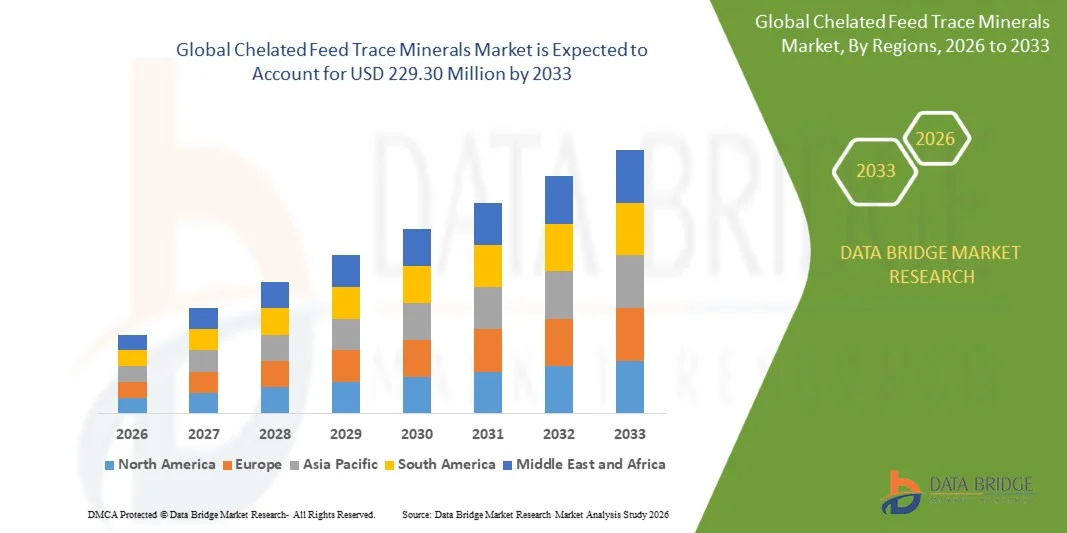
- As per Data Bridge Market Research analysis, the chelated feed trace minerals market was valued at USD 150.30 million in 2025 and is projected to reach USD 229.30 million by 2033, growing at a CAGR of 5.42% from 2026 to 2033.
- The market is gaining steady momentum as livestock producers shift away from antibiotic growth promoters toward bioavailable mineral solutions that support immunity, feed conversion, and reproductive performance without compromising regulatory compliance.
- Rising global demand for high-quality animal protein, tightening discharge regulations on zinc, copper, and phosphorus, and growing adoption of precision-chelation technologies across poultry, swine, ruminant, and aquaculture operations are compelling feed manufacturers and integrators to replace conventional inorganic salts with chelated organic trace minerals.
Market Size & Forecast
- Global Market Value (2025): USD 150.30 Million
- Expected Market Value (2033): USD 229.30 Million
- Forecast CAGR (2026–2033): 5.42%
- Leading Region in 2025: Asia-Pacific
- Fastest Growing Region: Middle East
What are the Major Takeaways of the Chelated Feed Trace Minerals Market?
- Asia-Pacific dominated the global chelated feed trace minerals market with the largest revenue share of 43.65% in 2025, supported by China’s expanding aquaculture output and India’s growing poultry and dairy sectors.
- Middle East is expected to be the fastest-growing region at a CAGR of 7.82% from 2026 to 2033, fueled by government-backed investments in protein production capacity and water-scarcity-driven precision feeding practices.
- The zinc segment led the market with a 35.62% share in 2025, owing to its essential role in immune modulation, skeletal growth, and reproductive performance across poultry, swine, and ruminant diets.
- The copper segment is the fastest-growing mineral type, projected to register a CAGR of 6.75%, reflecting its rising use as a bioavailable substitute for antibiotic growth promoters in post-weaning swine diets.
- The amino acid chelates segment dominated the chelating agent category with a 39.74% share in 2025, driven by established production processes, wide regulatory approval, and cost-effective compatibility with existing premix formulations.
- The poultry segment dominated the livestock category with a 32.58% revenue share in 2025, led by vertically integrated broiler and layer operations that require precise mineral specifications for feed conversion and eggshell quality.
- The dry form segment accounted for 68.40% of the market share in 2025, preferred for its storage stability and seamless integration with existing batch-mixing and premix production systems.
Report Scope and Chelated Feed Trace Minerals Market Segmentation
|
Attributes |
Chelated Feed Trace Minerals Key Market Insights |
|
Segments Covered |
|
|
Countries Covered |
North America
Europe
Asia-Pacific
Middle East and Africa
South America
|
|
Key Market Players |
|
|
Market Opportunities |
|
|
Value Added Data Infosets |
In addition to the insights on market scenarios such as market value, growth rate, segmentation, geographical coverage, and major players, the market reports curated by the Data Bridge Market Research also include in-depth expert analysis, geographically represented company-wise production and capacity, network layouts of distributors and partners, detailed and updated price trend analysis and deficit analysis of supply chain and demand. |
What is the Key Trend in the Chelated Feed Trace Minerals Market?
- Feed manufacturers are increasingly adopting hydroxy-trace mineral and micro-encapsulation technologies that maintain ligand stability through acidic gut conditions, improving absorption while reducing antagonistic mineral interactions during high-temperature pelleting and extrusion processes.
- For instance, in January 2026, Biochem Zusatzstoffe Handels- und Produktionsgesellschaft mbH received European Union approval for BetaTrace Cu, completing its BetaTrace organic trace mineral portfolio spanning zinc, copper, manganese, and iron bound to betaine, giving premix and compound feed customers a standardized product family.
- Integrators are also pairing chelated mineral programs with AI-based digital feed-formulation platforms that adjust dosing in real time based on species, life stage, and environmental stress indicators, improving return-on-investment visibility for nutritionists.
- Aquaculture operators are emerging as a distinct growth pocket, with shrimp, tilapia, and salmon farms adopting elevated selenium and zinc chelate inclusion rates to counter oxidative stress in high-density recirculating systems.
- For instance, in 2025, Zinpro Animal Nutrition Europe secured European Union authorization for a chromium chelate of DL-methionine for salmonids under Implementing Regulation (EU) 2025/1782, extending chelated mineral adoption into premium aquaculture nutrition.
- As feed manufacturers and integrators continue to prioritize measurable bioavailability and manure-compliant formulations, chelated trace minerals are expected to become a standard component of precision animal nutrition programs across livestock and aquaculture segments.
What are the Key Drivers of the Chelated Feed Trace Minerals Market?
- Regulatory bans and phase-downs on antibiotic growth promoters across North America, Europe, and parts of Asia-Pacific have significantly increased reliance on bioavailable zinc, copper, and selenium chelates to sustain gut health and immune function in livestock without in-feed antibiotics.
- For instance, following the European Union’s Regulation 2019/6, which capped zinc oxide at 150 parts per million and banned prophylactic antibiotic use in livestock from 2022, feed formulators across the region have scaled up organic zinc inclusion to sustain post-weaning gut health in swine.
- Feed manufacturers and integrators are integrating chelated trace minerals into precision nutrition programs to reduce mineral excretion, meet manure-phosphorus and heavy-metal discharge regulations, and secure sustainability-linked financing tied to lower environmental impact.
- For instance, in 2025, dairy operations in Wisconsin participating in Balchem’s chelated copper program reported a 42% reduction in phosphorous excretion, enabling farms to avoid escalating manure-hauling costs while remaining compliant with state nutrient-management rules.
- With rising global demand for animal protein and continued regulatory tightening around antibiotic use and mineral excretion, chelated feed trace minerals will remain central to livestock producers’ efforts to balance productivity, compliance, and sustainability.
Which Factors are Challenging the Growth of the Chelated Feed Trace Minerals Market?
- Chelated zinc, copper, and selenium command a substantial price premium over conventional inorganic sulfates and oxides, significantly raising finished-feed costs in commodity poultry and swine operations where margins per metric ton remain thin.
- This cost gap limits adoption among smallholder farmers and price-sensitive feed mills across Asia-Pacific, Africa, and South America, where feed already represents a majority of total production costs.
- For instance, extension systems serving family-operated poultry and swine herds across large parts of Asia-Pacific and Africa continue to lack the resources needed to demonstrate the return-on-investment case for chelated mineral programs, concentrating adoption among larger, vertically integrated operators.
- The combination of high input costs, limited technical awareness among smallholders, and fragmented multi-region registration requirements for new chelation chemistries continues to slow broader market penetration, despite growing recognition of the performance and compliance benefits chelated trace minerals offer.
How is the Chelated Feed Trace Minerals Market Segmented?
The chelated feed trace minerals market is segmented on the basis of type, chelating agent, livestock, application, form, and distribution channel.
- By Type
On the basis of type, the global chelated feed trace minerals market is segmented into zinc, iron, manganese, cobalt, chromium, and copper. The zinc segment dominated the market with a 35.62% share in 2025, owing to its essential role in over 80 metalloenzymes that support immune function, epithelial integrity, and reproduction. The higher bioavailability of chelated zinc allows producers to reduce dietary inclusion rates while still meeting environmental excretion limits, translating into lower compliance costs and improved feed-conversion outcomes across poultry, swine, and ruminant operations.
The copper segment is projected to register the fastest growth at a CAGR of 6.75% from 2026 to 2033, driven by its expanding role as a bioavailable substitute for antibiotic growth promoters in post-weaning swine diets. As regulators tighten permissible copper excretion levels, feed formulators are increasingly favoring chelated copper forms that sustain gut-health performance at lower inclusion rates, supporting segment expansion.
- By Chelating Agent
On the basis of chelating agent, the global chelated feed trace minerals market is segmented into amino acid chelates, proteinates, polysaccharide complexes, and hydroxy trace minerals. The amino acid chelates segment dominated the market with a 39.74% share in 2025 due to established production methods, widespread regulatory approval, and compatibility with existing premix and compound feed formulation matrices, making it the preferred choice for poultry operations focused on cost-effective performance.
The hydroxy trace minerals segment is expected to witness the fastest CAGR of 9.74% from 2026 to 2033, attributed to its enhanced stability in acidic gut environments and reduced antagonistic mineral interactions compared with conventional chelates. Growing adoption of hydroxy forms in ruminant total mixed rations and high-density aquaculture feeds is further accelerating segment growth.
- By Livestock
On the basis of livestock, the global chelated feed trace minerals market is segmented into poultry, swine, ruminants, and aquaculture. The poultry segment dominated the market with a 32.58% share in 2025, supported by vertically integrated broiler and layer operations that require precise mineral specifications to optimize feed conversion, bone strength, and eggshell integrity, thereby reducing cull rates and improving overall flock economics.
The aquaculture segment is anticipated to witness the fastest CAGR of 8.92% from 2026 to 2033, driven by rapidly expanding shrimp, tilapia, and salmon farming operations that require elevated chelated selenium and zinc inclusion to mitigate oxidative stress and disease pressure in high-density recirculating systems, while also helping operators avoid water-pollution penalties.
- By Application
On the basis of application, the global chelated feed trace minerals market is segmented into dairy cattle, poultry, horses, and pigs. The dairy cattle segment dominated the market with a 31.20% share in 2025 due to extended lactation cycles that require sustained mineral supplementation for reproductive performance, hoof strength, and milk quality control, reinforcing consistent demand from commercial dairy operations across major producing regions.
The pigs segment is expected to witness the fastest CAGR of 6.40% from 2026 to 2033, driven by rising adoption of chelated zinc and copper in antibiotic-free nursery formulations that help reduce post-weaning diarrhea and support consistent growth performance, as producers respond to tightening restrictions on in-feed antibiotic use.
- By Form
On the basis of form, the global chelated feed trace minerals market is segmented into dry and liquid. The dry segment dominated the market with a 68.40% share in 2025, favored for its storage stability, longer shelf life, and seamless compatibility with existing batch-mixing and premix production infrastructure used by feed mills of all sizes.
The liquid segment is projected to witness the fastest CAGR of 6.90% from 2026 to 2033, this growth is driven by the spread of precision-dosing systems that meter chelated minerals in real time, reducing over-formulation and supporting post-pelleting spray application that avoids thermal degradation in micro-inclusion settings.
- By Distribution Channel
On the basis of distribution channel, the global chelated feed trace minerals market is segmented into direct and indirect. The direct segment dominated the market with a 58.60% share in 2025 due to large, vertically integrated feed mills and premix manufacturers sourcing chelated minerals directly from producers to secure volume pricing, consistent quality specifications, and technical formulation support.
The indirect segment is expected to witness the fastest CAGR of 6.20% from 2026 to 2033, driven by growing distributor and regional partner networks that are extending chelated mineral access to smallholder farms and mid-sized feed mills across price-sensitive and emerging markets.
Which Region Holds the Largest Share of the Chelated Feed Trace Minerals Market?
- Asia-Pacific dominated the chelated feed trace minerals market and accounted for the largest revenue share of 43.65% in 2025, supported by China’s expanding aquaculture production, India’s growing poultry and dairy sectors, and concentrated manufacturing clusters that keep logistics costs low.
- The region also benefits from government subsidies for domestic feed additive production, rising broiler placements, and increasing awareness of the feed-conversion and compliance benefits of chelated minerals over conventional inorganic salts. Continued investment in aquaculture and dairy infrastructure is expected to reinforce Asia-Pacific’s leadership position in the global market.
China Chelated Feed Trace Minerals Market Insight
The China chelated feed trace minerals market is growing rapidly, supported by the recovery of the country’s hog inventory, expanding compound-feed production, and rising government focus on antibiotic-free livestock nutrition. Feed mills across major provinces are increasingly incorporating chelated zinc, copper, and manganese into swine and poultry rations to sustain feed-conversion performance amid tightening environmental regulations. Rising investments in aquaculture and continued modernization of feed manufacturing infrastructure are further strengthening China’s position as a key growth market for chelated feed trace minerals.
India Chelated Feed Trace Minerals Market Insight
The India chelated feed trace minerals market is expanding steadily, driven by rapid growth in broiler placements, rising dairy herd productivity programs, and increasing government support for mineralized rations under national livestock development initiatives. Growing awareness among organized dairies and poultry integrators regarding the feed-efficiency benefits of chelated minerals, combined with expanding domestic feed additive manufacturing capacity, continues to support market growth across the country.
North America Chelated Feed Trace Minerals Market Insight
The North America chelated feed trace minerals market is witnessing steady growth, supported by the Veterinary Feed Directive’s restrictions on medically important antibiotics and increasing adoption of precision-feeding platforms across U.S. and Canadian dairy, poultry, and swine operations. Established distribution networks, strong technical support from regional manufacturers, and rising sustainability-linked financing tied to reduced mineral excretion are further reinforcing regional demand for chelated formulations.
U.S. Chelated Feed Trace Minerals Market Insight
The U.S. chelated feed trace minerals market continues to expand as integrated poultry, swine, and dairy operations increasingly replace inorganic mineral salts with bioavailable chelates to sustain performance following restrictions on in-feed antibiotic use. Growing adoption of digital feed-formulation tools and sensor-driven dosing systems is improving the measurable return on investment of chelated mineral programs, encouraging further uptake among large-scale commercial producers across the country.
Middle East Chelated Feed Trace Minerals Market Insight
The Middle East chelated feed trace minerals market is expected to register the fastest regional growth, supported by government investments in domestic protein production, including large-scale aquaculture and poultry expansion programs in Saudi Arabia and the United Arab Emirates. Water-scarcity concerns are prompting feed mills to adopt precise, bioavailable mineral formats that reduce effluent discharge, while coastal feed-processing facilities are increasingly favoring temperature-resistant chelated formats to minimize oxidation during transport.
Which are the Top Companies in Chelated Feed Trace Minerals Market?
The chelated feed trace minerals industry is primarily led by well-established companies, including:
- Cargill, Incorporated (U.S.)
- ADM (U.S.)
- BASF SE (Germany)
- DSM-Firmenich (Netherlands)
- Nutreco N.V. (Netherlands)
- Adisseo (France)
- Alltech, Inc. (U.S.)
- Kemin Industries, Inc. (U.S.)
- Zinpro Corporation (U.S.)
- Novus International, Inc. (U.S.)
- Balchem Corporation (U.S.)
- Biochem Zusatzstoffe Handels- und Produktionsgesellschaft mbH (Germany)
- Orffa International Holding B.V. (Netherlands)
- Phibro Animal Health Corporation (U.S.)
- Vamso Biotec Pvt. Ltd. (India)
- DLG Group (Denmark)
- Pancosma SA (Switzerland)
- Impextraco NV (Belgium)
- Anpario plc (U.K.)
- Vetagro S.p.A. (Italy)
- Innovad NV/SA (Belgium)
- Norel S.A. (Spain)
- Jefo Nutrition Inc. (Canada)
- Qualitech Co., Inc. (U.S.)
- Zagro Asia Limited (Singapore)
What are Latest Developments in Chelated Feed Trace Minerals Market?
- In February 2026, ADM and Alltech launched Akralos Animal Nutrition as a joint venture combining their feed businesses to serve North America, including mineral and nutrition solutions sold through integrated channels. The combination expands manufacturing and distribution reach for feed additives and premixes, increasing scale for chelated trace-mineral delivery into commercial poultry, swine, and dairy systems.
- In January 2026, Biochem Zusatzstoffe Handels- und Produktionsgesellschaft mbH announced that BetaTrace Cu received European Union approval, completing its BetaTrace organic trace mineral portfolio spanning zinc, copper, manganese, and iron bound to betaine. The approval strengthens the company’s ability to serve EU feed and premix customers with a more standardized chelated mineral product family.
- In November 2025, Cargill completed an expansion at its Engerwitzdorf, Austria facility, increasing micronutrition production capacity by 50% to 30,000 metric tons per year. The added regional capacity supports faster supply and formulation support for European customers using organic and chelated trace mineral solutions.
- In September 2025, Zinpro opened an innovation center in Santiago de Compostela, Spain, focused on gastrointestinal research and rumen digestion, alongside development of chelated mineral nutritional solutions. The site adds localized R&D capability that can accelerate validation and adaptation of organic trace mineral programs for European production systems.
- In 2024, Nutreco completed the acquisition of Micronutrients, subsequently rebranding the business as Selko, consolidating its chelation technology portfolio and expanding its global distribution network for organic trace mineral products across poultry, swine, ruminant, and aquaculture applications.

- Interactive Data Analysis Dashboard
- Company Analysis Dashboard for high growth potential opportunities
- Research Analyst Access for customization & queries
- Competitor Analysis with Interactive dashboard
- Latest News, Updates & Trend analysis
- Harness the Power of Benchmark Analysis for Comprehensive Competitor Tracking
Data collection and base year analysis are done using data collection modules with large sample sizes. The stage includes obtaining market information or related data through various sources and strategies. It includes examining and planning all the data acquired from the past in advance. It likewise envelops the examination of information inconsistencies seen across different information sources. The market data is analysed and estimated using market statistical and coherent models. Also, market share analysis and key trend analysis are the major success factors in the market report. To know more, please request an analyst call or drop down your inquiry.
The key research methodology used by DBMR research team is data triangulation which involves data mining, analysis of the impact of data variables on the market and primary (industry expert) validation. Data models include Vendor Positioning Grid, Market Time Line Analysis, Market Overview and Guide, Company Positioning Grid, Patent Analysis, Pricing Analysis, Company Market Share Analysis, Standards of Measurement, Global versus Regional and Vendor Share Analysis. To know more about the research methodology, drop in an inquiry to speak to our industry experts.
Data Bridge Market Research is a leader in advanced formative research. We take pride in servicing our existing and new customers with data and analysis that match and suits their goal. The report can be customized to include price trend analysis of target brands understanding the market for additional countries (ask for the list of countries), clinical trial results data, literature review, refurbished market and product base analysis. Market analysis of target competitors can be analyzed from technology-based analysis to market portfolio strategies. We can add as many competitors that you require data about in the format and data style you are looking for. Our team of analysts can also provide you data in crude raw excel files pivot tables (Fact book) or can assist you in creating presentations from the data sets available in the report.