


What is the Chemical Mechanical Polishing (CMP) Pad Market Size and Growth Rate?
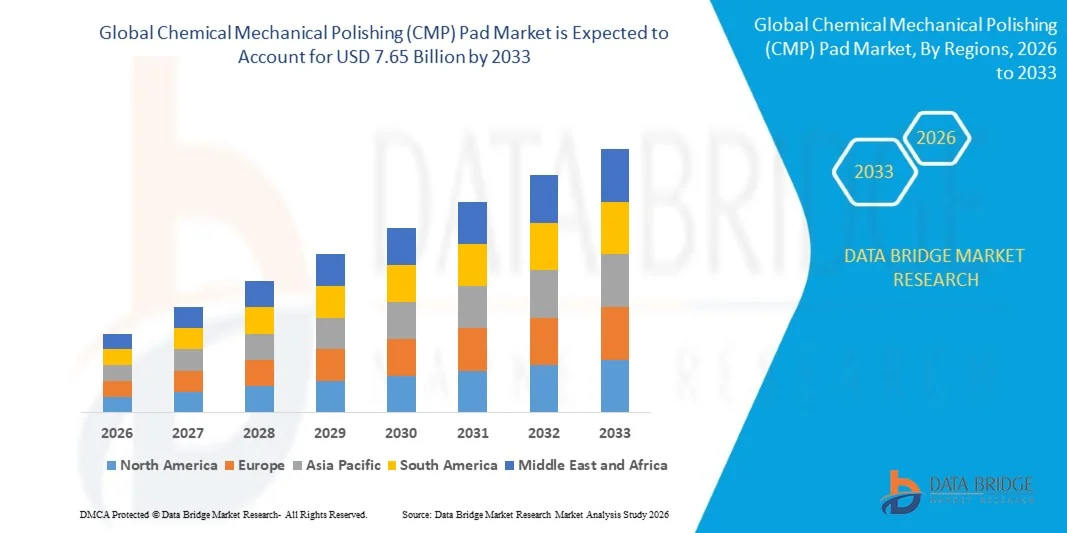
- As per Data Bridge Market Research analysis, the chemical mechanical polishing (CMP) pad market was valued at USD 4.32 billion in 2025 and is projected to reach USD 7.65 billion by 2033, growing at a CAGR of 7.40% from 2026 to 2033.
- The market is experiencing consistent growth driven by rising semiconductor wafer starts, an increasing number of planarization steps at advanced logic and memory nodes, and growing demand for AI accelerators, high-bandwidth memory, and advanced packaging.
- The increasing complexity of device architectures, the adoption of 3D NAND, gate-all-around transistors, and hybrid bonding, and the expansion of fab capacity worldwide are supporting market adoption. CMP pads are applied across semiconductor packaging, high-bandwidth memory, and foundry manufacturing, where they enable the atomic-scale planarity required for dielectric, metal, and barrier layers.
Market Size & Forecast
- Global Market Value (2025): USD 4.32 billion
- Expected Market Value (2033): USD 7.65 billion
- Forecast CAGR (2026–2033): 7.40%
- Leading Region in 2025: Asia-Pacific
- Fastest Growing Region: North America
What are the Major Takeaways of the Chemical Mechanical Polishing (CMP) Pad Market?
- Asia-Pacific dominated the chemical mechanical polishing (CMP) pad market with the largest revenue share of 71.6% in 2025, supported by the concentration of leading-edge logic, memory, and advanced packaging fabs in Taiwan, South Korea, China, and Japan, and by the region’s large installed base of CMP tools.
- North America is expected to be the fastest-growing region at a CAGR of 9.40% from 2026 to 2033, fueled by new fab construction, advanced packaging investment, and domestic semiconductor manufacturing incentives.
- The hard CMP pads segment led the pad type category with a 66.34% share in 2025, supported by their high planarization efficiency and wide use in oxide and metal polishing.
- Soft CMP pads is the fastest-growing pad type segment, projected to register a CAGR of 8.60% from 2026 to 2033, driven by demand for low-defectivity polishing in final buff and barrier steps.
- The 300 mm segment led the wafer size category with a 72.8% share in 2025, supported by the shift of leading-edge logic and memory production to 300 mm fabs.
- The dielectric (ILD & STI) polishing segment led the application category with a 43.64% share in 2025, supported by the number of oxide planarization steps in shallow trench isolation and 3D NAND processing.
- Advanced packaging & others is the fastest-growing application segment, projected to register a CAGR of 11.90% from 2026 to 2033, driven by hybrid bonding, through-silicon via, and 2.5D/3D integration for AI processors and memory.
Report Scope and Chemical Mechanical Polishing (CMP) Pad Market Segmentation
|
Attributes |
Chemical Mechanical Polishing (CMP) Pad Key Market Insights |
|
Segments Covered |
|
|
Countries Covered |
North America
Europe
Asia-Pacific
Middle East and Africa
South America
|
|
Key Market Players |
|
|
Market Opportunities |
|
|
Value Added Data Infosets |
In addition to the insights on market scenarios such as market value, growth rate, segmentation, geographical coverage, and major players, the market reports curated by the Data Bridge Market Research also include in-depth expert analysis, geographically represented company-wise production and capacity, network layouts of distributors and partners, detailed and updated price trend analysis and deficit analysis of supply chain and demand. |
What is the Key Trend in the Chemical Mechanical Polishing (CMP) Pad Market?
- CMP pads are evolving from general-purpose consumables into application-specific materials engineered for AI-era devices, with new pad platforms targeting advanced logic, high-bandwidth memory, and hybrid bonding with tighter defectivity and longer pad life.
- For instance, in October 2025, according to DuPont, its Qnity electronics business launched the Emblem CMP pad platform, a next-generation product family designed for chips used in AI and advanced computing, including high-bandwidth memory.
- Suppliers are shifting from transactional sales toward long-term supply agreements and co-development with memory and logic manufacturers to secure qualification positions at next-generation nodes.
- Localization is another defining trend, with regional suppliers expanding capacity to serve domestic fabs and reduce reliance on imported consumables.
- For instance, in June 2026, according to Action Intell, Hubei Dinglong announced a third CMP pad production line at its Qianjiang facility in Hubei Province, with an investment of CNY 30 million (USD 4.4 million) and added annual capacity of 300,000 polishing pads.
- As planarization requirements tighten with hybrid bonding, gate-all-around transistors, and 3D memory stacking, CMP pads are expected to see growing consumption per wafer and wider use in advanced packaging.
What are the Key Drivers of the Chemical Mechanical Polishing (CMP) Pad Market?
- The growing number of planarization steps at advanced logic and memory nodes, combined with expanding fab capacity for AI accelerators and high-bandwidth memory, has significantly increased demand for CMP pads.
- For instance, in October 2025, according to DuPont, Qnity signed a memorandum of understanding with SK hynix for a long-term supply of CMP polishing pads to support the memory maker’s next-generation semiconductor manufacturing and mass production, signaling the growing importance of pad supply security for memory expansion.
- Memory manufacturers, foundries, and advanced packaging houses are increasingly integrating CMP-intensive processes such as hybrid bonding and through-silicon via reveal, raising pad consumption per wafer.
- For instance, in June 2026, according to Action Intell, Hubei Dinglong’s decision to add a third CMP pad line with 300,000 pads of annual capacity reflects demand from domestic fabs and the build-out of regional consumables supply chains.
- Rising demand for power devices, sensors, and analog chips for electric vehicles and industrial applications is sustaining pad consumption in 200 mm and mature-node fabs alongside leading-edge growth.
What Factors Are Challenging the Growth of the Chemical Mechanical Polishing (CMP) Pad Market?
- CMP pads require lengthy qualification, as any change in pad supplier or formulation can alter removal rate, defectivity, and process stability, which slows adoption of new suppliers and limits fabs’ flexibility.
- Defectivity control is a critical technical challenge, as scratches, particles, and pad wear can reduce yield, particularly at advanced nodes and in hybrid bonding applications.
- For instance, in March 2018, according to the NCCAVS CMP Users Group (Texas Instruments), a first-generation hard polyurethane pad was disqualified because its performance degraded after about 400 wafers, causing higher defectivity.
- Supply is concentrated among a few global suppliers, and raw material volatility, particularly in polyurethane chemistry, can create procurement risk and margin pressure for pad manufacturers.
- Evolving environmental and chemical-compliance requirements may also require reformulation of pad materials, adding development cost and extending qualification timelines.
How is the Chemical Mechanical Polishing (CMP) Pad Market Segmented?
The chemical mechanical polishing (CMP) pad market is segmented on the basis of pad type, wafer size, application, and end user.
- By Pad Type
On the basis of pad type, the chemical mechanical polishing (CMP) pad market is segmented into hard CMP pads, soft CMP pads, and others. The hard CMP pads segment dominated the market with a 66.34% share in 2025, supported by their superior planarization efficiency and wide use in oxide and metal polishing across logic and memory fabs. Hard polyurethane pads with engineered groove and porosity patterns deliver consistent removal rates and long pad life, making them the standard choice for high-volume manufacturing.
The soft CMP pads segment is projected to register the fastest growth at a CAGR of 8.60% from 2026 to 2033, driven by growing demand for low-defectivity polishing in final buff steps, barrier removal, and advanced-node processes. Soft pads offer improved surface conformity and reduced scratching, which is increasingly important for hybrid bonding and sub-10 nm devices. Rising use in advanced packaging is further supporting segment growth.
- By Wafer Size
On the basis of wafer size, the chemical mechanical polishing (CMP) pad market is segmented into 300 mm and 200 mm and below. The 300 mm segment dominated the market with a 72.84% share in 2025, supported by the shift of leading-edge logic, DRAM, and 3D NAND production to 300 mm fabs. Higher pad consumption per wafer at advanced nodes and large-scale fab construction continue to anchor demand in this segment.
The 200 mm and below segment is projected to register the fastest growth at a CAGR of 8.10% from 2026 to 2033, driven by rising production of power devices, silicon carbide components, analog ICs, MEMS, and sensors. Automotive electrification and industrial automation are increasing demand for mature-node capacity, supporting steady pad consumption in these fabs.
- By Application
On the basis of application, the chemical mechanical polishing (CMP) pad market is segmented into dielectric (ILD & STI) polishing, metal (copper & tungsten) polishing, and advanced packaging & others. The dielectric polishing segment dominated the application category with a 43.64% share in 2025, supported by the number of oxide planarization steps in shallow trench isolation, interlayer dielectric, and 3D NAND stack processing. Stable demand from memory and logic fabs sustains segment leadership.
The advanced packaging & others segment is projected to register the fastest growth at a CAGR of 11.90% from 2026 to 2033, driven by hybrid bonding, through-silicon via reveal, redistribution layer planarization, and 2.5D/3D integration for AI processors and high-bandwidth memory. These processes require ultra-flat, low-defect surfaces, increasing pad consumption per wafer and creating demand for specialized pad formulations.
- By End User
On the basis of end user, the chemical mechanical polishing (CMP) pad market is segmented into foundries, integrated device manufacturers (IDMs), memory manufacturers, and OSATs. The foundries segment dominated the end-user category with a 45.72% share in 2025, supported by high wafer volumes and a large number of CMP steps at advanced logic nodes. Multi-year consumables agreements with leading pad suppliers reinforce stable demand.
The memory manufacturers segment is projected to register the fastest growth at a CAGR of 9.60% from 2026 to 2033, driven by expanding production of DRAM, 3D NAND, and high-bandwidth memory for AI servers. Increasing layer counts and the transition toward hybrid bonding in memory stacks are raising CMP intensity and pad demand.
Which Region Holds the Largest Share of the Chemical Mechanical Polishing (CMP) Pad Market?
- Asia-Pacific dominated the chemical mechanical polishing (CMP) pad market with the largest revenue share of 71.62% in 2025, supported by the concentration of leading-edge logic, memory, and advanced packaging fabs in Taiwan, South Korea, China, and Japan, and by the region’s large installed base of CMP tools.
- The region also benefits from the presence of the world’s largest foundries and memory manufacturers, strong localization of consumables in China and South Korea, and rising wafer starts for AI accelerators and high-bandwidth memory. Continuous capacity expansion and deep supplier–customer collaboration continue to strengthen Asia-Pacific’s position in the global market.
U.S. Chemical Mechanical Polishing (CMP) Pad Market Insight
The U.S. chemical mechanical polishing (CMP) pad market is witnessing strong growth due to new fab construction, advanced packaging investment, and the strong presence of leading CMP consumables suppliers. Government incentives for domestic semiconductor manufacturing are encouraging local sourcing and qualification of CMP materials. In addition, demand from logic, memory, and specialty fabs for AI and high-performance computing chips is increasing pad consumption across the country.
Asia-Pacific Chemical Mechanical Polishing (CMP) Pad Market Insight
The Asia-Pacific chemical mechanical polishing (CMP) pad market is expected to witness rapid growth, driven by the concentration of foundry, memory, and packaging capacity across countries such as China, Japan, and India. Rising wafer starts for AI accelerators, high-bandwidth memory, and consumer devices are lifting pad demand, while government-backed semiconductor programs are supporting new fab construction. Strong local supplier ecosystems are further accelerating regional market expansion.
Japan Chemical Mechanical Polishing (CMP) Pad Market Insight
The Japan chemical mechanical polishing (CMP) pad market is witnessing consistent growth due to the country’s strong base of semiconductor materials suppliers and its role in memory, image sensor, and power device manufacturing. Japanese pad and consumables makers focus on precision, low defectivity, and long-term customer collaboration. Renewed fab investment and advanced packaging initiatives are further contributing to demand.
China Chemical Mechanical Polishing (CMP) Pad Market Insight
The China chemical mechanical polishing (CMP) pad market is growing rapidly, driven by large-scale fab expansion and a national push to localize semiconductor materials. Domestic suppliers are adding pad capacity and qualifying products with local foundries and memory makers. Increasing production of mature-node, power, and memory devices is boosting pad consumption and positioning China as a key growth market in Asia-Pacific.
U.K. Chemical Mechanical Polishing (CMP) Pad Market Insight
The U.K. chemical mechanical polishing (CMP) pad market is experiencing steady growth, supported by compound semiconductor, photonics, and power device manufacturing clusters and research-driven pilot lines. Demand is concentrated in specialty and low-volume processes that require high-quality planarization. Public investment in semiconductor research and advanced packaging capability is also supporting adoption of CMP consumables.
Germany Chemical Mechanical Polishing (CMP) Pad Market Insight
The Germany chemical mechanical polishing (CMP) pad market is expanding steadily due to the country’s strong automotive and industrial semiconductor base, including power devices, sensors, and microcontrollers. New and expanded fab investments in Europe are increasing demand for CMP consumables, while Germany’s emphasis on process control, quality, and environmental compliance supports adoption of high-performance, low-defect pad solutions.
Which are the Top Companies in Chemical Mechanical Polishing (CMP) Pad Market?
The chemical mechanical polishing (CMP) pad industry is primarily led by well-established companies, including:
- Qnity Electronics, Inc. (DuPont Electronics) (U.S.)
- SK enpulse Co., Ltd. (South Korea)
- Entegris, Inc. (U.S.)
- Fujibo Holdings, Inc. (Japan)
- JSR Corporation (Japan)
- Hubei Dinglong Co., Ltd. (China)
- IVT Technologies Co., Ltd. (China)
- 3M Company (U.S.)
- TWI Incorporated (Taiwan)
- Kinik Company (Taiwan)
- FNS Tech Co., Ltd. (South Korea)
- Nitta Corporation (Japan)
- Toray Industries, Inc. (Japan)
- Fujimi Incorporated (Japan)
- Resonac Holdings Corporation (Japan)
- Applied Materials, Inc. (U.S.)
- Ebara Corporation (Japan)
- Merck KGaA (Germany)
- BASF SE (Germany)
- Saint-Gobain (France)
What are Latest Developments in Chemical Mechanical Polishing (CMP) Pad Market?
- In June 2026, Hubei Dinglong announced plans to build a third CMP pad production line at its Qianjiang facility in Hubei Province, investing CNY 30 million (US$4.4 million) to add annual capacity of 300,000 polishing pads, according to Action Intell.
- In November 2025, Qnity Electronics was separated from DuPont as an independent company focused on semiconductor technology solutions, including CMP pads such as the Ikonic and IC1000 brands, according to DuPont.
- In October 2025, Qnity signed a memorandum of understanding with SK hynix for a strategic long-term supply of CMP polishing pads, with the signing held during SEMICON West in Phoenix, Arizona, according to DuPont.
- In October 2025, Qnity highlighted the launch of its Emblem CMP pad platform, a next-generation family designed for AI and advanced computing chips, including high-bandwidth memory, according to DuPont.

- Interactive Data Analysis Dashboard
- Company Analysis Dashboard for high growth potential opportunities
- Research Analyst Access for customization & queries
- Competitor Analysis with Interactive dashboard
- Latest News, Updates & Trend analysis
- Harness the Power of Benchmark Analysis for Comprehensive Competitor Tracking
Global Chemical Mechanical Polishing Cmp Pad Market, Supply Chain Analysis and Ecosystem Framework
To support market growth and help clients navigate the impact of geopolitical shifts, DBMR has integrated in-depth supply chain analysis into its Global Chemical Mechanical Polishing Cmp Pad Market research reports. This addition empowers clients to respond effectively to global changes affecting their industries. The supply chain analysis section includes detailed insights such as Global Chemical Mechanical Polishing Cmp Pad Market consumption and production by country, price trend analysis, the impact of tariffs and geopolitical developments, and import and export trends by country and HSN code. It also highlights major suppliers with data on production capacity and company profiles, as well as key importers and exporters. In addition to research, DBMR offers specialized supply chain consulting services backed by over a decade of experience, providing solutions like supplier discovery, supplier risk assessment, price trend analysis, impact evaluation of inflation and trade route changes, and comprehensive market trend analysis.
Data collection and base year analysis are done using data collection modules with large sample sizes. The stage includes obtaining market information or related data through various sources and strategies. It includes examining and planning all the data acquired from the past in advance. It likewise envelops the examination of information inconsistencies seen across different information sources. The market data is analysed and estimated using market statistical and coherent models. Also, market share analysis and key trend analysis are the major success factors in the market report. To know more, please request an analyst call or drop down your inquiry.
The key research methodology used by DBMR research team is data triangulation which involves data mining, analysis of the impact of data variables on the market and primary (industry expert) validation. Data models include Vendor Positioning Grid, Market Time Line Analysis, Market Overview and Guide, Company Positioning Grid, Patent Analysis, Pricing Analysis, Company Market Share Analysis, Standards of Measurement, Global versus Regional and Vendor Share Analysis. To know more about the research methodology, drop in an inquiry to speak to our industry experts.
Data Bridge Market Research is a leader in advanced formative research. We take pride in servicing our existing and new customers with data and analysis that match and suits their goal. The report can be customized to include price trend analysis of target brands understanding the market for additional countries (ask for the list of countries), clinical trial results data, literature review, refurbished market and product base analysis. Market analysis of target competitors can be analyzed from technology-based analysis to market portfolio strategies. We can add as many competitors that you require data about in the format and data style you are looking for. Our team of analysts can also provide you data in crude raw excel files pivot tables (Fact book) or can assist you in creating presentations from the data sets available in the report.













