


Chemical Recycling Market Size
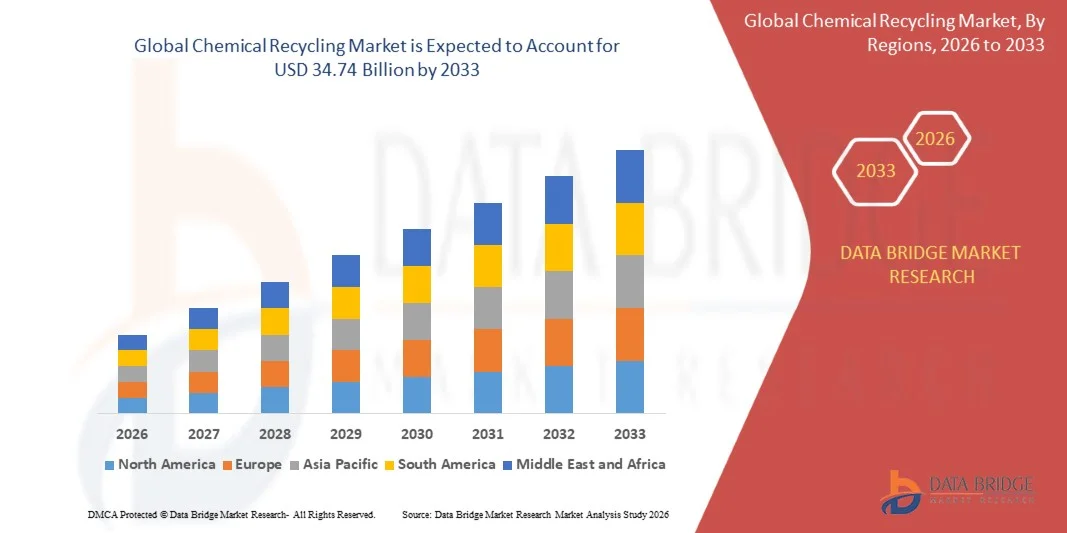
- The global chemical recycling market size was valued at USD 17.11 billion in 2025and is expected to reach USD 34.74 billion by 2033, at a CAGR of 8.94% during the forecast period
- Growth is primarily driven by increasing plastic waste generation and stringent environmental regulations promoting circular economy practices
- Rising investments in advanced recycling technologies and growing demand for sustainable polymers are accelerating market expansion
Chemical Recycling Market Analysis
- Chemical recycling represents a transformative approach in waste management, wherein plastic waste is converted back into its fundamental chemical building blocks such as monomers, fuels, and other value-added chemicals.
- The demand for chemical recycling is being significantly driven by increasing regulatory pressure across global economies. Governments and environmental bodies are enforcing stringent policies to reduce landfill dependency and curb greenhouse gas emissions. Regulations such as extended producer responsibility (EPR), plastic taxes, and recycling mandates are compelling manufacturers and packaging companies to incorporate recycled content into their products.
- Europe emerged as the dominant region in 2025, accounting for approximately 39.2% of the global market share, primarily due to its proactive regulatory framework and well-established recycling infrastructure. The region has implemented some of the world's most stringent environmental policies, including ambitious recycling targets, circular economy initiatives, and restrictions on single-use plastics, driving the adoption of advanced recycling technologies.
- The Asia-Pacific region is projected to witness the fastest growth during the forecast period, registering a CAGR of approximately 18.6%, largely attributed to rapid industrialization, urbanization, and a significant rise in plastic consumption across emerging economies such as China and India. Increasing government support for waste management and sustainability initiatives is further accelerating market expansion.
- The pyrolysis segment dominated the market with an estimated revenue share of 47.8% in 2025 due to its operational flexibility and efficiency in processing mixed plastic waste streams. Pyrolysis involves the thermal decomposition of plastics in the absence of oxygen, converting them into valuable outputs such as pyrolysis oil, gas, and char, making it one of the most commercially viable chemical recycling technologies.
Report Scope and Chemical Recycling Market Segmentation
|
Attributes |
Chemical Recycling Key Market Insights |
|
Segments Covered |
|
|
Countries Covered |
North America · U.S. · Canada · Mexico Europe · Germany · France · U.K. · Netherlands · Switzerland · Belgium · Russia · Italy · Spain · Turkey · Rest of Europe Asia-Pacific · China · Japan · India · South Korea · Singapore · Malaysia · Australia · Thailand · Indonesia · Philippines · Rest of Asia-Pacific Middle East and Africa · Saudi Arabia · U.A.E. · South Africa · Egypt · Israel · Rest of Middle East and Africa South America · Brazil · Argentina · Rest of South America |
|
Key Market Players |
|
|
Market Opportunities |
· Expansion of 5G infrastructure and fiber-to-the-home (FTTH) deployments globally · Rising demand for high-speed data transmission driven by cloud computing and data centers |
|
Value Added Data Infosets |
In addition to the insights on market scenarios such as market value, growth rate, segmentation, geographical coverage, and major players, the market reports curated by the Data Bridge Market Research also include import export analysis, production capacity overview, production consumption analysis, price trend analysis, climate change scenario, supply chain analysis, value chain analysis, raw material/consumables overview, vendor selection criteria, PESTLE Analysis, Porter Analysis, and regulatory framework. |
Chemical Recycling Market Trends
“Transition Toward Circular Economy and Advanced Recycling Technologies”
- Increasing focus on circular economy models is driving adoption of chemical recycling solutions globally
- Advanced technologies such as depolymerization and solvolysis are enabling production of virgin-quality recycled materials
- Companies are investing in large-scale plants to improve commercial viability
- Integration of AI and automation is optimizing process efficiency and yield
- Strategic collaborations between petrochemical companies and recycling firms are accelerating innovation.
Chemical Recycling Market Dynamics
Driver
“Rising Plastic Waste and Sustainability Regulations”
- One of the most significant drivers of the chemical recycling market is the exponential increase in global plastic waste. With rising consumption across packaging, automotive, electronics, and consumer goods industries, plastic production has surged dramatically over the past decade. However, a large portion of this waste particularly multi-layered, contaminated, or low-value plastics cannot be effectively managed through conventional mechanical recycling.
- Chemical recycling plays a critical role in addressing the limitations of traditional recycling methods. It enables the conversion of hard-to-recycle plastics into high-value outputs such as monomers and feedstock chemicals, thereby improving overall waste management efficiency.
- Another key growth factor is the increasing demand for recycled polymers, especially in packaging and automotive sectors. Major consumer goods companies are committing to incorporating a higher percentage of recycled content into their products to meet sustainability goals and regulatory requirements.
- Corporate sustainability commitments are further accelerating market growth. Large multinational companies are setting ambitious environmental targets, including carbon neutrality and zero waste goals.
Restraint/Challenge
“High Cost and Technology Complexity”
- The chemical recycling market faces significant challenges, primarily related to high costs and technological complexity. Establishing advanced recycling facilities requires substantial capital investment, including costs associated with specialized equipment, process development, and infrastructure.
- Operational costs also remain a concern due to the energy-intensive nature of chemical recycling processes. Technologies such as pyrolysis and gasification require high temperatures and controlled environments, leading to increased energy consumption.
- Another critical challenge is the lack of standardized regulations across different regions. While some countries have well-defined policies supporting advanced recycling, others are still in the early stages of regulatory development.
- Feedstock variability presents an additional layer of complexity. The quality and composition of plastic waste can vary significantly depending on its source, leading to inconsistencies in processing efficiency and output quality.
- In summary, while rising plastic waste and sustainability regulations are strongly driving the adoption of chemical recycling, challenges related to high capital investment, operational complexity, regulatory inconsistencies, and feedstock variability continue to restrain market growth.
Chemical Recycling Market Scope
The market is segmented on the basis of technology, feedstock, and end-use industry.
- By technology
On the basis of technology, the global chemical recycling market is segmented into pyrolysis, gasification, depolymerization, and others. The pyrolysis segment dominated the market with the largest revenue share in 2025, driven by its scalability, operational flexibility, and ability to process mixed and contaminated plastic waste. Pyrolysis enables the conversion of heterogeneous plastic streams into valuable outputs such as oil and gas, making it highly suitable for large-scale industrial applications. Its compatibility with existing petrochemical infrastructure further strengthens its adoption. Increasing investments by oil & gas companies and rising demand for fuel and chemical feedstock derived from waste plastics are also supporting the dominance of this segment.
The depolymerization segment is expected to witness the fastest growth during the forecast period, fueled by its ability to produce high-quality, virgin-equivalent monomers. This technology is particularly effective for specific polymers such as PET and nylon, making it highly relevant for packaging and textile industries. Growing demand for food-grade recycled materials, coupled with stringent regulatory requirements for recycled content, is accelerating adoption. Additionally, advancements in enzymatic and chemical depolymerization technologies are improving efficiency and commercial viability, further boosting segment growth.
- By Feedstock
On the basis of feedstock, the global chemical recycling market is segmented into plastic waste, biomass, rubber, and others. The plastic waste segment dominated the market with the largest revenue share in 2025, driven by the massive increase in global plastic consumption and waste generation. A significant portion of plastic waste, especially multi-layered and contaminated plastics, cannot be processed through mechanical recycling, making chemical recycling a crucial solution. Governments and industries are increasingly focusing on converting plastic waste into valuable resources, thereby strengthening the dominance of this segment. Rising environmental concerns and regulatory pressure to reduce plastic pollution are further accelerating demand.
The PET (polyethylene terephthalate) segment is expected to witness strong growth during the forecast period, particularly within plastic waste recycling. PET is widely used in packaging applications such as bottles and containers, and its recyclability makes it a key focus area for advanced recycling technologies like depolymerization. Increasing demand for food-grade recycled PET, along with commitments from major brands to use sustainable packaging materials, is driving growth. Technological advancements enabling efficient breakdown and purification of PET are also supporting segment expansion.
- By End-Use Industry
On the basis of end-use industry, the global chemical recycling market is segmented into packaging, automotive, construction, textiles, electronics, and others. The packaging segment dominated the market with the largest revenue share in 2025, driven by the high consumption of plastics in food, beverage, and consumer goods packaging. Increasing regulatory pressure to use recyclable and sustainable materials, along with corporate commitments toward circular economy practices, is significantly boosting demand for chemically recycled polymers. Chemical recycling enables the production of high-quality recycled materials suitable for food-grade applications, further strengthening its adoption in the packaging sector.
The automotive and textiles segments are expected to witness the fastest growth during the forecast period, fueled by increasing adoption of sustainable materials and lightweight components. In the automotive industry, recycled polymers are being used to reduce vehicle weight and improve fuel efficiency while meeting environmental regulations. Similarly, the textile industry is increasingly utilizing recycled fibers derived from chemical recycling processes to produce sustainable fabrics. Rising consumer awareness, coupled with brand commitments toward sustainability, is further accelerating the adoption of recycled materials across these industries.
Chemical Recycling Market Regional Analysis
- Europe dominated the Chemical Recycling market with the largest revenue share in 2025, supported by stringent environmental regulations, strong circular economy initiatives, and well-established recycling infrastructure. The presence of leading chemical and recycling companies such as BASF SE and TotalEnergies further strengthens the region’s leadership
- Governments and industries across the region place strong emphasis on reducing plastic waste and carbon emissions, driving widespread adoption of advanced recycling technologies across end-use industries such as packaging, automotive, and consumer goods. Increasing regulatory mandates for recycled content and sustainability targets are accelerating the deployment of chemical recycling solutions
- This strong market position is further supported by continuous investments in advanced recycling plants, favorable policy frameworks such as Extended Producer Responsibility (EPR), and growing collaboration between petrochemical companies and waste management firms. Additionally, high consumer awareness and demand for sustainable materials are establishing chemical recycling as a critical component of Europe’s circular economy strategy
U.S. Chemical Recycling Market Insight
The U.S. Chemical Recycling market is witnessing steady growth, driven by increasing plastic waste generation and rising corporate sustainability commitments. Strong investments from petrochemical and recycling companies are supporting the development of advanced recycling infrastructure. Favorable regulatory support and initiatives promoting circular economy practices are accelerating adoption. Additionally, growing demand for high-quality recycled polymers in packaging and automotive industries is further strengthening market expansion across the country.
Europe Chemical Recycling Market Insight
The Europe chemical recycling market is witnessing strong growth, driven by stringent environmental regulations, circular economy initiatives, and increasing demand for sustainable materials. The region benefits from advanced recycling infrastructure and significant investments in technologies such as pyrolysis and depolymerization. Additionally, regulatory mandates for recycled content and strong collaboration between industry players are accelerating market expansion across packaging and automotive sectors.
U.K. Chemical Recycling Market Insight
The U.K. chemical recycling market is witnessing steady growth, driven by stringent environmental regulations, plastic waste reduction targets, and strong government support for circular economy initiatives. Increasing investments in advanced recycling technologies, particularly depolymerization and pyrolysis, are accelerating market development. Additionally, rising demand for sustainable packaging and corporate commitments toward net-zero emissions are further strengthening adoption across industries.
Germany Chemical Recycling Market Insight
The Germany chemical recycling market is witnessing steady growth, driven by stringent environmental regulations and strong emphasis on circular economy practices. High plastic waste generation and advanced waste management infrastructure are supporting adoption. Increasing investments by chemical companies in depolymerization and pyrolysis technologies, along with demand for sustainable polymers in packaging and automotive sectors, are further accelerating market expansion.
Asia-Pacific Chemical Recycling Market Insight
The Asia-Pacific chemical recycling market is witnessing rapid growth, driven by increasing plastic waste generation, rapid industrialization, and rising environmental awareness across countries such as China, India, and Japan. Government initiatives promoting sustainable waste management and circular economy practices are accelerating adoption. Additionally, growing investments in advanced recycling technologies and rising demand for recycled polymers in packaging and automotive industries are further supporting regional market expansion.
Japan Chemical Recycling Market Insight
The Japan chemical recycling market is witnessing steady growth, driven by strong government support for circular economy initiatives and advanced waste management systems. Increasing plastic waste generation and stringent environmental regulations are encouraging adoption of chemical recycling technologies. The presence of leading chemical companies and investments in depolymerization and pyrolysis technologies are further supporting market expansion across packaging and automotive industries.
India Chemical Recycling Market Insight
The India chemical recycling market is witnessing steady growth driven by rising plastic waste generation, increasing environmental awareness, and supportive government initiatives such as plastic waste management rules. Growing demand for sustainable materials in packaging and automotive sectors is accelerating adoption. Additionally, investments in advanced recycling technologies and expanding partnerships between private players are strengthening market development across the country.
Chemical Recycling Market Share
The Chemical Recycling industry is primarily led by well-established companies, including:
- BASF SE (Germany)
- Shell plc (U.K.)
- ExxonMobil Corporation (U.S.)
- SABIC (Saudi Arabia)
- Dow Inc. (U.S.)
- TotalEnergies (France)
- LyondellBasell Industries (Netherlands)
- Eastman Chemical Company (U.S.)
- Veolia (France)
- Plastic Energy (U.K.)
What are the Recent Developments in Global chemical recycling market ?
- In February 2026, ExxonMobil expanded its advanced recycling capacity by launching a third unit at its Baytown facility, significantly increasing plastic waste processing capabilities. This development supports circular economy goals and demonstrates large-scale commercialization of chemical recycling technologies across integrated petrochemical complexes
- In November 2025, BASF and ExxonMobil entered a strategic partnership to co-develop methane pyrolysis technology, aiming to produce low-emission hydrogen and solid carbon. The collaboration includes plans for a demonstration plant, highlighting increasing joint ventures to scale advanced recycling and sustainable chemical production
- In May 2025, ExxonMobil partnered with Cyclyx and local authorities in the U.S. to develop a large-scale plastic recycling program, focusing on improving feedstock collection and recycling efficiency. This initiative reflects growing collaboration between industry players and municipalities to strengthen recycling infrastructure
- In November 2024, ExxonMobil announced a major investment of approximately $200 million to expand advanced recycling operations in Texas, aiming to process up to 1 billion pounds of plastic waste annually. This expansion highlights increasing capital investments to scale chemical recycling capacity globally
- In May 2025, OMV strengthened its chemical recycling capabilities through partnerships and feedstock agreements, including collaboration with Interzero for a large-scale sorting facility in Germany. The initiative supports its proprietary ReOil technology and enhances integration of circular feedstock into petrochemical production systems

- Interactive Data Analysis Dashboard
- Company Analysis Dashboard for high growth potential opportunities
- Research Analyst Access for customization & queries
- Competitor Analysis with Interactive dashboard
- Latest News, Updates & Trend analysis
- Harness the Power of Benchmark Analysis for Comprehensive Competitor Tracking
Global Chemical Recycling Market, Supply Chain Analysis and Ecosystem Framework
To support market growth and help clients navigate the impact of geopolitical shifts, DBMR has integrated in-depth supply chain analysis into its Global Chemical Recycling Market research reports. This addition empowers clients to respond effectively to global changes affecting their industries. The supply chain analysis section includes detailed insights such as Global Chemical Recycling Market consumption and production by country, price trend analysis, the impact of tariffs and geopolitical developments, and import and export trends by country and HSN code. It also highlights major suppliers with data on production capacity and company profiles, as well as key importers and exporters. In addition to research, DBMR offers specialized supply chain consulting services backed by over a decade of experience, providing solutions like supplier discovery, supplier risk assessment, price trend analysis, impact evaluation of inflation and trade route changes, and comprehensive market trend analysis.
Data collection and base year analysis are done using data collection modules with large sample sizes. The stage includes obtaining market information or related data through various sources and strategies. It includes examining and planning all the data acquired from the past in advance. It likewise envelops the examination of information inconsistencies seen across different information sources. The market data is analysed and estimated using market statistical and coherent models. Also, market share analysis and key trend analysis are the major success factors in the market report. To know more, please request an analyst call or drop down your inquiry.
The key research methodology used by DBMR research team is data triangulation which involves data mining, analysis of the impact of data variables on the market and primary (industry expert) validation. Data models include Vendor Positioning Grid, Market Time Line Analysis, Market Overview and Guide, Company Positioning Grid, Patent Analysis, Pricing Analysis, Company Market Share Analysis, Standards of Measurement, Global versus Regional and Vendor Share Analysis. To know more about the research methodology, drop in an inquiry to speak to our industry experts.
Data Bridge Market Research is a leader in advanced formative research. We take pride in servicing our existing and new customers with data and analysis that match and suits their goal. The report can be customized to include price trend analysis of target brands understanding the market for additional countries (ask for the list of countries), clinical trial results data, literature review, refurbished market and product base analysis. Market analysis of target competitors can be analyzed from technology-based analysis to market portfolio strategies. We can add as many competitors that you require data about in the format and data style you are looking for. Our team of analysts can also provide you data in crude raw excel files pivot tables (Fact book) or can assist you in creating presentations from the data sets available in the report.













