


Chemical Tanker Shipping Market Size
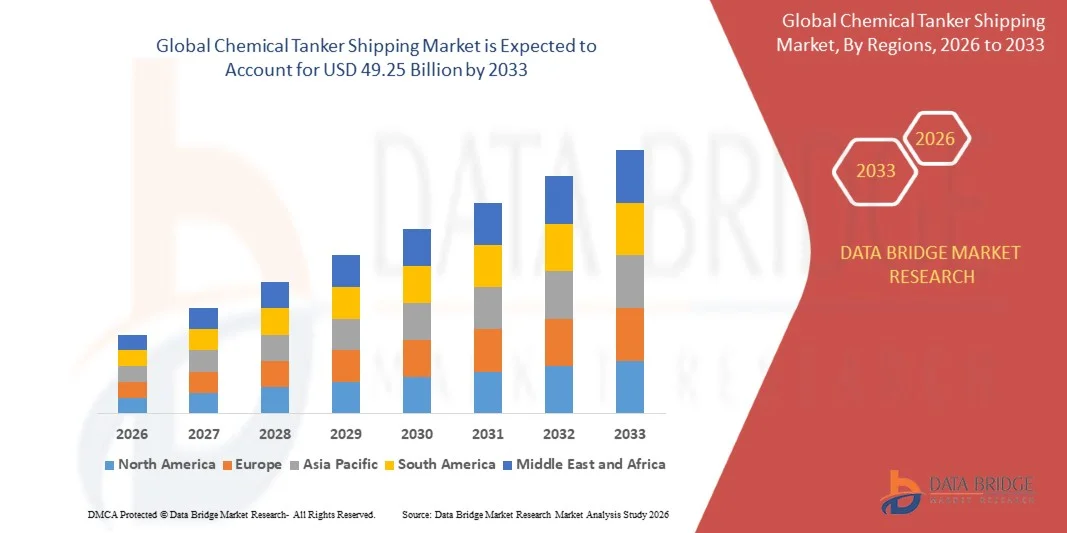
- The global chemical tanker shipping market size was valued at USD 37.17 billion in 2025and is expected to reach USD 49.25 billion by 2033, at a CAGR of 3.58% during the forecast period
- The market growth is largely fuelled by the increasing global trade of bulk chemicals, petrochemicals, and liquid industrial products across major manufacturing and industrial economies
- Rising demand for specialized maritime transportation solutions, coupled with expansion in chemical production capacities and international trade activities, is further accelerating the growth of the chemical tanker shipping market globally
Chemical Tanker Shipping Market Analysis
- The market is witnessing stable growth due to increasing international trade of specialty chemicals, edible oils, petrochemicals, and industrial liquid cargo requiring specialized tanker transportation systems
- Chemical tanker shipping services are gaining strong demand because they offer safe handling, contamination prevention, efficient bulk transportation, and regulatory compliance for transporting hazardous and non-hazardous liquid chemicals across global trade routes
- North America dominated the chemical tanker shipping market with the largest revenue share in 2025, driven by the strong presence of petrochemical industries, expanding exports of specialty chemicals, and advanced maritime transportation infrastructure
- Asia-Pacific region is expected to witness the highest growth rate in the global chemical tanker shipping market, driven by increasing industrial production, expanding chemical trade flows, and rising demand for cost-efficient maritime transportation across emerging economies such as China and India
- The organic chemicals segment held the largest market revenue share in 2025 driven by the rising global trade of petrochemicals, solvents, and industrial chemical products across manufacturing and pharmaceutical industries. Increasing demand for safe and efficient transportation of hazardous liquid chemicals, along with expanding industrial production activities, is further supporting segment growth
Report Scope and Chemical Tanker Shipping Market Segmentation
|
Attributes |
Chemical Tanker Shipping Key Market Insights |
|
Segments Covered |
· By Product: Organic Chemicals, Inorganic Chemicals, Vegetable Oils and Fats, and Others · By Shipment: Inland, Coastal, and Deep Sea · By Cargo Type: IMO I, IMO II, and IMO III · By Type of Coating: Stainless Steel Tanks and Epoxy Coated Tankers |
|
Countries Covered |
North America · U.S. · Canada · Mexico Europe · Germany · France · U.K. · Netherlands · Switzerland · Belgium · Russia · Italy · Spain · Turkey · Rest of Europe Asia-Pacific · China · Japan · India · South Korea · Singapore · Malaysia · Australia · Thailand · Indonesia · Philippines · Rest of Asia-Pacific Middle East and Africa · Saudi Arabia · U.A.E. · South Africa · Egypt · Israel · Rest of Middle East and Africa South America · Brazil · Argentina · Rest of South America |
|
Key Market Players |
• Stolt-Nielsen (U.K.) |
|
Market Opportunities |
• Growing Demand For Sustainable And Fuel-Efficient Chemical Tanker Fleets |
|
Value Added Data Infosets |
In addition to the insights on market scenarios such as market value, growth rate, segmentation, geographical coverage, and major players, the market reports curated by the Data Bridge Market Research also include import export analysis, production capacity overview, production consumption analysis, price trend analysis, climate change scenario, supply chain analysis, value chain analysis, raw material/consumables overview, vendor selection criteria, PESTLE Analysis, Porter Analysis, and regulatory framework. |
Chemical Tanker Shipping Market Trends
“Growing Demand for Safe and Efficient Transportation of Bulk Chemicals”
- The increasing global trade of industrial chemicals, petrochemicals, and specialty liquid cargo is significantly shaping the chemical tanker shipping market, as manufacturers and distributors increasingly require reliable and safe maritime transportation solutions. Chemical tanker shipping services are gaining traction due to their ability to transport hazardous and non-hazardous liquid chemicals efficiently while ensuring safety, contamination prevention, and regulatory compliance. This trend is strengthening demand across petrochemical, pharmaceutical, food processing, and industrial manufacturing sectors, encouraging shipping companies to modernize fleets and expand transportation capabilities
- Rising industrialization, expanding petrochemical production capacities, and increasing international trade activities have accelerated the demand for chemical tanker shipping services globally. Industrial manufacturers and chemical suppliers are actively seeking cost-effective and large-volume transportation solutions to support growing cross-border trade operations. This has also led to strategic collaborations between shipping operators, chemical producers, and logistics companies to improve transportation efficiency and strengthen global supply chain networks
- Sustainability and operational efficiency trends are increasingly influencing purchasing and fleet management decisions, with shipping companies emphasizing fuel-efficient vessels, digital fleet monitoring systems, and environmentally compliant shipping operations. These factors are helping operators differentiate services in a competitive maritime transportation market while improving operational reliability and regulatory compliance. Companies are also investing in advanced navigation systems, vessel automation technologies, and eco-friendly propulsion systems to reinforce sustainability goals and reduce emissions
- For instance, in 2024, Stolt-Nielsen Limited in the U.K. and Odfjell SE in Norway expanded their chemical tanker fleets by introducing fuel-efficient and environmentally compliant vessels for transporting specialty chemicals and liquid bulk cargo across international trade routes. These fleet expansion initiatives were introduced in response to rising global demand for safe and sustainable chemical transportation services, with operations strengthened across Asia-Pacific, Europe, and North America. The companies also promoted these investments as part of broader sustainability and fleet modernization strategies aimed at improving operational performance and reducing environmental impact
- While demand for chemical tanker shipping services continues to grow, sustained market expansion depends on advancements in vessel efficiency, regulatory compliance, and cost-effective fleet operations. Shipping companies are also focusing on improving logistics coordination, digital fleet optimization, and environmental sustainability to support broader adoption and maintain competitiveness in global maritime trade markets
Chemical Tanker Shipping Market Dynamics
Driver
“Increasing Global Trade of Chemicals and Petrochemicals”
- Rising international trade of chemicals, petrochemicals, edible oils, and specialty liquid products is a major driver for the chemical tanker shipping market. Shipping operators are increasingly expanding specialized tanker fleets to meet growing demand for safe and efficient transportation of bulk liquid cargo while complying with strict international maritime regulations. This trend is also encouraging investments in technologically advanced vessels and sustainable shipping solutions to improve transportation efficiency and reduce operational risks
- Expanding applications across chemical manufacturing, oil & gas, pharmaceutical, and food processing industries are influencing market growth. Chemical tanker shipping services help improve bulk cargo handling, transportation safety, and supply chain reliability while enabling manufacturers and exporters to support increasing global trade requirements. The growing industrialization and petrochemical production activities worldwide further reinforce this trend
- Shipping companies and logistics providers are actively promoting advanced tanker shipping solutions through fleet modernization, digital monitoring systems, and sustainability initiatives. These efforts are supported by growing demand for reliable and environmentally responsible maritime transportation services while also encouraging collaborations between tanker operators, port authorities, and chemical manufacturers to improve operational performance and cargo safety standards
- For instance, in 2023, MOL Chemical Tankers Pte. Ltd. in Singapore and Bahri in Saudi Arabia expanded their chemical tanker operations by introducing advanced stainless-steel tanker vessels designed for transporting hazardous and specialty chemicals. This expansion followed increasing global demand for safe and efficient liquid cargo transportation services, driving long-term shipping contracts and strengthening global trade connectivity. Both companies also emphasized operational safety, digital fleet management, and sustainability initiatives in corporate strategies to improve market positioning and customer confidence
- Although increasing chemical trade and industrial expansion support market growth, wider adoption depends on reducing fuel costs, maintaining vessel efficiency, and ensuring compliance with evolving environmental regulations. Investments in green shipping technologies, fleet automation systems, and low-emission propulsion solutions will be essential for meeting global transportation demand and maintaining long-term competitive advantage
Restraint/Challenge
“Stringent Maritime Regulations and Volatile Fuel Costs”
- The relatively high operational and maintenance costs associated with chemical tanker shipping remain a key challenge for the market, particularly amid fluctuating fuel prices and stringent environmental regulations. Rising bunker fuel costs, vessel maintenance expenses, and compliance requirements related to emissions and safety standards contribute to increased operational uncertainties and higher transportation costs for shipping operators
- Regulatory and environmental compliance requirements remain complex across global maritime trade routes, particularly in regions with strict emission control regulations and evolving sustainability standards. Compliance with IMO regulations, ballast water treatment systems, and carbon emission reduction targets can increase capital investment requirements and operational challenges for tanker shipping companies. This also slows fleet expansion activities among smaller operators with limited financial capabilities
- Supply chain disruptions and port congestion challenges also impact market growth, as chemical tanker shipping operations depend heavily on efficient logistics coordination and global trade stability. Delays in cargo handling, geopolitical uncertainties, and disruptions in shipping routes can increase transportation costs and operational inefficiencies. Companies must invest in digital logistics systems, fleet optimization technologies, and route management strategies to improve reliability and operational resilience
- For instance, in 2024, chemical shipping operators in Europe and Asia reported increased operational pressures due to higher marine fuel prices, stricter carbon emission regulations, and delays across major international ports. Compliance costs related to low-emission fuel adoption and environmental standards were additional barriers affecting profitability and operational flexibility. These challenges also encouraged some shipping companies to postpone fleet expansion and modernization projects amid uncertain market conditions
- Overcoming these challenges will require investments in fuel-efficient vessel technologies, expansion of digital fleet management systems, and stronger collaboration between shipping companies, regulatory authorities, and logistics providers. Furthermore, advancements in alternative marine fuels, sustainable propulsion technologies, and smart shipping infrastructure will be essential for improving operational efficiency, reducing environmental impact, and supporting the long-term growth potential of the global chemical tanker shipping market
Chemical Tanker Shipping Market Scope
The market is segmented on the basis of product, shipment, cargo type, and type of coating.
- By Product
On the basis of product, the chemical tanker shipping market is segmented into organic chemicals, inorganic chemicals, vegetable oils and fats, and others. The organic chemicals segment held the largest market revenue share in 2025 driven by the rising global trade of petrochemicals, solvents, and industrial chemical products across manufacturing and pharmaceutical industries. Increasing demand for safe and efficient transportation of hazardous liquid chemicals, along with expanding industrial production activities, is further supporting segment growth.
The vegetable oils and fats segment is expected to witness the fastest growth rate from 2026 to 2033, driven by increasing international trade of edible oils, bio-based products, and sustainable raw materials. Growing consumption of palm oil, sunflower oil, and specialty fats in food processing and biofuel industries is accelerating the demand for specialized tanker transportation solutions. Furthermore, rising focus on sustainability and renewable feedstocks is contributing to higher shipment volumes globally.
- By Shipment
On the basis of shipment, the chemical tanker shipping market is segmented into inland, coastal, and deep sea. The deep sea segment accounted for the largest market revenue share in 2025 due to the growing intercontinental trade of bulk chemicals and liquid cargo between major manufacturing and industrial economies. Increasing globalization of chemical supply chains and rising export-import activities are significantly driving the demand for deep sea chemical tanker services.
The coastal segment is expected to witness the fastest growth rate from 2026 to 2033, driven by increasing regional trade activities and expanding demand for short-distance chemical transportation. Coastal shipping offers cost-effective and efficient logistics solutions for transporting chemicals between nearby ports while reducing road congestion and transportation costs. Growing investments in port infrastructure and maritime connectivity are further supporting market expansion.
- By Cargo Type
On the basis of cargo type, the chemical tanker shipping market is segmented into IMO I, IMO II, and IMO III. The IMO II segment held the largest market revenue share in 2025 driven by its extensive use for transporting moderately hazardous liquid chemicals across industrial applications. These tankers provide enhanced safety standards and operational flexibility, making them highly suitable for a wide range of chemical products traded globally.
The IMO III segment is expected to witness the fastest growth rate from 2026 to 2033, driven by increasing transportation demand for lower hazard liquid chemicals and edible cargo products. Growing trade activities in less hazardous industrial liquids and vegetable oils are contributing to the expansion of IMO III tanker operations. In addition, lower operational complexity and cost advantages are encouraging wider adoption among shipping operators.
- By Type of Coating
On the basis of type of coating, the chemical tanker shipping market is segmented into stainless steel tanks and epoxy coated tankers. The stainless steel tanks segment accounted for the largest market revenue share in 2025 due to its superior corrosion resistance, durability, and compatibility with highly aggressive chemical cargo. Stainless steel tanks are widely preferred for transporting high-purity and hazardous chemicals, particularly in pharmaceutical and specialty chemical applications.
The epoxy coated tankers segment is expected to witness the fastest growth rate from 2026 to 2033, driven by their cost efficiency and suitability for transporting a broad range of chemical products and edible oils. Epoxy coatings provide effective protection against contamination and corrosion while reducing maintenance costs for ship operators. Increasing demand for economical tanker solutions in regional and international trade is further supporting segment growth
Chemical Tanker Shipping Market Regional Analysis
- North America dominated the chemical tanker shipping market with the largest revenue share in 2025, driven by the strong presence of petrochemical industries, expanding exports of specialty chemicals, and advanced maritime transportation infrastructure
- The region benefits from rising shale gas production, increasing chemical manufacturing activities, and growing demand for safe bulk liquid transportation across domestic and international trade routes
- This widespread market growth is further supported by continuous investments in modern tanker fleets, port expansion projects, and advanced logistics technologies, establishing North America as a major hub for global chemical tanker shipping operations
U.S. Chemical Tanker Shipping Market Insight
The U.S. chemical tanker shipping market captured the largest revenue share in 2025 within North America, fueled by the country’s strong petrochemical production base and expanding exports of industrial chemicals and liquid cargo. Increasing shale gas exploration and refining activities are supporting higher production of chemical products requiring maritime transportation. The growing demand for safe and efficient chemical logistics solutions, combined with investments in technologically advanced tanker fleets and port infrastructure, is further propelling market growth. Moreover, rising international trade activities and increasing demand for specialty chemical transportation are significantly contributing to the expansion of the U.S. market.
Europe Chemical Tanker Shipping Market Insight
The Europe chemical tanker shipping market is expected to witness the fastest growth rate from 2026 to 2033, primarily driven by stringent maritime safety regulations and increasing demand for sustainable shipping solutions. The presence of major chemical manufacturing hubs and advanced port infrastructure across countries such as Germany, the Netherlands, and Belgium is supporting market development. European shipping operators are increasingly investing in fuel-efficient vessels and environmentally sustainable transportation technologies to meet evolving environmental standards. In addition, rising trade of specialty chemicals and edible oils across regional and international markets is accelerating demand for chemical tanker shipping services.
U.K. Chemical Tanker Shipping Market Insight
The U.K. chemical tanker shipping market is expected to witness the fastest growth rate from 2026 to 2033, driven by increasing chemical trade activities and strong maritime logistics capabilities. Growing investments in port modernization and rising demand for specialized tanker transportation are supporting market growth across the country. The increasing focus on sustainable marine operations and low-emission shipping technologies is also contributing to industry expansion. Furthermore, the U.K.’s strategic trade connectivity and established shipping infrastructure continue to strengthen chemical tanker transportation services.
Germany Chemical Tanker Shipping Market Insight
The Germany chemical tanker shipping market is expected to witness significant growth from 2026 to 2033, fueled by the country’s strong chemical manufacturing industry and increasing exports of industrial chemicals across Europe and global markets. Germany’s advanced logistics infrastructure and emphasis on industrial innovation are supporting the adoption of specialized tanker shipping solutions. Increasing investments in sustainable shipping technologies and environmentally compliant vessels are further driving market development. In addition, strong connectivity through major European ports is contributing to rising demand for chemical tanker transportation services.
Asia-Pacific Chemical Tanker Shipping Market Insight
The Asia-Pacific chemical tanker shipping market is expected to witness the fastest growth rate from 2026 to 2033, driven by rapid industrialization, expanding petrochemical production, and increasing exports of bulk and specialty chemicals. Countries such as China, India, Japan, and South Korea are significantly investing in chemical manufacturing and maritime logistics infrastructure to strengthen international trade capabilities. Rising demand for edible oils, industrial chemicals, and liquid cargo transportation is further accelerating market growth. Furthermore, the region’s growing shipbuilding industry and competitive shipping costs are expanding the availability of advanced tanker fleets across Asia-Pacific.
Japan Chemical Tanker Shipping Market Insight
The Japan chemical tanker shipping market is expected to witness considerable growth from 2026 to 2033 due to the country’s advanced maritime industry, strong chemical production capabilities, and increasing focus on sustainable shipping technologies. Japan continues to invest in fuel-efficient and technologically advanced tanker fleets to improve operational efficiency and environmental compliance. The increasing export of specialty chemicals and industrial liquids is further supporting market growth. Moreover, the integration of digital shipping technologies and smart fleet management systems is enhancing the efficiency and safety of chemical transportation operations across the country.
China Chemical Tanker Shipping Market Insight
The China chemical tanker shipping market accounted for the largest market revenue share in Asia-Pacific in 2025, attributed to the country’s expanding petrochemical sector, rising industrial exports, and strong maritime trade activities. China remains one of the world’s largest producers and exporters of industrial chemicals, significantly increasing demand for chemical tanker transportation services. The rapid expansion of port infrastructure and government support for international trade are further propelling market growth. In addition, increasing investments in large-scale tanker fleets and growing demand for bulk liquid transportation are strengthening China’s position in the global chemical tanker shipping market.
Chemical Tanker Shipping Market Share
The Chemical Tanker Shipping industry is primarily led by well-established companies, including:
• Stolt-Nielsen (U.K.)
• Odfjell (Norway)
• Navig8 Chemical Tankers Inc. (U.K.)
• IINO KAIUN KAISHA, LTD. (Japan)
• Navios Maritime Acquisition Corporation (Greece)
• Maersk Tankers (Denmark)
• Stena Bulk (Sweden)
• Petronav Caspian Sea Marine Services Pvt. Ltd (India)
• MOL Nordic Tankers A/S (Denmark)
• Uni-Tankers A/S (Denmark)
• Düzgit Grup (Turkey)
• Alaska Tanker Company (U.S.)
• Algoma Central Corporation (Canada)
• Groupe Desgagnés (Canada)
• UPT United Product Tankers GmbH & Co. KG (Germany)
• BASF SE (Germany)
• Arkema (France)
• Dow (U.S.)
• DuPont (U.S.)
Latest Developments in Global Chemical Tanker Shipping Market
- In August 2025, Stolt-Nielsen Limited introduced a major fleet investment in eco-friendly chemical tankers to reduce emissions and improve fuel efficiency. This development focuses on expanding sustainable shipping capacity and strengthening operational performance. It is expected to enhance the company’s competitive positioning in the chemical tanker shipping market while aligning with tightening global environmental regulations
- In September 2025, Odfjell SE launched a new digital logistics platform to optimize fleet operations and improve customer engagement. The initiative is designed to provide real-time tracking, better route planning, and enhanced transparency for clients. This advancement is likely to improve operational efficiency and strengthen Odfjell’s service competitiveness in the global chemical tanker market
- In July 2025, Teekay Corporation entered a strategic partnership with a technology firm to integrate AI-driven analytics into its fleet management systems. The development aims to improve predictive maintenance, reduce operational downtime, and enhance fleet reliability. This is expected to support cost efficiency and accelerate the adoption of digital solutions across the chemical tanker shipping industry
- In March 2024, Mitsui OSK Lines’ subsidiary Mitsui Chemical Tankers acquired Fairfield Chemical Carriers in a large-scale acquisition. This move was aimed at expanding fleet capacity and strengthening market presence in chemical transportation. The acquisition is expected to improve operational scale, increase global reach, and enhance competitiveness in the chemical tanker sector
- In February 2023, Chemship introduced its first wind-assisted propulsion chemical tanker, the MT Chemical Challenger, operating on the Trans-Atlantic route. The development focuses on reducing fuel consumption and lowering carbon emissions through renewable wind support technology. This innovation is expected to set a sustainability benchmark and influence greener propulsion adoption across the industry

- Interactive Data Analysis Dashboard
- Company Analysis Dashboard for high growth potential opportunities
- Research Analyst Access for customization & queries
- Competitor Analysis with Interactive dashboard
- Latest News, Updates & Trend analysis
- Harness the Power of Benchmark Analysis for Comprehensive Competitor Tracking
Global Chemical Tanker Shipping Market, Supply Chain Analysis and Ecosystem Framework
To support market growth and help clients navigate the impact of geopolitical shifts, DBMR has integrated in-depth supply chain analysis into its Global Chemical Tanker Shipping Market research reports. This addition empowers clients to respond effectively to global changes affecting their industries. The supply chain analysis section includes detailed insights such as Global Chemical Tanker Shipping Market consumption and production by country, price trend analysis, the impact of tariffs and geopolitical developments, and import and export trends by country and HSN code. It also highlights major suppliers with data on production capacity and company profiles, as well as key importers and exporters. In addition to research, DBMR offers specialized supply chain consulting services backed by over a decade of experience, providing solutions like supplier discovery, supplier risk assessment, price trend analysis, impact evaluation of inflation and trade route changes, and comprehensive market trend analysis.
Data collection and base year analysis are done using data collection modules with large sample sizes. The stage includes obtaining market information or related data through various sources and strategies. It includes examining and planning all the data acquired from the past in advance. It likewise envelops the examination of information inconsistencies seen across different information sources. The market data is analysed and estimated using market statistical and coherent models. Also, market share analysis and key trend analysis are the major success factors in the market report. To know more, please request an analyst call or drop down your inquiry.
The key research methodology used by DBMR research team is data triangulation which involves data mining, analysis of the impact of data variables on the market and primary (industry expert) validation. Data models include Vendor Positioning Grid, Market Time Line Analysis, Market Overview and Guide, Company Positioning Grid, Patent Analysis, Pricing Analysis, Company Market Share Analysis, Standards of Measurement, Global versus Regional and Vendor Share Analysis. To know more about the research methodology, drop in an inquiry to speak to our industry experts.
Data Bridge Market Research is a leader in advanced formative research. We take pride in servicing our existing and new customers with data and analysis that match and suits their goal. The report can be customized to include price trend analysis of target brands understanding the market for additional countries (ask for the list of countries), clinical trial results data, literature review, refurbished market and product base analysis. Market analysis of target competitors can be analyzed from technology-based analysis to market portfolio strategies. We can add as many competitors that you require data about in the format and data style you are looking for. Our team of analysts can also provide you data in crude raw excel files pivot tables (Fact book) or can assist you in creating presentations from the data sets available in the report.













