


What is the Chemiluminescence Imaging Market Size and Growth Rate?
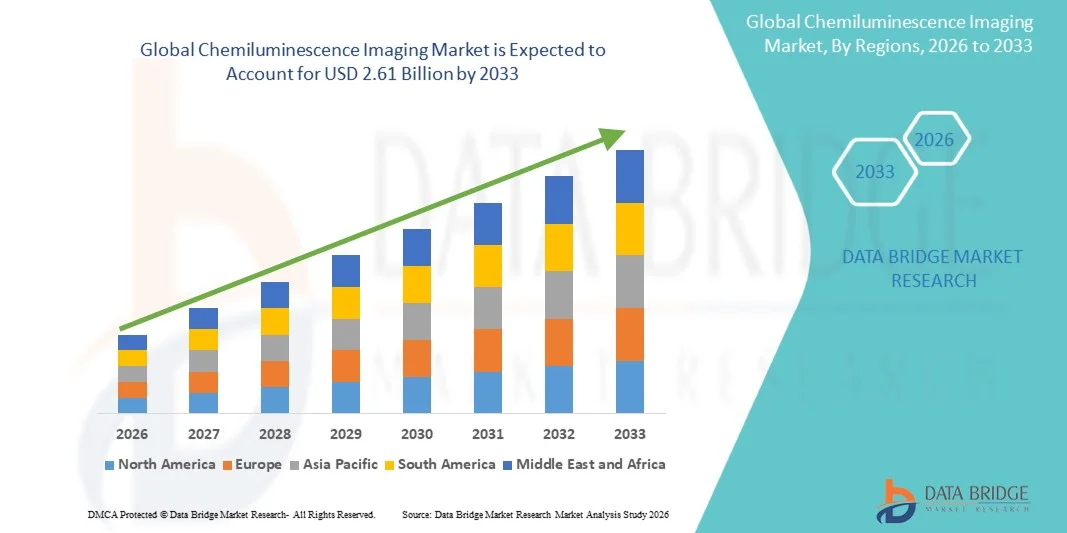
- As per Data Bridge Market Research analysis, the chemiluminescence imaging market was valued at USD 1.25 billion in 2025 and is projected to reach USD 2.61 billion by 2033, growing at a CAGR of 9.65% from 2026 to 2033.
- The market is experiencing consistent growth driven by rising demand for sensitive protein and nucleic acid detection, increasing adoption of advanced imaging systems in life sciences research, and expanding applications across biotechnology, pharmaceutical research, and clinical diagnostics.
- The increasing use of chemiluminescence-based techniques in Western blotting, immunoassays, and molecular biology, combined with advancements in high-sensitivity cameras, automated imaging platforms, and digital image analysis, is encouraging research laboratories and pharmaceutical companies to adopt advanced chemiluminescence imaging technologies for accurate, reproducible, and high-throughput analysis.
Market Size & Forecast
- Global Market Value (2025): USD 1.25 Billion
- Expected Market Value (2033): USD 2.61 Billion
- Forecast CAGR (2026–2033): 9.65%
- Leading Region in 2025: North America
- Fastest Growing Region: Asia Pacific
What are the Major Takeaways of the Chemiluminescence Imaging Market?
- North America dominated the chemiluminescence imaging market with the largest revenue share of 39.44% in 2025, supported by advanced life sciences research infrastructure, strong pharmaceutical and biotechnology activity, and high adoption of sensitive imaging technologies.
- Asia-Pacific is expected to be the fastest-growing region at a CAGR of 11.88% from 2026 to 2033, fueled by expanding biopharmaceutical manufacturing, increasing research infrastructure investments, and rising adoption of advanced diagnostic technologies across China, India, and other emerging markets.
- The imaging systems segment led the market with a 68.40% share in 2025, driven by widespread adoption of integrated digital platforms for western blotting, protein detection, and molecular biology research.
- Consumables and reagents are the fastest-growing product type, projected to register a CAGR of 7.90%, reflecting the surge in demand for substrates, reagents, and compatible materials used with installed imaging platforms.
- The CCD-based imaging systems segment dominated the technology category with a 60% revenue share in 2025, led by their established use in sensitive low-light chemiluminescence detection.
- Western blotting accounted for 47.68% of the market share in 2025, preferred by its extensive use in molecular biology, proteomics, and biopharmaceutical research.
- The immunoassay imaging segment is the fastest-growing application category, with a CAGR of 8.35%, driven by increasing demand for sensitive biomarker measurement and standardized high-throughput laboratory workflows.
Report Scope and Chemiluminescence Imaging Market Segmentation
|
Attributes |
Chemiluminescence Imaging Key Market Insights |
|
Segments Covered |
|
|
Countries Covered |
North America
Europe
Asia-Pacific
Middle East and Africa
South America
|
|
Key Market Players |
|
|
Market Opportunities |
|
|
Value Added Data Infosets |
In addition to the insights on market scenarios such as market value, growth rate, segmentation, geographical coverage, and major players, the market reports curated by the Data Bridge Market Research also include in-depth expert analysis, patient epidemiology, pipeline analysis, pricing analysis, and regulatory framework. |
What is the Key Trend in the Chemiluminescence Imaging Market?
- Laboratories are increasingly shifting from film-based detection toward digital chemiluminescence imaging systems that provide higher sensitivity, automated exposure, quantitative analysis, and improved data traceability for western blotting and protein research.
- For instance, in January 2023, Azure Biosystems launched the chemiSOLO personal chemiluminescent Western blot imaging system, featuring a cooled 6.29-megapixel camera, smartphone and tablet control through a web-based interface, and digital image analysis, demonstrating the industry's shift from film-based documentation toward compact, connected digital imaging workflows.
- Multiplex and multimodal imaging is gaining traction as laboratories seek platforms capable of combining chemiluminescence, fluorescence, gel documentation, and nucleic-acid imaging within a single instrument to maximize equipment utilization.
- Integrated platforms are particularly attractive to pharmaceutical, biotechnology, and academic laboratories because they can support multiple protein-analysis workflows while reducing the requirement for separate imaging equipment and associated validation procedures.
- AI-enabled image analysis and automated quantification are also emerging as important technology trends, helping researchers reduce manual interpretation, improve reproducibility, and process larger datasets more efficiently across complex biological imaging workflows.
- For instance, in July 2024, Bio-Rad launched the ChemiDoc Go Imaging System, a compact benchtop platform using CMOS digital imaging for highly sensitive chemiluminescence and fluorescence detection, supporting protein and nucleic-acid quantification and demonstrating the growing adoption of automated, versatile digital imaging systems in life-sciences laboratories.
- As laboratories increasingly prioritize quantitative, automated, and connected workflows, the adoption of digital chemiluminescence imaging platforms with advanced software, multiplex capabilities, and data-management functions is expected to accelerate, strengthening the role of imaging technology in modern life-sciences research.
What are the Key Drivers of the Chemiluminescence Imaging Market?
- The rapid expansion of proteomics, biologics development, and biomarker research is increasing demand for highly sensitive chemiluminescence imaging capable of detecting low-abundance proteins and supporting reproducible protein characterization workflows.
- For instance, in July 2024, Bio-Rad launched the ChemiDoc Go Imaging System, providing highly sensitive digital chemiluminescence and fluorescence imaging for western blots, gels, and protein and nucleic-acid quantification, supporting the growing need for rapid and sensitive protein-analysis workflows in life-sciences research.
- Pharmaceutical and biotechnology companies are increasingly adopting advanced chemiluminescence technologies for drug discovery, protein characterization, quality control, and biomarker analysis, as biologics pipelines require repeated and highly reproducible analytical measurements.
- For instance, in March 2023, Fujirebio expanded its Lumipulse G portfolio with fully automated chemiluminescent enzyme immunoassays for Neurofilament light (NfL) in cerebrospinal fluid and blood, enabling quantitative biomarker measurement in approximately 35 minutes and demonstrating the growing use of chemiluminescence-based technologies in sensitive neurodegenerative disease biomarker research.
- With increasing investment in precision biomarker research, automated laboratory workflows, and biopharmaceutical development, chemiluminescence imaging will remain an important analytical technology for sensitive protein detection, quantitative analysis, and high-throughput life-sciences research.
Which Factors are Challenging the Growth of the Chemiluminescence Imaging Market?
- Advanced chemiluminescence imaging systems require substantial capital investment because they incorporate high-sensitivity cameras, automated exposure controls, specialized optics, image-analysis software, and multifunctional detection capabilities.
- For instance, in October 2022, Scientific Reports published a study showing that accurate and reproducible quantification of chemiluminescent Western blots remains challenging because of limited quantitative range, signal saturation, and the need for careful exposure and data-analysis procedures, highlighting the technical limitations associated with chemiluminescence-based imaging.
- These high acquisition and maintenance costs can restrict adoption among smaller academic laboratories, budget-constrained research institutions, and facilities in emerging markets where laboratory capital expenditure remains limited.
- Signal variability and dynamic-range limitations can also complicate quantitative chemiluminescence measurements because exposure conditions, substrate performance, and signal intensity can influence reproducibility and may require repeated exposures or optimized imaging protocols.
- For instance, in May 2023, Bio-protocol published a study reporting that chemiluminescent Western blot quantification can vary because laboratories use different software and protocols, with saturated images potentially producing incorrect results, emphasizing the need for standardized procedures and specialized analysis expertise.
- The combination of high equipment costs, recurring consumable requirements, technical expertise, and the need for careful exposure optimization continues to challenge adoption, particularly among smaller laboratories and price-sensitive institutions, despite the growing demand for sensitive digital protein-analysis technologies.
How is the Chemiluminescence Imaging Market Segmented?
The chemiluminescence imaging market is segmented on the basis of product type, technology, application, and end user.
- By Product Type
On the basis of product type, the chemiluminescence imaging market is segmented into imaging systems, cameras & detectors, accessories, consumables and reagents and others. The imaging systems segment dominated the market with a 68.40% share in 2025, owing to widespread adoption of integrated digital platforms for western blotting, protein detection, and molecular biology research. These systems combine sensitive cameras, optics, illumination, and image-analysis software within a single platform. They are widely used in pharmaceutical, biotechnology, academic, and research laboratories requiring reproducible protein-analysis workflows. Increasing demand for automated exposure, quantitative analysis, and higher sensitivity is supporting continued investment in advanced imaging systems. Their established installed base and integration with laboratory workflows further reinforce their leading position.
The consumables and reagents segment is projected to register the fastest growth at a CAGR of 7.90% from 2026 to 2033, driven by recurring demand for substrates, reagents, and compatible materials used with installed imaging platforms. These products are continuously consumed during western blotting, protein detection, and other chemiluminescence-based laboratory procedures. Growing numbers of installed imaging systems are therefore creating a recurring replacement and replenishment market. Pharmaceutical and biotechnology laboratories conducting repeated protein-analysis experiments are major sources of recurring demand. Increasing research activity in proteomics and biologics development is further expanding reagent consumption.
- By Technology
On the basis of technology, the chemiluminescence imaging market is segmented into CCD-based imaging systems, CMOS-based imaging systems, and hybrid systems. The CCD-based imaging systems segment dominated the technology category, accounting for 60% share in 2025, supported by their established use in sensitive low-light chemiluminescence detection. CCD sensors have traditionally been preferred for western blot imaging because of their high sensitivity and ability to capture weak emitted signals. They are widely installed across academic, pharmaceutical, and biotechnology laboratories. Existing laboratory protocols and familiarity with CCD-based platforms continue to support their utilization. The technology also remains suitable for quantitative protein-analysis applications requiring consistent image quality.
The CMOS-based imaging systems segment is expected to witness the fastest growth at an 8% CAGR from 2026 to 2033, driven by improvements in sensor sensitivity, rapid image acquisition, and compact system designs. CMOS technology enables manufacturers to develop smaller and more flexible digital imaging platforms for laboratory applications. Advances in sensor architecture are increasingly improving performance for low-light chemiluminescence detection. These systems can also support automated image acquisition and software-based quantitative analysis. Growing demand for benchtop imaging systems among academic and smaller research laboratories is creating additional opportunities for CMOS platforms. Continued improvements in digital imaging performance are expected to accelerate the transition toward CMOS-based next-generation chemiluminescence systems.
- By Application
On the basis of application, the chemiluminescence imaging market is segmented into western blotting, nucleic acid detection, protein quantification, biomarker research, clinical diagnostics, drug discovery, immunoassay imaging and others. The western blotting segment dominated the application category with a 47.68% share in 2025, driven by its extensive use in molecular biology, proteomics, and biopharmaceutical research. Western blotting remains a widely established method for identifying and verifying specific proteins in biological samples. Chemiluminescence provides the sensitivity required to detect relatively low-abundance proteins following membrane separation. Pharmaceutical and biotechnology laboratories routinely use the technique during protein characterization and research workflows. Established protocols, compatible reagents, and widespread availability of digital imaging systems further support adoption. The continuing importance of protein analysis in biologics development is expected to maintain western blotting as the leading application.
The immunoassay imaging segment is projected to register the fastest growth at a CAGR of 8.35% from 2026 to 2033, supported by increasing demand for sensitive biomarker measurement and standardized high-throughput laboratory workflows. Chemiluminescence immunoassays can provide high sensitivity for detecting biological markers present at low concentrations. Growing interest in blood-based biomarkers is expanding applications beyond traditional research-oriented protein analysis. Automated analyzers are enabling laboratories to process larger testing volumes with greater consistency. Pharmaceutical and clinical research organizations are increasingly adopting sensitive immunoassay technologies for biomarker development and disease research.
- By End User
On the basis of end user, the chemiluminescence imaging market is segmented into diagnostic laboratories, pharmaceutical & biotechnology companies, academic research institutes, hospitals, and others. The hospitals and diagnostic laboratories segment dominated the end-user category with a 48.45% share in 2025, supported by increasing use of automated chemiluminescence-based laboratory testing and diagnostic workflows. Centralized diagnostic laboratories require sensitive and reliable technologies capable of processing substantial testing volumes. Hospitals are increasingly adopting automated platforms for biomarker and immunoassay testing. Standardized workflows help improve consistency and reduce manual intervention during routine laboratory analysis. Growing healthcare expenditure and laboratory modernization are further supporting adoption among healthcare institutions. The combination of recurring testing demand and increasing automation strengthens the segment's leading position.
The pharmaceutical & biotechnology companies segment is projected to register the fastest growth at a CAGR of 9.45% from 2026 to 2033, driven by expanding biologics development, proteomics research, and protein-characterization requirements. These companies use chemiluminescence technologies for western blotting, biomarker research, assay development, and analytical characterization. The growing number of biologic drug candidates is increasing demand for sensitive and reproducible protein-analysis methods. Pharmaceutical laboratories also require documented analytical workflows to support research, development, and quality-control activities. Increasing investment in precision medicine and biomarker-driven drug discovery is creating additional demand for advanced chemiluminescence technologies.
Which Region Holds the Largest Share of the Chemiluminescence Imaging Market?
- North America dominated the chemiluminescence imaging market with the largest revenue share of 39.44% in 2025, supported by advanced life sciences research infrastructure, strong pharmaceutical and biotechnology activity, and high adoption of sensitive imaging technologies.
- The region also benefits from a strong presence of pharmaceutical and biotechnology companies, extensive academic research activities, and increasing demand for sensitive protein and biomarker analysis. Growing investments in proteomics, drug discovery, and laboratory automation continue to strengthen North America’s leadership position in the global chemiluminescence imaging market
U.S. Chemiluminescence Imaging Market Insight
The U.S. chemiluminescence imaging market is witnessing strong growth due to rising investments in life-sciences research, pharmaceutical development, proteomics, and advanced laboratory imaging technologies. The country’s mature biotechnology and pharmaceutical ecosystem, along with extensive adoption of digital, automated, and high-sensitivity imaging systems, is driving demand across academic, clinical, and research applications. In addition, growing emphasis on biomarker discovery, protein analysis, and drug development is accelerating the adoption of chemiluminescence imaging technologies across research laboratories and biotechnology companies.
Asia-Pacific Chemiluminescence Imaging Market Insight
The Asia-Pacific chemiluminescence imaging market is expected to witness rapid growth, driven by expanding biotechnology and pharmaceutical industries, increasing investments in research infrastructure, and rising demand for advanced laboratory technologies across countries such as China, India, and Japan. Growing adoption of proteomics, molecular biology, and biomarker research, along with increasing demand for sensitive and automated imaging solutions, is supporting regional market expansion. In addition, the establishment of new research laboratories and increasing biopharmaceutical development activities are accelerating adoption of chemiluminescence imaging systems across academic and commercial sectors.
Japan Chemiluminescence Imaging Market Insight
The Japan chemiluminescence imaging market is witnessing consistent growth due to rising investments in pharmaceutical research, biotechnology, proteomics, and advanced laboratory technologies. Pharmaceutical companies, academic institutions, and research laboratories are increasingly adopting high-sensitivity imaging systems for western blotting, protein analysis, and biomarker research. Moreover, increasing integration of automated image analysis, digital detection technologies, and advanced laboratory workflows, combined with Japan’s strong focus on biomedical research and technological innovation, is further contributing to market growth.
China Chemiluminescence Imaging Market Insight
The China chemiluminescence imaging market is growing rapidly, driven by increasing investments in biotechnology, pharmaceutical R&D, and life-sciences research infrastructure. Growing adoption of digital imaging platforms and automated laboratory technologies across academic, pharmaceutical, and biotechnology sectors is significantly boosting market demand. In addition, rising investments in proteomics and molecular biology research, increasing development of biopharmaceutical products, and government support for biotechnology innovation are positioning China as one of the fastest-growing markets for chemiluminescence imaging technologies globally.
U.K. Chemiluminescence Imaging Market Insight
The U.K. chemiluminescence imaging market is experiencing steady growth, supported by rising adoption of advanced imaging technologies in pharmaceutical research, biotechnology, academic research, and molecular biology applications. Increasing investments in life-sciences research infrastructure and growing demand for sensitive, quantitative, and automated protein-analysis solutions are contributing to market growth. Furthermore, integration of digital imaging, automated exposure, and advanced image-analysis technologies is improving research efficiency and analytical reproducibility, positioning the U.K. as an important market for chemiluminescence imaging in Europe.
Germany Chemiluminescence Imaging Market Insight
The Germany chemiluminescence imaging market is expanding steadily due to the country’s strong pharmaceutical and biotechnology base, advanced research capabilities, and increasing adoption of next-generation laboratory imaging technologies. Pharmaceutical companies, academic institutions, and research laboratories are increasingly utilizing chemiluminescence imaging for western blotting, protein characterization, biomarker research, and drug discovery activities. Continuous advancements in digital imaging, automated analysis, and high-sensitivity detection technologies, along with Germany’s strong focus on biomedical research and laboratory innovation, are further driving market growth.
Which are the Top Companies in Chemiluminescence Imaging Market?
The chemiluminescence imaging industry is primarily led by well-established companies, including:
- Bio-Rad Laboratories, Inc. (U.S.)
- Thermo Fisher Scientific Inc. (U.S.)
- LI-COR, Inc. (U.S.)
- Vilber (France)
- Clinx Science Instruments Co., Ltd. (China)
- Wealtec Bioscience Co., Ltd. (Taiwan)
- ATTO Corporation (Japan)
- DNR Bio-Imaging Systems, Ltd (Israel)
- Uvitec Ltd (U.K.)
- NIPPON SHEET GLASS CO., LTD. (Japan)
- BioD Co., Ltd. (South Korea)
- Shenhua Science Technology Co., Ltd. (China)
- Scitek Usa.,Ltd (U.S.)
- Berthold Technologies GmbH & Co. KG (Germany)
- Merck KGaA (Germany)
- Revvity, Inc. (U.S.)
- Cleaver Scientific Ltd. (U.K.)
- Tanon Science & Technology Co., Ltd. (China)
What are Latest Developments in Chemiluminescence Imaging Market?
- In November 2025, RSC’s Materials Chemistry Frontiers published research on a novel bicyclic dioxetane chemiluminescent nanoprobe, called C10-SPN, designed for highly sensitive and selective imaging of superoxide anion radicals in vivo. The nanoprobe produced a red-shifted emission at 680 nm and extended chemiluminescence half-life of up to 7 minutes, while demonstrating high-contrast imaging in mouse models of peritonitis and breast cancer, highlighting advances in next-generation chemiluminescence probes for disease-related molecular imaging.
- In February 2024, the Royal Society of Chemistry’s Chemical Communications published research demonstrating electrogenerated chemiluminescence imaging of plasmon-induced electrochemical reactions at individual nanocatalysts, using ECL microscopy to perform real-time screening and quantitative analysis of reactions at the single-nanoparticle level. The development demonstrated the potential of chemiluminescence imaging for high-throughput investigation of nanoscale electrochemical processes and optimization of plasmonic nanocatalysts.
- In January 2023, Azure Biosystems launched the chemiSOLO personal chemiluminescent Western blot imaging system, designed as a compact and economical alternative for laboratories performing digital Western blot imaging. The system uses a cooled 6.29-megapixel camera and F0.9 lens for sensitive chemiluminescent detection and can be controlled through a smartphone, tablet, or laptop using a web-based interface, supporting the industry's shift toward accessible digital imaging and away from film-based documentation.
- In August 2022, the American Chemical Society published research on the rational design of NIR-II aggregation-induced emission luminogens (AIEgens) with ultrahigh quantum yields for photo- and chemiluminescence imaging, addressing limitations associated with low quantum yields in practical NIR-II imaging. The development demonstrated a pathway toward brighter chemiluminescent probes capable of deeper-tissue imaging and improved performance for biological applications.
- In June 2021, the American Chemical Society published research on chemiluminescent 1,2-dioxetanes for quantitative measurements and in vivo imaging, demonstrating highly sensitive probes capable of imaging reactive species, enzyme activity, pH, and hypoxia in living cells and tumor models. The research also explored applications extending toward clinical translation, including monitoring hydrogen peroxide in exhaled breath, highlighting the expanding role of chemiluminescence imaging in biomedical research and molecular diagnostics.

- Interactive Data Analysis Dashboard
- Company Analysis Dashboard for high growth potential opportunities
- Research Analyst Access for customization & queries
- Competitor Analysis with Interactive dashboard
- Latest News, Updates & Trend analysis
- Harness the Power of Benchmark Analysis for Comprehensive Competitor Tracking
Data collection and base year analysis are done using data collection modules with large sample sizes. The stage includes obtaining market information or related data through various sources and strategies. It includes examining and planning all the data acquired from the past in advance. It likewise envelops the examination of information inconsistencies seen across different information sources. The market data is analysed and estimated using market statistical and coherent models. Also, market share analysis and key trend analysis are the major success factors in the market report. To know more, please request an analyst call or drop down your inquiry.
The key research methodology used by DBMR research team is data triangulation which involves data mining, analysis of the impact of data variables on the market and primary (industry expert) validation. Data models include Vendor Positioning Grid, Market Time Line Analysis, Market Overview and Guide, Company Positioning Grid, Patent Analysis, Pricing Analysis, Company Market Share Analysis, Standards of Measurement, Global versus Regional and Vendor Share Analysis. To know more about the research methodology, drop in an inquiry to speak to our industry experts.
Data Bridge Market Research is a leader in advanced formative research. We take pride in servicing our existing and new customers with data and analysis that match and suits their goal. The report can be customized to include price trend analysis of target brands understanding the market for additional countries (ask for the list of countries), clinical trial results data, literature review, refurbished market and product base analysis. Market analysis of target competitors can be analyzed from technology-based analysis to market portfolio strategies. We can add as many competitors that you require data about in the format and data style you are looking for. Our team of analysts can also provide you data in crude raw excel files pivot tables (Fact book) or can assist you in creating presentations from the data sets available in the report.













